Paper I — Q5
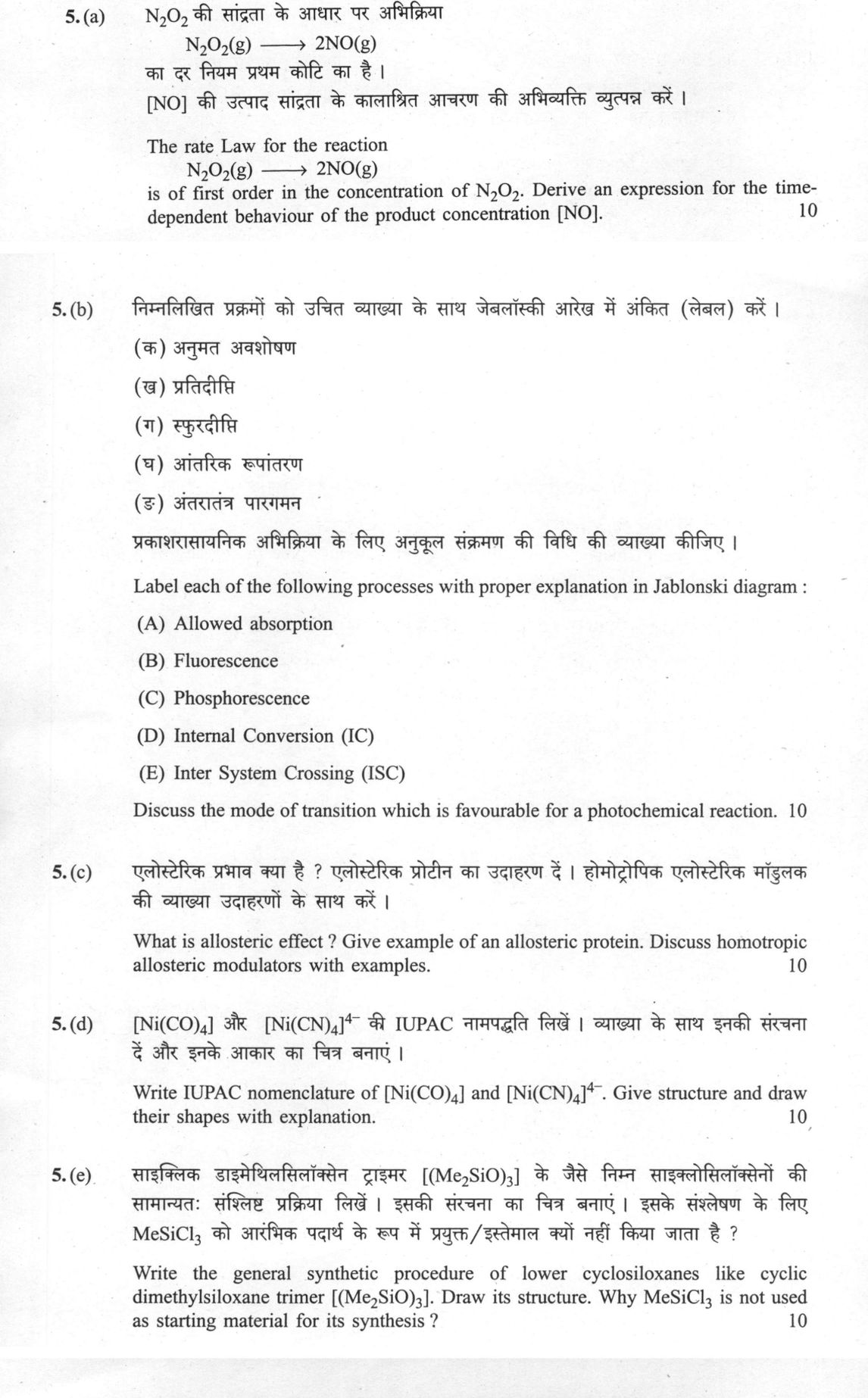
(a) The rate Law for the reaction N₂O₂(g) → 2NO(g) is of first order in the concentration of N₂O₂. Derive an expression for the…
The rate Law for the reaction N₂O₂(g) → 2NO(g) is of first order in the concentration of N₂O₂. Derive an expression for the time-dependent behaviour of the product concentration [NO]. 10 marks
Label each of the following processes with proper explanation in Jablonski diagram: (A) Allowed absorption, (B) Fluorescence, (C) Phosphorescence, (D) Internal Conversion (IC), (E) Inter System Crossing (ISC). Discuss the mode of transition which is favourable for a photochemical reaction. 10 marks
What is allosteric effect? Give example of an allosteric protein. Discuss homotropic allosteric modulators with examples. 10 marks
Write IUPAC nomenclature of [Ni(CO)₄] and [Ni(CN)₄]⁴⁻. Give structure and draw their shapes with explanation. 10 marks
Write the general synthetic procedure of lower cyclosiloxanes like cyclic dimethylsiloxane trimer [(Me₂SiO)₃]. Draw its structure. Why MeSiCl₃ is not used as starting material for its synthesis? 10 marks
हिंदी में प्रश्न पढ़ें
N₂O₂ की सांद्रता के आधार पर अभिक्रिया N₂O₂(g) → 2NO(g) का दर नियम प्रथम कोटि का है। [NO] की उत्पाद सांद्रता के कालानुक्रम आचरण की अभिव्यक्ति व्युत्पन्न करें। (10 अंक)
निम्नलिखित प्रक्रमों को उचित व्याख्या के साथ जेब्लॉन्स्की आरेख में अंकित (लेबल) करें: (क) अनुमत अवशोषण, (ख) प्रतिदीप्ति, (ग) स्फुरदीप्ति, (घ) आंतरिक रूपांतरण, (ङ) अंतरतंत्र पारगमन। प्रकाशरासायनिक अभिक्रिया के लिए अनुकूल संक्रमण की विधि की व्याख्या कीजिए। (10 अंक)
एलोस्टेरिक प्रभाव क्या है? एलोस्टेरिक प्रोटीन का उदाहरण दें। होमोट्रोपिक एलोस्टेरिक मॉडुलक की व्याख्या उदाहरणों के साथ करें। (10 अंक)
[Ni(CO)₄] और [Ni(CN)₄]⁴⁻ की IUPAC नामपद्धति लिखें। व्याख्या के साथ इनकी संरचना दें और इनके आकार का चित्र बनाएं। (10 अंक)
साइक्लिक डाइमेथिलसिलॉक्सेन ट्राइमर [(Me₂SiO)₃] के जैसे निम्न साइक्लोसिलॉक्सेनों की सामान्यतः संश्लिष्ट प्रक्रिया लिखें। इसकी संरचना का चित्र बनाएं। इसके संश्लेषण के लिए MeSiCl₃ को आरंभिक पदार्थ के रूप में प्रयुक्त/इस्तेमाल क्यों नहीं किया जाता है? (10 अंक)
Model answer
Written by UPSC Answer Check against this question's marking rubric, to the expected length. UPSC does not publish answers for Mains — this is one way to score well, not an official key.
(a) Let the concentration of N₂O₂ at time t be [N₂O₂] = x, and initially [N₂O₂]₀ = a. The given first-order rate law is
Rate = −d[N₂O₂]/dt = k[N₂O₂]
So,
−dx/dt = kx
Separating variables:
dx/x = −k dt
Integrating from x = a at t = 0 to x at time t:
∫(a to x) dx/x = −k ∫(0 to t) dt
ln(x/a) = −kt
x = a e^(−kt)
Thus, [N₂O₂] = a e^(−kt).
From the stoichiometry N₂O₂ → 2NO, the amount of N₂O₂ consumed is a − x, so the amount of NO formed is 2(a − x). If initially [NO]₀ = b,
[NO] = b + 2(a − a e^(−kt))
If initially no NO is present, b = 0, so:
[NO] = 2a(1 − e^(−kt))
As t → ∞, [NO] → 2a. This is valid for constant volume, isothermal conditions, no reverse reaction, and when the given first-order law holds. The unit of k is s⁻¹.
(b) In a Jablonski diagram, the vertical axis represents energy and the horizontal axis represents spin multiplicity. S₀, S₁, S₂ are singlet states; T₁, T₂ are triplet states. Radiative transitions are shown by straight arrows and non-radiative transitions by wavy arrows.
- (A) Allowed absorption: An upward straight arrow from S₀ to S₁ or S₂. It is a spin-allowed singlet → singlet transition, ΔS = 0. It is very fast, about 10⁻¹⁵ s, and gives strong absorption.
- (B) Fluorescence: A downward straight arrow from S₁ to S₀. It is radiative emission between states of same multiplicity, singlet → singlet. It occurs after vibrational relaxation and internal conversion to the lowest vibrational level of S₁. Lifetime is typically 10⁻⁹–10⁻⁷ s.
- (C) Phosphorescence: A downward straight arrow from T₁ to S₀. It is radiative emission between different multiplicities, triplet → singlet, hence spin-forbidden. It is slow, often 10⁻³–10 s, and is favoured in rigid media, at low temperature, or when heavy atoms increase spin-orbit coupling.
- (D) Internal Conversion (IC): A wavy arrow between electronic states of the same spin multiplicity, e.g. S₂ → S₁ or S₁ → S₀. It is non-radiative and often very fast. It converts electronic energy into vibrational energy.
- (E) Inter System Crossing (ISC): A wavy arrow between states of different multiplicity, usually S₁ → T₁. It is non-radiative and spin-forbidden, but becomes efficient when spin-orbit coupling is large.
For photochemical reaction, the favourable mode is usually absorption to an excited singlet, followed by internal conversion/vibrational relaxation to S₁, and then ISC to T₁ if spin-orbit coupling is significant. The triplet T₁ is long-lived, so it can undergo energy transfer, electron transfer, or bond-breaking before phosphorescence. If the reaction is very fast, the singlet S₁ itself may be the reactive state.
(c) Allosteric effect is the change in the activity of a protein at one site caused by the binding of a ligand at a different, non-overlapping site. The binding causes a conformational change that alters the affinity or catalytic activity of the active site. It is usually non-covalent, reversible, and important in regulation of enzymes and transport proteins.
An example of an allosteric protein is hemoglobin, which transports oxygen. Binding of O₂ to one heme increases the affinity of the remaining hemes for O₂, giving a sigmoidal oxygen-binding curve.
Homotropic allosteric modulators are modulators that are identical to the normal ligand or substrate. Their binding at one site affects binding at other identical sites. Usually they produce positive cooperativity. Examples:
- In hemoglobin, O₂ itself is a homotropic positive modulator: binding of O₂ to one subunit increases O₂ affinity of other subunits.
- In aspartate transcarbamoylase, aspartate is a homotropic positive modulator for its own binding and reaction.
- In phosphofructokinase-1, fructose-6-phosphate shows homotropic positive cooperativity; ATP can act as a negative homotropic modulator at high concentration.
- Negative homotropic effects are less common and appear as substrate inhibition at high substrate concentration.
(d) IUPAC names:
- [Ni(CO)₄]: tetracarbonylnickel(0)
- [Ni(CN)₄]⁴⁻: tetracyanonickelate(0)
For [Ni(CO)₄], CO is neutral, so Ni is in oxidation state zero. Ni(0) has d¹⁰ configuration. With four ligands, hybridization is sp³, giving a tetrahedral shape. The complex is diamagnetic. Structure: Ni at the centre bonded to four carbonyl carbon atoms, each Ni–C≡O group being linear at carbon.
For [Ni(CN)₄]⁴⁻, each CN⁻ has charge −1. Total ligand charge = −4, so:
x + 4(−1) = −4
x = 0
Thus Ni is again in oxidation state zero, d¹⁰. It is also sp³ hybridized and tetrahedral. Structure: Ni at the centre bonded to four cyanide carbon atoms, each Ni–C≡N linear at carbon. It is diamagnetic.
Perspective description: in both complexes, the four ligand donor atoms occupy the corners of a tetrahedron around Ni. Two ligands lie roughly in the plane, one projects toward the viewer, and one projects away. If the cyanide complex were [Ni(CN)₄]²⁻, Ni would be Ni(II), d⁸, and the shape would be square planar dsp²; however, for the species written as [Ni(CN)₄]⁴⁻, Ni is Ni(0), d¹⁰, and the shape is tetrahedral.
(e) The general synthetic route to lower cyclosiloxanes such as cyclic dimethylsiloxane trimer, (Me₂SiO)₃, is controlled hydrolysis and condensation of dimethyldichlorosilane.
Procedure:
- Take Me₂SiCl₂ in an inert solvent such as dry ether or benzene.
- Add water or dilute hydrochloric acid slowly with vigorous stirring at low temperature, about 0–10 °C.
- Add a base such as pyridine or ammonium hydroxide to neutralize the HCl produced.
- Hydrolysis gives dimethylsilanediol:
Me₂SiCl₂ + 2H₂O → Me₂Si(OH)₂ + 2HCl
- The silanediol condenses with loss of water:
n Me₂Si(OH)₂ → (Me₂SiO)ₙ + n H₂O
Overall:
n Me₂SiCl₂ + n H₂O → (Me₂SiO)ₙ + 2n HCl
For the trimer, n = 3.
The crude product is a mixture of linear and cyclic dimethylsiloxanes, mainly cyclic trimer D₃, cyclic tetramer D₄, and higher cyclics. The lower cyclics are separated by fractional distillation or recrystallization. To increase the yield of lower cyclics, high dilution, low temperature, and an acid acceptor are used. Linear siloxanes can also be cracked with KOH at elevated temperature and redistributed to give more cyclic trimer and tetramer.
Structure of (Me₂SiO)₃: it is a six-membered ring with alternating Si and O atoms:
Si1–O–Si2–O–Si3–O–Si1
Each silicon atom carries two methyl groups. Thus the ring contains three Si–O–Si linkages and three dimethylsilyl units, giving the cyclic trimer. The ring is puckered rather than planar.
MeSiCl₃ is not used as the starting material for this synthesis because it is trifunctional. Hydrolysis of MeSiCl₃ gives MeSi(OH)₃, which can condense in three directions. This leads to branching, cross-linking, and three-dimensional silsesquioxane or resin-type networks of formula (MeSiO₁.₅)ₙ. It does not give discrete lower cyclosiloxanes like (Me₂SiO)₃. For cyclic dimethylsiloxane trimer, the required monomer is difunctional Me₂SiCl₂, so that each silicon has two methyl groups and forms only two siloxane bonds, allowing ring formation without cross-linking.
What "Derive" is asking you to do
Reach the stated expression from a starting relation, justifying every step. The destination is printed in the question, so only the route earns marks, and the assumptions you work under are part of that route.
Structure that answers it
Assumptions and notation defined → starting relation or governing equation → each step with its justification → the required expression → limiting case or boundary check
Where marks are lost
Writing the standard result first and fitting three lines to it, which an examiner reads at a glance. Marks also go on assumptions left unstated — lossless medium, small amplitude, errors independent with zero mean — and on symbols used before they are defined, even when the question says usual notations.
How this answer will be evaluated
Approach
Framework: Concept > Structure or mechanism > Reasoning > Result. (a) derive: given > assumptions > stepwise derivation > result > check | (b) describe: define > structure or process in order > labelled diagram > significance | (c) explain: definition/context > points in order > small example > short close | (d) describe: define > structure or process in order > labelled diagram > significance | (e) describe: define > structure or process in order > labelled diagram > significance Full marks: Complete derivations, accurate diagrams, and precise chemical reasoning for all parts.
Key points expected
- Rate law: -d[N2O2]/dt = k[N2O2]
- Stoichiometric link: d[NO]/dt = -2d[N2O2]/dt
- Integration of first-order rate law
- Final expression: [NO] = 2[A]0(1 - e^-kt)
- Correct Jablonski diagram (S0, S1, T1 levels)
- Labelled arrows for Absorption, Fluorescence, Phosphorescence
- Labelled arrows for IC and ISC
- Identification of T1 state as favourable for photochemistry
Evaluation rubric
Each sub-part is marked on its own, against the marks and word limit printed on the paper.
- (a) Mathematical expression for [NO] as a function of time t. 10 marks
derive— given → assumptions → stepwise derivation → result → check
Must cover
- Rate law: -d[N2O2]/dt = k[N2O2]
- Stoichiometric link: d[NO]/dt = -2d[N2O2]/dt
- Integration of first-order rate law
- Final expression: [NO] = 2[A]0(1 - e^-kt)
Loses marks
- Missing factor of 2 in final expression
- Confusing reactant and product concentration
Earns more
- Definition of initial concentration [A]0
- Step-by-step algebraic substitution
Extra mark
- Graphical representation of [NO] vs t
- (b) Jablonski diagram with labelled transitions and discussion of photochemical mode. 10 marks
describe— define → structure or process in order → labelled diagram → significance
Must cover
- Correct Jablonski diagram (S0, S1, T1 levels)
- Labelled arrows for Absorption, Fluorescence, Phosphorescence
- Labelled arrows for IC and ISC
- Identification of T1 state as favourable for photochemistry
Loses marks
- Missing spin-forbidden/allowed distinction
- Incorrect energy level ordering
Earns more
- Explanation of spin multiplicity rules
- Mention of Kasha's rule
Extra mark
- Mention of intersystem crossing efficiency
- (c) Definition of allosteric effect and discussion of homotropic modulators. 10 marks
explain— definition/context → points in order → small example → short close
Must cover
- Definition of allosteric effect (conformational change)
- Example of allosteric protein (e.g., Hemoglobin)
- Definition of homotropic modulators
- Example of homotropic regulation (e.g., O2 on Hb)
Loses marks
- Confusing homotropic with heterotropic
- Missing conformational change mechanism
Earns more
- Distinction between T and R states
- Mention of cooperative binding
Extra mark
- Graph of sigmoidal binding curve
- (d) IUPAC names, structures, and shapes of [Ni(CO)4] and [Ni(CN)4]4-. 10 marks
describe— define → structure or process in order → labelled diagram → significance
Must cover
- IUPAC name: Tetracarbonylnickel(0)
- IUPAC name: Tetracyanonickelate(II)
- Structure: Tetrahedral for [Ni(CO)4]
- Structure: Square planar for [Ni(CN)4]4-
Loses marks
- Wrong oxidation state assignment
- Incorrect geometry for either complex
Earns more
- Explanation via VBT or CFT (dsp2 vs sp3)
- Mention of magnetic properties (diamagnetic)
Extra mark
- Bond angle values (109.5 vs 90)
- (e) Synthesis of cyclic dimethylsiloxane trimer and reason for excluding MeSiCl3. 10 marks
describe— define → structure or process in order → labelled diagram → significance
Must cover
- Synthesis via hydrolysis of Me2SiCl2
- Structure of cyclic trimer (D3)
- Reason: MeSiCl3 leads to linear polymers
- Reason: MeSiCl3 has 3 reactive sites (branching)
Loses marks
- Using MeSiCl3 as starting material in procedure
- Failing to link valency to polymer structure
Earns more
- Mention of ring-chain equilibrium
- Catalyst usage (e.g., H2SO4 or NaOH)
Extra mark
- Mention of D4 as major product
Practice this exact question
Write your answer and it is marked point by point against the model answer above — what you covered, what you missed, what you got wrong.
Evaluate my answer →More from Chemistry 2022 Paper I
- Q2 2.(a) An automobile tyre contains air at 320×10³ Pa at 20°C. The stem valve is removed an…
- Q3 (a) Identify the least stable ion of the following ions and justify your answer. OCN⁻ ONC…
- Q4 (a) By using the following given data, find that under what conditions is H₂ in the state…
- Q5 (a) The rate Law for the reaction N₂O₂(g) → 2NO(g) is of first order in the concentration…
- Q6 (a) (i) Calculate the number of metal-metal bond in Cp₂Fe₂(CO)₄. (ii) Determine the struc…
- Q7 (a) Cite one example of an optically active tetracoordinated complex compound where the m…
- Q8 (a) Which one is more stable between the two isomers? Explain. [(H₃N)₅ Cr – CN – Cr(CN)₅]…