Paper I — Q6
(a) (i) Calculate the number of metal-metal bond in Cp₂Fe₂(CO)₄. (ii) Determine the structural type of the metal atom cluster…
Calculate the number of metal-metal bond in Cp₂Fe₂(CO)₄. (ii) Determine the structural type of the metal atom cluster, Bi₅³⁺. 10 marks
Why are 4f metal ions (lanthanide ions) generally pale in colour? Why do they show line like electronic spectra? 10 marks
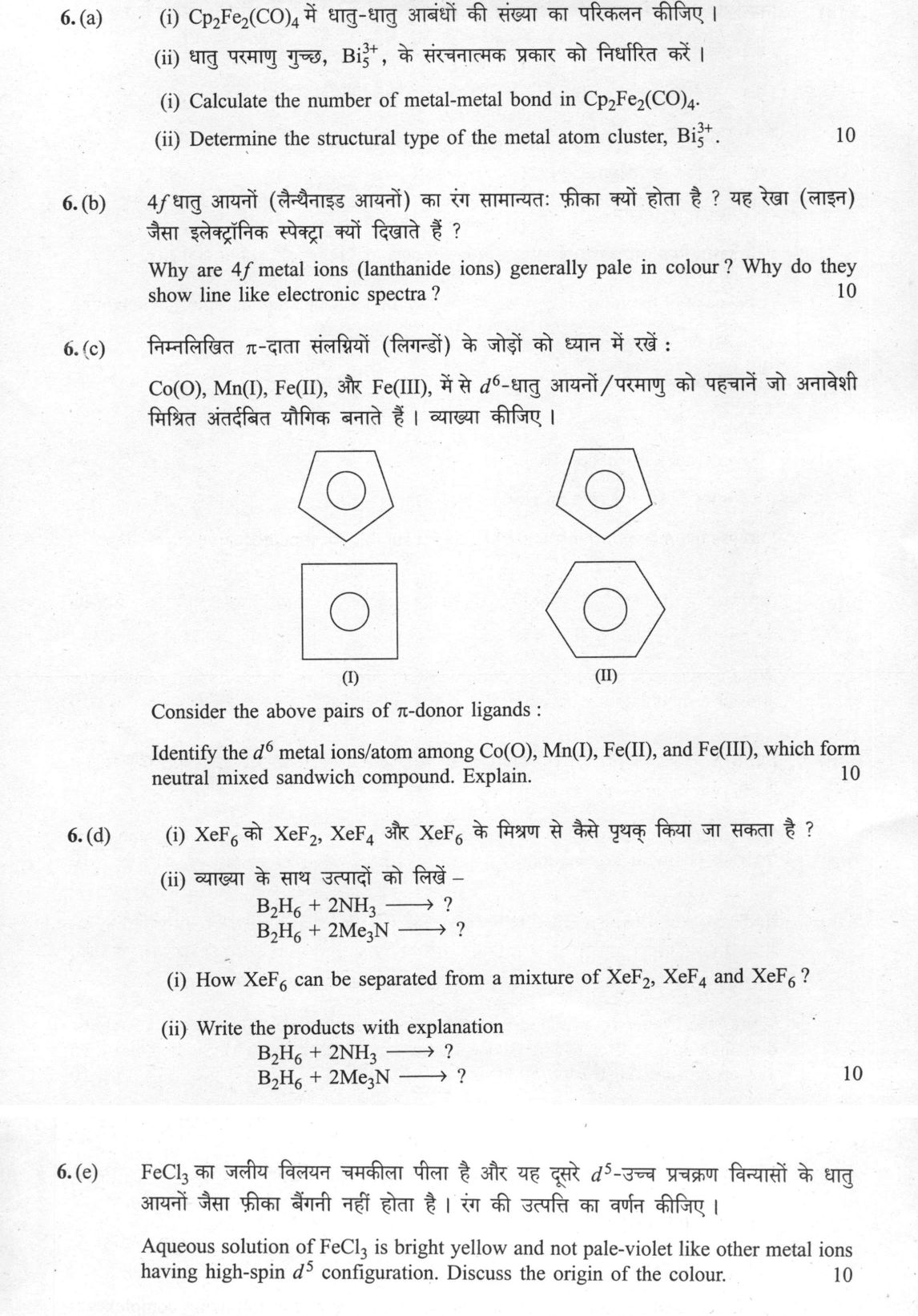
Consider the above pairs of π-donor ligands: Identify the d⁶ metal ions/atom among Co(O), Mn(I), Fe(II), and Fe(III), which form neutral mixed sandwich compound. Explain. 10 marks
How XeF₆ can be separated from a mixture of XeF₂, XeF₄ and XeF₆? (ii) Write the products with explanation: B₂H₆ + 2NH₃ → ? and B₂H₆ + 2Me₃N → ? 10 marks
Aqueous solution of FeCl₃ is bright yellow and not pale-violet like other metal ions having high-spin d⁵ configuration. Discuss the origin of the colour. 10 marks
हिंदी में प्रश्न पढ़ें
Cp₂Fe₂(CO)₄ में धातु-धातु आबंधों की संख्या का परिकलन कीजिए। (ii) धातु परमाणु गुच्छ, Bi₅³⁺, के संरचनात्मक प्रकार को निर्धारित करें। (10 अंक)
4f धातु आयनों (लैन्थेनाइड आयनों) का रंग सामान्यतः फीका क्यों होता है? यह रेखा (लाइन) जैसा इलेक्ट्रॉनिक स्पेक्ट्रा क्यों दिखाते हैं? (10 अंक)
निम्नलिखित π-दाता संतुलियों (लिगंडों) के जोड़ों को ध्यान में रखें: Co(O), Mn(I), Fe(II), और Fe(III), में से d⁶-धातु आयनों/परमाणुओं को पहचानें जो अनवेशी मिश्रित अंतर्द्वितीय यौगिक बनाते हैं। व्याख्या कीजिए। (10 अंक)
XeF₆ को XeF₂, XeF₄ और XeF₆ के मिश्रण से कैसे पृथक किया जा सकता है? (ii) व्याख्या के साथ उत्पादों को लिखें — B₂H₆ + 2NH₃ → ? और B₂H₆ + 2Me₃N → ? (10 अंक)
FeCl₃ का जलीय विलयन चमकीला पीला है और यह दूसरे d⁵-उच्च प्रचक्रण विच्यासों के धातु आयनों जैसा फीका बैंगनी नहीं होता है। रंग की उत्पत्ति का वर्णन कीजिए। (10 अंक)
The figure this question refers to, in words
The question paper is a scan and the diagram did not survive as text. This is the figure as read from the original page — every component, value and label — so the question can be worked from the text below.
(c) Two pairs of chemical structures representing pi-donor ligands, labeled (I) and (II). Pair (I) consists of a five-membered ring with a circle inside (cyclopentadienyl) and a four-membered ring with a circle inside (cyclobutadienyl). Pair (II) consists of a five-membered ring with a circle inside (cyclopentadienyl) and a six-membered ring with a circle inside (benzene).
Model answer
Written by UPSC Answer Check against this question's marking rubric, to the expected length. UPSC does not publish answers for Mains — this is one way to score well, not an official key.
(a) Metal–metal bond and Bi₅³⁺ cluster. In Cp₂Fe₂(CO)₄, each CpFe(CO)₂ fragment can be counted as a 17-electron unit: Fe contributes 8 valence electrons, η⁵-Cp contributes 5 in the neutral covalent count, and two CO ligands contribute 4, giving 17. Equivalently, in the dimer the average Fe oxidation state is +1, so each Fe is d⁷; d⁷ + 6 from Cp⁻ + 4 from two CO = 17. Two such fragments would have 34 electrons; one Fe–Fe bond supplies one electron to each metal and brings both to the 18-electron configuration. Therefore the dimer contains one metal–metal bond, and no additional Fe–Fe bond is required. For Bi₅³⁺, n = 5 vertices. The total valence electron count is 5 × 5 − 3 = 22; after allowing for one exo lone pair at each Bi, the skeletal electron count is 12 electrons, i.e. 6 pairs. This equals n + 1, the closo requirement of Wade–Mingos rules. The cluster is therefore a closo deltahedron, specifically trigonal bipyramidal.
(b) Lanthanide colour and spectra. Lanthanide ions are generally pale because their 4f orbitals lie inside the 5s²5p⁶ shell and are strongly shielded from the ligand field. The crystal-field splitting of the 4f levels is therefore small, and 4f–4f transitions are parity-forbidden; they gain intensity only weakly through vibronic coupling or slight 5d/5p mixing. The resulting molar absorptivities are low, so solutions are often pale. Because the 4f–4f transitions are weak, only ions with several low-energy f-f bands or charge-transfer bands appear strongly coloured; most are pale. The spectra are line-like because the 4f electrons are weakly coupled to the lattice and to the ligand field; the transitions are essentially intraconfigurational 4f–4f transitions between fine-structure levels, so the band positions depend only weakly on the coordination environment and appear as sharp lines rather than broad d-d bands.
(c) Neutral mixed sandwich compound. The d⁶ centres in the list are Mn(I) and Fe(II). Mn(I) is d⁶ because Mn is group 7 and the +1 oxidation state leaves 6 d electrons; Fe(II) is d⁶ because Fe is group 8 and the +2 oxidation state leaves 6 d electrons. For the Cp/benzene pair, charge neutrality fixes the metal oxidation state: Cp⁻ is anionic and benzene is neutral, so the metal must be +1. Mn(I) therefore gives the neutral mixed sandwich [CpMn(C₆H₆)], and its electron count is d⁶ + 6 from η⁵-Cp + 6 from η⁶-benzene = 18. Fe(II) is also d⁶, but with Cp⁻ and a neutral arene it gives [CpFe(C₆H₆)]⁺, not a neutral compound; Fe(II) gives a neutral sandwich only with two Cp⁻ ligands, as in ferrocene. Co(0) is d⁹ and Fe(III) is d⁵, so they are not the required d⁶ centres; with Cp⁻ and benzene, Co(0) would be anionic and 21-electron, while Fe(III) would be dicationic and 17-electron. For the four-membered ligand in pair (I), if it is the neutral η⁴-cyclobutadiene ligand, charge neutrality again points to Mn(I), although the count is 16 electrons; the unambiguous 18-electron neutral mixed sandwich from the figure is the Cp/benzene manganese(I) compound.
(d) Noble-gas fluoride separation and diborane adducts. XeF₆ can be separated from XeF₂ and XeF₄ by selective adduct formation with NaF. XeF₆ reacts to give the ionic, non-volatile heptafluoroxenate(VI): XeF₆ + NaF → NaXeF₇. XeF₂ and XeF₄ are less reactive toward NaF under these conditions and remain covalent and volatile; the ionic adduct is retained, while the covalent fluorides can be removed by sublimation or fractional sublimation because their volatilities differ. Heating NaXeF₇ regenerates XeF₆: NaXeF₇ → XeF₆ + NaF. Thus the separation uses differential reactivity with NaF followed by thermal recovery.
Diborane contains two B–H–B bridges, which are three-centre two-electron bonds. Lewis bases attack boron and convert these bridges into ordinary B–H and B–N bonds. With trimethylamine, steric bulk favours symmetrical heterolytic cleavage of the bridges, giving two neutral adducts: B₂H₆ + 2 Me₃N → 2 Me₃N·BH₃. Each boron receives one bridging hydride and coordinates to one Me₃N, completing a four-coordinate neutral borane. With ammonia, the smaller and strongly donating NH₃ allows unsymmetrical ionic cleavage: B₂H₆ + 2 NH₃ → [H₂B(NH₃)₂]⁺[BH₄]⁻. One boron becomes tetrahydridoborate, the other a tetracoordinate ammoniated boron cation. The difference is electronic and steric: NH₃ can approach and stabilise the ionic pair, whereas bulky Me₃N favours the neutral 1:1 adduct.
(e) Colour of aqueous FeCl₃. High-spin d⁵ Fe(III) has a half-filled 3d shell; its d-d transitions are spin-allowed but Laporte-forbidden, so an aqua complex such as [Fe(H₂O)₆]³⁺ is only pale violet. In aqueous FeCl₃, the bright yellow colour is dominated by ligand-to-metal charge transfer (LMCT), in which an electron is promoted from a filled ligand orbital, mainly Cl⁻ 3p or hydroxo/aqua oxygen p, to an Fe acceptor orbital of 3d/4d character. These CT transitions are electric-dipole allowed and much more intense than d-d bands. Chloride raises the donor orbital energy relative to water, lowering the LMCT energy into the visible and giving yellow/orange absorption; the yellow colour corresponds to absorption in the violet-blue region. Hydrolysis also contributes: [Fe(H₂O)₆]³⁺ forms [Fe(H₂O)₅OH]²⁺ and, on further hydrolysis, oligomeric or colloidal ferric hydroxide, FeO(OH), whose surface and ligand environments produce additional yellow-brown CT absorption. Hence the observed colour is not the intrinsic pale d-d colour of high-spin d⁵ Fe(III), but a charge-transfer and hydrolysis effect.
In each case, the observed structural or spectral property is controlled by a specific electronic cause: 18-electron completion, Wade–Mingos skeletal electron count, 4f shielding, charge neutrality, selective fluoride adduct formation, and allowed ligand-to-metal charge transfer.
What "Explain" is asking you to do
Make the working of something clear — what sets it off, what follows from what, and what it produces. Explain is the Commission's mechanism word: it dominates the technical papers and the “explain why” stems, where the marks sit in the causal chain and not in the label.
Structure that answers it
State what it is → the initiating condition → the chain of cause, step by step → an instance where it plays out → what the chain produces
Where marks are lost
Describing what something looks like instead of why it works that way. Naming the stages without linking them reads as description too.
How this answer will be evaluated
Approach
Framework: Concept > Structure or mechanism > Reasoning > Result. (a(i)) calculate: given > formula > substitution > result with units > interpretation | (a(ii)) calculate: given > formula > substitution > result with units > interpretation | (b) explain: definition/context > points in order > small example > short close | (c) enumerate: list the items in order > one line each > no commentary | (d(i)) describe: define > structure or process in order > labelled diagram > significance | (d(ii)) explain: definition/context > points in order > small example > short close | (e) discuss: intro > 3-4 dimensions > example > balanced close Full marks: All parts answered with correct mechanisms, electron counts, and clear reasoning.
Key points expected
- Calculate total valence electrons (TVE)
- Apply 18-electron rule for Fe(0)
- Deduce bond order from electron deficit
- Apply Wade's rules (n+1 skeletal orbitals)
- Name the specific geometry (e.g., square pyramid)
- Identify f-f transitions as the cause
- Explain shielding by 5s/5p orbitals
- Link shielding to small crystal field splitting
Evaluation rubric
Each sub-part is marked on its own, against the marks and word limit printed on the paper.
- (a(i)) Determine the number of metal-metal bonds in Cp₂Fe₂(CO)₄.
calculate— given → formula → substitution → result with units → interpretation
Must cover
- Calculate total valence electrons (TVE)
- Apply 18-electron rule for Fe(0)
- Deduce bond order from electron deficit
Loses marks
- Stating bond number without electron count
- Incorrect oxidation state assignment
Earns more
- Explicit electron count: 2(8) + 2(9) + 4(2) = 38
- Mention of 18e rule requirement (36e)
Extra mark
- Drawing of the butterfly structure
- (a(ii)) Identify the structural type of the Bi₅³⁺ cluster.
calculate— given → formula → substitution → result with units → interpretation
Must cover
- Calculate total valence electrons (TVE)
- Apply Wade's rules (n+1 skeletal orbitals)
- Name the specific geometry (e.g., square pyramid)
Loses marks
- Naming geometry without Wade's rule justification
- Confusing Bi₅³⁺ with Bi₅⁻
Earns more
- Explicit TVE calculation: 5(5) - 3 = 22e
- Reference to closo/nido/arachno classification
Extra mark
- Sketch of the square pyramidal structure
- (b) Explain the pale color and line spectra of lanthanide ions. 10 marks
explain— definition/context → points in order → small example → short close
Must cover
- Identify f-f transitions as the cause
- Explain shielding by 5s/5p orbitals
- Link shielding to small crystal field splitting
- Connect small splitting to line spectra
Loses marks
- Attributing color to d-d transitions
- Ignoring the shielding effect
Earns more
- Mention of Laporte forbidden nature
- Reference to spin-orbit coupling
Extra mark
- Comparison with d-block transition metals
- (c) Identify the d⁶ metal forming a neutral mixed sandwich compound. 10 marks
enumerate— list the items in order → one line each → no commentary
Must cover
- Identify Fe(II) as the d⁶ metal
- Select the correct ligand pair (e.g., Cp and Cp*)
- Show charge balance for neutral compound
- Explain the 18-electron stability
Loses marks
- Choosing a non-d⁶ metal
- Ignoring the 'neutral' requirement
Earns more
- Explicit electron counting for the complex
- Mention of steric/electronic factors
Extra mark
- Drawing of the sandwich structure
- (d(i)) Describe the separation of XeF₆ from XeF₂ and XeF₄.
describe— define → structure or process in order → labelled diagram → significance
Must cover
- Identify sublimation as the method
- Note XeF₆'s high sublimation temperature
- Mention fractional sublimation
Loses marks
- Suggesting distillation or chromatography
- Ignoring the volatility differences
Earns more
- Specific temperature ranges if known
- Mention of vacuum conditions
Extra mark
- Diagram of the sublimation setup
- (d(ii)) Write products and explain the reactions of B₂H₆.
explain— definition/context → points in order → small example → short close
Must cover
- Identify product with NH₃ (e.g., H₃B-NH₃)
- Identify product with Me₃N (e.g., H₃B-NMe₃)
- Explain Lewis acid-base interaction
- Show the bridging hydrogen mechanism
Loses marks
- Writing products without mechanism
- Ignoring the Lewis acid nature of B
Earns more
- Arrow pushing for the reaction
- Mention of adduct formation
Extra mark
- Drawing of the transition state
- (e) Discuss the origin of the bright yellow color of FeCl₃. 10 marks
discuss— intro → 3-4 dimensions → example → balanced close
Must cover
- Identify charge transfer (CT) as the cause
- Distinguish CT from d-d transitions
- Explain the intensity of CT bands
- Link to the specific Fe(III) complex
Loses marks
- Attributing color to d-d transitions
- Ignoring the charge transfer mechanism
Earns more
- Mention of ligand-to-metal CT
- Reference to the specific wavelength
Extra mark
- Comparison with other Fe(III) complexes
Practice this exact question
Write your answer and it is marked point by point against the model answer above — what you covered, what you missed, what you got wrong.
Evaluate my answer →More from Chemistry 2022 Paper I
- Q3 (a) Identify the least stable ion of the following ions and justify your answer. OCN⁻ ONC…
- Q4 (a) By using the following given data, find that under what conditions is H₂ in the state…
- Q5 (a) The rate Law for the reaction N₂O₂(g) → 2NO(g) is of first order in the concentration…
- Q6 (a) (i) Calculate the number of metal-metal bond in Cp₂Fe₂(CO)₄. (ii) Determine the struc…
- Q7 (a) Cite one example of an optically active tetracoordinated complex compound where the m…
- Q8 (a) Which one is more stable between the two isomers? Explain. [(H₃N)₅ Cr – CN – Cr(CN)₅]…