Paper II — Q1
(a) Ionization of 3,4-dichloro-1,2,3,4-tetramethylcyclobutene in SbF₅-SO₂ at –75 °C produces a reaction intermediate of its own…
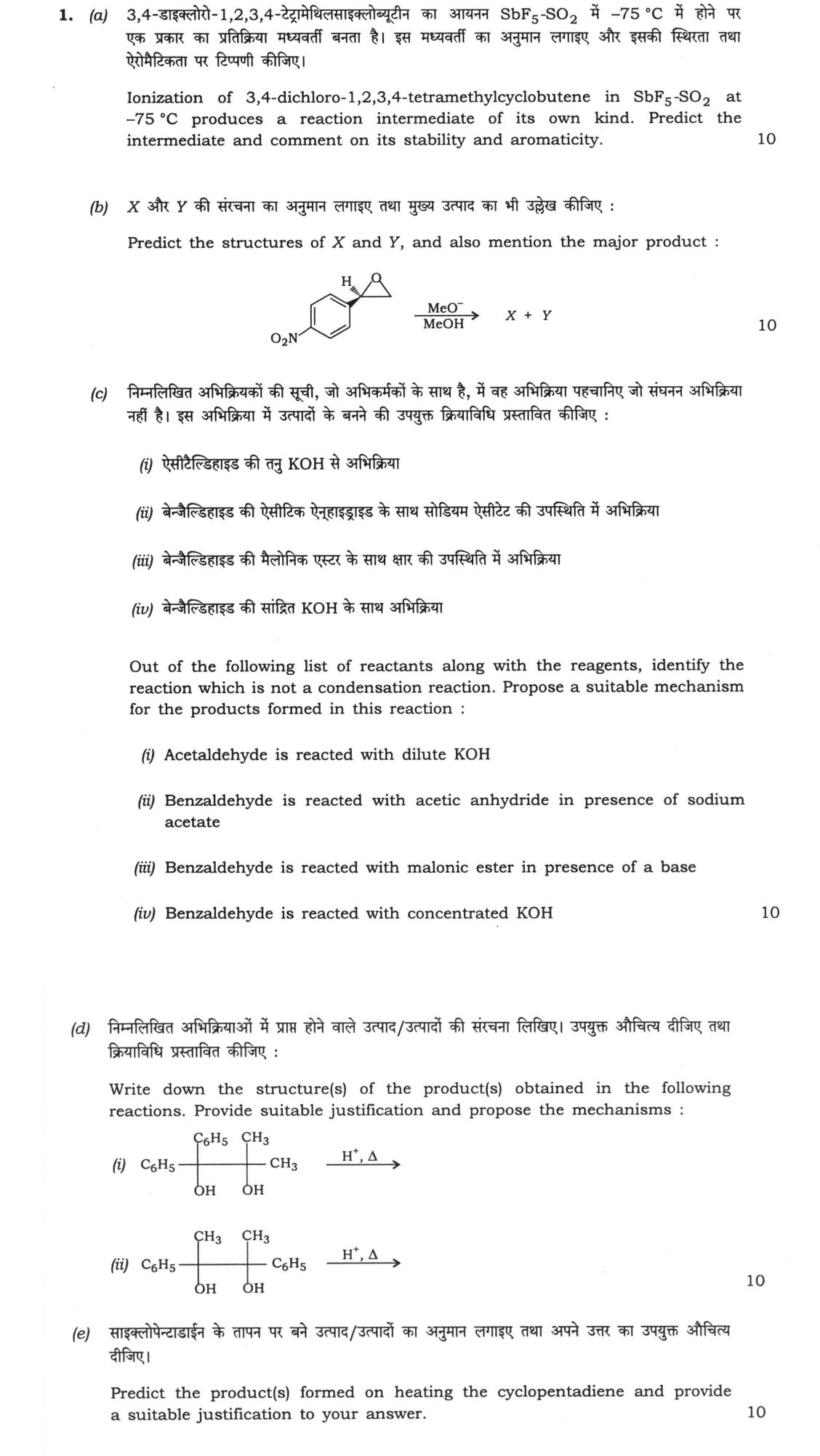
Ionization of 3,4-dichloro-1,2,3,4-tetramethylcyclobutene in SbF₅-SO₂ at –75 °C produces a reaction intermediate of its own kind. Predict the intermediate and comment on its stability and aromaticity. 10 marks
Predict the structures of X and Y, and also mention the major product: 10 marks
Out of the following list of reactants along with the reagents, identify the reaction which is not a condensation reaction. Propose a suitable mechanism for the products formed in this reaction: (10 marks) Acetaldehyde is reacted with dilute KOH
Benzaldehyde is reacted with acetic anhydride in presence of sodium acetate
Benzaldehyde is reacted with malonic ester in presence of a base
Benzaldehyde is reacted with concentrated KOH
Write down the structure(s) of the product(s) obtained in the following reactions. Provide suitable justification and propose the mechanisms: (10 marks) [reaction diagram not shown]
[reaction diagram not shown]
Predict the product(s) formed on heating the cyclopentadiene and provide a suitable justification to your answer. 10 marks
हिंदी में प्रश्न पढ़ें
3,4-डाइक्लोरो-1,2,3,4-टेट्रामेथिलसाइक्लोब्यूटीन का आयनन SbF₅-SO₂ में –75 °C में होने पर एक प्रकार का प्रतिक्रिया मध्यवर्ती बनता है। इस मध्यवर्ती का अनुमान लगाइए और इसकी स्थिरता तथा एरोमैटिसिटी पर टिप्पणी कीजिए। (10 अंक)
X और Y की संरचना का अनुमान लगाइए तथा मुख्य उत्पाद का भी उल्लेख कीजिए: (10 अंक)
निम्नलिखित अभिक्रियकों की सूची, जो अभिकर्मकों के साथ है, में वह अभिक्रिया पहचानिए जो संघनन अभिक्रिया नहीं है। इस अभिक्रिया में उत्पादों के बनने की उपयुक्त क्रियाविधि प्रस्तावित कीजिए: (10 अंक) ऐसीटैल्डिहाइड की तनु KOH से अभिक्रिया
बेंजैल्डिहाइड की ऐसीटिक ऐन्हाइड्राइड के साथ सोडियम ऐसीटेट की उपस्थिति में अभिक्रिया
बेंजैल्डिहाइड की मैलोनिक एस्टर के साथ क्षार की उपस्थिति में अभिक्रिया
बेंजैल्डिहाइड की सांद्रित KOH के साथ अभिक्रिया
निम्नलिखित अभिक्रियाओं में प्राप्त होने वाले उत्पाद/उत्पादों की संरचना लिखिए। उपयुक्त औचित्य दीजिए तथा क्रियाविधि प्रस्तावित कीजिए: (10 अंक) [आरेख नहीं दिखाया गया]
[आरेख नहीं दिखाया गया]
साइक्लोपेंटाडाइन के तापन पर बने उत्पाद/उत्पादों का अनुमान लगाइए तथा अपने उत्तर का उपयुक्त औचित्य दीजिए। (10 अंक)
The figure this question refers to, in words
The question paper is a scan and the diagram did not survive as text. This is the figure as read from the original page — every component, value and label — so the question can be worked from the text below.
(b) Text description of a reaction: '2-chloro-2,3-dimethylpentane' is treated with 'sodium ethoxide' (NaOEt). The question asks for the structures of the alkenes expected after dehydrohalogenation.
(d) Reaction (ii): A molecule with a central single bond connecting two carbon atoms. The left carbon is bonded to one phenyl group (C6H5), one methyl group (CH3), and one hydroxyl group (OH). The right carbon is bonded to one phenyl group (C6H5), one methyl group (CH3), and one hydroxyl group (OH). The reaction arrow points to the right with conditions H+ and Delta (heat) above it.
(e) Chemical structure (5): A benzene ring attached to a methylene group (-CH2-), which is attached to another methylene group (-CH2-), which is attached to a carboxylic acid group (-C(=O)-O-H). The full structure is 3-phenylpropanoic acid.
What "Explain" is asking you to do
Make the working of something clear — what sets it off, what follows from what, and what it produces. Explain is the Commission's mechanism word: it dominates the technical papers and the “explain why” stems, where the marks sit in the causal chain and not in the label.
Structure that answers it
State what it is → the initiating condition → the chain of cause, step by step → an instance where it plays out → what the chain produces
Where marks are lost
Describing what something looks like instead of why it works that way. Naming the stages without linking them reads as description too.
How this answer will be evaluated
Approach
(a) comment: context > arguments both sides > judgment > close | (b) describe: define > structure or process in order > labelled diagram > significance | (c) explain: definition/context > points in order > small example > short close | (d) describe: define > structure or process in order > labelled diagram > significance | (e) justify: claim > 3-4 reasons > evidence > conclusion Full marks: All parts answered with correct structures, mechanisms, and justifications.
Key points expected
- Identify the intermediate as a cyclobutadiene dication
- State the 2π electron count of the intermediate
- Apply Hückel's rule to determine aromaticity
- Justify stability based on electronic configuration
- Draw the structure of product X
- Draw the structure of product Y
- Identify the major product between X and Y
- Provide a mechanism for the epoxide opening
Evaluation rubric
Each sub-part is marked on its own, against the marks and word limit printed on the paper.
- (a) Predict the intermediate and comment on its stability and aromaticity. 10 marks
comment— context → arguments both sides → judgment → close
Must cover
- Identify the intermediate as a cyclobutadiene dication
- State the 2π electron count of the intermediate
- Apply Hückel's rule to determine aromaticity
- Justify stability based on electronic configuration
Loses marks
- Confusing dication with neutral cyclobutadiene
- Incorrect application of Hückel's rule
Earns more
- Draw the resonance structures of the dication
- Mention the specific solvent system (SbF5-SO2)
Extra mark
- Compare stability with neutral cyclobutadiene
- (b) Predict the structures of X and Y and mention the major product. 10 marks
describe— define → structure or process in order → labelled diagram → significance
Must cover
- Draw the structure of product X
- Draw the structure of product Y
- Identify the major product between X and Y
- Provide a mechanism for the epoxide opening
Loses marks
- Failing to show the mechanism
- Incorrect regioselectivity in the product structures
Earns more
- Explain the regioselectivity of the nucleophilic attack
- Discuss the role of the nitro group in directing the reaction
Extra mark
- Mention the stereochemistry of the products
- (c) Identify the non-condensation reaction and propose a mechanism for its product. 10 marks
explain— definition/context → points in order → small example → short close
Must cover
- Identify reaction (iv) as the non-condensation reaction
- Name the reaction as Cannizzaro reaction
- Propose the mechanism for the Cannizzaro reaction
- Show the formation of benzyl alcohol and benzoate
Loses marks
- Incorrectly identifying the non-condensation reaction
- Failing to show the hydride transfer step
Earns more
- Briefly explain why the other reactions are condensations
- Show the hydride transfer step in the mechanism
Extra mark
- Mention the specific conditions required for Cannizzaro
- (d) Write the product structures, provide justification, and propose mechanisms. 10 marks
describe— define → structure or process in order → labelled diagram → significance
Must cover
- Draw the product structure for reaction (i)
- Draw the product structure for reaction (ii)
- Propose the mechanism for the dehydration
- Justify the product formation based on stability
Loses marks
- Failing to show the mechanism
- Incorrect product structure
Earns more
- Show the carbocation intermediate in the mechanism
- Explain the role of heat in the reaction
Extra mark
- Mention the specific type of elimination (E1 or E2)
- (e) Predict the product(s) formed on heating cyclopentadiene and provide justification. 10 marks
justify— claim → 3-4 reasons → evidence → conclusion
Must cover
- Identify the product as dicyclopentadiene
- Name the reaction as Diels-Alder reaction
- Explain the dimerization of cyclopentadiene
- Justify the product formation based on orbital symmetry
Loses marks
- Failing to identify the Diels-Alder reaction
- Incorrect product structure
Earns more
- Draw the structure of dicyclopentadiene
- Mention the specific conditions for the reaction
Extra mark
- Show the orbital interaction in the Diels-Alder reaction
Model answer coming soon
Every evaluation on this site is marked against a verified model answer. This question's answer is still being written; evaluation opens the moment it lands.
More from Chemistry 2022 Paper II
- Q1 (a) Ionization of 3,4-dichloro-1,2,3,4-tetramethylcyclobutene in SbF₅-SO₂ at –75 °C produ…
- Q2 (a) Predict the products X and Y in the following reactions: (5×3=15 marks) (i) [compound…
- Q3 The compound A, acetal of acetaldehyde, on reaction with B, under given reaction conditio…
- Q4 (a) (i) Complete the following reaction by showing stepwise reaction mechanism for the fo…