Paper II — Q2
(a) Predict the products X and Y in the following reactions: (5×3=15 marks) (i) [compound] →(1) O₃ (2) H₂O₂→ X + Y (ii)…
Predict the products X and Y in the following reactions: (5×3=15 marks) [compound] →(1) O₃ (2) H₂O₂→ X + Y
[compound] →PBr₃→ [intermediate] →Br₂ (57%)→ X
CH₃—CH(CH₃)—CH₃ →Br₂/hv, 127 °C→ X + Y
What happens when the compound A is heated with one equivalent of HI? Give the structure of the product. Justify your answer: (5 marks) A [structure not shown]
Predict [A] and [B] in the following reaction: (5 marks) [Starting compound] →NBS, CCl₄→ [A] →NaOEt, EtOH/Δ→ [B]
Give the structures of alkenes expected after dehydrohalogenation of 2-chloro-2,3-dimethylpentane by sodium ethoxide. 5 marks
Match the following for the synthesis of class of compounds listed in Set-I with the reactants and reagents of Set-II: (10 marks) Set-I: (A) Quinoline, (B) Isoquinoline, (C) Indole Set-II: (1) Cinnamaldehyde, hydroxylamine, P₂O₅; (2) Acetaldehyde, phenylhydrazine, acid; (3) Glycerol, aniline, acid, nitrobenzene; (4) α-Halocarbonyl compound, thiourea Propose the mechanism for the synthesis of indole.
Write the reaction sequence for the synthesis of L-dopa (B), a drug for the treatment of Parkinson's disease, from L-tyrosine (A), an α-amino acid: 10 marks
हिंदी में प्रश्न पढ़ें
निम्नलिखित अभिक्रियाओं में उत्पाद X तथा Y का अनुमान लगाइए: (5×3=15 अंक) [यौगिक] →(1) O₃ (2) H₂O₂→ X + Y
[यौगिक] →PBr₃→ [मध्यवर्ती] →Br₂ (57%)→ X
CH₃—CH(CH₃)—CH₃ →Br₂/hv, 127 °C→ X + Y
यौगिक A को एक तुल्यांक HI के साथ तापन करने पर क्या होगा? उत्पाद की संरचना बताइए। अपने उत्तर का औचित्य सिद्ध कीजिए: (5 अंक) A [संरचना नहीं दिखाई गई]
निम्नलिखित अभिक्रिया में [A] तथा [B] का अनुमान लगाइए: (5 अंक) [प्रारंभिक यौगिक] →NBS, CCl₄→ [A] →NaOEt, EtOH/Δ→ [B]
2-क्लोरो-2,3-डाइमेथिलपेंटेन का सोडियम एथोक्साइड के साथ विहाइड्रोहैलोजनन करने पर अपेक्षित ऐल्कीनों की संरचना दीजिए। (5 अंक)
निम्नलिखित यौगिकों के वर्ग, जो समूह-I में सूचीबद्ध हैं, के संश्लेषण के लिए समूह-II के अभिक्रियकों तथा अभिकर्मकों के साथ मिलान कीजिए: (10 अंक) समूह-I: (A) क्विनोलिन, (B) आइसोक्विनोलिन, (C) इंडोल समूह-II: (1) सिनेमैल्डिहाइड, हाइड्रोक्सिलएमीन, P₂O₅; (2) एसीटेल्डिहाइड, फेनिलहाइड्राजीन, अम्ल; (3) ग्लिसरॉल, एनिलीन, अम्ल, नाइट्रोबेंजीन; (4) α-हैलोकार्बनिल यौगिक, थायोयूरिया इंडोल के संश्लेषण की क्रियाविधि को प्रस्तावित कीजिए।
L-डोपा (B), पार्किनसन की बीमारी के उपचार के लिए एक औषध, L-टायरोसिन (A), एक α-अमीनो अम्ल, से बनता है। इस संश्लेषण के अनुक्रम को लिखिए: (10 अंक)
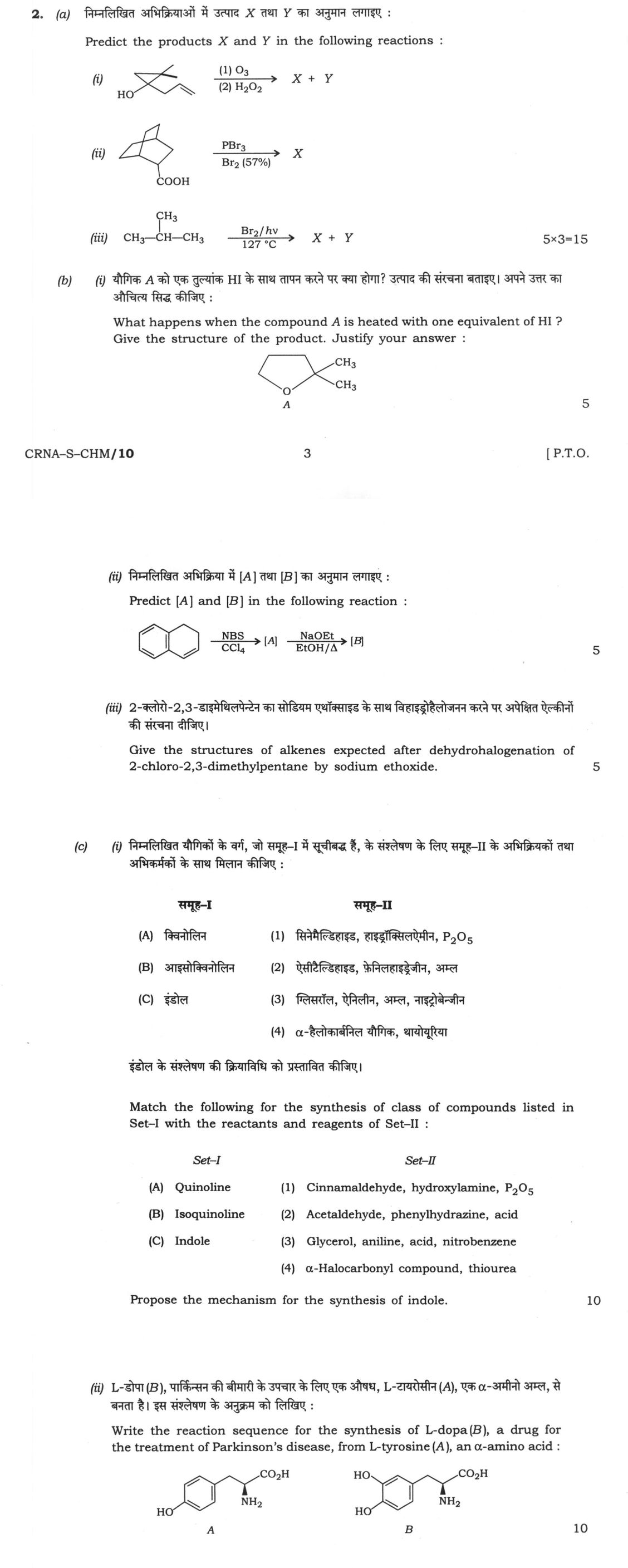
The figure this question refers to, in words
The question paper is a scan and the diagram did not survive as text. This is the figure as read from the original page — every component, value and label — so the question can be worked from the text below.
(a(i)) A bicyclic organic molecule, specifically a substituted norbornane derivative. The structure features a bicyclo[2.2.1]heptane skeleton. At the bridgehead carbon (C1), there is a methyl group and a hydroxyl group (HO-). At the opposite bridgehead carbon (C4), there is a vinyl group (-CH=CH2). The reaction arrow points to the right with reagents listed as (1) O3 and (2) H2O2, leading to products labeled X + Y.
(a(ii)) A bicyclic organic molecule, specifically a substituted norbornane derivative. The structure features a bicyclo[2.2.1]heptane skeleton. At one of the bridgehead carbons, there is a carboxylic acid group (-COOH). The reaction arrow points to the right with reagents listed as PBr3 followed by Br2 (57%), leading to a product labeled X.
(a(iii)) The chemical structure of isobutane (2-methylpropane), written as CH3-CH(CH3)-CH3. The reaction arrow points to the right with reagents listed as Br2/hv and temperature 127 °C, leading to products labeled X + Y.
(b) Reaction scheme: A bicyclic aromatic compound (1,2,3,4-tetrahydronaphthalene) reacts with NBS in CCl4 to form intermediate [A]. Intermediate [A] then reacts with NaOEt in EtOH under heat (delta) to form product [B].
(b(i)) A chemical structure labeled 'A'. It is a five-membered ring containing one oxygen atom (a tetrahydrofuran ring). At the carbon atom adjacent to the oxygen (position 2), there are two methyl groups (gem-dimethyl). The structure is 2,2-dimethyltetrahydrofuran.
(c) Two chemical structures are shown side-by-side. On the left is structure A, labeled 'A' below it. It consists of a benzene ring with a hydroxyl group (HO-) attached at the para position relative to a side chain. The side chain is a two-carbon chain where the first carbon is a CH2 group and the second carbon is a chiral center bonded to an amino group (NH2) and a carboxylic acid group (CO2H). The stereochemistry at the chiral center is indicated by a solid wedge bond to the NH2 group. On the right is structure B, labeled 'B' below it. It has the same backbone as A, but the benzene ring has two hydroxyl groups (HO-) at the meta and para positions relative to the side chain (3,4-dihydroxyphenyl group). The side chain is identical to A, with the NH2 group on a solid wedge.
What "Predict" is asking you to do
State the outcome and show the rule or trend that produces it. In the science papers this is determinate — name the product or structure and the mechanism that yields it; in the general papers it is a projection, and the assumptions it rests on have to be named on the page.
Structure that answers it
Given inputs or present position → the governing rule or driver → the predicted outcome stated definitely → assumptions and conditions under which it holds
Where marks are lost
Hedging into a list of possibilities, which commits to nothing and is marked as description. Stating the right product without the mechanism loses the reasoning marks, which are usually the larger share.
How this answer will be evaluated
Approach
(a(i)) map: locate accurately > label > one line on why it matters | (a(ii)) map: locate accurately > label > one line on why it matters | (a(iii)) map: locate accurately > label > one line on why it matters | (b(i)) justify: claim > 3-4 reasons > evidence > conclusion | (b(ii)) map: locate accurately > label > one line on why it matters | (b(iii)) map: locate accurately > label > one line on why it matters | (c(i)) map: locate accurately > label > one line on why it matters | (c(ii)) trace: start point > the stages in sequence > end point > what changed Full marks: All products correctly identified with mechanisms and justifications. Synthesis sequences are complete and accurate.
Key points expected
- Identify the alkene as the reactive site
- Show cleavage of the C=C double bond
- Identify X as the carboxylic acid product
- Identify Y as the carboxylic acid product
- Identify the reaction as the Hunsdiecker reaction
- Show the conversion of -COOH to -Br
- Draw the structure of the resulting alkyl bromide
- Maintain the stereochemistry of the bicyclic system
Evaluation rubric
Each sub-part is marked on its own, against the marks and word limit printed on the paper.
- (a(i)) Identify products X and Y from oxidative ozonolysis of the alkene.
map— locate accurately → label → one line on why it matters
Must cover
- Identify the alkene as the reactive site
- Show cleavage of the C=C double bond
- Identify X as the carboxylic acid product
- Identify Y as the carboxylic acid product
Loses marks
- Treating the reaction as reductive ozonolysis (giving aldehydes)
- Failing to account for the tertiary alcohol group
Earns more
- Mention oxidative workup (H2O2) converts aldehydes to acids
- Correctly draw the structure of the tertiary alcohol fragment
Extra mark
- Mention the formation of the ozonide intermediate
- (a(ii)) Predict product X from the reaction of the carboxylic acid with PBr3 and Br2.
map— locate accurately → label → one line on why it matters
Must cover
- Identify the reaction as the Hunsdiecker reaction
- Show the conversion of -COOH to -Br
- Draw the structure of the resulting alkyl bromide
- Maintain the stereochemistry of the bicyclic system
Loses marks
- Confusing the reaction with simple esterification
- Losing the stereochemical configuration of the bridgehead
Earns more
- Mention the formation of the acyl hypobromite intermediate
- Note the decarboxylation step
Extra mark
- Mention the radical mechanism of the Hunsdiecker reaction
- (a(iii)) Predict products X and Y from the radical bromination of isobutane.
map— locate accurately → label → one line on why it matters
Must cover
- Identify the reaction as free radical substitution
- Distinguish between primary and tertiary C-H bonds
- Identify the major product (tertiary bromide)
- Identify the minor product (primary bromide)
Loses marks
- Predicting substitution at the primary carbon as the major product
- Ignoring the regioselectivity of radical bromination
Earns more
- Justify the major product based on radical stability
- Mention the role of light (hv) in initiation
Extra mark
- Mention the relative reactivity of tertiary vs primary hydrogens
- (b(i)) Predict the product of the reaction of the epoxide with HI and justify the regioselectivity. 5 marks
justify— claim → 3-4 reasons → evidence → conclusion
Must cover
- Identify the reaction as acid-catalyzed epoxide ring opening
- Show the attack of I- at the more substituted carbon
- Draw the structure of the resulting iodo-alcohol
- Justify the regioselectivity based on carbocation character
Loses marks
- Predicting attack at the less substituted carbon
- Failing to show the protonation step
Earns more
- Mention the SN1-like character of the mechanism
- Show the protonation of the epoxide oxygen
Extra mark
- Mention the stereochemistry of the ring opening (trans-diaxial)
- (b(ii)) Predict intermediates [A] and [B] in the NBS/NaOEt reaction sequence. 5 marks
map— locate accurately → label → one line on why it matters
Must cover
- Identify [A] as the allylic bromide
- Show the allylic bromination by NBS
- Identify [B] as the diene product
- Show the elimination of HBr by NaOEt
Loses marks
- Predicting addition of Br2 across the double bond
- Failing to show the elimination step
Earns more
- Mention the radical mechanism of allylic bromination
- Show the E2 elimination mechanism
Extra mark
- Mention the formation of the more stable conjugated diene
- (b(iii)) Draw the structures of alkenes formed by dehydrohalogenation of 2-chloro-2,3-dimethylpentane. 5 marks
map— locate accurately → label → one line on why it matters
Must cover
- Identify the reaction as E2 elimination
- Show the removal of beta-hydrogens
- Draw the major product (Zaitsev product)
- Draw the minor product (Hofmann product)
Loses marks
- Failing to identify all possible beta-hydrogens
- Ignoring the Zaitsev rule
Earns more
- Justify the major product based on alkene stability
- Show the anti-periplanar geometry requirement
Extra mark
- Mention the stereochemistry of the alkene products (E/Z isomers)
- (c(i)) Match the synthesis methods for Quinoline, Isoquinoline, and Indole with the correct reagents. 10 marks
map— locate accurately → label → one line on why it matters
Must cover
- Match Quinoline with the Skraup synthesis (Glycerol, aniline, acid)
- Match Isoquinoline with the Pfitzinger synthesis (Cinnamaldehyde, hydroxylamine)
- Match Indole with the Fischer indole synthesis (Acetaldehyde, phenylhydrazine)
- Provide the correct matching for all three compounds
Loses marks
- Incorrectly matching the reagents to the products
- Failing to name the specific synthesis reactions
Earns more
- Name the specific synthesis reactions (Skraup, Pfitzinger, Fischer)
- Briefly describe the key steps of each synthesis
Extra mark
- Draw the mechanism for the Fischer indole synthesis
- (c(ii)) Write the reaction sequence for the synthesis of L-dopa from L-tyrosine. 10 marks
trace— start point → the stages in sequence → end point → what changed
Must cover
- Identify the need for a second hydroxylation on the aromatic ring
- Show the protection of the amino group
- Show the hydroxylation of the aromatic ring
- Show the deprotection of the amino group
Loses marks
- Failing to protect the amino group before hydroxylation
- Using incorrect reagents for the hydroxylation
Earns more
- Mention the use of a protecting group for the amine
- Specify the reagents for the hydroxylation step
Extra mark
- Mention the stereochemistry of the final product (L-dopa)
Model answer coming soon
Every evaluation on this site is marked against a verified model answer. This question's answer is still being written; evaluation opens the moment it lands.
More from Chemistry 2022 Paper II
- Q1 (a) Ionization of 3,4-dichloro-1,2,3,4-tetramethylcyclobutene in SbF₅-SO₂ at –75 °C produ…
- Q2 (a) Predict the products X and Y in the following reactions: (5×3=15 marks) (i) [compound…
- Q3 The compound A, acetal of acetaldehyde, on reaction with B, under given reaction conditio…
- Q4 (a) (i) Complete the following reaction by showing stepwise reaction mechanism for the fo…
- Q5 (a) Write the structures of nucleosides and nucleotides, and discuss the primary structur…