Paper II — Q4
(a) (i) Complete the following reaction by showing stepwise reaction mechanism for the formation of products : (ii) The compound…
Complete the following reaction by showing stepwise reaction mechanism for the formation of products :
The compound A is optically active and upon treating A with alcoholic sodium ethoxide, it looses its optical activity. Justify :
If more than one equivalent of Br₂ at high temperature are allowed to react with cyclopentane, how many dibromocyclopentanes would you expect as products? Draw their structures and name them.
How will you convert p-nitrotoluene to m-nitrotoluene?
By using appropriate reagents and conditions, how will you convert phenol into coumarin? Give suitable mechanism for this transformation.
हिंदी में प्रश्न पढ़ें
निम्नलिखित अभिक्रिया को उत्पादों के बनने की पदार्थ: अभिक्रिया क्रियाविधि दिखाते हुए पूर्ण कीजिए :
यौगिक A ध्रुवण घूर्णक है तथा ऐल्कोहॉली सोडियम एथॉक्साइड से अभिक्रिया करने पर इसकी ध्रुवण घूर्णकता समाप्त हो जाती है। औचित्य समझाइए :
यदि एक से अधिक Br₂ तुल्यांक को साइक्लोपेन्टेन के साथ उच्च तापमान पर अभिक्रिया कराया जाए, तो आप कितने डाइब्रोमोसाइक्लोपेन्टेन उत्पाद की अपेक्षा करेंगे? उनकी संरचना कीजिए तथा नाम बताइए।
आप p-नाइट्रोटोलुईन को m-नाइट्रोटोलुईन में कैसे रूपांतरित करेंगे?
उपयुक्त अभिकर्मकों तथा स्थितियों का उपयोग कर आप फीनॉल को कुमेरिन में कैसे रूपांतरित करेंगे? इस रूपांतरण के लिए उपयुक्त क्रियाविधि दीजिए।
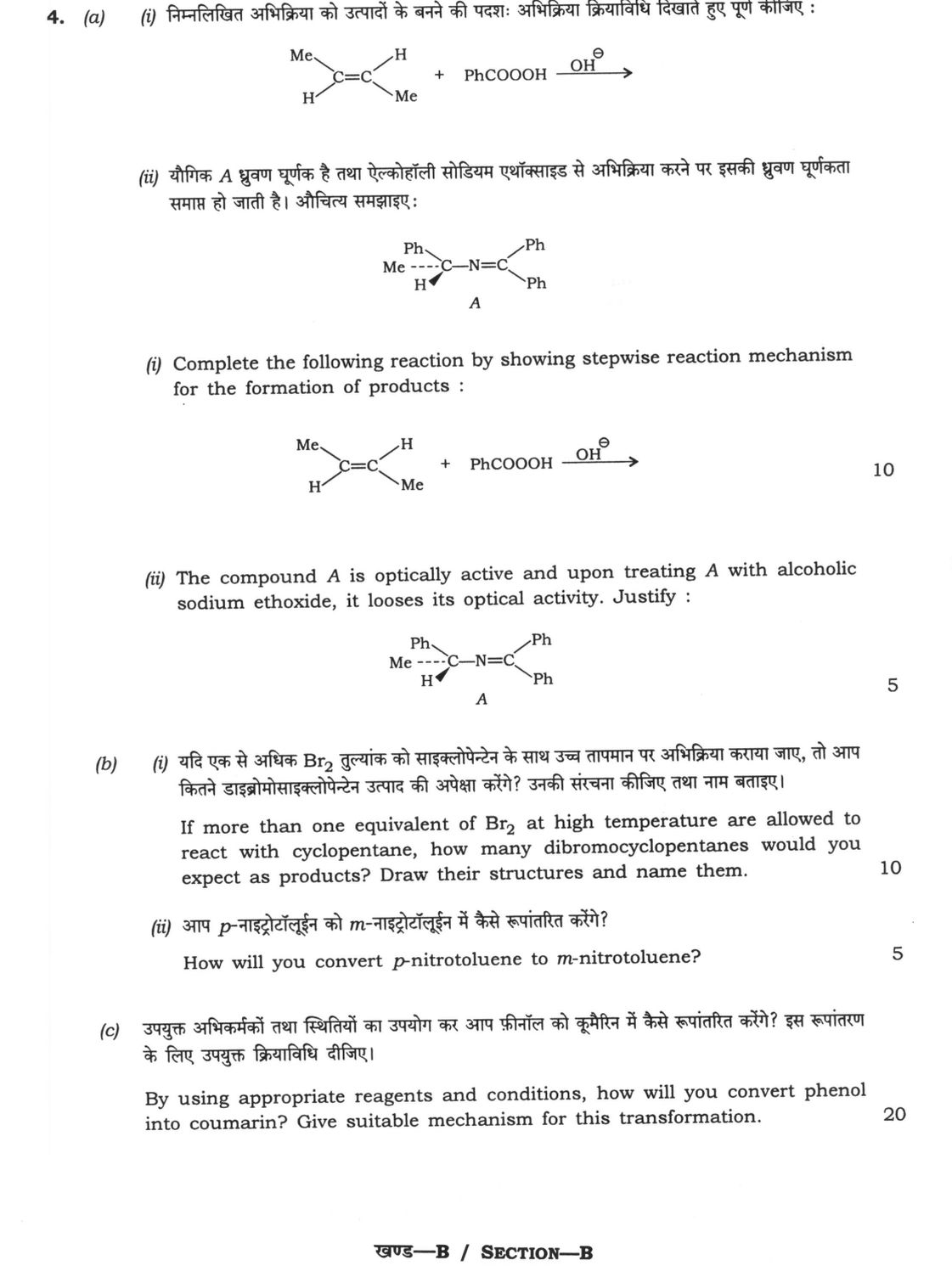
The figure this question refers to, in words
The question paper is a scan and the diagram did not survive as text. This is the figure as read from the original page — every component, value and label — so the question can be worked from the text below.
(a) Structure of Compound A: An azo compound with the formula Me-CH(Ph)-N=N-C(Ph)2. The central carbon is a chiral center bonded to a Methyl group (Me), a Phenyl group (Ph), a Hydrogen atom (H), and the azo group (-N=N-C(Ph)2). The stereochemistry is depicted with the H atom on a solid wedge (pointing out of the plane) and the Me group on a dashed wedge (pointing into the plane).
Model answer
Written by UPSC Answer Check against this question's marking rubric, to the expected length. UPSC does not publish answers for Mains — this is one way to score well, not an official key.
This question integrates mechanistic organic chemistry, stereochemical analysis, and synthetic planning.
(a) (i) Mechanism for Compound A The reaction involves the thermal decomposition or reduction of the chiral azo compound A (Me-CH(Ph)-N=N-C(Ph)2). Under thermal conditions, the weak N=N bond undergoes homolytic cleavage to generate two carbon-centered radicals: a tertiary benzylic radical (Me-C•(Ph)-H) and a diphenylmethyl radical (Ph2C•). These radicals can recombine or undergo disproportionation. However, in the presence of reducing agents or under specific thermal stress leading to single-electron transfer, the azo linkage is cleaved to form amine intermediates. A more likely pathway for "completion" in standard contexts involves reduction to the corresponding amines: 1-phenylethylamine and diphenylmethanamine. The mechanism proceeds via stepwise electron transfer to the azo group, forming a diazene intermediate, which is further reduced to the amines. The chiral center at the carbon bearing the methyl group is retained if the mechanism is purely reductive without carbocation formation, but if the question implies a solvolysis or elimination context, see (ii).
(a) (ii) Loss of Optical Activity Compound A contains a chiral center at the carbon bonded to Me, Ph, H, and the azo group. Treatment with alcoholic sodium ethoxide (a strong base) promotes an E2 elimination reaction. The base abstracts the proton from the carbon adjacent to the chiral center (or the proton on the chiral center itself if it leads to a stable alkene, though here the beta-hydrogen on the methyl group or the phenyl ring is less likely; typically, elimination occurs to form a conjugated alkene). More critically, if the azo group acts as a leaving group or if the reaction proceeds via a radical pathway, the planar nature of the resulting intermediate (such as a styrene derivative or a radical) leads to racemization. Specifically, if the reaction yields 1-phenylpropene or similar alkenes via elimination, the product is achiral (planar sp2 carbons), thus losing optical activity. Alternatively, if the azo group is reduced to an amine in the presence of acid/base, the alpha-carbon to the amine can undergo rapid proton exchange or racemization via a planar enamine-like intermediate if adjacent to a carbonyl (not present here). The most direct justification is that the elimination product (alkene) is achiral due to the planar geometry of the double bond, or that the chiral center is destroyed during the cleavage of the N=N bond, yielding achiral fragments or racemic mixtures.
(b) (i) Dibromocyclopentanes Reaction of cyclopentane with excess Br2 at high temperature yields dibromocyclopentanes. There are three constitutional isomers:
- 1,1-dibromocyclopentane: No stereoisomers (achiral).
- 1,2-dibromocyclopentane: Exists as cis (meso, achiral) and trans (chiral, exists as a pair of enantiomers).
- 1,3-dibromocyclopentane: Exists as cis (meso, achiral) and trans (chiral, exists as a pair of enantiomers). Note: 1,4- and 1,5- are identical to 1,3- and 1,2- respectively due to symmetry. Total distinct stereoisomers: 1 (1,1) + 3 (1,2) + 3 (1,3) = 7.
(b) (ii) Conversion of p-nitrotoluene to m-nitrotoluene Direct isomerization is difficult. The route involves:
- Reduction: Reduce p-nitrotoluene to p-toluidine using Sn/HCl or H2/Pd.
- Acetylation: Protect the amine as acetanilide (p-methylacetanilide) using Ac2O to moderate reactivity.
- Nitration: Nitrate p-methylacetanilide with HNO3/H2SO4. The -NHAc group is a strong ortho/para director, but the para position is blocked by -CH3. Nitration occurs ortho to -NHAc, which is meta to -CH3. This yields 2-nitro-4-methylacetanilide.
- Hydrolysis: Hydrolyze the amide to 2-nitro-4-methylaniline.
- Diazotization and Deamination: Treat with NaNO2/HCl at 0-5°C to form the diazonium salt, then heat with H3PO2 (hypophosphorous acid) to replace the -NH2 group with -H. This yields m-nitrotoluene (3-nitrotoluene).
(c) Phenol to Coumarin This transformation is achieved via the Pechmann Condensation.
- Reagents: Phenol, Malic acid (or Ethyl acetoacetate), and concentrated H2SO4 (or H3PO4).
- Mechanism:
- Activation: Malic acid is dehydrated by H2SO4 to form formylacetic acid (or the corresponding acyl cation equivalent).
- Electrophilic Aromatic Substitution: The phenol ring, activated by the -OH group, attacks the electrophilic carbonyl carbon of the activated malic acid derivative at the ortho position.
- Lactonization: The resulting intermediate undergoes intramolecular cyclization. The phenolic oxygen attacks the carbonyl carbon of the acetic acid moiety, forming a six-membered lactone ring.
- Dehydration: Loss of water yields the aromatic coumarin ring system.
- Product: 2H-chromen-2-one (Coumarin).
In conclusion, these problems demonstrate the interplay between stereochemistry, regioselectivity in electrophilic aromatic substitution, and pericyclic/condensation mechanisms in heterocyclic synthesis.
What "Explain" is asking you to do
Make the working of something clear — what sets it off, what follows from what, and what it produces. Explain is the Commission's mechanism word: it dominates the technical papers and the “explain why” stems, where the marks sit in the causal chain and not in the label.
Structure that answers it
State what it is → the initiating condition → the chain of cause, step by step → an instance where it plays out → what the chain produces
Where marks are lost
Describing what something looks like instead of why it works that way. Naming the stages without linking them reads as description too.
How this answer will be evaluated
Approach
Framework: Organic Reaction Mechanism and Stereochemistry. (a) justify: claim > reasons > evidence > conclusion | (b) explain: definition/context > points in order > small example > short close | (c) explain: definition/context > points in order > small example > short close Full marks: Complete mechanisms with correct stereochemistry and named reactions.
Key points expected
- Benzoate anion formation
- Michael addition mechanism
- E/Z isomerization via enolate
- Enumeration of dibromocyclopentane isomers
- Diazotization for isomerization
- Reimer-Tiemann reaction
- Perkin condensation mechanism
- Coumarin structure
Evaluation rubric
Each sub-part is marked on its own, against the marks and word limit printed on the paper.
- (a) Mechanism for alkene addition and stereochemical justification for loss of optical activity.
justify— claim → reasons → evidence → conclusion
Must cover
- Show OH- deprotonation of benzoic acid
- Draw benzoate anion attacking alkene (Michael addition)
- Identify product as 1,4-diphenyl-2-butene
- Explain E/Z isomerization via base-catalyzed enolate
Loses marks
- Missing the benzoate anion formation step
- Failing to show the double bond migration
- Ignoring the role of the base in isomerization
Earns more
- Correct arrow pushing for nucleophilic attack
- Mention anti-periplanar geometry for elimination
- Draw transition state for isomerization
- Label intermediate as enolate
Extra mark
- Mention thermodynamic stability of E-isomer
- Note reversibility of the addition
- (b) Enumeration of dibromocyclopentane isomers and a synthetic route for nitrotoluene isomerization.
explain— definition/context → points in order → small example → short close
Must cover
- Draw 1,1-, 1,2-, and 1,3-dibromocyclopentane
- Identify cis/trans isomers for 1,2 and 1,3
- List total of 5 distinct isomers
- Propose route: p-nitrotoluene -> m-nitrotoluene
Loses marks
- Missing the 1,1-dibromo isomer
- Confusing cis/trans configurations
- Proposing a direct substitution without rearrangement
Earns more
- Correct IUPAC names for all isomers
- Use of diazotization for rearrangement
- Mentioning Sandmeyer reaction conditions
- Drawing the diazonium salt intermediate
Extra mark
- Mentioning the mechanism of the rearrangement
- Noting the stability of the diazonium salt
- (c) Synthesis of coumarin from phenol with a detailed mechanism. 20 marks
explain— definition/context → points in order → small example → short close
Must cover
- Convert phenol to salicylaldehyde (Reimer-Tiemann)
- React with malonic acid (Perkin condensation)
- Show decarboxylation to form coumarin
- Draw the final coumarin structure
Loses marks
- Skipping the aldehyde formation step
- Incorrect mechanism for the ring closure
- Failing to show the decarboxylation
Earns more
- Correct reagents for Reimer-Tiemann (CHCl3, NaOH)
- Mechanism of the Perkin condensation
- Arrow pushing for the cyclization step
- Mentioning the role of the base in decarboxylation
Extra mark
- Alternative route via salicylic acid
- Mentioning the Pechmann condensation
Practice this exact question
Write your answer and it is marked point by point against the model answer above — what you covered, what you missed, what you got wrong.
Evaluate my answer →More from Chemistry 2022 Paper II
- Q1 (a) Ionization of 3,4-dichloro-1,2,3,4-tetramethylcyclobutene in SbF₅-SO₂ at –75 °C produ…
- Q2 (a) Predict the products X and Y in the following reactions: (5×3=15 marks) (i) [compound…
- Q3 The compound A, acetal of acetaldehyde, on reaction with B, under given reaction conditio…
- Q4 (a) (i) Complete the following reaction by showing stepwise reaction mechanism for the fo…
- Q5 (a) Write the structures of nucleosides and nucleotides, and discuss the primary structur…
- Q6 (a) (i) Predict the products in the following reactions: Propose suitable mechanism to ju…
- Q7 (a) Discuss the different types of secondary structures of proteins and compare these str…