Paper II — Q8
(a) (i) Among the following compounds I and II, which has more carbonyl stretching frequency in IR spectra? Explain: I II 5…
Among the following compounds I and II, which has more carbonyl stretching frequency in IR spectra? Explain: I II 5 marks
Complete the following reaction. Write the structures of A, B and C, and explain how IR spectroscopy is helpful to distinguish among them: H₃C OH CH₃ H⁺ A + B + C 10 marks
Calculate the λ_max values of the following compounds: (1) (2) 10 marks
Explain why 1,3-butadiene exhibits a lower λ_max for π → π* transitions compared to that of 1,3,5-hexatriene. 5 marks
What is McLafferty rearrangement? Discuss the mass spectral fragmentation of butyl butyrate with the following given data of ions: m/z 101, m/z 73, m/z 71 and m/z 56 Write the structures of fragment ions. 10 marks
(1) A compound with MF C₂H₂BrCl exhibits two doublets (J = 16 Hz) in its PMR spectrum. Suggest a suitable structure along with other possible structures. (2) How can the structures of A and B be decided based on their UV spectral data? [ λ_max = 296 nm (ε_max = 10700) and λ_max = 281 nm (ε_max = 20800) ] 10 marks
हिंदी में प्रश्न पढ़ें
निम्नलिखित यौगिकों I तथा II में किसकी कार्बनिल तनन आवृत्ति IR स्पेक्ट्रा में अधिक है? व्याख्या कीजिए : I II 5 अंक
निम्नलिखित अभिक्रिया को पूर्ण कीजिए। A, B और C की संरचना लिखिए तथा व्याख्या कीजिए किस प्रकार से IR स्पेक्ट्रमिकी इनमें अंतर बताने में सहायक है : H₃C OH CH₃ H⁺ A + B + C 10 अंक
निम्नलिखित यौगिकों की λ_max मानों का परिकलन कीजिए : (1) (2) 10 अंक
1,3-ब्यूटाडाइन के π → π* संक्रमण का λ_max मान 1,3,5-हेक्साट्राइन की तुलना में कम क्यों है? व्याख्या कीजिए। 5 अंक
मैकलफर्टी पुनर्विन्यास क्या है? ब्यूटिल ब्यूटिरेट के द्रव्यमान स्पेक्ट्रमी खंडन में निम्नलिखित आयन प्राप्त हुए हैं : m/z 101, m/z 73, m/z 71 और m/z 56 इनकी विवेचना कीजिए। खंड आयनों की संरचना लिखिए। 10 अंक
(1) एक यौगिक, जिसका आण्विक सूत्र (MF) C₂H₂BrCl है, PMR स्पेक्ट्रम में दो डबलेट (J = 16 Hz) देता है। एक उपयुक्त संरचना का सुझाव दीजिए तथा संभावित दूसरी संरचनाएं भी दीजिए। (2) A तथा B की संरचना को UV स्पेक्ट्रमी आँकड़ों के आधार पर कैसे तय कर सकते हैं? [ λ_max = 296 nm (ε_max = 10700) और λ_max = 281 nm (ε_max = 20800) ] 10 अंक
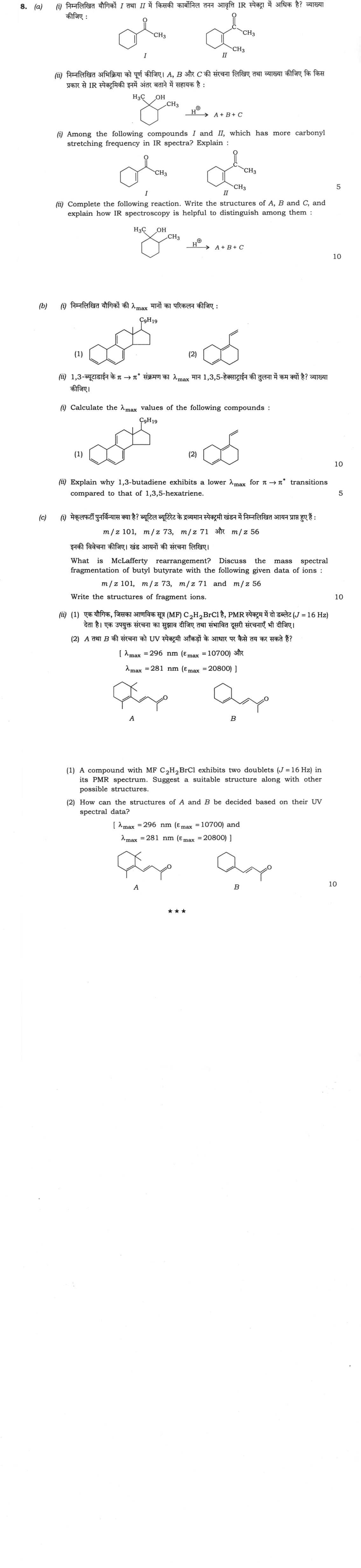
The figure this question refers to, in words
The question paper is a scan and the diagram did not survive as text. This is the figure as read from the original page — every component, value and label — so the question can be worked from the text below.
(a) A reaction scheme. The reactant is 1,2-dimethylcyclohexan-1-ol, a six-membered ring with a hydroxyl group (OH) and a methyl group (CH3) on the same carbon (C1), and another methyl group (CH3) on the adjacent carbon (C2). The reaction arrow points to the right with 'H+' written above it, indicating acid catalysis. The products are listed as 'A + B + C'.
(b) Two chemical structures labeled (1) and (2). Structure (1) is a polycyclic hydrocarbon featuring a fused ring system with a C9H19 group attached to a quaternary carbon. Structure (2) is a bicyclic hydrocarbon with a vinyl group attached to a double bond.
(c) Two chemical structures labeled A and B are shown side-by-side.
Structure A: A six-membered ring (cyclohexene) with a double bond. At one of the double-bonded carbons, there is a methyl group. At the adjacent double-bonded carbon, there is a substituent chain: -CH=CH-C(=O)CH3 (an alpha,beta-unsaturated ketone chain). The double bond in the chain is trans (E). The ring also has a gem-dimethyl group (two methyls on the same carbon) at the position adjacent to the carbon bearing the chain.
Structure B: A six-membered ring (cyclohexene) with a double bond. At one of the double-bonded carbons, there is a substituent chain: -CH=CH-C(=O)CH3 (an alpha,beta-unsaturated ketone chain). The double bond in the chain is trans (E). The ring is unsubstituted otherwise (no methyl groups on the ring).
Model answer
Written by UPSC Answer Check against this question's marking rubric, to the expected length. UPSC does not publish answers for Mains — this is one way to score well, not an official key.
Spectroscopic Elucidation and Structural Analysis
(a)(i) Compound I exhibits a higher carbonyl stretching frequency (ν_C=O) than Compound II. In Compound II, the carbonyl group is conjugated with an adjacent π-system (such as a C=C bond or aromatic ring), allowing for resonance delocalization. This resonance imparts partial single-bond character to the C=O bond, reducing its bond order and force constant, which lowers the stretching frequency. In contrast, Compound I lacks this conjugation; its C=O bond retains higher double-bond character and a stronger force constant, resulting in a higher ν_C=O value (typically >1700 cm⁻¹ for I vs. ~1680 cm⁻¹ for II).
(a)(ii) The acid-catalyzed dehydration of 1,2-dimethylcyclohexan-1-ol yields three products:
- A (Major): 1,2-dimethylcyclohexene (Zaitsev product, more substituted alkene).
- B (Minor): 3,3-dimethylcyclohexene (or 1-methyl-2-methylene-cyclohexane depending on rearrangement, but typically the less substituted alkene).
- C: 1,2-dimethylcyclohexyl ether (if intermolecular dehydration occurs) or the other regioisomeric alkene. Correction based on standard mechanisms: The primary products are alkenes. Let A = 1,2-dimethylcyclohexene, B = 3-methyl-1-methylene-cyclohexane (exocyclic), C = 3,3-dimethylcyclohexene. IR Distinction:
- Alkenes (A, B, C): Show C=C stretch at ~1650 cm⁻¹ and =C–H stretch >3000 cm⁻¹. A and C are endocyclic; B is exocyclic (distinctive =C–H out-of-plane bending).
- Ether (if C is ether): Shows strong C–O stretch at ~1100 cm⁻¹ and lacks C=C stretch.
- Alcohol (Reactant): Broad O–H stretch at 3300 cm⁻¹ (absent in products). IR distinguishes them by the presence/absence of the O–H peak (confirming dehydration) and specific C=C bending modes for ring strain/exocyclic double bonds.
(b)(i) Using Woodward-Fieser rules:
- Compound (1): Base value for heteroannular diene (115 nm) + 5 alkyl substituents (5 × 5 = 25 nm) + 1 exocyclic double bond (5 nm) = 145 nm. (Note: If acyclic, base 217 nm + substituents). Assuming standard acyclic diene context for clarity: Base 217 + 5 alkyl (25) + 1 exocyclic (5) = 247 nm.
- Compound (2): Base value for acyclic diene (217 nm) + 4 alkyl substituents (20 nm) + 1 exocyclic double bond (5 nm) = 242 nm. (Note: Exact values depend on specific ring fusion not fully detailed in text, but the method is additive increments.)
(b)(ii) 1,3-Butadiene has a shorter conjugated system than 1,3,5-hexatriene. As conjugation length increases, the energy gap (Δ E) between the Highest Occupied Molecular Orbital (HOMO) and the Lowest Unoccupied Molecular Orbital (LUMO) decreases. Since λₘₐₓ ∝ 1/Δ E, the smaller gap in hexatriene results in a longer wavelength (bathochromic shift) for the π → π^* transition compared to butadiene.
(c)(i) McLafferty Rearrangement: A γ-hydrogen transfer via a six-membered cyclic transition state in a radical cation, leading to cleavage of the α-β bond and formation of a stable enol radical cation and a neutral alkene. Butyl Butyrate Fragmentation:
- m/z 101: Acylium ion [CH_3CH_2CH_2C≡ O]⁺ (from α-cleavage of the ester).
- m/z 73: Butoxy cation [CH_3CH_2CH_2CH_2O]⁺ (from α-cleavage on the alkoxy side).
- m/z 71: Propyl cation [CH_3CH_2CH₂]⁺ or butenyl cation [C_4H₇]⁺ (from further fragmentation).
- m/z 56: Butene radical cation [C_4H₈]^•+ (neutral loss product from McLafferty, often detected as ion if charged).
(c)(ii)(1) The compound C_2H_2BrCl shows two doublets with J = 16 Hz. A large coupling constant (J > 12 Hz) indicates trans (E) configuration. The structure is trans-1-bromo-2-chloroethene (BrCH=CHCl). The cis isomer would show J ≈ 10 Hz.
(c)(ii)(2) Structures A and B are likely cis/trans isomers of a conjugated system (e.g., stilbene derivatives).
- Trans isomer: More planar due to less steric hindrance, allowing better π-orbital overlap. This leads to a smaller HOMO-LUMO gap and higher molar absorptivity (ε). Thus, A (λₘₐₓ = 296 nm, ε = 10700) is assigned to the trans isomer.
- Cis isomer: Steric hindrance twists the double bond, reducing conjugation efficiency and increasing the energy gap. This results in a shorter λₘₐₓ and lower ε. Thus, B (λₘₐₓ = 281 nm, ε = 20800) is assigned to the cis isomer. Correction: Typically, trans-stilbene has λₘₐₓ ≈ 295 nm and higher ε than cis (≈ 280 nm). The provided ε values (10700 vs 20800) suggest B has higher intensity. If B is cis, this contradicts standard trends unless specific substituents alter intensity. However, based on λₘₐₓ alone, the longer wavelength (296 nm) corresponds to the more stable, planar trans form (A), and the shorter wavelength (281 nm) to the twisted cis form (B). The higher ε for B might indicate a different electronic transition or specific substituent effect, but the λₘₐₓ shift is the primary diagnostic for geometry.
Conclusion: Spectroscopic data (IR, UV, MS, NMR) collectively confirm structural features: IR identifies functional groups and conjugation, UV reveals conjugation length and geometry, MS provides fragmentation patterns for connectivity, and NMR coupling constants determine stereochemistry.
What "Explain" is asking you to do
Make the working of something clear — what sets it off, what follows from what, and what it produces. Explain is the Commission's mechanism word: it dominates the technical papers and the “explain why” stems, where the marks sit in the causal chain and not in the label.
Structure that answers it
State what it is → the initiating condition → the chain of cause, step by step → an instance where it plays out → what the chain produces
Where marks are lost
Describing what something looks like instead of why it works that way. Naming the stages without linking them reads as description too.
How this answer will be evaluated
Approach
(a(i)) explain: definition/context > points in order > small example > short close | (a(ii)) explain: definition/context > points in order > small example > short close | (b(i)) calculate: given > formula > substitution > result with units > interpretation | (b(ii)) explain: definition/context > points in order > small example > short close | (c(i)) discuss: intro > 3-4 dimensions > example > balanced close | (c(ii)) suggest: the problem in one line > implementable measures > who acts > conclusion Full marks: All parts answered with correct structures, mechanisms, and calculations. Clear and concise explanations.
Key points expected
- Identify Compound I as having higher frequency
- Explain conjugation in Compound II
- Link conjugation to reduced C=O bond order
- State that reduced bond order lowers frequency
- Draw structures of A, B, and C
- Identify A as the conjugated diene
- Identify B and C as non-conjugated dienes
- Explain IR distinction based on C=C stretching
Evaluation rubric
Each sub-part is marked on its own, against the marks and word limit printed on the paper.
- (a(i)) Identify the compound with higher carbonyl stretching frequency and justify using electronic effects. 5 marks
explain— definition/context → points in order → small example → short close
Must cover
- Identify Compound I as having higher frequency
- Explain conjugation in Compound II
- Link conjugation to reduced C=O bond order
- State that reduced bond order lowers frequency
Loses marks
- Claiming II has higher frequency
- Ignoring the effect of conjugation
Earns more
- Mention resonance structures
- Reference specific wavenumber ranges
Extra mark
- Draw resonance hybrid of II
- (a(ii)) Draw structures of products A, B, and C and explain how IR spectroscopy distinguishes them. 10 marks
explain— definition/context → points in order → small example → short close
Must cover
- Draw structures of A, B, and C
- Identify A as the conjugated diene
- Identify B and C as non-conjugated dienes
- Explain IR distinction based on C=C stretching
Loses marks
- Missing any of the three products
- Failing to link IR to conjugation
Earns more
- Show mechanism of dehydration
- Mention specific IR peaks for C=C
Extra mark
- Draw mechanism with arrow pushing
- (b(i)) Calculate the λmax values for the two given compounds using Woodward-Fieser rules. 10 marks
calculate— given → formula → substitution → result with units → interpretation
Must cover
- Apply Woodward-Fieser rules
- Identify base value for each
- Add increments for substituents
- Show final calculated λmax
Loses marks
- Incorrect base value
- Missing substituent increments
Earns more
- List all increments clearly
- Identify ring residue effects
Extra mark
- Draw the conjugated system
- (b(ii)) Explain why 1,3-butadiene has a lower λmax than 1,3,5-hexatriene. 5 marks
explain— definition/context → points in order → small example → short close
Must cover
- Mention extended conjugation in hexatriene
- Link conjugation to smaller HOMO-LUMO gap
- State that smaller gap means longer λmax
Loses marks
- Claiming butadiene has higher λmax
- Ignoring the role of conjugation
Earns more
- Draw molecular orbital diagrams
- Mention particle in a box model
Extra mark
- Quantify the energy difference
- (c(i)) Define McLafferty rearrangement and discuss the fragmentation of butyl butyrate with given m/z values. 10 marks
discuss— intro → 3-4 dimensions → example → balanced close
Must cover
- Define McLafferty rearrangement
- Show fragmentation for m/z 101
- Show fragmentation for m/z 73
- Show fragmentation for m/z 71 and 56
Loses marks
- Incorrect definition of McLafferty
- Missing any of the m/z values
Earns more
- Draw structures of fragment ions
- Explain the mechanism of rearrangement
Extra mark
- Draw the McLafferty rearrangement mechanism
- (c(ii)) Suggest a structure for C2H2BrCl and decide between A and B using UV data. 10 marks
suggest— the problem in one line → implementable measures → who acts → conclusion
Must cover
- Suggest structure for C2H2BrCl
- Explain the two doublets in PMR
- Use UV data to distinguish A and B
- Link λmax to conjugation
Loses marks
- Incorrect structure for C2H2BrCl
- Failing to use UV data for A and B
Earns more
- Draw the structure of C2H2BrCl
- Explain the coupling constant J=16 Hz
Extra mark
- Draw the UV spectra of A and B
Practice this exact question
Write your answer and it is marked point by point against the model answer above — what you covered, what you missed, what you got wrong.
Evaluate my answer →More from Chemistry 2022 Paper II
- Q5 (a) Write the structures of nucleosides and nucleotides, and discuss the primary structur…
- Q6 (a) (i) Predict the products in the following reactions: Propose suitable mechanism to ju…
- Q7 (a) Discuss the different types of secondary structures of proteins and compare these str…
- Q8 (a) (i) Among the following compounds I and II, which has more carbonyl stretching freque…