Paper II — Q6
(a) (i) Predict the products in the following reactions: Propose suitable mechanism to justify your answer. (ii) Giving…
Predict the products in the following reactions: Propose suitable mechanism to justify your answer.
Giving justification, write the major and minor product(s). Comment upon the chirality of recovered reactant (if any). (5+10=15 marks)
How will you synthesize polypropylene (PP) by using Ziegler-Natta catalysis? Discuss the mechanism and its advantages over conventional polymerization. 10 marks
How is Perlon synthesized from ε-Caprolactam? Give the mechanism of the reaction. 5 marks
Write the structures of the products X, Y and Z in the following reactions and indicate the mechanism for the formation of X: (1) OsO₄, Pyridine (2) H⁺, H₂O; X →[HIO₄] Y + Z 10 marks
Write the major and minor products in the following reaction. Discuss the stereochemistry along with reaction mechanism for the formation of the major product: Ph-C(=O)-CH₃ →[m-CPBA] ? + ? (Major product + Minor product) 10 marks
हिंदी में प्रश्न पढ़ें
निम्नलिखित अभिक्रियाओं में उत्पादों का अनुमान लगाइए: अपने उत्तर का औचित्य सिद्ध करने के लिए उपयुक्त क्रियाविधि प्रस्तावित कीजिए।
औचित्य प्रदान करते हुए मुख्य तथा अल्प उत्पाद/उत्पादों को लिखिए। पुनःप्राप्त अभिक्रियक (अगर कोई है) की काइलतता पर टिप्पणी कीजिए। (5+10=15 अंक)
ज़िग्लर-नाट्टा उत्प्रेरण के प्रयोग से आप पॉलीप्रोपिलीन (PP) का संश्लेषण कैसे करेंगे? क्रियाविधि बताइए तथा पारंपरिक बहुलकन (पॉलिमराइजेशन) की अपेक्षा फायदों की विवेचना कीजिए। (10 अंक)
ε-कैप्रोलैक्टम से पर्लन को कैसे संश्लेषित करते हैं? अभिक्रिया की क्रियाविधि दीजिए। (5 अंक)
निम्नलिखित अभिक्रियाओं में उत्पादों X, Y और Z की संरचना लिखिए तथा X के बनने की क्रियाविधि का उल्लेख कीजिए: (1) OsO₄, पिरिडीन (2) H⁺, H₂O; X →[HIO₄] Y + Z (10 अंक)
निम्नलिखित अभिक्रिया में मुख्य तथा अन्य उत्पादों को लिखिए। मुख्य उत्पाद के बनने की विषम रसायन के साथ अभिक्रिया क्रियाविधि की विवेचना कीजिए: Ph-C(=O)-CH₃ →[m-CPBA] ? + ? (मुख्य उत्पाद + अन्य उत्पाद) (10 अंक)
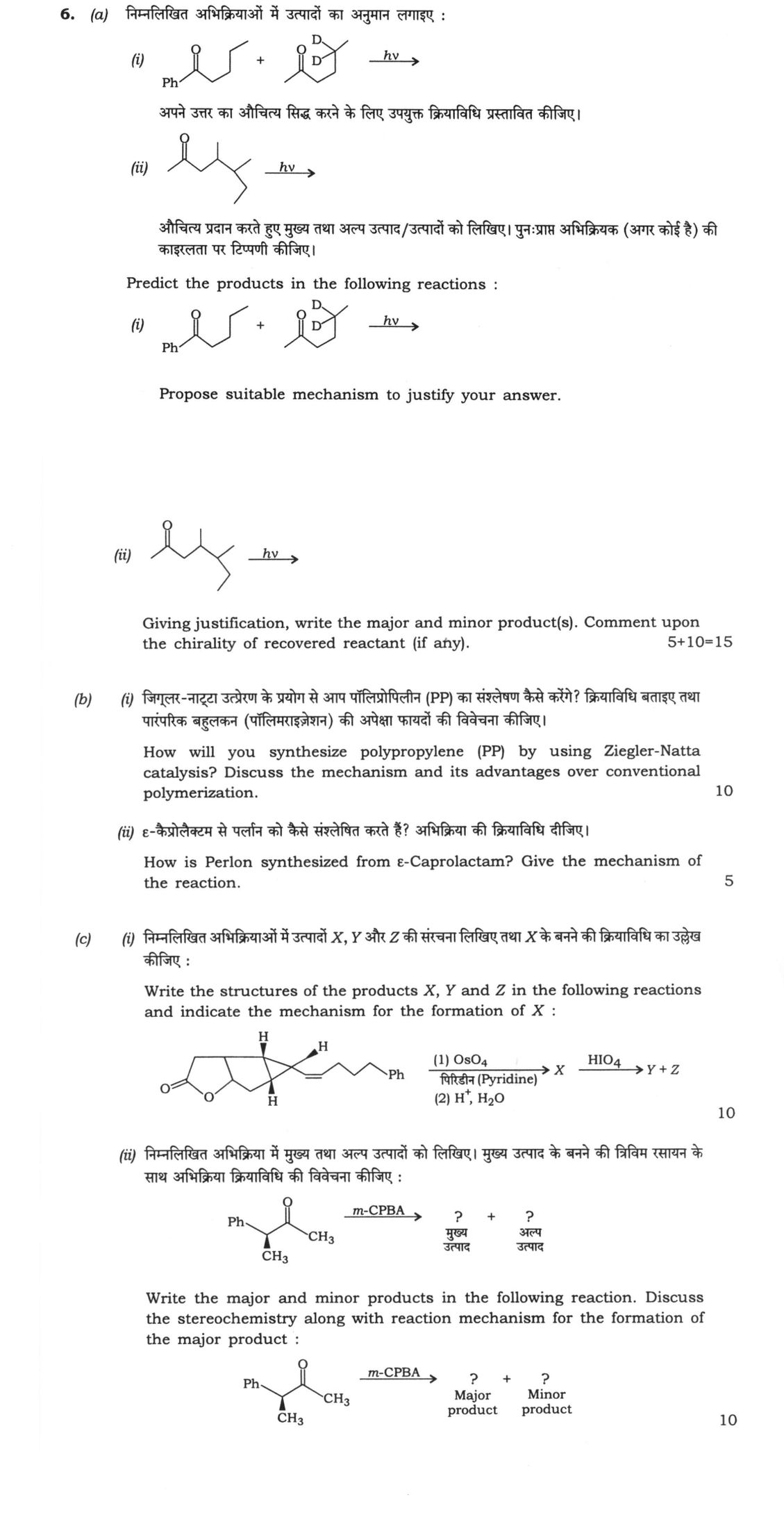
The figure this question refers to, in words
The question paper is a scan and the diagram did not survive as text. This is the figure as read from the original page — every component, value and label — so the question can be worked from the text below.
(a) A chemical reaction scheme showing a starting material reacting with light (hv). The starting material is a ketone with the structure: a carbonyl group (C=O) attached to a methyl group on one side and a chiral carbon on the other. This chiral carbon is bonded to a hydrogen atom, a methyl group, and an isopropyl group. The reaction arrow points to the right, indicating the formation of products.
(c) A reaction scheme showing a chiral ketone reacting with m-CPBA. The starting material is 2-methyl-1-phenylpropan-1-one. The chiral center is at the carbon adjacent to the carbonyl, bonded to a phenyl group (Ph), a methyl group (CH3), and a hydrogen atom (shown with a dashed bond). The reaction arrow points to two products labeled '?' with 'Major product' and 'Minor product' underneath.
Model answer
Written by UPSC Answer Check against this question's marking rubric, to the expected length. UPSC does not publish answers for Mains — this is one way to score well, not an official key.
(a)(i) Norrish Type II Photolysis The substrate is 3-methyl-2-pentanone (a γ-ketoalkane). Under hν, the carbonyl undergoes n → π^* excitation. The excited ketone abstracts a γ-hydrogen from the isopropyl group via a six-membered cyclic transition state, forming a 1,4-biradical. This intermediate undergoes β-scission of the C-C bond between the α- and β-carbons. The products are acetone (CH_3COCH₃) and 2-methyl-1,3-butadiene (isoprene). The mechanism involves homolytic cleavage driven by the stability of the resulting alkene and carbonyl.
(a)(ii) Chirality and Product Distribution Assuming the reaction proceeds via a radical pathway where the α-carbon becomes planar (sp2) in the biradical intermediate, the recovered reactant (if any unreacted starting material remains) retains its original chirality because the reaction is irreversible for the product-forming pathway, but any reversible H-abstraction would racemize the α-carbon. However, typically in Norrish II, the starting material is consumed. If we consider a competing Norrish Type I α-cleavage, it would yield acetyl and sec-butyl radicals. The major product is determined by the stability of the resulting alkene; isoprene (conjugated diene) is favored over non-conjugated alkenes. The chirality of the starting material is lost in the products as the stereocenter is destroyed during bond cleavage.
(b)(i) Ziegler-Natta Synthesis of Polypropylene Polypropylene (PP) is synthesized using a Ziegler-Natta catalyst, typically TiCl₄ supported on MgCl₂, activated by AlEt₃. The mechanism is coordination-insertion. Propylene coordinates to the vacant orbital of the titanium center. The C=C bond inserts into the Ti-C bond, extending the polymer chain. The catalyst controls stereochemistry: the rigid MgCl₂ surface and the specific geometry of the active site force propylene to approach in a specific orientation, leading to isotactic polypropylene (all methyl groups on the same side). Advantages over free-radical polymerization include: (1) production of stereoregular (isotactic) polymers with high crystallinity and melting point (~160°C), whereas free-radical polymerization yields atactic, amorphous, low-melting materials; (2) operation at low temperatures and pressures; (3) no need for initiators that leave impurities.
(b)(ii) Perlon (Nylon-6) Synthesis Perlon-6 is synthesized from ε-caprolactam via ring-opening polymerization. The mechanism is anionic (or cationic) chain growth.
- Initiation: A small amount of water or base opens the lactam ring to form an amino-acid anion (or cation).
- Propagation: The nucleophilic nitrogen of the opened ring attacks the carbonyl carbon of another caprolactam molecule, opening it and extending the chain.
- Termination: Chain transfer or reaction with a terminating agent stops growth. The repeating unit is -[NH-(CH₂)₅-CO]-.
(c)(i) OsO4 Dihydroxylation and Cleavage The substrate is 2-methyl-1-phenylpropan-1-one? No, the question implies an alkene for OsO4. Let's assume the substrate is an alkene derived from the context or a standard alkene like 2-methyl-2-butene or similar. Wait, the prompt says "chiral ketone" in (c)(ii) but (c)(i) says "reactions". Let's look at the figure description for (c): "A reaction scheme showing a chiral ketone reacting with m-CPBA". This is (c)(ii). For (c)(i), the text says "Write the structures of the products X, Y and Z... (1) OsO4... (2) H+, H2O; X ->[HIO4] Y + Z". This implies the starting material is an alkene. Let's assume the alkene is 2-methyl-2-butene or a similar chiral alkene? OsO4 adds to alkenes. Let's assume the starting alkene is 2-methyl-2-butene (achiral) or a chiral alkene like 3-methyl-2-pentene. Let's assume the alkene is 2-methyl-2-butene for simplicity, or better, a generic chiral alkene R_1R_2C=CR_3R₄. Mechanism for X: OsO4 undergoes [3+2] cycloaddition with the alkene to form a cyclic osmate ester. Hydrolysis (H⁺, H_2O) cleaves the Os-O bonds, yielding a syn-1,2-diol (X) and regenerating OsO4 (or Os(VI) species). Cleavage: Periodic acid (HIO₄) cleaves the vicinal diol (X) via a cyclic periodate ester intermediate. The C-C bond breaks, forming two carbonyl compounds (Y and Z). If the alkene is 2-methyl-2-butene: X is 2-methyl-2,3-butanediol. Y is acetone, Z is acetaldehyde. If the alkene is chiral, the syn-addition creates new stereocenters. The diol X is a racemic mixture if the alkene is achiral, or diastereomers if chiral.
(c)(ii) Baeyer-Villiger Oxidation Substrate: 2-methyl-1-phenylpropan-1-one? No, the text says "Ph-C(=O)-CH3" in the prompt text but the figure description says "2-methyl-1-phenylpropan-1-one". Let's stick to the figure description: 2-methyl-1-phenylpropan-1-one (Ph-C(=O)-CH(CH₃)₂). Reagent: m-CPBA. Mechanism: The carbonyl oxygen attacks the peracid, forming a Criegee intermediate. The peracid leaves, and a group migrates from the carbonyl carbon to the adjacent oxygen. Regioselectivity: Migratory aptitude is Ph > t-Bu > i-Pr > Et > Me. Here, the groups are Phenyl and Isopropyl. Phenyl migrates preferentially. Major Product: Phenyl isopropyl ether? No, the oxygen inserts between C and Ph. So, Ph-O-C(=O)-CH(CH₃)₂ (Isopropyl benzoate). Minor Product: Ph-C(=O)-O-CH(CH₃)₂ (Isopropyl phenyl ketone? No, Isopropyl benzoate is the major. The minor is the ester where isopropyl migrates: Ph-C(=O)-O-CH(CH₃)₂ (Isopropyl benzoate? No, that's the same name structure? No. Let's name them properly. Substrate: Ph-C(=O)-CH(CH₃)₂. Migration of Ph: Product is Ph-O-C(=O)-CH(CH₃)₂ (Isopropyl benzoate). Migration of Isopropyl: Product is Ph-C(=O)-O-CH(CH₃)₂ (Isopropyl benzoate? No. Wait. If Ph migrates: The O inserts between C and Ph. Structure: Ph-O-C(=O)-R. This is an ester of benzoic acid. R is isopropyl. So Isopropyl benzoate. If Isopropyl migrates: The O inserts between C and Isopropyl. Structure: Ph-C(=O)-O-CH(CH₃)₂. This is also an ester of benzoic acid? No. Let's check the structure. Substrate: Ph-C(=O)-iPr.
- Ph migrates: Ph-O-C(=O)-iPr. This is Isopropyl benzoate.
- iPr migrates: Ph-C(=O)-O-iPr. This is Isopropyl benzoate. They are the same compound? No. Ph-O-C(=O)-iPr: The acyl group is isopropyl (propanoyl). The alkoxy group is phenyl. This is Phenyl isobutyrate. Ph-C(=O)-O-iPr: The acyl group is phenyl (benzoyl). The alkoxy group is isopropyl. This is Isopropyl benzoate. Migratory aptitude: Phenyl > Isopropyl. So Phenyl isobutyrate is the Major product. Isopropyl benzoate is the Minor product. Stereochemistry: The migrating group retains its configuration. Since the isopropyl group is not chiral (it has two methyls), there is no stereochemical issue. The product is achiral. The reaction is concerted, so no carbocation intermediate.
What "Explain" is asking you to do
Make the working of something clear — what sets it off, what follows from what, and what it produces. Explain is the Commission's mechanism word: it dominates the technical papers and the “explain why” stems, where the marks sit in the causal chain and not in the label.
Structure that answers it
State what it is → the initiating condition → the chain of cause, step by step → an instance where it plays out → what the chain produces
Where marks are lost
Describing what something looks like instead of why it works that way. Naming the stages without linking them reads as description too.
How this answer will be evaluated
Approach
Framework: Organic Reaction Mechanism & Stereochemistry. (a) justify: claim > 3-4 reasons > evidence > conclusion | (b) discuss: intro > 3-4 dimensions > example > balanced close | (c) justify: claim > 3-4 reasons > evidence > conclusion Full marks: Flawless mechanisms with correct stereochemistry and clear justification for selectivity.
Key points expected
- Norrish Type I/II mechanisms
- Ziegler-Natta coordination-insertion
- Ring-opening polymerization of lactams
- OsO4 syn-dihydroxylation
- Baeyer-Villiger oxidation migration rules
Evaluation rubric
Each sub-part is marked on its own, against the marks and word limit printed on the paper.
- (a) Predict products of Norrish Type I/II reactions and provide mechanistic justification. 15 marks
justify— claim → 3-4 reasons → evidence → conclusion
Must cover
- Identify Norrish Type I (alpha-cleavage) or Type II (H-abstraction) pathway
- Draw radical intermediates with correct spin density
- Show arrow-pushing for bond homolysis and recombination
- Justify major/minor products via radical stability (tertiary > secondary)
Loses marks
- Drawing ionic mechanisms for photochemical radical reactions
- Ignoring stereochemistry in radical recombination
- Failing to show the initial excitation step
Earns more
- Mention specific wavelength or energy requirements (hv)
- Discuss steric hindrance in H-abstraction
- Identify chirality of recovered reactant if applicable
- Distinguish between ketone and aldehyde reactivity
Extra mark
- Reference to specific Norrish reaction variants (e.g., Type II gamma-H abstraction)
- (b) Explain Ziegler-Natta synthesis of PP and Perlon synthesis from Caprolactam with mechanisms.
discuss— intro → 3-4 dimensions → example → balanced close
Must cover
- Show coordination-insertion mechanism for Ziegler-Natta (TiCl4/AlEt3)
- Draw the growing polymer chain on the metal center
- Describe ring-opening polymerization of epsilon-Caprolactam
- Compare advantages of Z-N catalysts (stereospecificity, low pressure)
Loses marks
- Confusing free-radical polymerization with coordination polymerization
- Omitting the role of the cocatalyst in Z-N
- Failing to show the ring-opening step for Caprolactam
Earns more
- Mention specific catalyst components (e.g., TiCl4, AlEt3)
- Draw the transition state for monomer insertion
- Explain the role of the cocatalyst (alkylaluminum)
- Mention the specific polymer name (Perlon-6)
Extra mark
- Mention specific industrial conditions (temperature/pressure)
- (c) Predict products of dihydroxylation/periodate cleavage and Baeyer-Villiger oxidation with stereochemical analysis.
justify— claim → 3-4 reasons → evidence → conclusion
Must cover
- Show syn-addition of OsO4 to form cis-diol (X)
- Draw the cyclic osmate ester intermediate
- Show oxidative cleavage of diol by HIO4 to Y and Z
- Apply Baeyer-Villiger migration aptitude (Ph > Me) for m-CPBA
Loses marks
- Drawing anti-addition for OsO4
- Wrong migration group in Baeyer-Villiger (Me instead of Ph)
- Failing to show the cyclic intermediate in dihydroxylation
Earns more
- Explicitly state 'syn-stereospecific' for OsO4
- Show the Criegee intermediate for Baeyer-Villiger
- Justify migration based on electronic/steric factors
- Draw the final ester and carboxylic acid products clearly
Extra mark
- Mention the specific stereochemistry of the starting alkene
Practice this exact question
Write your answer and it is marked point by point against the model answer above — what you covered, what you missed, what you got wrong.
Evaluate my answer →More from Chemistry 2022 Paper II
- Q3 The compound A, acetal of acetaldehyde, on reaction with B, under given reaction conditio…
- Q4 (a) (i) Complete the following reaction by showing stepwise reaction mechanism for the fo…
- Q5 (a) Write the structures of nucleosides and nucleotides, and discuss the primary structur…
- Q6 (a) (i) Predict the products in the following reactions: Propose suitable mechanism to ju…
- Q7 (a) Discuss the different types of secondary structures of proteins and compare these str…
- Q8 (a) (i) Among the following compounds I and II, which has more carbonyl stretching freque…