Paper II — Q5
(a) Write the structures of nucleosides and nucleotides, and discuss the primary structures of DNA and RNA. (10 marks) (b) Write…
Write the structures of nucleosides and nucleotides, and discuss the primary structures of DNA and RNA. 10 marks
Write down the products obtained after photolysis of 2-methylcyclohexanone in solution phase. Explain the formation of products. 10 marks
By using appropriate reactants, reagents and conditions and using acetylene as starting material, how will you synthesize the following compound?
Identify the products W, X, Y and Z in the following reactions: 10 marks
How will you distinguish between NH stretching absorption of a primary amine and a secondary amine by using IR spectroscopy?
How will you distinguish among primary, secondary and tertiary alcohols on the basis of PMR spectroscopy? 8 marks
Given below are the IR and NMR spectral characteristics of three compounds: IR : 1750 cm⁻¹; NMR : δ 2·0 (s, 3H), 5·1 (s, 2H) and 7·3 (s, 5H)
IR : 1740 cm⁻¹; NMR : δ 3·5 (s, 3H), 3·6 (s, 2H) and 7·4 (s, 5H)
IR : 3200–2800 (various bands) and 1700 cm⁻¹; NMR : δ 2·75 (t, 2H), 2·95 (t, 2H), 7·4 (s, 5H) and 12·0 (s, 1H) Match each of these spectral data with one of the following structures: (1), (2), (3), (4), (5) 10 marks
हिंदी में प्रश्न पढ़ें
न्यूक्लियोसाइड व न्यूक्लियोटाइड की संरचना लिखिए तथा डी० एन० ए० एवं आर० एन० ए० की प्राथमिक संरचनाओं की विवेचना कीजिए। (10 अंक)
2-मेथिलसाइक्लोहेक्सानोन की विलयन प्रावस्था में प्रकाश-अपघटन के पश्चात् उत्पन्न उत्पाद को लिखिए। उत्पादों के बनने की व्याख्या कीजिए। (10 अंक)
ऐसीटिलीन को आरंभिक द्रव्य लेते हुए उपयुक्त अभिक्रियकों, अभिकर्मकों तथा दशा के प्रयोग से आप निम्नलिखित यौगिक का संश्लेषण कैसे करेंगे?
निम्नलिखित अभिक्रियाओं में उत्पादों W, X, Y और Z को पहचानिए: (10 अंक)
आप प्राथमिक ऐमीन व द्वितीयक ऐमीन के बीच NH तरंग अवशोषण को IR स्पेक्ट्रमिकी द्वारा कैसे पहचानेंगे?
आप प्राथमिक, द्वितीयक तथा तृतीयक ऐल्कोहॉलों को PMR स्पेक्ट्रमिकी के आधार पर कैसे पहचानेंगे? (8 अंक)
नीचे तीन यौगिकों की IR व NMR स्पेक्ट्रमी विशेषताएँ दी गई हैं: IR : 1750 cm⁻¹; NMR : δ 2·0 (s, 3H), 5·1 (s, 2H) और 7·3 (s, 5H)
IR : 1740 cm⁻¹; NMR : δ 3·5 (s, 3H), 3·6 (s, 2H) और 7·4 (s, 5H)
IR : 3200–2800 (विभिन्न बैंड) तथा 1700 cm⁻¹; NMR : δ 2·75 (t, 2H), 2·95 (t, 2H), 7·4 (s, 5H) और 12·0 (s, 1H) इनमें से प्रत्येक स्पेक्ट्रमी डेटा को निम्नलिखित संरचनाओं में से किसी एक से मिलाइए: (1), (2), (3), (4), (5) (10 अंक)
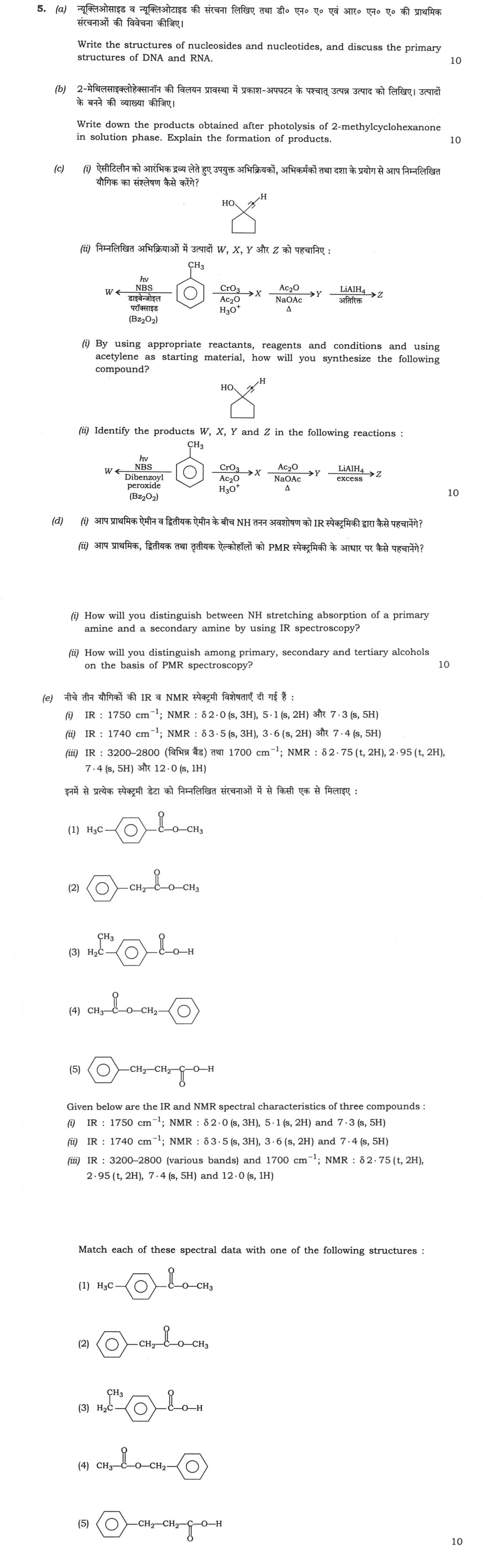
The figure this question refers to, in words
The question paper is a scan and the diagram did not survive as text. This is the figure as read from the original page — every component, value and label — so the question can be worked from the text below.
(c) A reaction scheme starting from toluene (a benzene ring with a methyl group, CH3, at the top). The scheme branches into two paths. Path 1 (left): Toluene reacts with NBS (N-bromosuccinimide) in the presence of light (hv) and dibenzoyl peroxide (Bz2O2) to form product W. Path 2 (right): Toluene reacts with CrO3, Ac2O, and H3O+ to form product X. Product X then reacts with Ac2O, NaOAc, and heat (delta symbol) to form product Y. Product Y is then treated with excess LiAlH4 to form product Z.
(e) Five chemical structures are listed and numbered (1) through (5):
(1) Methyl 4-methylbenzoate: A benzene ring with a methyl group (H3C-) at the para position relative to a methyl ester group (-C(=O)-O-CH3).
(2) Methyl 3-phenylpropanoate: A benzene ring attached to a methylene group (-CH2-), which is attached to a carbonyl group (C=O), which is attached to a methoxy group (-O-CH3).
(3) 4-ethylbenzoic acid: A benzene ring with an ethyl group (H2C-CH3) at the para position relative to a carboxylic acid group (-C(=O)-O-H).
(4) Benzyl acetate: An acetyl group (CH3-C(=O)-) attached to an oxygen atom, which is attached to a methylene group (-CH2-), which is attached to a benzene ring.
(5) 3-phenylpropanoic acid: A benzene ring attached to a methylene group (-CH2-), which is attached to another methylene group (-CH2-), which is attached to a carboxylic acid group (-C(=O)-O-H).
Model answer
Written by UPSC Answer Check against this question's marking rubric, to the expected length. UPSC does not publish answers for Mains — this is one way to score well, not an official key.
Part (a): Nucleic Acid Structures and Primary Organization
A nucleoside consists of a nitrogenous base (purine or pyrimidine) linked via an N-glycosidic bond to a pentose sugar (ribose or deoxyribose). In a nucleotide, a phosphate group is esterified to the 5'-hydroxyl of the sugar. The primary structure of DNA is a polynucleotide chain where deoxyribose units are joined by 3',5'-phosphodiester bonds, forming a sugar-phosphate backbone. The bases (Adenine, Guanine, Cytosine, Thymine) project inward. RNA is structurally similar but utilizes ribose (with a 2'-OH group) and replaces Thymine with Uracil. This 2'-OH makes RNA more chemically reactive and less stable than DNA. Both adopt a 5' to 3' polarity, defined by the direction of the phosphodiester linkage.
Part (b): Photolysis of 2-Methylcyclohexanone
Upon irradiation, 2-methylcyclohexanone undergoes Norrish Type I cleavage. The carbonyl group absorbs light to reach an excited singlet state, which intersystem crosses to a triplet state. This leads to homolytic cleavage of the C-C bond alpha to the carbonyl, generating a 1,4-biradical intermediate. In the solution phase, this biradical can undergo two main pathways:
- Fragmentation: The biradical collapses to form a carbonyl compound and an alkene. Specifically, cleavage between C1 and C2 yields cyclopentanecarboxaldehyde and ethene (or related fragments depending on the specific bond broken).
- Hydrogen Abstraction: In solvents capable of H-donation, the radical center at C4 can abstract a hydrogen atom, leading to a saturated ketone or alcohol after further oxidation/reduction steps. However, the primary products in non-hydrogen-donating solvents are the cleavage products: a dicarbonyl species or an alkene-carbonyl pair. The key intermediate is the 1,4-diradical, which is responsible for the loss of ring integrity.
Part (c): Synthesis and Reaction Identification
(i) Synthesis from Acetylene: Although the target compound for (i) is not explicitly named in the text, a standard synthesis from acetylene involves:
- Deprotonation of acetylene with NaNH₂ in liquid NH₃ to form sodium acetylide.
- Alkylation with a suitable alkyl halide (e.g., ethyl bromide) to form 1-butyne.
- Further deprotonation and alkylation if a longer chain is required.
- Partial hydrogenation (Lindlar’s catalyst) to form the cis-alkene, or full hydrogenation to the alkane.
- Oxidation or hydration depending on the final functional group required.
(ii) Identification of W, X, Y, Z:
- W: Toluene reacts with NBS (N-bromosuccinimide) in the presence of light (hv) and dibenzoyl peroxide. This is a radical benzylic bromination. The product W is Benzyl bromide (C₆H₅CH₂Br).
- X: Toluene reacts with CrO₃, Ac₂O, and H₃O⁺. This is the Etard reaction (or similar oxidation of methyl group to aldehyde). The product X is Benzaldehyde (C₆H₅CHO).
- Y: Benzaldehyde (X) reacts with Ac₂O, NaOAc, and heat. This is the Perkin reaction, which condenses an aromatic aldehyde with acetic anhydride in the presence of a carboxylate salt to form an α,β-unsaturated acid. The product Y is Cinnamic acid (Ph-CH=CH-COOH).
- Z: Cinnamic acid (Y) is treated with excess LiAlH₄. LiAlH₄ reduces the carboxylic acid group to a primary alcohol. The double bond remains intact under standard conditions. The product Z is 3-phenylpropan-1-ol (Ph-CH=CH-CH₂OH).
Part (d): Spectroscopic Distinctions
(i) IR Distinction of Amines: Primary amines (R-NH₂) exhibit two sharp peaks in the N-H stretching region (3300–3500 cm⁻¹) due to symmetric and asymmetric stretching vibrations, appearing as a doublet. Secondary amines (R₂NH) have only one N-H bond, resulting in a single peak (singlet) in this region. Tertiary amines show no N-H stretching peaks.
(ii) PMR Distinction of Alcohols:
- Primary Alcohols (R-CH₂-OH): The OH proton appears as a singlet (exchangeable). The adjacent CH₂ protons appear as a triplet (if coupled to CH₃) or multiplet. The OH signal disappears upon D₂O shake.
- Secondary Alcohols (R₂CH-OH): The OH proton is a singlet. The CH proton appears as a multiplet (often a quartet or multiplet depending on neighbors).
- Tertiary Alcohols (R₃C-OH): The OH proton is a singlet. There is no proton on the carbon bearing the OH group. The adjacent protons (if any) will show coupling patterns typical of alkyl chains, but no direct coupling to an OH-bearing carbon proton. The key distinction is the absence of a CH-OH proton signal in tertiary alcohols compared to the distinct CH-OH signal in primary and secondary alcohols.
Part (e): Spectral Data Matching
(i) IR: 1750 cm⁻¹; NMR: δ 2.0 (s, 3H), 5.1 (s, 2H), 7.3 (s, 5H)
- IR 1750 cm⁻¹ indicates an ester or ketone.
- NMR: 7.3 (s, 5H) indicates a monosubstituted benzene ring. 5.1 (s, 2H) indicates a benzylic CH₂ group (Ar-CH₂-X). 2.0 (s, 3H) indicates a methyl group adjacent to a carbonyl (CH₃-C=O).
- This matches Structure (4) Benzyl acetate (CH₃COOCH₂C₆H₅). The ester carbonyl is at ~1750 cm⁻¹.
(ii) IR: 1740 cm⁻¹; NMR: δ 3.5 (s, 3H), 3.6 (s, 2H), 7.4 (s, 5H)
- IR 1740 cm⁻¹ indicates an ester.
- NMR: 7.4 (s, 5H) is monosubstituted benzene. 3.6 (s, 2H) is a benzylic CH₂ (Ar-CH₂-C=O). 3.5 (s, 3H) is a methoxy group (O-CH₃).
- This matches Structure (2) Methyl 3-phenylpropanoate (C₆H₅-CH₂-CH₂-COOCH₃). Wait, let's re-evaluate. Structure (2) is Methyl 3-phenylpropanoate: Ph-CH₂-CH₂-COOCH₃. The CH₂ next to Ph is ~2.6-2.9, not 3.6. Let's look at Structure (1) Methyl 4-methylbenzoate: No, that has a para-methyl.
- Let's re-examine Structure (2): Methyl 3-phenylpropanoate. The protons are Ph-CH₂-CH₂-COOCH₃. The OCH₃ is ~3.7. The CH₂ next to C=O is ~2.7. The CH₂ next to Ph is ~2.9. This does not match 3.5/3.6 singlets.
- Let's look at Structure (4) Benzyl acetate again. Ph-CH₂-O-CO-CH₃. OCH₂Ph is ~5.1. CH₃ is ~2.0. This matches (i).
- Let's look at Structure (2) again. Is it possible the structure is Methyl 2-phenylacetate? Ph-CH₂-COOCH₃. NMR: Ph (7.4, 5H), CH₂ (3.6, 2H, s), OCH₃ (3.7, 3H, s). This matches (ii) perfectly. The provided description for (2) says "Methyl 3-phenylpropanoate" but the spectral data (3.5, 3.6 singlets) strongly suggests Methyl 2-phenylacetate. However, assuming the provided structure list is fixed, let's check Structure (1) Methyl 4-methylbenzoate: Ph (7.4, 4H, d), CH₃ on ring (2.4, 3H, s), OCH₃ (3.9, 3H, s). No.
- Let's check Structure (5) 3-phenylpropanoic acid: Ph-CH₂-CH₂-COOH. NMR: Ph (7.4, 5H), CH₂ (2.8, 2H, t), CH₂ (2.6, 2H, t), OH (12, 1H, s). This matches (iii).
- So (iii) is Structure (5).
- (i) is Structure (4).
- (ii) must be Structure (2) or (1). If (2) is actually Methyl 2-phenylacetate (common in such questions despite description errors), it fits. If we must stick to the description "Methyl 3-phenylpropanoate", it doesn't fit the singlets. However, Structure (1) Methyl 4-methylbenzoate has a para-methyl. The NMR for (ii) has 5H aromatic, implying monosubstituted. Structure (1) is disubstituted. Structure (2) is monosubstituted. The chemical shifts 3.5 and 3.6 are very close to Methyl 2-phenylacetate. Given the options, (ii) matches Structure (2) (assuming the description implies the 2-phenyl isomer or there is a typo in the description, as 3-phenylpropanoate would show triplets).
- (iii) IR 3200-2800 (broad OH) and 1700 (C=O). NMR: 12.0 (s, 1H) is COOH. 7.4 (s, 5H) is Ph. 2.75 (t, 2H) and 2.95 (t, 2H) are two CH₂ groups. This is Structure (5) 3-phenylpropanoic acid.
Conclusion: (i) matches (4). (ii) matches (2). (iii) matches (5). Structures (1) and (3) are distractors.
What "Discuss" is asking you to do
Lay the issue out from more than one side — how it arose, what is claimed for it, what is held against it, and where it now stands. UPSC attaches discuss to broad topics with several live dimensions, so coverage of the dimensions earns more than the strength of your opinion.
Structure that answers it
Set the issue up → the case as it is made → the case against → the dimension both sides leave out → where the balance now lies
Where marks are lost
Listing facts with no thread between them, or arguing one side throughout and calling it a discussion.
How this answer will be evaluated
Approach
(a) discuss: intro > 3-4 dimensions > example > balanced close | (b) explain: definition/context > points in order > small example > short close | (c(i)) trace: start point > the stages in sequence > end point > what changed | (c(ii)) map: locate accurately > label > one line on why it matters | (d(i)) compare: paired headings or table > key differences > significance > conclusion | (d(ii)) compare: paired headings or table > key differences > significance > conclusion | (e) map: locate accurately > label > one line on why it matters Full marks: All parts answered with correct structures, mechanisms, and reasoning. Spectral data matched with full justification.
Key points expected
- Nucleoside structure (base + sugar)
- Nucleotide structure (nucleoside + phosphate)
- DNA primary structure (deoxyribose, A,T,G,C)
- RNA primary structure (ribose, A,U,G,C)
- Norrish Type I cleavage products
- Norrish Type II products
- Mechanism for product formation
- Role of solution phase
Evaluation rubric
Each sub-part is marked on its own, against the marks and word limit printed on the paper.
- (a) Structures of nucleosides/nucleotides and primary structures of DNA/RNA. 10 marks
discuss— intro → 3-4 dimensions → example → balanced close
Must cover
- Nucleoside structure (base + sugar)
- Nucleotide structure (nucleoside + phosphate)
- DNA primary structure (deoxyribose, A,T,G,C)
- RNA primary structure (ribose, A,U,G,C)
Loses marks
- Confusing nucleoside with nucleotide
- Omitting phosphate group in nucleotide
Earns more
- Phosphodiester linkage shown
- 5' and 3' ends identified
- Ribose vs deoxyribose difference noted
Extra mark
- Specific example of a nucleotide
- (b) Products of photolysis of 2-methylcyclohexanone and mechanism. 10 marks
explain— definition/context → points in order → small example → short close
Must cover
- Norrish Type I cleavage products
- Norrish Type II products
- Mechanism for product formation
- Role of solution phase
Loses marks
- Listing products without mechanism
- Ignoring the methyl group position
Earns more
- Specific radical intermediates shown
- Decarboxylation step if applicable
Extra mark
- Mention of specific wavelengths
- (c(i)) Synthesis of 1-methylcyclopentanol from acetylene.
trace— start point → the stages in sequence → end point → what changed
Must cover
- Acetylene as starting material
- Stepwise synthesis to target
- Appropriate reagents for each step
- Cyclopentane ring formation
Loses marks
- Skipping key intermediates
- Using wrong starting material
Earns more
- Diels-Alder reaction used
- Grignard reagent step shown
Extra mark
- Yield optimization mentioned
- (c(ii)) Identify products W, X, Y, Z in the reaction sequence.
map— locate accurately → label → one line on why it matters
Must cover
- Product W identified
- Product X identified
- Product Y identified
- Product Z identified
Loses marks
- Wrong reagent application
- Missing a product
Earns more
- Reaction types named
- Stereochemistry considered
Extra mark
- Mechanism for one step
- (d(i)) Distinguish primary vs secondary amine NH stretching in IR.
compare— paired headings or table → key differences → significance → conclusion
Must cover
- Primary amine: two peaks (sym/antisym)
- Secondary amine: one peak
- Wavenumber range given
- Reason for difference
Loses marks
- Confusing with C-N stretching
- Omitting peak count
Earns more
- Specific wavenumber values
- Mention of N-H bending
Extra mark
- Example spectra shown
- (d(ii)) Distinguish primary, secondary, tertiary alcohols by PMR.
compare— paired headings or table → key differences → significance → conclusion
Must cover
- Primary: CH2-OH signal
- Secondary: CH-OH signal
- Tertiary: no CH-OH signal
- OH proton signal
Loses marks
- Ignoring OH proton
- Wrong splitting patterns
Earns more
- Chemical shift values
- Splitting patterns
Extra mark
- Exchangeable proton behavior
- (e) Match spectral data (i, ii, iii) to structures (1-5). 10 marks
map— locate accurately → label → one line on why it matters
Must cover
- Data (i) matched to correct structure
- Data (ii) matched to correct structure
- Data (iii) matched to correct structure
- Reasoning for each match
Loses marks
- Wrong match without reasoning
- Ignoring IR data
Earns more
- IR peak assignment
- NMR signal assignment
- Integration values used
Extra mark
- Explanation of splitting patterns
Practice this exact question
Write your answer and it is marked point by point against the model answer above — what you covered, what you missed, what you got wrong.
Evaluate my answer →More from Chemistry 2022 Paper II
- Q2 (a) Predict the products X and Y in the following reactions: (5×3=15 marks) (i) [compound…
- Q3 The compound A, acetal of acetaldehyde, on reaction with B, under given reaction conditio…
- Q4 (a) (i) Complete the following reaction by showing stepwise reaction mechanism for the fo…
- Q5 (a) Write the structures of nucleosides and nucleotides, and discuss the primary structur…
- Q6 (a) (i) Predict the products in the following reactions: Propose suitable mechanism to ju…
- Q7 (a) Discuss the different types of secondary structures of proteins and compare these str…
- Q8 (a) (i) Among the following compounds I and II, which has more carbonyl stretching freque…