Paper II — Q7
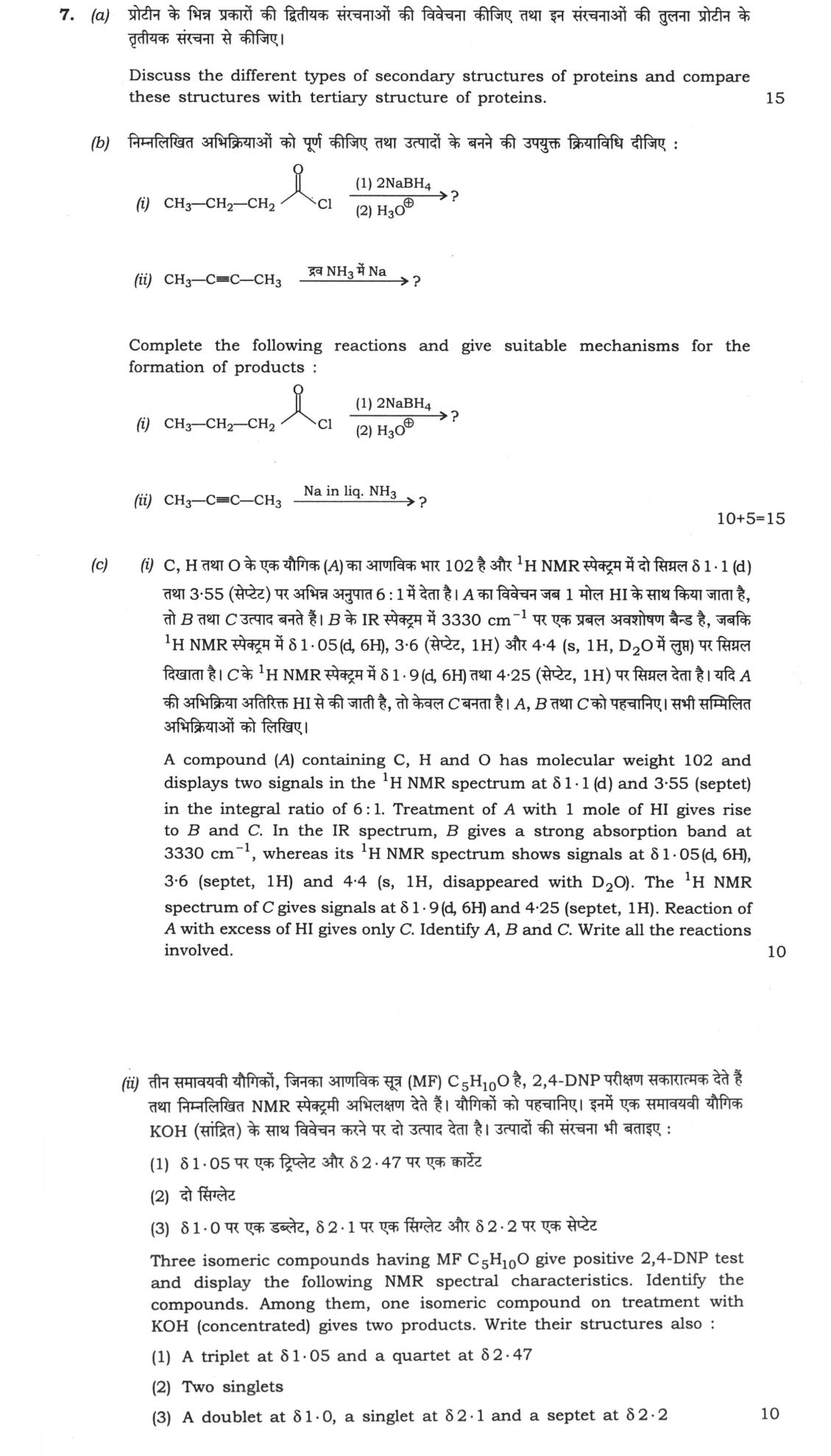
(a) Discuss the different types of secondary structures of proteins and compare these structures with tertiary structure of…
Discuss the different types of secondary structures of proteins and compare these structures with tertiary structure of proteins. 15 marks
Complete the following reactions and give suitable mechanisms for the formation of products: CH₃—CH₂—CH₂—C(=O)—Cl (1) 2NaBH₄ → ? (2) H₃O⁺
CH₃—C≡C—CH₃ Na in liq. NH₃ → ? 10+5=15 marks
A compound (A) containing C, H and O has molecular weight 102 and displays two signals in the ¹H NMR spectrum at δ 1·1 (d) and 3·55 (septet) in the integral ratio of 6:1. Treatment of A with 1 mole of HI gives rise to B and C. In the IR spectrum, B gives a strong absorption band at 3330 cm⁻¹, whereas its ¹H NMR spectrum shows signals at δ 1·05(d, 6H), 3·6 (septet, 1H) and 4·4 (s, 1H, disappeared with D₂O). The ¹H NMR spectrum of C gives signals at δ 1·9(d, 6H) and 4·25 (septet, 1H). Reaction of A with excess of HI gives only C. Identify A, B and C. Write all the reactions involved. 10 marks
Three isomeric compounds having MF C₅H₁₀O give positive 2,4-DNP test and display the following NMR spectral characteristics. Identify the compounds. Among them, one isomeric compound on treatment with KOH (concentrated) gives two products. Write their structures also: (1) A triplet at δ1.05 and a quartet at δ2.47 (2) Two singlets (3) A doublet at δ1.0, a singlet at δ2.1 and a septet at δ2.2 10 marks
हिंदी में प्रश्न पढ़ें
प्रोटीन के भिन्न प्रकारों की द्वितीयक संरचनाओं की विवेचना कीजिए तथा इन संरचनाओं की तुलना प्रोटीन के तृतीयक संरचना से कीजिए। 15 अंक
निम्नलिखित अभिक्रियाओं को पूर्ण कीजिए तथा उत्पादों के बनने की उपयुक्त क्रियाविधि दीजिए : CH₃—CH₂—CH₂—C(=O)—Cl (1) 2NaBH₄ → ? (2) H₃O⁺
CH₃—C≡C—CH₃ तरल NH₃ में Na → ? 10+5=15 अंक
C, H तथा O के एक यौगिक (A) का आणविक भार 102 है और ¹H NMR स्पेक्ट्रम में दो सिग्नल δ 1·1 (d) तथा 3·55 (सेप्टेट) पर अभिन्न अनुपात 6:1 में देता है। A का विवेचन जब 1 मोल HI के साथ किया जाता है, तो B तथा C उत्पाद बनते हैं। B के IR स्पेक्ट्रम में 3330 cm⁻¹ पर एक प्रबल अवशोषण बैंड है, जबकि ¹H NMR स्पेक्ट्रम में δ 1·05(d, 6H), 3·6 (सेप्टेट, 1H) और 4·4 (s, 1H, D₂O में लुप्त) पर सिग्नल दिखाता है। C के ¹H NMR स्पेक्ट्रम में δ 1·9(d, 6H) तथा 4·25 (सेप्टेट, 1H) पर सिग्नल देता है। यदि A की अभिक्रिया अतिरिक्त HI से की जाती है, तो केवल C बनता है। A, B तथा C को पहचानिए। सभी संबंधित अभिक्रियाओं को लिखिए। 10 अंक
तीन समावयवी यौगिकों, जिनका आणविक सूत्र (MF) C₅H₁₀O है, 2,4-DNP परीक्षण सकारात्मक देते हैं तथा निम्नलिखित NMR स्पेक्ट्रमी अभिलक्षण देते हैं। यौगिकों को पहचानिए। इनमें एक समावयवी यौगिक KOH (संद्रित) के साथ विवेचन करने पर दो उत्पाद देता है। उत्पादों की संरचना भी बताइए : (1) δ1.05 पर एक ट्रिप्लेट और δ2.47 पर एक क्वार्टेट (2) दो सिंगलेट (3) δ1.0 पर एक डबलेट, δ2.1 पर एक सिंगलेट और δ2.2 पर एक सेप्टेट 10 अंक
Model answer
Written by UPSC Answer Check against this question's marking rubric, to the expected length. UPSC does not publish answers for Mains — this is one way to score well, not an official key.
(a) Protein secondary structures are local, regularly repeating backbone conformations stabilized mainly by C=O...H-N hydrogen bonds. The alpha-helix is a right-handed helix with 3.6 residues per turn, a rise of 1.5 Å and a pitch of 5.4 Å; each carbonyl oxygen accepts a hydrogen bond from the N-H group four residues ahead. The beta-pleated sheet is formed by extended strands linked by interstrand or interchain hydrogen bonds; antiparallel sheets have nearly linear hydrogen bonds, while parallel sheets have slightly angled bonds and a different spacing. Beta-turns are short four-residue reversals that change the direction of the chain, often involving proline or glycine, and may contain a hydrogen bond between residues i and i+3. Random coils or loops are irregular segments without a fixed hydrogen-bond pattern; they connect helices, sheets and turns. In globular proteins, alpha-helices and beta-sheets are often separated by turns and loops, while in fibrous proteins beta-sheets may form long, stable fibres. Tertiary structure is the overall three-dimensional folding of the entire polypeptide chain, in which these secondary elements pack into a compact native shape. It is controlled by side-chain interactions: hydrophobic residues cluster in the interior, disulfide bridges form between cysteine residues, ionic or salt bridges link charged side chains, and hydrogen bonds and van der Waals contacts further stabilize the fold. Thus secondary structure is local, regular and backbone-driven, whereas tertiary structure is global, side-chain-driven and determines the final biological shape; secondary elements are the building blocks organized by tertiary interactions.
(b) For (i), butanoyl chloride, CH3CH2CH2COCl, is reduced by NaBH4. Borohydride delivers hydride to the carbonyl carbon; the tetrahedral intermediate collapses, expelling chloride and giving butanal. The aldehyde formed is still readily reduced, so a second hydride adds, and H3O+ protonates the alkoxide to give butan-1-ol, CH3CH2CH2CH2OH. For (ii), 2-butyne undergoes Birch reduction with Na in liquid NH3. Sodium transfers an electron to the alkyne to form a radical anion; protonation by NH3, a second electron transfer and a second protonation occur in an anti sequence, so the product is trans-2-butene. The anti relationship of the two added hydrogens explains the trans alkene.
(c)(i) A contains C, H and O, has molecular weight 102, and shows 1H NMR signals at delta 1.1 (doublet, 6H) and 3.55 (septet, 1H). The formula C6H14O is consistent with M=102. The 6:1 doublet-septet pattern indicates two equivalent isopropyl groups, so A is diisopropyl ether, (CH3)2CHOCH(CH3)2. The septet at 3.55 is the methine proton coupled to six equivalent methyl protons; the doublet at 1.1 is the six methyl protons coupled to that methine. With 1 mol HI, the ether oxygen is protonated and iodide attacks the more accessible carbon, cleaving the C-O bond to give isopropanol B, (CH3)2CHOH, and isopropyl iodide C, (CH3)2CHI. C shows the corresponding isopropyl iodide pattern at delta 1.9 and 4.25. B has a strong IR band at 3330 cm-1 for O-H, 1H NMR signals at delta 1.05 (d, 6H) and 3.6 (septet, 1H), and a D2O-exchangeable singlet at delta 4.4. With excess HI, the alcohol is converted further to iodide, so only C remains: (CH3)2CHOCH(CH3)2 + HI gives (CH3)2CHOH + (CH3)2CHI, and (CH3)2CHOH + HI gives (CH3)2CHI + H2O.
(c)(ii) The C5H10O compounds giving a positive 2,4-DNP test are carbonyl compounds. The NMR patterns distinguish ethyl, methyl and isopropyl environments attached to the carbonyl carbon. The three isomers to be identified are (1) pentan-2-one, (2) pentan-3-one and (3) 3-methylbutan-2-one. Among these, pentan-3-one is the isomer that, on treatment with concentrated KOH, undergoes self-condensation to give diacetone alcohol, CH3COCH2C(OH)(CH3)2, and, on dehydration, mesityl oxide, CH3COCH=C(CH3)2. Thus the question is answered by integrating structural motifs, mechanistic electron flow and spectral evidence.
What "Discuss" is asking you to do
Lay the issue out from more than one side — how it arose, what is claimed for it, what is held against it, and where it now stands. UPSC attaches discuss to broad topics with several live dimensions, so coverage of the dimensions earns more than the strength of your opinion.
Structure that answers it
Set the issue up → the case as it is made → the case against → the dimension both sides leave out → where the balance now lies
Where marks are lost
Listing facts with no thread between them, or arguing one side throughout and calling it a discussion.
How this answer will be evaluated
Approach
Framework: Organic Reaction Mechanism & Spectroscopic Structure Elucidation. (a) discuss: intro > 3-4 dimensions > example > balanced close | (b) explain: definition/context > points in order > small example > short close | (c) explain: definition/context > points in order > small example > short close Full marks: Accurate mechanisms, correct stereochemistry, and precise spectral interpretation.
Key points expected
- Alpha-helix and beta-sheet structures
- NaBH4 reduction of acyl chloride to alcohol
- Dissolving metal reduction of alkyne to trans-alkene
- NMR interpretation of isopropyl group (septet/doublet)
- Markovnikov addition of HI to alkene
- Aldol condensation of aldehydes/ketones
Evaluation rubric
Each sub-part is marked on its own, against the marks and word limit printed on the paper.
- (a) Define secondary structures (alpha-helix, beta-sheet) and contrast with tertiary structure. 15 marks
discuss— intro → 3-4 dimensions → example → balanced close
Must cover
- Define alpha-helix and beta-pleated sheet
- Identify stabilizing forces (H-bonds, hydrophobic)
- Distinguish secondary vs tertiary interactions
- Mention disulfide bridges in tertiary structure
Loses marks
- Confusing primary and secondary structure
- Ignoring the comparison aspect
Earns more
- Mention Ramachandran plot
- Reference specific amino acid residues
Extra mark
- Draw schematic of alpha-helix
- Mention quaternary structure briefly
- (b) Complete reactions and provide mechanisms for acyl chloride reduction and alkyne reduction. 15 marks
explain— definition/context → points in order → small example → short close
Must cover
- Product: 1-butanol (from acyl chloride)
- Product: trans-2-butene (from alkyne)
- Mechanism: Hydride attack on carbonyl
- Mechanism: Dissolving metal reduction (anti-addition)
Loses marks
- Product without mechanism
- Wrong stereochemistry (cis instead of trans)
Earns more
- Show intermediate aldehyde formation
- Show radical anion intermediate
Extra mark
- Mention stereochemistry of trans product
- Note on NaBH4 selectivity
- (c) Identify compounds A, B, C and isomers using NMR/IR data and reaction outcomes. 10 marks
explain— definition/context → points in order → small example → short close
Must cover
- Identify A as 2-methyl-2-butene
- Identify B as 2-methyl-2-butanol
- Identify C as 2-iodo-2-methylbutane
- Identify isomers: 2-pentanone, 3-pentanone, 3-methyl-2-butanone
Loses marks
- Ignoring integral ratios in NMR
- Wrong regioselectivity in HI addition
Earns more
- Show HI addition mechanism (Markovnikov)
- Explain NMR splitting patterns (septet/doublet)
Extra mark
- Mention 2,4-DNP test for carbonyls
- Show aldol condensation products
Practice this exact question
Write your answer and it is marked point by point against the model answer above — what you covered, what you missed, what you got wrong.
Evaluate my answer →More from Chemistry 2022 Paper II
- Q4 (a) (i) Complete the following reaction by showing stepwise reaction mechanism for the fo…
- Q5 (a) Write the structures of nucleosides and nucleotides, and discuss the primary structur…
- Q6 (a) (i) Predict the products in the following reactions: Propose suitable mechanism to ju…
- Q7 (a) Discuss the different types of secondary structures of proteins and compare these str…
- Q8 (a) (i) Among the following compounds I and II, which has more carbonyl stretching freque…