Paper II — Q3
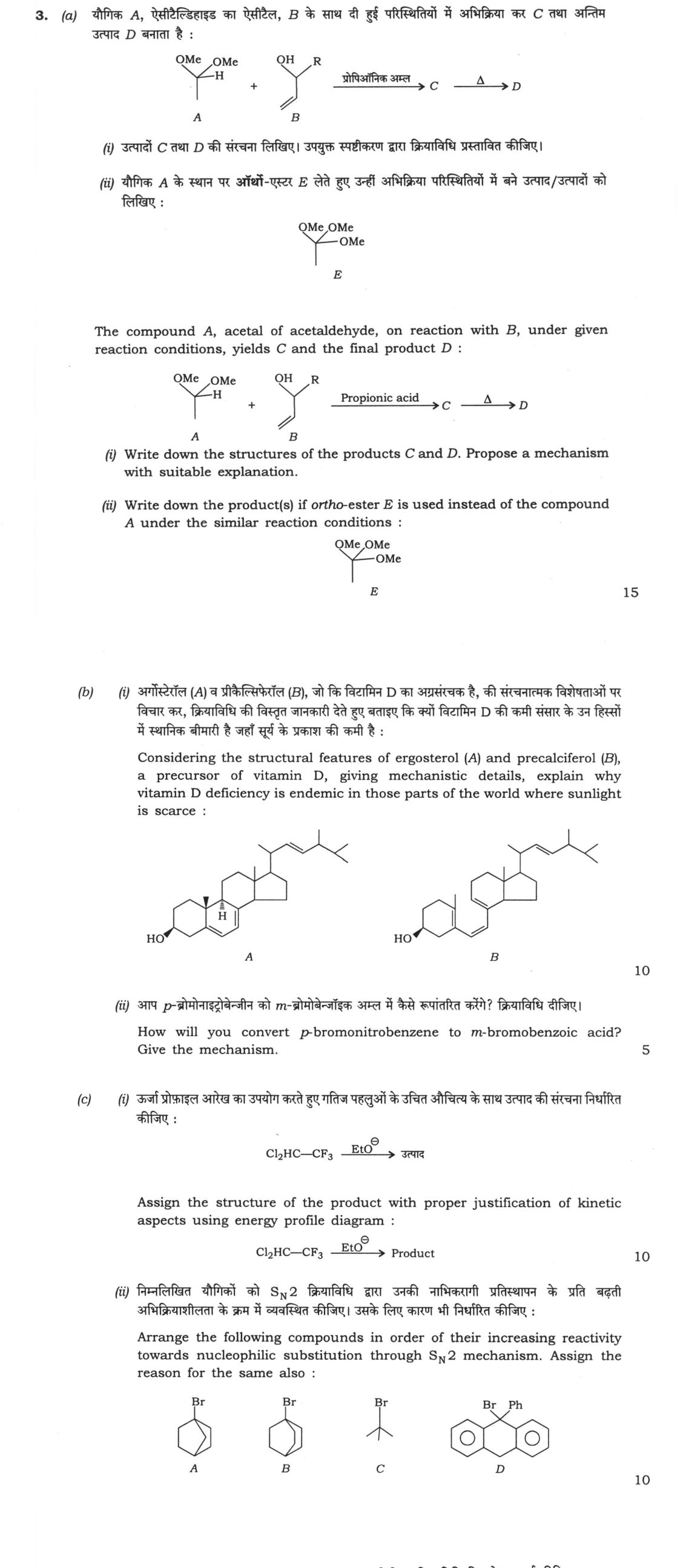
The compound A, acetal of acetaldehyde, on reaction with B, under given reaction conditions, yields C and the final product D…
The compound A, acetal of acetaldehyde, on reaction with B, under given reaction conditions, yields C and the final product D :
Write down the structures of the products C and D. Propose a mechanism with suitable explanation.
Write down the product(s) if ortho-ester E is used instead of the compound A under the similar reaction conditions :
हिंदी में प्रश्न पढ़ें
यौगिक A, ऐसिटैल्डिहाइड का ऐसिटैल, B के साथ दी हुई परिस्थितियों में अभिक्रिया कर C तथा अंतिम उत्पाद D बनाता है :
उत्पादों C तथा D की संरचना लिखिए। उपयुक्त स्पष्टीकरण द्वारा क्रियाविधि प्रस्तावित कीजिए।
यौगिक A के स्थान पर ऑर्थो-एस्टर E लेते हुए उन्हीं अभिक्रिया परिस्थितियों में बने उत्पाद/उत्पादों को लिखिए :
Model answer
Written by UPSC Answer Check against this question's marking rubric, to the expected length. UPSC does not publish answers for Mains — this is one way to score well, not an official key.
(i) A is the diethyl acetal of acetaldehyde, CH₃CH(OEt)₂. Under the given Lewis-acidic Johnson–Claisen conditions (Ti(OiPr)₄/Δ), Ti(IV) coordinates to an acetal oxygen, increasing the electrophilicity of the acetal carbon and making EtO a better leaving group. The allylic alcohol B attacks the resulting oxocarbenium ion; EtOH departs, giving C, the mixed allyl acetal CH₃CH(OEt)(OCH₂CH=CH₂). C can lose EtOH to the allyl vinyl ether CH₂=CH–OCH₂CH=CH₂. On heating, this six-atom system undergoes a concerted [3,3] sigmatropic Claisen rearrangement: the O–allyl σ bond breaks, a new C–C bond forms between the vinyl carbon and the terminal allyl carbon, the allyl π bond shifts, and the vinyl-ether oxygen becomes the carbonyl oxygen. The driving force is formation of a strong C–C bond and a carbonyl group. Hence D, after work-up, is the corresponding γ,δ-unsaturated aldehyde; with allyl alcohol this is 4-pentenal, and the substituted allylic alcohol in the scheme gives the analogous branched aldehyde (e.g. 2-methylpent-4-enal).
(ii) If ortho-ester E, e.g. triethyl orthoacetate CH₃C(OEt)₃, is used, Ti(IV) similarly activates it and B substitutes to give an allyl ester/mixed orthoester. Because the acyl carbon bears three alkoxy groups, two EtO groups are expelled as EtOH and one remains as the ester alkoxy group; no hemiacetal/alcohol pathway is favoured. The allyl ester undergoes the same [3,3] rearrangement to give the γ,δ-unsaturated ester, e.g. ethyl pent-4-enoate, CH₂=CHCH₂CH₂CO₂Et. Thus the causal sequence is Lewis-acid activation, allyl acetal/ester formation, sigmatropic C–C bond formation, and carbonyl/ester regeneration; acetals mask aldehydes, while orthoesters act as masked carboxylic-acid/acyl-anion equivalents.
What "Explain" is asking you to do
Make the working of something clear — what sets it off, what follows from what, and what it produces. Explain is the Commission's mechanism word: it dominates the technical papers and the “explain why” stems, where the marks sit in the causal chain and not in the label.
Structure that answers it
State what it is → the initiating condition → the chain of cause, step by step → an instance where it plays out → what the chain produces
Where marks are lost
Describing what something looks like instead of why it works that way. Naming the stages without linking them reads as description too.
How this answer will be evaluated
Approach
(a(i)) explain: definition/context > points in order > small example > short close | (a(ii)) explain: definition/context > points in order > small example > short close Full marks: Correct structures for C and D with a complete, step-by-step mechanism including hydrolysis and acetal formation.
Key points expected
- Structure of C as the acetal of the alcohol B
- Structure of D as the alkene formed by dehydration
- Mechanism showing acid-catalyzed acetal hydrolysis to aldehyde
- Mechanism showing acetal formation with the alcohol B
- Identification of the aldehyde released from ortho-ester E
- Structure of the product formed with alcohol B
- Explanation of the difference between acetal and ortho-ester reactivity
Evaluation rubric
Each sub-part is marked on its own, against the marks and word limit printed on the paper.
- (a(i)) Structures of C and D and a mechanism for their formation.
explain— definition/context → points in order → small example → short close
Must cover
- Structure of C as the acetal of the alcohol B
- Structure of D as the alkene formed by dehydration
- Mechanism showing acid-catalyzed acetal hydrolysis to aldehyde
- Mechanism showing acetal formation with the alcohol B
Loses marks
- Product without mechanism
- Incorrect structure of the acetal C
- Missing the dehydration step to D
Earns more
- Identification of acetaldehyde as the intermediate
- Arrow pushing for the nucleophilic attack of alcohol B
- Explanation of the dehydration step to form D
Extra mark
- Mention of the specific acid catalyst (propionic acid)
- (a(ii)) Product(s) formed when ortho-ester E is used instead of A.
explain— definition/context → points in order → small example → short close
Must cover
- Identification of the aldehyde released from ortho-ester E
- Structure of the product formed with alcohol B
- Explanation of the difference between acetal and ortho-ester reactivity
Loses marks
- Assuming ortho-ester E behaves identically to acetal A
- Failing to identify the aldehyde intermediate
Earns more
- Mechanism of ortho-ester hydrolysis
- Comparison of stability between acetal A and ortho-ester E
Extra mark
- Mention of the byproduct (methanol) from ortho-ester hydrolysis
Practice this exact question
Write your answer and it is marked point by point against the model answer above — what you covered, what you missed, what you got wrong.
Evaluate my answer →More from Chemistry 2022 Paper II
- Q1 (a) Ionization of 3,4-dichloro-1,2,3,4-tetramethylcyclobutene in SbF₅-SO₂ at –75 °C produ…
- Q2 (a) Predict the products X and Y in the following reactions: (5×3=15 marks) (i) [compound…
- Q3 The compound A, acetal of acetaldehyde, on reaction with B, under given reaction conditio…
- Q4 (a) (i) Complete the following reaction by showing stepwise reaction mechanism for the fo…
- Q5 (a) Write the structures of nucleosides and nucleotides, and discuss the primary structur…
- Q6 (a) (i) Predict the products in the following reactions: Propose suitable mechanism to ju…