Paper I — Q1
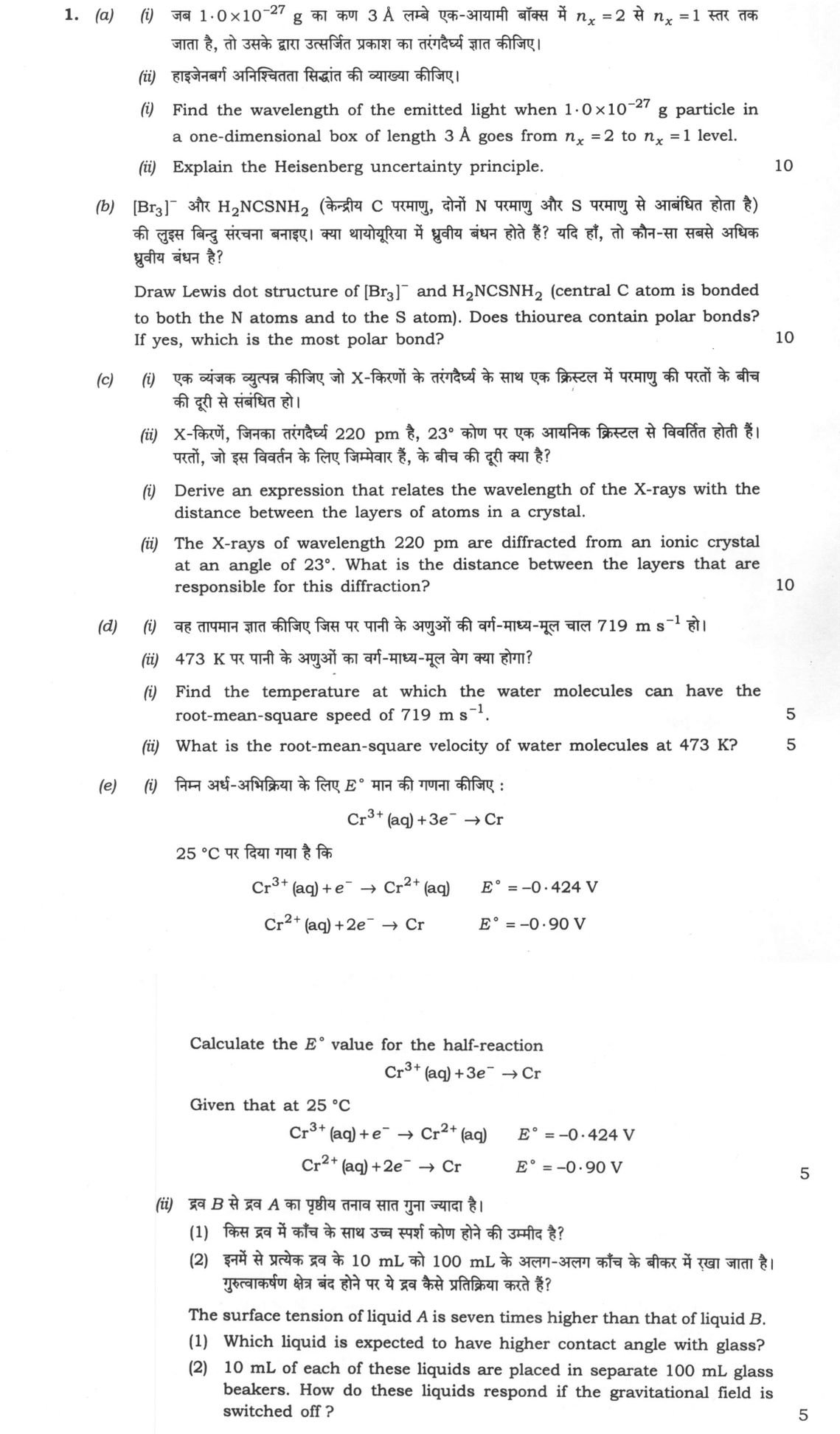
(a) (i) Find the wavelength of the emitted light when 1.0×10⁻²⁷ g particle in a one-dimensional box of length 3 Å goes from nₓ =…
Find the wavelength of the emitted light when 1.0×10⁻²⁷ g particle in a one-dimensional box of length 3 Å goes from nₓ = 2 to nₓ = 1 level.
Explain the Heisenberg uncertainty principle. 10 marks
Draw Lewis dot structure of [Br₃]⁻ and H₂NCSNH₂ (central C atom is bonded to both the N atoms and to the S atom). Does thiourea contain polar bonds? If yes, which is the most polar bond? 10 marks
Derive an expression that relates the wavelength of the X-rays with the distance between the layers of atoms in a crystal.
The X-rays of wavelength 220 pm are diffracted from an ionic crystal at an angle of 23°. What is the distance between the layers that are responsible for this diffraction? 10 marks
Find the temperature at which the water molecules can have the root-mean-square speed of 719 m s⁻¹. 5 marks
What is the root-mean-square velocity of water molecules at 473 K? 5 marks
Calculate the E° value for the half-reaction Cr³⁺(aq)+3e⁻ → Cr
Given that at 25 °C Cr³⁺(aq)+e⁻ → Cr²⁺(aq) E° = –0.424 V Cr²⁺(aq)+2e⁻ → Cr E° = –0.90 V
The surface tension of liquid A is seven times higher than that of liquid B.
(1) Which liquid is expected to have higher contact angle with glass?
(2) 10 mL of each of these liquids are placed in separate 100 mL glass beakers. How do these liquids respond if the gravitational field is switched off?
हिंदी में प्रश्न पढ़ें
जब 1.0×10⁻²⁷ g का कण 3 Å लम्बे एक-आयामी बॉक्स में nₓ = 2 से nₓ = 1 स्तर तक जाता है, तो उसके द्वारा उत्सर्जित प्रकाश का तरंगदैर्ध्य ज्ञात कीजिए।
हाइजेनबर्ग अनिश्चितता सिद्धांत की व्याख्या कीजिए।
[Br₃]⁻ और H₂NCSNH₂ (केंद्रीय C परमाणु, दोनों N परमाणु और S परमाणु से आबंधित होता है) की लुईस बिंदु संरचना बनाइए। क्या थायोयूरिया में ध्रुवीय बंधन होते हैं? यदि हाँ, तो कौन-सा सबसे अधिक ध्रुवीय बंधन है?
एक व्यंजक व्युत्पन्न कीजिए जो X-किरणों के तरंगदैर्ध्य के साथ एक क्रिस्टल में परमाणु की परतों के बीच की दूरी से संबंधित हो।
X-किरणें, जिनका तरंगदैर्ध्य 220 pm है, 23° कोण पर एक आयनिक क्रिस्टल से विवर्तित होती हैं। परतों, जो इस विवर्तन के लिए जिम्मेदार हैं, के बीच की दूरी क्या है?
वह तापमान ज्ञात कीजिए जिस पर पानी के अणुओं की वर्ग-माध्य-मूल चाल 719 m s⁻¹ हो।
473 K पर पानी के अणुओं का वर्ग-माध्य-मूल वेग क्या होगा?
निम्न अर्ध-अभिक्रिया के लिए E° मान की गणना कीजिए :
Cr³⁺(aq) + 3e⁻ → Cr
25 °C पर दिया गया है कि Cr³⁺(aq) + e⁻ → Cr²⁺(aq) E° = –0.424 V Cr²⁺(aq) + 2e⁻ → Cr E° = –0.90 V
द्रव B से द्रव A का पृष्ठीय तनाव सात गुना ज्यादा है।
(1) किस द्रव में काँच के साथ उच्च स्पर्श कोण होने की उम्मीद है?
(2) इनमें से प्रत्येक द्रव के 10 mL को 100 mL के अलग-अलग काँच के बीकर में रखा जाता है। गुरुत्वाकर्षण क्षेत्र बंद होने पर ये द्रव कैसे प्रतिक्रिया करते हैं?
Model answer
Written by UPSC Answer Check against this question's marking rubric, to the expected length. UPSC does not publish answers for Mains — this is one way to score well, not an official key.
(a)(i) For a particle of mass m in a one-dimensional box of length L, Eₙ = n²h²/(8mL²), n = 1, 2, 3, …
Here m = 1.0×10⁻²⁷ g = 1.0×10⁻³⁰ kg, L = 3 Å = 3.0×10⁻¹⁰ m, and the transition is nₓ = 2 → nₓ = 1. ΔE = E₂ − E₁ = h²/(8mL²)(2² − 1²) = 3h²/(8mL²).
The emitted photon has energy hc/λ = ΔE, so λ = hc/ΔE = 8mcL²/(3h).
Substituting h = 6.626×10⁻³⁴ J s, c = 3.00×10⁸ m s⁻¹, λ = [8 × 1.0×10⁻³⁰ × 3.00×10⁸ × (3.0×10⁻¹⁰)²] / [3 × 6.626×10⁻³⁴] = [8 × 1.0×10⁻³⁰ × 3.00×10⁸ × 9.0×10⁻²⁰] / [1.9878×10⁻³³] = 2.16×10⁻⁴⁰ / 1.9878×10⁻³³ m = 1.086×10⁻⁷ m.
Final: λ ≈ 1.09×10⁻⁷ m = 109 nm (about 108.6 nm).
(a)(ii) Heisenberg’s uncertainty principle states that certain pairs of conjugate variables cannot both be measured with arbitrary precision at the same time. For position x and momentum pₓ, Δx · Δpₓ ≥ ħ/2 = h/(4π), where Δx and Δpₓ are the uncertainties in position and momentum respectively.
Similarly, for energy and time, ΔE · Δt ≥ ħ/2.
The principle is intrinsic to quantum mechanics; it is not merely due to imperfect instruments. If a particle is localised within a small region Δx, its momentum must have a minimum spread Δpₓ ≥ ħ/(2Δx). Thus a particle confined in a box cannot have zero kinetic energy even at absolute zero, which explains zero-point energy. It also means that a definite simultaneous trajectory in the classical sense does not exist for a quantum particle.
(b) For [Br₃]⁻, total valence electrons = 3×7 + 1 = 22. The Lewis dot structure is linear:
:Br̈—B̈r̈—B̈r̈:⁻
More explicitly, each terminal Br has three lone pairs and is singly bonded to the central Br. The central Br has three lone pairs, is singly bonded to both terminal Br atoms, and carries the negative charge. Thus the central Br has an expanded valence shell.
For thiourea, H₂NCSNH₂, total valence electrons = 4(1) + 2(5) + 4 + 6 = 24. The central C is bonded to both N atoms and to the S atom. Its Lewis structure is
H H | | H — N: — C — N: — H || S:
Here each N has one lone pair and is bonded to two H atoms and to the central C. The central C is doubly bonded to S; S has two lone pairs.
Yes, thiourea contains polar bonds. The bonds present are N—H, C—N, and C=S. Using Pauling electronegativities, N—H: Δχ ≈ 3.04 − 2.20 = 0.84 C—N: Δχ ≈ 3.04 − 2.55 = 0.49 C—S: Δχ ≈ 2.58 − 2.55 = 0.03.
Final: The most polar bond is N—H. Among the bonds at the central carbon, C—N is more polar than C—S.
(c)(i) The relation is Bragg’s law. Consider parallel lattice planes separated by distance d. A narrow X-ray beam falls on the crystal at a glancing angle θ to the planes. One ray is reflected from the top plane and another from the next plane.
The extra path travelled by the ray reflected from the lower plane is AB + BC = d sinθ + d sinθ = 2d sinθ.
For constructive interference, this path difference must be an integral number of wavelengths: 2d sinθ = nλ, where n = 1, 2, 3, …
Thus λ = 2d sinθ/n.
For first-order diffraction, n = 1, so λ = 2d sinθ.
This derivation assumes monochromatic X-rays, elastic scattering, specular reflection, equally spaced parallel planes, and θ measured from the plane, not from the normal.
(c)(ii) Given λ = 220 pm, θ = 23°. Assuming first-order diffraction, n = 1: d = λ/(2 sinθ) = 220 pm/(2 sin23°).
sin23° = 0.3907, so d = 220 pm/(2 × 0.3907) = 220 pm/0.7814 = 281.5 pm.
Final: d ≈ 281.5 pm = 2.815×10⁻¹⁰ m = 2.815 Å. If a higher order n were specified, d = nλ/(2 sinθ).
(d)(i) For an ideal gas, the root-mean-square speed is v_rms = √(3RT/M).
For water, M = 18.015 g mol⁻¹ = 0.018015 kg mol⁻¹. Given v_rms = 719 m s⁻¹, T = Mv_rms²/(3R).
v_rms² = (719)² = 516,961 m² s⁻². 3R = 3 × 8.314462618 J mol⁻¹ K⁻¹ = 24.9434 J mol⁻¹ K⁻¹.
T = (0.018015 kg mol⁻¹ × 516,961 m² s⁻²)/(24.9434 J mol⁻¹ K⁻¹) = 9313.05/24.9434 K = 373.37 K.
Final: T ≈ 373 K = 100 °C. This assumes water vapour behaves as an ideal gas.
(d)(ii) At T = 473 K, v_rms = √(3RT/M).
3RT = 3 × 8.314462618 × 473 J mol⁻¹ = 11,798.22 J mol⁻¹.
v_rms² = 11,798.22/0.018015 m² s⁻² = 654,911 m² s⁻².
v_rms = √654,911 m s⁻¹ = 809.3 m s⁻¹.
Final: v_rms ≈ 809 m s⁻¹ at 473 K.
(e)(i) The overall reaction is the sum of two reduction half-reactions:
Cr³⁺(aq) + e⁻ → Cr²⁺(aq), E₁° = −0.424 V, n₁ = 1 Cr²⁺(aq) + 2e⁻ → Cr(s), E₂° = −0.90 V, n₂ = 2.
Adding gives Cr³⁺(aq) + 3e⁻ → Cr(s), n = 3.
Standard electrode potentials are intensive quantities, so they cannot be simply added. Use free-energy changes: ΔG₁° = −n₁FE₁° = −1 × F × (−0.424) = +0.424F ΔG₂° = −n₂FE₂° = −2 × F × (−0.90) = +1.80F.
For the overall reaction, ΔG₃° = ΔG₁° + ΔG₂° = +0.424F + 1.80F = +2.224F.
Also, ΔG₃° = −nFE° = −3FE°. Therefore, −3FE° = +2.224F E° = −2.224/3 V = −0.7413 V.
Final: E°(Cr³⁺ + 3e⁻ → Cr) ≈ −0.741 V.
(e)(ii)(1) By Young’s equation for a liquid drop on a solid, γ_SV − γ_SL = γ_LV cosθ, where θ is the contact angle and γ_LV is the liquid surface tension. For the same glass surface, a higher liquid surface tension generally gives a larger contact angle, i.e. poorer wetting, if γ_SL does not change drastically.
Liquid A has surface tension seven times that of liquid B. Therefore, liquid A is expected to have the higher contact angle with glass.
(e)(ii)(2) In ordinary gravity, the liquid shape in a beaker is controlled largely by gravitational force. When the gravitational field is switched off, capillary and interfacial forces dominate.
Liquid B has lower surface tension and lower contact angle with glass, so it wets glass well. In zero gravity, it will spread over the glass surface, climb along the inner walls, and tend to form a thin film or fill corners of the beaker to minimise surface energy.
Liquid A has much higher surface tension and a higher contact angle, so it wets glass poorly. In zero gravity, it will minimise contact with the glass and coalesce into a nearly spherical drop or globule. It may remain as a compact drop inside the beaker, touching the glass only slightly or floating freely if dislodged.
Thus, in zero gravity, B spreads and wets the glass, while A beads up into a compact drop.
What "Solve" is asking you to do
Choose the method, then carry it through to a final answer. Identifying what kind of problem this is and why that method applies is the first thing marked; a correct figure arrived at invisibly earns almost nothing.
Structure that answers it
Given data and what is required → method chosen, with the reason it applies → set-up (equation, circuit, free body, trial balance) → working, step by step → answer with units and any condition of validity
Where marks are lost
Doing the middle steps mentally and writing only the result. In mathematics papers, a further loss comes from giving a decimal where the exact value in surds or fractions was wanted, or from skipping the justification a part explicitly asks for.
How this answer will be evaluated
Approach
(a(i)) calculate: given > formula > substitution > result with units > interpretation | (a(ii)) explain: definition/context > points in order > small example > short close | (b) describe: define > structure or process in order > labelled diagram > significance | (c(i)) derive: given > assumptions > stepwise derivation > result > check | (c(ii)) calculate: given > formula > substitution > result with units > interpretation | (d(i)) calculate: given > formula > substitution > result with units > interpretation | (d(ii)) calculate: given > formula > substitution > result with units > interpretation | (e(i)) calculate: given > formula > substitution > result with units > interpretation | (e(ii)(1)) justify: claim > 3-4 reasons > evidence > conclusion | (e(ii)(2)) explain: definition/context > points in order > small example > short close Full marks: All parts complete with correct calculations, clear reasoning, and proper units.
Key points expected
- Use particle in a box energy formula
- Calculate energy difference between n=2 and n=1
- Convert energy to wavelength using E=hc/λ
- Final answer in appropriate units
- State the principle mathematically (ΔxΔp ≥ h/4π)
- Explain position-momentum uncertainty
- Mention fundamental nature, not measurement error
- Brief physical interpretation
Evaluation rubric
Each sub-part is marked on its own, against the marks and word limit printed on the paper.
- (a(i)) Wavelength of light emitted during transition from n=2 to n=1.
calculate— given → formula → substitution → result with units → interpretation
Must cover
- Use particle in a box energy formula
- Calculate energy difference between n=2 and n=1
- Convert energy to wavelength using E=hc/λ
- Final answer in appropriate units
Loses marks
- Incorrect energy level formula
- Unit conversion errors
Earns more
- Correct substitution of mass and length
- Clear step-by-step calculation
Extra mark
- Mention of quantum confinement concept
- (a(ii)) Explanation of Heisenberg uncertainty principle.
explain— definition/context → points in order → small example → short close
Must cover
- State the principle mathematically (ΔxΔp ≥ h/4π)
- Explain position-momentum uncertainty
- Mention fundamental nature, not measurement error
- Brief physical interpretation
Loses marks
- Confusing with observer effect
- Missing mathematical expression
Earns more
- Reference to wave-particle duality
- Example or analogy
Extra mark
- Mention of energy-time uncertainty
- (b) Lewis structures and polarity analysis of [Br₃]⁻ and thiourea. 10 marks
describe— define → structure or process in order → labelled diagram → significance
Must cover
- Correct Lewis structure of [Br₃]⁻ with lone pairs
- Correct Lewis structure of H₂NCSNH₂
- Identify polar bonds in thiourea
- Determine most polar bond with reasoning
Loses marks
- Incorrect bonding in [Br₃]⁻
- Missing lone pairs
Earns more
- Formal charge calculations
- Electronegativity values cited
Extra mark
- Molecular geometry mention
- (c(i)) Derivation of Bragg's law relating X-ray wavelength to crystal spacing.
derive— given → assumptions → stepwise derivation → result → check
Must cover
- State Bragg's law: nλ = 2d sinθ
- Show path difference derivation
- Define all variables clearly
- Explain constructive interference condition
Loses marks
- Missing path difference explanation
- Incorrect angle definition
Earns more
- Diagram of crystal planes
- Step-by-step geometric reasoning
Extra mark
- Mention of Miller indices
- (c(ii)) Interplanar spacing from given wavelength and diffraction angle.
calculate— given → formula → substitution → result with units → interpretation
Must cover
- Use Bragg's law with n=1
- Substitute λ=220 pm and θ=23°
- Calculate d = λ/(2sinθ)
- Final answer in pm or Å
Loses marks
- Using degrees vs radians incorrectly
- Arithmetic errors
Earns more
- Correct trigonometric calculation
- Unit consistency
Extra mark
- Mention of first-order diffraction
- (d(i)) Temperature for water molecules with rms speed 719 m/s. 5 marks
calculate— given → formula → substitution → result with units → interpretation
Must cover
- Use v_rms = √(3RT/M) formula
- Rearrange for T = Mv²/(3R)
- Substitute M=0.018 kg/mol, v=719 m/s
- Calculate T in Kelvin
Loses marks
- Using wrong molar mass units
- Missing square in velocity
Earns more
- Correct molar mass conversion
- Unit consistency check
Extra mark
- Comparison with boiling point
- (d(ii)) RMS velocity of water molecules at 473 K. 5 marks
calculate— given → formula → substitution → result with units → interpretation
Must cover
- Use v_rms = √(3RT/M) formula
- Substitute T=473 K, M=0.018 kg/mol
- Calculate v_rms in m/s
- Final answer with units
Loses marks
- Incorrect temperature in formula
- Unit errors
Earns more
- Correct gas constant usage
- Step-by-step calculation
Extra mark
- Comparison with part (i) result
- (e(i)) E° for Cr³⁺ + 3e⁻ → Cr using given half-reactions. 5 marks
calculate— given → formula → substitution → result with units → interpretation
Must cover
- Use ΔG = -nFE relationship
- Calculate ΔG for each step
- Sum ΔG values for overall reaction
- Convert back to E° using n=3
Loses marks
- Averaging E° values directly
- Incorrect electron counts
Earns more
- Clear electron count for each step
- Correct sign handling
Extra mark
- Mention of additivity of ΔG
- (e(ii)(1)) Which liquid has higher contact angle with glass.
justify— claim → 3-4 reasons → evidence → conclusion
Must cover
- Relate surface tension to contact angle
- Higher surface tension means higher contact angle
- Liquid A has higher contact angle
- Brief explanation of wetting behavior
Loses marks
- Reversing the relationship
- Missing physical explanation
Earns more
- Young's equation reference
- Physical reasoning about adhesion
Extra mark
- Mention of specific surface energies
- (e(ii)(2)) Behavior of liquids in zero gravity field.
explain— definition/context → points in order → small example → short close
Must cover
- Liquids form spherical droplets
- Surface tension dominates over gravity
- Higher surface tension forms smaller spheres
- Both liquids float as spheres
Loses marks
- Saying liquids spread out
- Ignoring surface tension effects
Earns more
- Mention of Laplace pressure
- Comparison of droplet sizes
Extra mark
- Reference to space experiments
Practice this exact question
Write your answer and it is marked point by point against the model answer above — what you covered, what you missed, what you got wrong.
Evaluate my answer →More from Chemistry 2023 Paper I
- Q1 (a) (i) Find the wavelength of the emitted light when 1.0×10⁻²⁷ g particle in a one-dimen…
- Q2 (a) Using the Gibbs equation for a closed system in the absence of non-expansion work at…
- Q3 (a) Determine the electronic and molecular geometry of [BrF₅] and [ICl₂]⁻ interhalogen co…
- Q4 (a) The volume of a certain gas is found to be 5.0×10⁻⁴ m³ mol⁻¹ at 273 K and 3.0×10⁶ Pa.…