Paper I — Q8
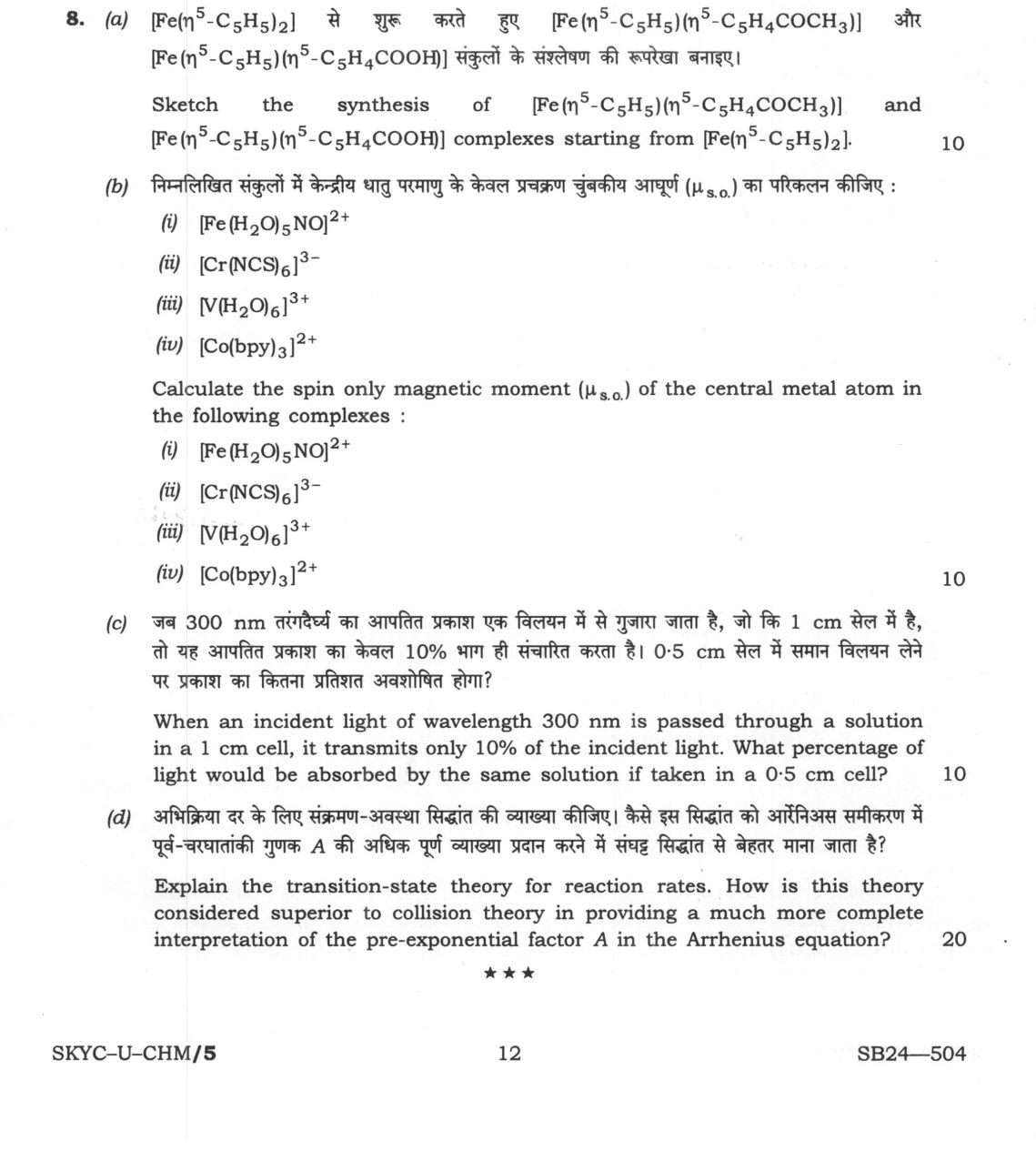
(a) Sketch the synthesis of [Fe(η⁵-C₅H₅)(η⁵-C₅H₄COCH₃)] and [Fe(η⁵-C₅H₅)(η⁵-C₅H₄COOH)] complexes starting from [Fe(η⁵-C₅H₅)₂]…
Sketch the synthesis of [Fe(η⁵-C₅H₅)(η⁵-C₅H₄COCH₃)] and [Fe(η⁵-C₅H₅)(η⁵-C₅H₄COOH)] complexes starting from [Fe(η⁵-C₅H₅)₂]. 10 marks
Calculate the spin only magnetic moment (μ_s.o.) of the central metal atom in the following complexes: [Fe(H₂O)₅NO]²⁺
[Cr(NCS)₆]³⁻
[V(H₂O)₆]³⁺
[Co(bpy)₃]²⁺ 10 marks
When an incident light of wavelength 300 nm is passed through a solution in a 1 cm cell, it transmits only 10% of the incident light. What percentage of light would be absorbed by the same solution if taken in a 0.5 cm cell? 10 marks
Explain the transition-state theory for reaction rates. How is this theory considered superior to collision theory in providing a much more complete interpretation of the pre-exponential factor A in the Arrhenius equation? 20 marks
हिंदी में प्रश्न पढ़ें
[Fe(η⁵-C₅H₅)₂] से शुरू करते हुए [Fe(η⁵-C₅H₅)(η⁵-C₅H₄COCH₃)] और [Fe(η⁵-C₅H₅)(η⁵-C₅H₄COOH)] संकुलों के संश्लेषण की रूपरेखा बनाइए। (10 अंक)
निम्नलिखित संकुलों में केंद्रीय धातु परमाणु के केवल प्रचक्रण चुंबकीय आघूर्ण (μ_s.o.) का परिकलन कीजिए: [Fe(H₂O)₅NO]²⁺
[Cr(NCS)₆]³⁻
[V(H₂O)₆]³⁺
[Co(bpy)₃]²⁺ (10 अंक)
जब 300 nm तरंगदैर्घ्य का आपतित प्रकाश एक विलयन में से गुजारा जाता है, जो कि 1 cm सेल में है, तो यह आपतित प्रकाश का केवल 10% भाग ही संचारित करता है। 0.5 cm सेल में समान विलयन लेने पर प्रकाश का कितना प्रतिशत अवशोषित होगा? (10 अंक)
अभिक्रिया दर के लिए संक्रमण-अवस्था सिद्धांत की व्याख्या कीजिए। कैसे इस सिद्धांत को अर्रेनियस समीकरण में पूर्व-चरघातांकी गुणक A की अधिक पूर्ण व्याख्या प्रदान करने में संघट्ट सिद्धांत से बेहतर माना जाता है? (20 अंक)
Model answer
Written by UPSC Answer Check against this question's marking rubric, to the expected length. UPSC does not publish answers for Mains — this is one way to score well, not an official key.
The question links organometallic synthesis, magnetic structure, spectroscopy and kinetics; each part is a separate application of coordination and physical chemistry principles, but all depend on relating molecular structure to measurable properties.
Synthesis of acetyl- and carboxyferrocene Ferrocene, Fe(η5-C5H5)2, behaves as a substituted aromatic system in which the cyclopentadienyl rings are more nucleophilic than benzene. Treatment with acetic anhydride and AlCl3 generates an acylium electrophile, CH3CO+, which attacks one η5 ring to give, after aqueous work-up, monoacetylferrocene, [Fe(η5-C5H5)(η5-C5H4COCH3)]. The iron centre remains formally Fe(II) and retains η5 bonding to both rings. The acetyl group is electron-withdrawing; it deactivates the ring on which it is attached, so any further electrophilic substitution is directed preferentially to the unsubstituted ring, giving heteroannular disubstitution if acylating reagent is in excess. Controlled stoichiometry, low conversion and mild conditions therefore favour the monoacetyl product. The monoacetyl product is the desired intermediate because it retains the methyl ketone needed for haloform conversion. The methyl ketone is then converted into the carboxylic acid by the haloform reaction: NaOBr in NaOH forms the tribromomethyl ketone, which hydrolyses to the carboxylate; acidification gives [Fe(η5-C5H5)(η5-C5H4COOH)]. Oxidation of the side chain is possible, but haloform conditions are selective for the acetyl group.
Spin-only magnetic moments The spin-only moment is μ_s.o. = √[n(n+2)] BM, where n is the number of unpaired d electrons. In [Fe(H2O)5NO]2+, the brown-ring ion is treated formally as Fe(I) with nitrosyl as NO+; the Fe(I) centre is d7 and, in this aqua-nitrosyl environment, high spin, t2g5 eg2. Thus n=3 and μ=√15=3.87 BM. In [Cr(NCS)6]3-, x + 6(-1) = -3 gives Cr(III), d3; the octahedral t2g3 configuration has n=3 and μ=3.87 BM. In [V(H2O)6]3+, V is +3 and d2; the t2g2 configuration has n=2 and μ=√8=2.83 BM. In [Co(bpy)3]2+, Co is +2 and d7, but 2,2'-bipyridine is a strong-field N-donor ligand, so the complex is low spin, t2g6 eg1, with n=1 and μ=√3=1.73 BM.
Beer–Lambert calculation For the 1 cm cell, transmission T=0.10, so A1 = -log10 T = 1.0. Since A=εcl and the solution concentration and molar absorptivity are unchanged, halving the path length halves the absorbance: A2=0.5. The transmission in the 0.5 cm cell is T2=10^-0.5=0.316, i.e. 31.6% of the incident light is transmitted. Therefore the percentage absorbed is 100-31.6 = 68.4%. This follows because absorbance is proportional to the number of absorbing molecules encountered along the optical path.
Transition-state theory and the pre-exponential factor Transition-state theory assumes that reactants form an activated complex in a rapid pre-equilibrium, A + B ⇌ [A‡B]‡, and that the complex crosses a single reaction coordinate to products. The pre-equilibrium is statistical: the activated complex is a high-energy configuration on the same potential-energy surface, and its population is governed by Boltzmann statistics. The activated complex corresponds to a first-order saddle point on the potential-energy surface; one vibrational mode is replaced by the reaction coordinate. The rate constant is k = (kBT/h)K‡, where K‡ is the equilibrium constant for formation of the activated complex. Writing K‡ in thermodynamic form, K‡ = exp(-ΔG‡/RT) = exp(ΔS‡/R)exp(-ΔH‡/RT), gives k = (kBT/h)exp(ΔS‡/R)exp(-ΔH‡/RT). Comparison with the Arrhenius equation, k = A exp(-Ea/RT), gives A = (kBT/h)exp(ΔS‡/R), apart from a transmission coefficient if the crossing probability is not unity.
This is the main superiority over collision theory. Collision theory estimates A from collision frequency and introduces an empirical steric factor P, often P << 1, but treats molecules as hard spheres and mostly translational motion. TST expresses A through molecular partition functions: for a bimolecular gas reaction, A may be written, in the usual standard-state convention, as A = (kBT/h)(q‡/q_A q_B), with the standard-state volume factor included in the definition of q‡. Here q_A, q_B and q‡ contain translational, rotational, vibrational and electronic contributions; q‡ excludes the reaction coordinate, which is represented by the kBT/h crossing frequency. Thus A depends explicitly on molecular masses, moments of inertia, vibrational frequencies, electronic degeneracies and the geometry of the activated complex. It explains orientation and steric effects through entropy of activation rather than an arbitrary factor; in collision theory, the steric factor is introduced because not all collisions with sufficient energy lead to reaction, while TST shows that this factor arises from the ratio of partition functions and the requirement that the complex have the correct geometry and internal energy distribution. It allows A to vary with temperature and molecular structure. A negative ΔS‡ for an ordered transition state lowers A, while a loose complex raises it.
The spectroscopic part connects directly to kinetics: Beer–Lambert absorbance measurements can follow concentration changes, giving rate constants; an Eyring plot of ln(k/T) against 1/T then yields ΔH‡ and ΔS‡. Thus the same absorbance measurement that quantifies transmission in part (c) can be used in a UV-Vis kinetic experiment to obtain k at several temperatures. In catalysis, this thermodynamic formulation guides design by identifying transition-state stabilization; homogeneous catalysis research at NCL Pune and IISc Bangalore uses such TST-based kinetic and computational analysis to optimise catalysts.
Thus the four parts move from controlled substitution and spin states to quantitative absorption and rate theory, showing that structure, electronic configuration, spectroscopic measurement and transition-state energetics together provide a coherent explanation of chemical reactivity. The answer therefore treats the question as a sequence of structure-property relationships rather than isolated calculations.
What "Explain" is asking you to do
Make the working of something clear — what sets it off, what follows from what, and what it produces. Explain is the Commission's mechanism word: it dominates the technical papers and the “explain why” stems, where the marks sit in the causal chain and not in the label.
Structure that answers it
State what it is → the initiating condition → the chain of cause, step by step → an instance where it plays out → what the chain produces
Where marks are lost
Describing what something looks like instead of why it works that way. Naming the stages without linking them reads as description too.
How this answer will be evaluated
Approach
Framework: Concept > Structure or mechanism > Reasoning > Result. (a) trace: start point > the stages in sequence > end point > what changed | (b) calculate: given > formula > substitution > result with units > interpretation | (c) calculate: given > formula > substitution > result with units > interpretation | (d) explain: definition/context > points in order > small example > short close Full marks: Complete mechanisms, correct calculations with working, and a detailed theoretical comparison for part (d).
Key points expected
- Oxidative addition of MeI to ferrocene
- Nucleophilic attack by MeMgBr to form acetylferrocene
- Hydrolysis of acetylferrocene to carboxyferrocene
- Correct structures of intermediates and products
- Correct oxidation state and d-electron count for each metal
- Determination of high/low spin state based on ligands
- Application of formula μ = √(n(n+2)) BM
- Correct final values for all four complexes
Evaluation rubric
Each sub-part is marked on its own, against the marks and word limit printed on the paper.
- (a) Synthesis pathways for two specific organometallic complexes starting from ferrocene. 10 marks
trace— start point → the stages in sequence → end point → what changed
Must cover
- Oxidative addition of MeI to ferrocene
- Nucleophilic attack by MeMgBr to form acetylferrocene
- Hydrolysis of acetylferrocene to carboxyferrocene
- Correct structures of intermediates and products
Loses marks
- Missing the oxidative addition step
- Incorrect product structures (e.g. wrong ring substitution)
Earns more
- Mention of reagents like AlCl3 or H2O
- Explanation of regioselectivity (C5H4 ring)
Extra mark
- Mention of specific reaction conditions (temperature/solvent)
- (b) Spin-only magnetic moments for four specific transition metal complexes. 10 marks
calculate— given → formula → substitution → result with units → interpretation
Must cover
- Correct oxidation state and d-electron count for each metal
- Determination of high/low spin state based on ligands
- Application of formula μ = √(n(n+2)) BM
- Correct final values for all four complexes
Loses marks
- Incorrect oxidation state assignment
- Using wrong formula for magnetic moment
Earns more
- Explicit calculation of unpaired electrons (n)
- Justification of spin state (e.g. NCS- is weak field)
Extra mark
- Mention of orbital contribution if relevant (though question asks spin-only)
- (c) Percentage of light absorbed in a 0.5 cm cell given 10% transmission in 1 cm cell. 10 marks
calculate— given → formula → substitution → result with units → interpretation
Must cover
- Use of Beer-Lambert Law (A = εcl)
- Calculation of Absorbance (A) from 10% transmission
- Scaling of Absorbance for 0.5 cm path length
- Conversion of new Absorbance back to % Absorption
Loses marks
- Confusing % Transmission with % Absorption
- Incorrect scaling of path length
Earns more
- Showing the relationship A = -log(T)
- Clear step-by-step substitution
Extra mark
- Mention of units for path length
- (d) Transition-state theory and its superiority over collision theory regarding the pre-exponential factor A. 20 marks
explain— definition/context → points in order → small example → short close
Must cover
- Definition of the activated complex/transition state
- Derivation or statement of the Eyring equation
- Comparison of A in TST vs Collision Theory
- Explanation of the entropy of activation (ΔS‡)
Loses marks
- Failing to link TST to the Arrhenius pre-exponential factor
- Confusing activation energy with activation entropy
Earns more
- Mention of the transmission coefficient (κ)
- Discussion of the frequency factor in TST (kT/h)
Extra mark
- Reference to specific examples where TST fits better than collision theory
Practice this exact question
Write your answer and it is marked point by point against the model answer above — what you covered, what you missed, what you got wrong.
Evaluate my answer →More from Chemistry 2023 Paper I
- Q5 The decomposition of AB₂ to AB and B is a first-order reaction with k = 2·8 × 10⁻⁷ s⁻¹ at…
- Q6 Complete the following reactions and draw the structure of the major product(s) formed: (…
- Q7 (a) Explain the common structural features of two major iron-containing proteins—haemoglo…
- Q8 (a) Sketch the synthesis of [Fe(η⁵-C₅H₅)(η⁵-C₅H₄COCH₃)] and [Fe(η⁵-C₅H₅)(η⁵-C₅H₄COOH)] co…