Paper I — Q2
(a) Using the Gibbs equation for a closed system in the absence of non-expansion work at constant composition, answer the…
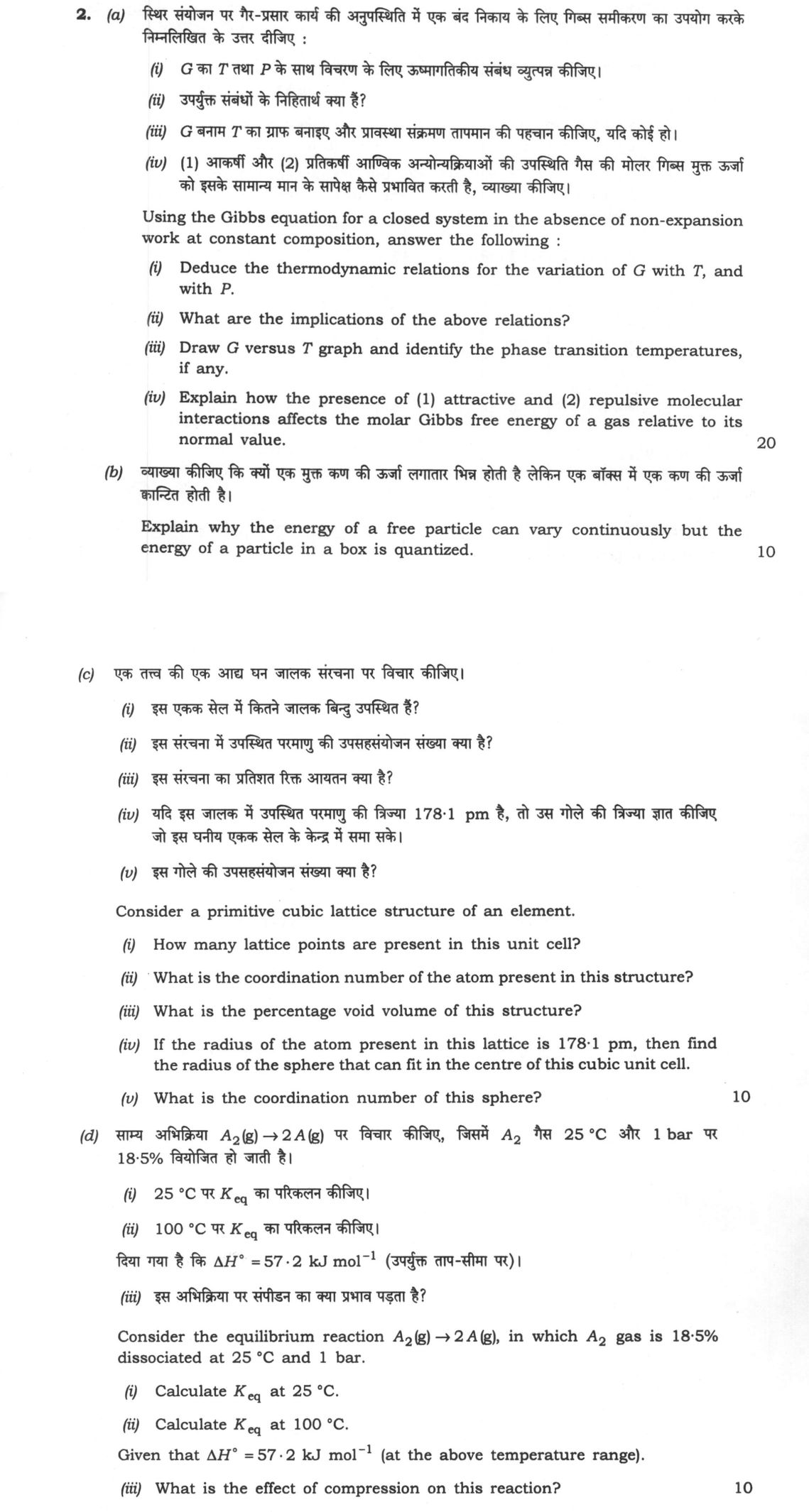
Using the Gibbs equation for a closed system in the absence of non-expansion work at constant composition, answer the following :
Deduce the thermodynamic relations for the variation of G with T, and with P.
What are the implications of the above relations?
Draw G versus T graph and identify the phase transition temperatures, if any.
Explain how the presence of (1) attractive and (2) repulsive molecular interactions affects the molar Gibbs free energy of a gas relative to its normal value.
Explain why the energy of a free particle can vary continuously but the energy of a particle in a box is quantized.
Consider a primitive cubic lattice structure of an element.
How many lattice points are present in this unit cell?
What is the coordination number of the atom present in this structure?
What is the percentage void volume of this structure?
If the radius of the atom present in this lattice is 178·1 pm, then find the radius of the sphere that can fit in the centre of this cubic unit cell.
What is the coordination number of this sphere? 10 marks
Consider the equilibrium reaction A₂(g) → 2A(g), in which A₂ gas is 18·5% dissociated at 25 °C and 1 bar.
Calculate K_eq at 25 °C.
Calculate K_eq at 100 °C.
Given that ΔH° = 57·2 kJ mol⁻¹ (at the above temperature range).
What is the effect of compression on this reaction? 10 marks
हिंदी में प्रश्न पढ़ें
स्थिर संयोजन पर गैर-प्रसार कार्य की अनुपस्थिति में एक बंद निकाय के लिए गिब्स समीकरण का उपयोग करके निम्नलिखित के उत्तर दीजिए :
G का T तथा P के साथ विचरण के लिए क्षमागतिकीय संबंध व्युत्पन्न कीजिए।
उपर्युक्त संबंधों के निहितार्थ क्या हैं?
G बनाम T का ग्राफ बनाइए और प्रावस्था संक्रमण तापमान की पहचान कीजिए, यदि कोई हो।
(1) आकर्षी और (2) प्रतिकर्षी आणविक अन्योन्यक्रियाओं की उपस्थिति गैस की मोलर गिब्स मुक्त ऊर्जा को इसके सामान्य मान के सापेक्ष कैसे प्रभावित करती है, व्याख्या कीजिए।
व्याख्या कीजिए कि क्यों एक मुक्त कण की ऊर्जा लगातार भिन्न होती है लेकिन एक बॉक्स में एक कण की ऊर्जा कांतित होती है।
एक तत्व की एक आध घन जालक संरचना पर विचार कीजिए।
इस एकक सेल में कितने जालक बिंदु उपस्थित हैं?
इस संरचना में उपस्थित परमाणु की उपसहसंयोजन संख्या क्या है?
इस संरचना का प्रतिशत रिक्त आयतन क्या है?
यदि इस जालक में उपस्थित परमाणु की त्रिज्या 178·1 pm है, तो उस गोले की त्रिज्या ज्ञात कीजिए जो इस घनीय एकक सेल के केंद्र में समा सके।
इस गोले की उपसहसंयोजन संख्या क्या है?
साम्य अभिक्रिया A₂(g) → 2A(g) पर विचार कीजिए, जिसमें A₂ गैस 25 °C और 1 bar पर 18·5% विघटित हो जाती है।
25 °C पर K_eq का परिकलन कीजिए।
100 °C पर K_eq का परिकलन कीजिए।
दिया गया है कि ΔH° = 57·2 kJ mol⁻¹ (उपर्युक्त ताप-सीमा पर)।
इस अभिक्रिया पर संपीडन का क्या प्रभाव पड़ता है?
The figure this question refers to, in words
The question paper is a scan and the diagram did not survive as text. This is the figure as read from the original page — every component, value and label — so the question can be worked from the text below.
(b) A phase diagram with Pressure (P) on the vertical axis and Temperature (T) on the horizontal axis. It shows three phase boundary curves meeting at a triple point labelled D: a sublimation curve rising from low P and T to D; a solid-liquid boundary curve extending upward from D with a negative slope (leaning to the left); and a liquid-vapor boundary curve extending upward and to the right from D, terminating at critical point C. A horizontal dashed line marked at '1 atm' intersects the solid-liquid curve at point A and the liquid-gas curve at point B. Two paths are indicated with dashed lines and arrows: (1) Path E -> B -> H, a vertical dashed line with arrows pointing upward starting from point E in the vapor region directly below B, passing through B at 1 atm, and ending at point H in the liquid region at a pressure above 1 atm; (2) Path E -> F -> G -> H, which goes horizontally to the right from E to point F (at a temperature higher than critical point C), vertically upward from F to point G (at the same pressure as H, above critical point C), and horizontally to the left from G to point H.
Model answer
Written by UPSC Answer Check against this question's marking rubric, to the expected length. UPSC does not publish answers for Mains — this is one way to score well, not an official key.
(a)(i) For a closed system of constant composition and no non-expansion work, the Gibbs equation is dG = −S dT + V dP. But G = G(T, P), so its total differential is dG = (∂G/∂T)_P dT + (∂G/∂P)_T dP. Comparing coefficients gives (∂G/∂T)_P = −S and (∂G/∂P)_T = V. Also, (∂²G/∂T²)_P = −(∂S/∂T)_P = −Cₚ/T, (∂²G/∂P²)_T = (∂V/∂P)_T = −V κ_T, and the cross-derivative gives the Maxwell relation (∂S/∂P)_T = −(∂V/∂T)_P. For a phase change, the Gibbs–Helmholtz relation is ∂(ΔG/T)/∂T = −ΔH/T². These relations are valid for a closed system, constant composition, and only P–V work.
(a)(ii) At constant P, G decreases as T increases because S is positive. At constant T, G increases as P increases because V is positive. The pressure effect is large for gases, small for liquids and solids. Since entropy follows S_gas > S_liquid > S_solid, the G–T slope −S is most negative for the gas and least negative for the solid. At a given T and P, the stable phase is the one with the lowest G. A phase transition occurs when the G curves of two phases intersect, i.e. when ΔG = 0. For a first-order transition, S and V change discontinuously, so the slope of G changes abruptly. The Clapeyron equation follows: dP/dT = ΔS/ΔV = ΔH/(T ΔV).
(a)(iii) At constant pressure, the required G versus T graph has three curves: solid (least steep negative slope), liquid (intermediate slope), and gas (steepest negative slope). At low T the solid curve is lowest; at intermediate T the liquid curve is lowest; at high T the gas curve is lowest. The intersections are the phase transition temperatures:
- Tₘ where G_solid = G_liquid, the melting point.
- T_b where G_liquid = G_gas, the boiling point. If the pressure is below the triple-point pressure, the solid and gas curves intersect directly at the sublimation temperature T_sub. At the triple point, all three curves meet. A sketch is: G ↑ | S | \ | L | V | \ |_______________→ T 0 Tₘ T_b At Tₘ and T_b, ΔG = 0 and the slope changes discontinuously because entropy changes.
(a)(iv) For a real gas at temperature T and pressure P, μ_real = μ° + RT ln(f/p°), while for the ideal gas, μ_ideal = μ° + RT ln(P/p°). Hence ΔGₘ = G_real − G_ideal = RT ln(f/P) = RT ln φ.
- Attractive interactions lower the escaping tendency, so f < P and φ < 1. Hence ln φ < 0, and the molar Gibbs free energy is lower than the normal ideal-gas value.
- Repulsive interactions increase the escaping tendency, so f > P and φ > 1. Hence ln φ > 0, and the molar Gibbs free energy is higher than the normal ideal-gas value. Equivalently, at the same T and P, attractive forces reduce V relative to ideal, giving a negative contribution to ∫V dP; repulsive forces increase V, giving a positive contribution.
(b) For a free particle, V = 0 everywhere. The time-independent Schrödinger equation in one dimension is −(ħ²/2m)(d²ψ/dx²) = Eψ. Its solutions are plane waves ψₖ(x) = A e^ikx, with k any real number. The energy is E = ħ²k²/(2m). Since k is not restricted by any boundary condition, E can take any value from 0 to ∞ continuously. Momentum p = ħk is also continuous. A single plane wave is not normalizable, but normalizable wave packets can be formed by superposing many k values.
For a particle in a one-dimensional box of length L, the potential is zero inside 0 < x < L and infinite outside. The boundary conditions are ψ(0) = 0 and ψ(L) = 0. Therefore ψ(x) = A sin(kx), and sin(kL) = 0, so kL = nπ, n = 1, 2, 3, ... Thus kₙ = nπ/L, and Eₙ = ħ²kₙ²/(2m) = n²h²/(8mL²). Only discrete energies are allowed because the confined wave must form standing waves with an integer number of half-wavelengths between the walls. As L → ∞, the spacing ΔE = (2n + 1)h²/(8mL²) → 0, so the continuum of the free particle is recovered.
(c)(i) A primitive cubic unit cell has atoms only at the eight corners. Each corner is shared by eight unit cells, so the number of lattice points per unit cell is 8 × 1/8 = 1.
(c)(ii) In primitive cubic packing, each atom touches six nearest neighbours along the three axes. Hence the coordination number is 6.
(c)(iii) For touching atoms, edge length a = 2r. The unit-cell volume is a³ = 8r³. One atom occupies (4/3)πr³. Packing fraction = [(4/3)πr³]/8r³ = π/6 = 0.5236. Therefore percentage void volume = (1 − π/6) × 100 = (6 − π)/6 × 100 = 47.64%.
(c)(iv) Given R = 178.1 pm. The cube edge is a = 2R = 356.2 pm. The distance from the body centre to a corner atom is (√3/2)a = √3 R. If the central sphere just touches the corner atoms, r + R = √3 R. Hence r = R(√3 − 1) = 178.1 × 0.7320508 pm = 130.38 pm.
(c)(v) The central sphere touches the eight corner atoms of the primitive cubic unit cell. Therefore its coordination number is 8.
(d)(i) Let initial moles of A₂ be 1. Degree of dissociation α = 0.185. At equilibrium: A₂ = 1 − α = 0.815, A = 2α = 0.370, total moles = 1 + α = 1.185. At total pressure P = 1 bar, p_A₂ = [(1 − α)/(1 + α)]P, p_A = [2α/(1 + α)]P. Thus Kₚ = (p_A)²/p_A₂ = 4α²P/(1 − α²). Putting α = 0.185, α² = 0.034225, Kₚ = 4 × 0.034225 × 1 / (1 − 0.034225) = 0.1369 / 0.965775 = 0.14175 bar. Taking p° = 1 bar, K° ≈ 0.1418.
(d)(ii) Use the van’t Hoff equation: ln(K₂/K₁) = −ΔH°/R (1/T₂ − 1/T₁) = ΔH°/R (1/T₁ − 1/T₂). T₁ = 298.15 K, T₂ = 373.15 K, ΔH° = 57.2 kJ mol⁻¹ = 57200 J mol⁻¹, R = 8.314 J K⁻¹ mol⁻¹. 1/298.15 − 1/373.15 = 6.7413 × 10⁻⁴ K⁻¹. Therefore ln(K₂/K₁) = (57200/8.314)(6.7413 × 10⁻⁴) = 4.638. So K₂/K₁ = e⁴.638 ≈ 103.3. K₂ = 0.14175 × 103.3 ≈ 14.65 bar. Thus K_eq at 100 °C is about 14.65 (or dimensionless relative to p° = 1 bar). The increase with temperature is expected because the reaction is endothermic.
(d)(iii) The reaction A₂(g) → 2A(g) increases the number of gaseous moles: Δn_gas = 2 − 1 = +1. By Le Chatelier’s principle, compression increases pressure and shifts the equilibrium towards the side with fewer gas molecules, i.e. towards A₂. Thus the degree of dissociation of A₂ decreases. At constant temperature, Kₚ itself remains unchanged; only the equilibrium position changes.
What "Derive" is asking you to do
Reach the stated expression from a starting relation, justifying every step. The destination is printed in the question, so only the route earns marks, and the assumptions you work under are part of that route.
Structure that answers it
Assumptions and notation defined → starting relation or governing equation → each step with its justification → the required expression → limiting case or boundary check
Where marks are lost
Writing the standard result first and fitting three lines to it, which an examiner reads at a glance. Marks also go on assumptions left unstated — lossless medium, small amplitude, errors independent with zero mean — and on symbols used before they are defined, even when the question says usual notations.
How this answer will be evaluated
Approach
(a) derive: given > assumptions > stepwise derivation > result > check | (b) explain: definition/context > points in order > small example > short close | (c) calculate: given > formula > substitution > result with units > interpretation | (d) calculate: given > formula > substitution > result with units > interpretation Full marks: All derivations correct, calculations precise, clear reasoning, proper diagrams where needed
Key points expected
- Derive (∂G/∂T)_P = -S and (∂G/∂P)_T = V
- Explain slope of G-T graph is -S
- Identify phase transition at G-T graph intersection
- Link attractive/repulsive forces to G deviation
- State free particle has no boundary conditions
- State box particle has infinite potential walls
- Mention standing wave condition in box
- Link quantization to discrete energy levels
Evaluation rubric
Each sub-part is marked on its own, against the marks and word limit printed on the paper.
- (a) Derive G relations, interpret implications, graph G vs T, and explain interaction effects. 20 marks
derive— given → assumptions → stepwise derivation → result → check
Must cover
- Derive (∂G/∂T)_P = -S and (∂G/∂P)_T = V
- Explain slope of G-T graph is -S
- Identify phase transition at G-T graph intersection
- Link attractive/repulsive forces to G deviation
Loses marks
- Confusing G with H or S
- Failing to link slope to entropy
- Ignoring the 'closed system' constraint
Earns more
- Mention Gibbs-Helmholtz equation
- Sketch G-T graph with labeled phases
- Reference ideal gas as baseline
- Mention enthalpy of mixing
Extra mark
- Cite specific example of phase transition
- Provide mathematical proof of slope
- (b) Explain why free particle energy is continuous but box particle energy is quantized. 10 marks
explain— definition/context → points in order → small example → short close
Must cover
- State free particle has no boundary conditions
- State box particle has infinite potential walls
- Mention standing wave condition in box
- Link quantization to discrete energy levels
Loses marks
- Confusing quantization with uncertainty
- Failing to mention boundary conditions
- Treating box as finite potential well
Earns more
- Write Schrödinger equation for box
- Show E_n proportional to n^2
- Contrast de Broglie wavelength in free vs bound state
- Mention Heisenberg uncertainty principle
Extra mark
- Draw potential energy diagram for box
- Calculate specific energy levels
- (c) Calculate lattice points, coordination number, void volume, and sphere radius for primitive cubic lattice. 10 marks
calculate— given → formula → substitution → result with units → interpretation
Must cover
- State 1 lattice point per unit cell
- State coordination number is 6
- Calculate void volume as 32%
- Calculate sphere radius using geometry
Loses marks
- Confusing primitive with body-centered cubic
- Incorrect void volume calculation
- Failing to use given radius correctly
Earns more
- Show calculation for void volume
- Draw primitive cubic unit cell
- Show geometric derivation for sphere radius
- State coordination number of sphere is 6
Extra mark
- Provide diagram of sphere in center
- Calculate packing efficiency explicitly
- (d) Calculate K_eq at two temperatures and explain compression effect on dissociation reaction. 10 marks
calculate— given → formula → substitution → result with units → interpretation
Must cover
- Calculate K_eq at 25°C using dissociation data
- Use van't Hoff equation for 100°C K_eq
- State compression shifts equilibrium left
- Explain using Le Chatelier's principle
Loses marks
- Incorrect dissociation calculation
- Failing to use van't Hoff equation
- Wrong direction for compression effect
Earns more
- Show ICE table for dissociation
- Show van't Hoff equation substitution
- Mention Δn = +1 for reaction
- State reaction is endothermic
Extra mark
- Calculate ΔG° from K_eq
- Provide numerical value for 100°C K_eq
Practice this exact question
Write your answer and it is marked point by point against the model answer above — what you covered, what you missed, what you got wrong.
Evaluate my answer →More from Chemistry 2023 Paper I
- Q1 (a) (i) Find the wavelength of the emitted light when 1.0×10⁻²⁷ g particle in a one-dimen…
- Q2 (a) Using the Gibbs equation for a closed system in the absence of non-expansion work at…
- Q3 (a) Determine the electronic and molecular geometry of [BrF₅] and [ICl₂]⁻ interhalogen co…
- Q4 (a) The volume of a certain gas is found to be 5.0×10⁻⁴ m³ mol⁻¹ at 273 K and 3.0×10⁶ Pa.…
- Q5 The decomposition of AB₂ to AB and B is a first-order reaction with k = 2·8 × 10⁻⁷ s⁻¹ at…