Paper I — Q7
(a) Explain the common structural features of two major iron-containing proteins—haemoglobin and cytochrome c present in the…
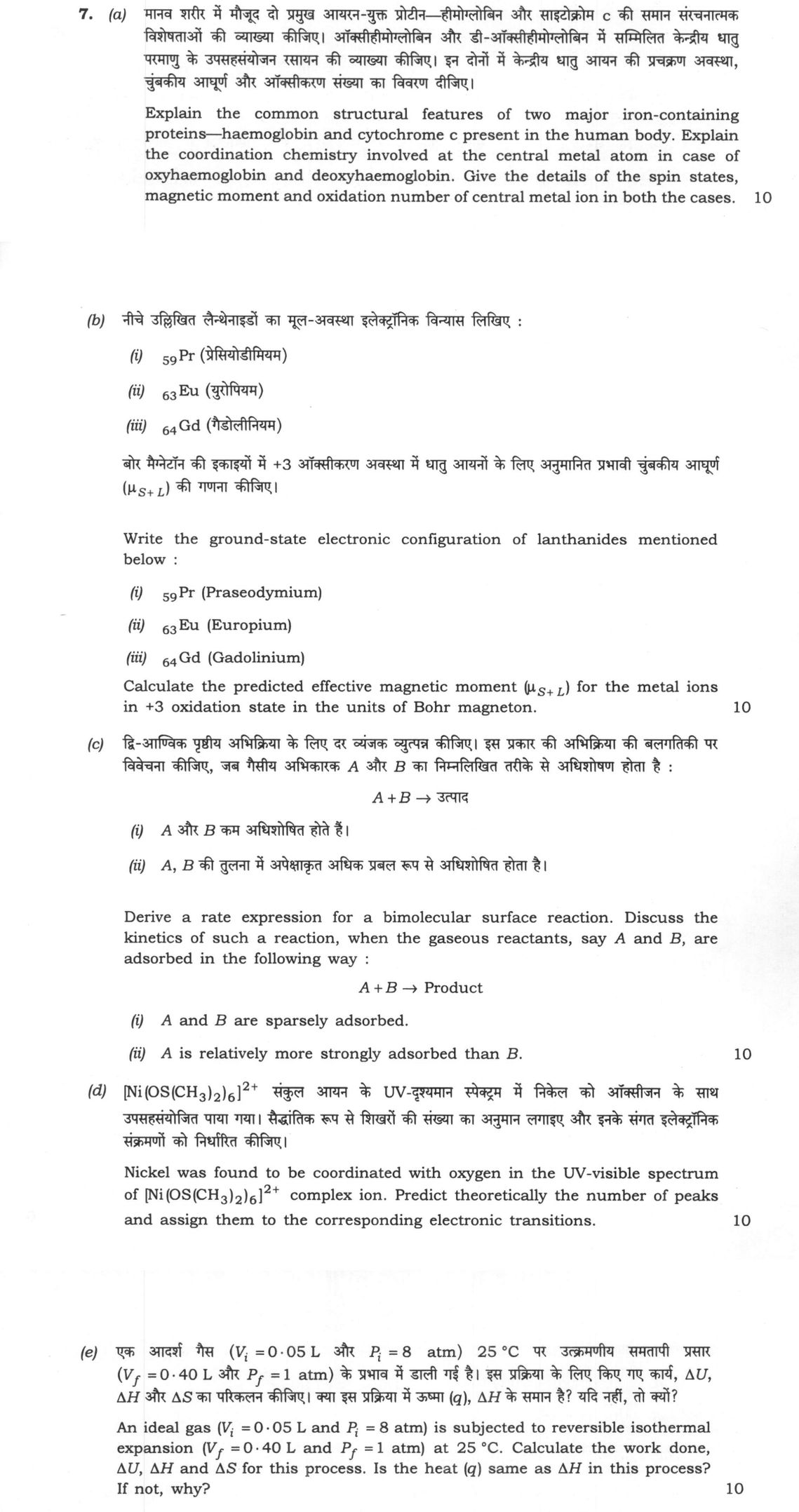
Explain the common structural features of two major iron-containing proteins—haemoglobin and cytochrome c present in the human body. Explain the coordination chemistry involved at the central metal atom in case of oxyhaemoglobin and deoxyhaemoglobin. Give the details of the spin states, magnetic moment and oxidation number of central metal ion in both the cases. 10 marks
Write the ground-state electronic configuration of lanthanides mentioned below: ₅₉Pr (Praseodymium)
₆₃Eu (Europium)
₆₄Gd (Gadolinium) Calculate the predicted effective magnetic moment (μₛ₊ₗ) for the metal ions in +3 oxidation state in the units of Bohr magneton. 10 marks
Derive a rate expression for a bimolecular surface reaction. Discuss the kinetics of such a reaction, when the gaseous reactants, say A and B, are adsorbed in the following way: A + B → Product A and B are sparsely adsorbed.
A is relatively more strongly adsorbed than B. 10 marks
Nickel was found to be coordinated with oxygen in the UV-visible spectrum of [Ni(OS(CH₃)₂)₆]²⁺ complex ion. Predict theoretically the number of peaks and assign them to the corresponding electronic transitions. 10 marks
An ideal gas (V_i = 0.05 L and P_i = 8 atm) is subjected to reversible isothermal expansion (V_f = 0.40 L and P_f = 1 atm) at 25 °C. Calculate the work done, ΔU, ΔH and ΔS for this process. Is the heat (q) same as ΔH in this process? If not, why? 10 marks
हिंदी में प्रश्न पढ़ें
मानव शरीर में मौजूद दो प्रमुख आयरन-युक्त प्रोटीन—हीमोग्लोबिन और साइटोक्रोम c की समान संरचनात्मक विशेषताओं की व्याख्या कीजिए। ऑक्सीहीमोग्लोबिन और डी-ऑक्सीहीमोग्लोबिन में सम्मिलित केंद्रीय धातु परमाणु के उपसहसंयोजन रसायन की व्याख्या कीजिए। इन दोनों में केंद्रीय धातु आयन की प्रचक्रण अवस्था, चुंबकीय आघूर्ण और ऑक्सीकरण संख्या का विवरण दीजिए। (10 अंक)
नीचे उल्लिखित लैन्थेनाइडों का मूल-अवस्था इलेक्ट्रॉनिक विन्यास लिखिए: ₅₉Pr (प्रेसियोडीमियम)
₆₃Eu (युरोपियम)
₆₄Gd (गैडोलीनियम) बोर मैग्नेटन की इकाइयों में +3 ऑक्सीकरण अवस्था में धातु आयनों के लिए अनुमानित प्रभावी चुंबकीय आघूर्ण (μₛ₊ₗ) की गणना कीजिए। (10 अंक)
द्वि-आण्विक पृष्ठीय अभिक्रिया के लिए दर व्यंजक व्युत्पन्न कीजिए। इस प्रकार की अभिक्रिया की बलगतिकी पर विवेचना कीजिए, जब गैसीय अभिकारक A और B का निम्नलिखित तरीके से अधिशोषण होता है: A + B → उत्पाद A और B कम अधिशोषित होते हैं।
A, B की तुलना में अपेक्षाकृत अधिक प्रबल रूप से अधिशोषित होता है। (10 अंक)
[Ni(OS(CH₃)₂)₆]²⁺ संकुल आयन के UV-दृश्यमान स्पेक्ट्रम में निकेल को ऑक्सीजन के साथ उपसहसंयोजित पाया गया। सैद्धांतिक रूप से शिखरों की संख्या का अनुमान लगाइए और इनके संगत इलेक्ट्रॉनिक संक्रमणों को निर्धारित कीजिए। (10 अंक)
एक आदर्श गैस (V_i = 0.05 L और P_i = 8 atm) 25 °C पर उत्क्रमणीय समतापी प्रसार (V_f = 0.40 L और P_f = 1 atm) के प्रभाव में डाली गई है। इस प्रक्रिया के लिए किए गए कार्य, ΔU, ΔH और ΔS का परिकलन कीजिए। क्या इस प्रक्रिया में ऊष्मा (q), ΔH के समान है? यदि नहीं, तो क्यों? (10 अंक)
Model answer
Written by UPSC Answer Check against this question's marking rubric, to the expected length. UPSC does not publish answers for Mains — this is one way to score well, not an official key.
The five parts are linked by the idea that structure fixes electronic state, surface coverage fixes rate, and state functions differ from path functions.
(a) Haemoglobin and cytochrome c. Both haemoglobin and cytochrome c are iron porphyrin proteins. In each, iron is held in a porphyrin ring, mainly through four nitrogen donors, and completes its coordination sphere with axial ligands from the protein. Haemoglobin contains heme b, with a proximal histidine and a distal histidine in the binding pocket; cytochrome c contains heme c, covalently attached to cysteine residues, with axial histidine and methionine ligands. The protein environment controls redox behaviour and ligand binding. Cytochrome c functions by cycling between Fe(II) and Fe(III) during electron transfer, whereas haemoglobin transports O₂ with iron remaining formally Fe(II).
In deoxyhaemoglobin, Fe(II) is five-coordinate: four porphyrin nitrogens plus the proximal histidine, with the distal site vacant. The ligand field is relatively weak, so the d⁶ ion is high-spin, paramagnetic, with μ ≈ √24 = 4.90 BM. In oxyhaemoglobin, O₂ binds at the distal site, making the iron six-coordinate. O₂ acts as a π-acceptor, and Fe→O₂ back-donation increases the splitting; the d⁶ ion becomes low-spin, t₂g⁶, diamagnetic, with μ = 0 BM. In both cases the formal oxidation number of iron is +2, although oxyhaemoglobin has important Fe(III)–superoxide resonance character.
(b) Lanthanide configurations and moments. The ground-state configurations are: Pr, ₅₉Pr: [Xe]4f³6s²; Eu, ₆₃Eu: [Xe]4f⁷6s²; Gd, ₆₄Gd: [Xe]4f⁷5d¹6s². In the +3 state: Pr³⁺ is [Xe]4f², Eu³⁺ is [Xe]4f⁶, and Gd³⁺ is [Xe]4f⁷.
For the requested μₛ₊ₗ expression, Pr³⁺ has S = 1 and L = 5, so μₛ₊ₗ = √[4S(S+1)+L(L+1)] = √[8+30] = √38 ≈ 6.16 BM. Gd³⁺ has S = 7/2 and L = 0, giving μₛ₊ₗ = √[4(7/2)(9/2)] = √63 ≈ 7.94 BM. Eu³⁺ is special: its ground term is ⁷F₀, with J = 0, so the zero-temperature spin–orbital ground-state moment is 0. The accepted room-temperature effective moment is about 3.4 BM because the low-lying ⁷F₁ level is thermally populated; it is not the spin-only 6.93 BM value.
(c) Surface reaction kinetics. For a Langmuir–Hinshelwood surface reaction, A and B first adsorb and then react on the surface: rate = kθ_Aθ_B. Using Langmuir adsorption, θ_A = K_A P_A/(1+K_A P_A) and θ_B = K_B P_B/(1+K_B P_B), so
rate = k K_A K_B P_A P_B / [(1+K_A P_A)(1+K_B P_B)].
If A and B are sparsely adsorbed, K_A P_A ≪ 1 and K_B P_B ≪ 1, so the denominator is approximately 1. The rate becomes rate ≈ k K_A K_B P_A P_B, first order in both A and B. If A is relatively more strongly adsorbed than B, θ_A approaches unity while B remains weakly adsorbed, so θ_B ≈ K_B P_B. The rate then becomes rate ≈ k K_B P_B, independent of P_A and first order in P_B.
(d) Spectrum of [Ni(OS(CH₃)₂)₆]²⁺. In this complex, DMSO coordinates through oxygen, giving an octahedral Ni(II) centre with a d⁸ configuration. For an octahedral d⁸ ion, the ground term is ³A₂g. The theoretically expected spin-allowed d–d transitions are three: ³A₂g → ³T₂g (ν₁), ³A₂g → ³T₁g(F) (ν₂), and ³A₂g → ³T₁g(P) (ν₃). Because O-donor DMSO is a weak-field ligand, Δ_o is relatively small, so the bands lie in the visible/near-UV region. Weak spin-forbidden bands may appear, but the principal theoretical count is three spin-allowed peaks.
(e) Isothermal reversible expansion. For the ideal gas, n = P_iV_i/RT = (8 atm × 0.05 L)/(0.0821 L atm mol⁻¹ K⁻¹ × 298 K) ≈ 0.0163 mol. For reversible isothermal expansion,
w = −nRT ln(V_f/V_i) = −nRT ln(0.40/0.05) = −nRT ln 8.
Using nRT = P_iV_i = 0.40 L atm, w = −0.40 × 2.079 = −0.832 L atm ≈ −84.3 J. Thus the work done by the gas is +84.3 J. For an ideal gas at constant temperature, ΔU = 0 and ΔH = 0, because both depend only on temperature. The entropy change is
ΔS = nR ln(V_f/V_i) = 0.0163 × 8.314 × 2.079 ≈ 0.282 J K⁻¹.
For a reversible isothermal process, q = −w = +84.3 J. The heat is not the same as ΔH here because ΔH = q only at constant pressure with only PV work. This expansion is isothermal but not isobaric; pressure falls from 8 atm to 1 atm, while ΔH remains zero for the ideal gas.
Thus, ligand field and protein environment control spin and magnetism, adsorption coverage controls surface reaction order, and isothermal ideal-gas behaviour fixes ΔU and ΔH while heat and work remain path-dependent.
What "Explain" is asking you to do
Make the working of something clear — what sets it off, what follows from what, and what it produces. Explain is the Commission's mechanism word: it dominates the technical papers and the “explain why” stems, where the marks sit in the causal chain and not in the label.
Structure that answers it
State what it is → the initiating condition → the chain of cause, step by step → an instance where it plays out → what the chain produces
Where marks are lost
Describing what something looks like instead of why it works that way. Naming the stages without linking them reads as description too.
How this answer will be evaluated
Approach
Framework: Concept > Structure or mechanism > Reasoning > Result. (a) explain: definition/context > points in order > small example > short close | (b) calculate: given > formula > substitution > result with units > interpretation | (c) derive: given > assumptions > stepwise derivation > result > check | (d) analyse: intro > causes > effects > stakeholders/linkages > way forward | (e) calculate: given > formula > substitution > result with units > interpretation Full marks: Complete derivations, correct values, clear reasoning, all parts fully addressed
Key points expected
- Common features: globin fold, heme/cytochrome cofactor, Fe(II) center
- Oxy-Hb: Fe(II) low spin, 6-coordinate, diamagnetic
- Deoxy-Hb: Fe(II) high spin, 5-coordinate, paramagnetic
- Oxidation state of Fe is +2 in both cases
- Correct ground-state configurations for Pr, Eu, Gd
- Correct +3 ion configurations (e.g., Pr³⁺ 4f²)
- Application of μ = √(4S(S+1) + L(L+1)) formula
- Final values in Bohr magnetons (BM)
Evaluation rubric
Each sub-part is marked on its own, against the marks and word limit printed on the paper.
- (a) Common structural features of Hb/Cyt c and coordination chemistry of Fe in oxy/deoxy-Hb. 10 marks
explain— definition/context → points in order → small example → short close
Must cover
- Common features: globin fold, heme/cytochrome cofactor, Fe(II) center
- Oxy-Hb: Fe(II) low spin, 6-coordinate, diamagnetic
- Deoxy-Hb: Fe(II) high spin, 5-coordinate, paramagnetic
- Oxidation state of Fe is +2 in both cases
Loses marks
- Confusing Fe(II) with Fe(III)
- Omitting spin state details
- Failing to distinguish 5 vs 6 coordination
Earns more
- Mention of proximal histidine ligation
- Mention of porphyrin ring structure
- Mention of spin crossover mechanism
Extra mark
- Diagram of heme pocket showing Fe displacement
- (b) Ground-state electronic configurations of Pr, Eu, Gd and magnetic moments for +3 ions. 10 marks
calculate— given → formula → substitution → result with units → interpretation
Must cover
- Correct ground-state configurations for Pr, Eu, Gd
- Correct +3 ion configurations (e.g., Pr³⁺ 4f²)
- Application of μ = √(4S(S+1) + L(L+1)) formula
- Final values in Bohr magnetons (BM)
Loses marks
- Incorrect 4f electron count
- Using spin-only formula instead of total moment
- Arithmetic errors in L or S summation
Earns more
- Correct determination of L and S values
- Mention of Hund's rules application
Extra mark
- Comparison of calculated vs experimental moments
- (c) Rate expression for bimolecular surface reaction A+B and discussion of kinetics. 10 marks
derive— given → assumptions → stepwise derivation → result → check
Must cover
- Langmuir-Hinshelwood mechanism derivation
- Case (i): Rate ∝ P_A P_B (low coverage)
- Case (ii): Rate ∝ P_B (A strongly adsorbed)
- Assumption of quasi-equilibrium adsorption
Loses marks
- Missing the derivation steps
- Incorrect dependence on partial pressures
- Confusing adsorption with reaction rate
Earns more
- Explicit definition of surface coverage θ
- Mention of surface reaction as rate-determining step
Extra mark
- Mention of Eley-Rideal mechanism as alternative
- (d) Theoretical prediction of UV-vis peaks and assignment of electronic transitions for [Ni(OS(CH₃)₂)₆]²⁺. 10 marks
analyse— intro → causes → effects → stakeholders/linkages → way forward
Must cover
- Identification of Ni(II) d⁸ configuration
- Prediction of number of d-d transitions
- Assignment of peaks to specific transitions
- Consideration of ligand field splitting
Loses marks
- Incorrect d-electron count
- Failing to assign specific transitions
- Ignoring ligand field effects
Earns more
- Mention of charge transfer bands
- Discussion of geometry (octahedral vs square planar)
Extra mark
- Specific energy values for transitions
- (e) Work, ΔU, ΔH, ΔS for reversible isothermal expansion and comparison of q vs ΔH. 10 marks
calculate— given → formula → substitution → result with units → interpretation
Must cover
- Calculation of work w = -nRT ln(Vf/Vi)
- ΔU = 0 for isothermal ideal gas
- ΔH = 0 for isothermal ideal gas
- Calculation of ΔS = nR ln(Vf/Vi)
Loses marks
- Non-zero ΔU or ΔH for isothermal process
- Incorrect work formula
- Failing to explain q vs ΔH difference
Earns more
- Correct use of ideal gas law for n
- Explanation that q = -w for isothermal process
Extra mark
- Mention of entropy of surroundings
Practice this exact question
Write your answer and it is marked point by point against the model answer above — what you covered, what you missed, what you got wrong.
Evaluate my answer →More from Chemistry 2023 Paper I
- Q4 (a) The volume of a certain gas is found to be 5.0×10⁻⁴ m³ mol⁻¹ at 273 K and 3.0×10⁶ Pa.…
- Q5 The decomposition of AB₂ to AB and B is a first-order reaction with k = 2·8 × 10⁻⁷ s⁻¹ at…
- Q6 Complete the following reactions and draw the structure of the major product(s) formed: (…
- Q7 (a) Explain the common structural features of two major iron-containing proteins—haemoglo…
- Q8 (a) Sketch the synthesis of [Fe(η⁵-C₅H₅)(η⁵-C₅H₄COCH₃)] and [Fe(η⁵-C₅H₅)(η⁵-C₅H₄COOH)] co…