Paper I — Q3
(a) Determine the electronic and molecular geometry of [BrF₅] and [ICl₂]⁻ interhalogen compounds. 10 (b) Answer the following…
Determine the electronic and molecular geometry of [BrF₅] and [ICl₂]⁻ interhalogen compounds. 10 marks
Answer the following questions based on the phase diagram given below : How many components does this phase diagram represent?
Identify the points A to D with corresponding degrees of freedom.
Explain the changes expected in the paths E → B → H and E → F → G → H. 20 marks
Consider the reaction H₂(g) + ½O₂(g) → H₂O(l), which occurs in a H₂–O₂ fuel cell. Identify the elements that undergo oxidation and reduction.
Calculate the standard reaction Gibbs free energy (ΔᵣG°) at 25 °C.
Write down the two reduction half-reactions for the cell.
Calculate the E_cell. Given that Δ_fH°(H₂O, l) = –285.83 kJ mol⁻¹ S°_m(H₂O, l) = 69.91 J K⁻¹ mol⁻¹ S°_m(H₂, g) = 130.68 J K⁻¹ mol⁻¹ S°_m(O₂, g) = 205.14 J K⁻¹ mol⁻¹ 20
हिंदी में प्रश्न पढ़ें
[BrF₅] और [ICl₂]⁻ अंतर्हैलोजन यौगिकों की इलेक्ट्रॉनिक और आणविक ज्यामिति निर्धारित कीजिए। 10
निम्नलिखित प्रश्नों के उत्तर दीजिए, जो कि नीचे दिए गए प्रावस्था आरेख पर आधारित हैं : यह प्रावस्था आरेख कितने घटकों को दर्शाता है?
संगत स्वातंत्र्य कोटि के साथ A से D तक के बिंदुओं की पहचान कीजिए।
पथ E → B → H और E → F → G → H में अपेक्षित परिवर्तनों की व्याख्या कीजिए। 20
अभिक्रिया H₂(g) + ½O₂(g) → H₂O(l) पर विचार कीजिए, जो कि एक H₂–O₂ ईंधन सेल में होती है। उन तत्वों को पहचानिए जिनमें ऑक्सीकरण और अपचयन होता है।
25 °C पर मानक अभिक्रिया गिब्स मुक्त ऊर्जा (ΔᵣG°) का परिकलन कीजिए।
सेल की दो अपचयन अर्ध-अभिक्रियाएँ लिखिए।
E°सेल का परिकलन कीजिए। दिया गया है कि ΔᶠH°(H₂O, l) = –285·83 kJ mol⁻¹ S°ₘ(H₂O, l) = 69·91 J K⁻¹ mol⁻¹ S°ₘ(H₂, g) = 130·68 J K⁻¹ mol⁻¹ S°ₘ(O₂, g) = 205·14 J K⁻¹ mol⁻¹ 20
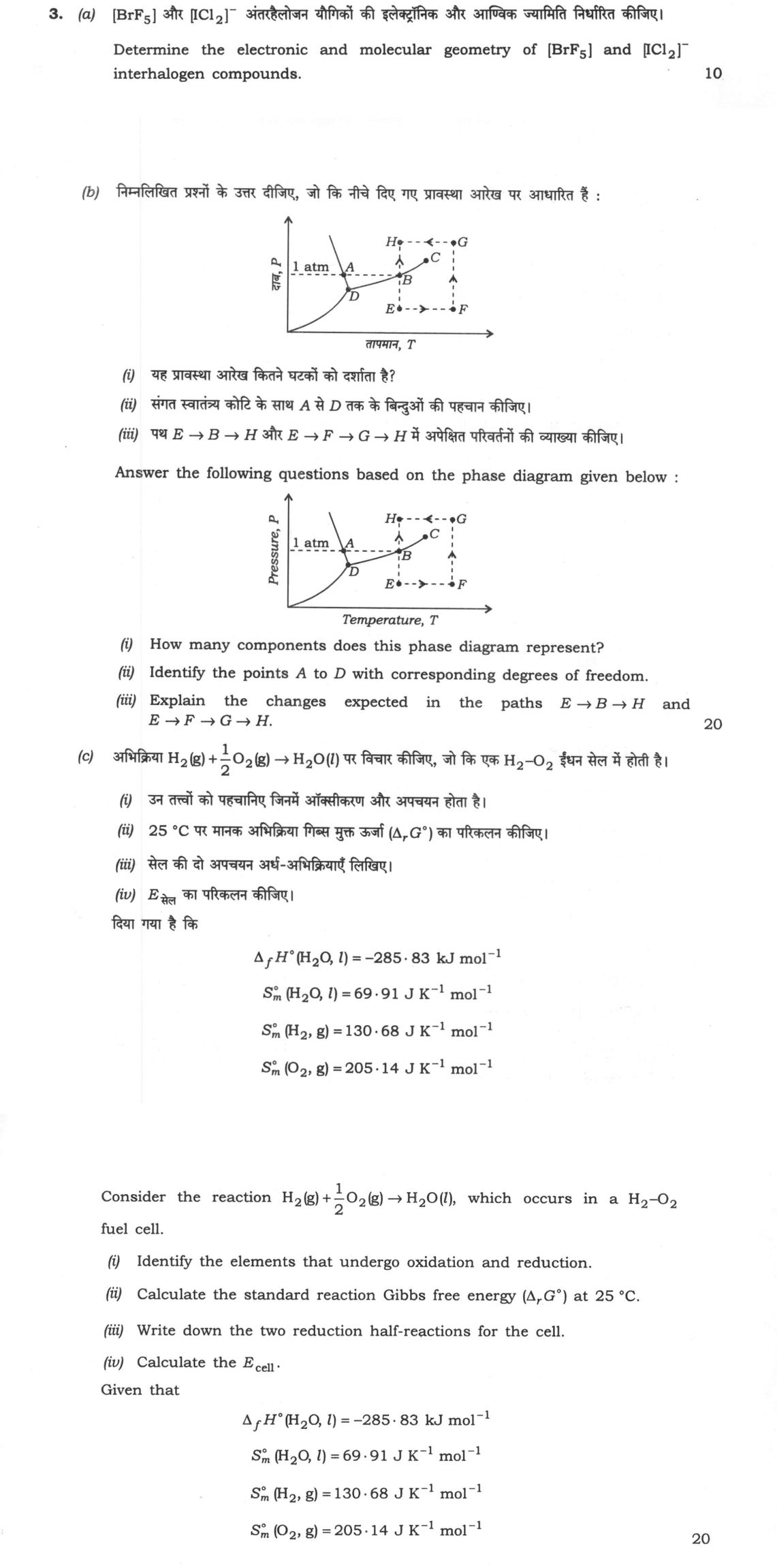
The figure this question refers to, in words
The question paper is a scan and the diagram did not survive as text. This is the figure as read from the original page — every component, value and label — so the question can be worked from the text below.
(b) A phase diagram with Pressure (P) on the vertical axis and Temperature (T) on the horizontal axis. A horizontal dashed line indicates a pressure of 1 atm. The diagram features a solid curve rising from the bottom left, representing the sublimation curve, which meets a liquid-vapor curve at a point labeled D (the triple point). The liquid-vapor curve extends to the right, passing through points B and C. A steep solid line extends upwards from point D, representing the melting curve, passing through point A. Several specific points are marked: A is on the melting curve at 1 atm; B is on the liquid-vapor curve at 1 atm; C is on the liquid-vapor curve at a higher temperature than B; D is the triple point. There are also points E, F, G, and H located in the gas phase region. Dashed arrows indicate specific paths: a vertical arrow from E to B, a vertical arrow from B to H, a horizontal arrow from E to F, a vertical arrow from F to G, and a horizontal arrow from G to H.
Model answer
Written by UPSC Answer Check against this question's marking rubric, to the expected length. UPSC does not publish answers for Mains — this is one way to score well, not an official key.
(a) Use VSEPR: steric number = σ bonds + lone pairs on the central atom; electron-pair geometry minimises repulsions, and molecular geometry is obtained by ignoring lone pairs.
- BrF₅: Br has 7 valence e⁻. Five Br–F σ bonds use 5 e⁻, leaving 2 e⁻ as one lone pair. Steric number = 5 + 1 = 6. The six electron pairs are octahedral; one site is a lone pair, so the five F atoms form a square base and one apex. Final: BrF₅ has electronic geometry octahedral and molecular geometry square pyramidal (AX₅E).
- [ICl₂]⁻: I has 7 valence e⁻; the negative charge adds 1 e⁻, and two I–Cl σ bonds account for 2 e⁻, giving (7 + 2 + 1)/2 = 5 electron pairs on I: two bonding pairs and three lone pairs. Steric number = 2 + 3 = 5. Electron-pair geometry is trigonal bipyramidal; the three lone pairs occupy equatorial positions, leaving the two Cl atoms axial. Final: [ICl₂]⁻ has electronic geometry trigonal bipyramidal and molecular geometry linear (AX₂E₃).
(b)(i) A component is an independent chemical constituent. The diagram has only one chemical species, one set of solid–liquid, liquid–vapour and sublimation curves, and one triple point; there is no composition axis. A binary system would require a third variable, usually composition. Final: the phase diagram represents one component, C = 1.
(b)(ii) Use Gibbs phase rule: F = C − φ + 2, where φ is the number of coexisting phases; valid for a non-reactive system with only T and P as intensive variables. For C = 1, F = 3 − φ.
- A: solid + liquid on the melting curve, φ = 2, so F = 1. At 1 atm it is the normal melting point.
- B: liquid + vapour on the liquid–vapour curve, φ = 2, so F = 1. At 1 atm it is the normal boiling point.
- C: liquid + vapour on the liquid–vapour curve at higher T, φ = 2, so F = 1.
- D: triple point, solid + liquid + vapour, φ = 3, so F = 0. Final: A, B and C each have F = 1; D has F = 0.
(b)(iii) In the diagram, E, F, G and H lie in the gas region; a vertical segment is isothermal and a horizontal segment is isobaric.
- Path E → B → H: E → B is isothermal compression of the gas until the liquid–vapour curve is reached at B. The gas becomes saturated; at B liquid and vapour coexist, so φ = 2 and F = 1. B → H is isothermal decompression into the gas region, so any liquid formed at B evaporates; H is a single gas phase, F = 2.
- Path E → F → G → H: E → F is an isobaric temperature change, F → G is an isothermal pressure change, and G → H is an isobaric temperature change. Since the drawn route lies in the gas region, it remains a single gas phase, F = 2 throughout. No melting, condensation, or sublimation occurs. Final: the only phase change in the first path is at B; the second route remains entirely gaseous.
(c)(i) Oxidation states: H in H₂(g) is 0 and in H₂O(l) is +1, so hydrogen loses electrons and is oxidised. O in O₂(g) is 0 and in H₂O(l) is −2, so oxygen gains electrons and is reduced. Final: H is oxidised; O is reduced.
(c)(ii) Use ΔᵣG° = ΔᵣH° − TΔᵣS° at T = 298.15 K. Standard enthalpies of formation of H₂(g) and O₂(g) in their reference states are zero; standard states are pure gases at the standard pressure and pure liquid water. ΔᵣH° = ΔfH°(H₂O,l) − [ΔfH°(H₂,g) + ½ΔfH°(O₂,g)] = −285.83 kJ mol⁻¹ − [0 + 0] = −285.83 kJ mol⁻¹. ΔᵣS° = S°ₘ(H₂O,l) − [S°ₘ(H₂,g) + ½S°ₘ(O₂,g)] = 69.91 J K⁻¹ mol⁻¹ − [130.68 + ½(205.14)] J K⁻¹ mol⁻¹ = 69.91 J K⁻¹ mol⁻¹ − 233.25 J K⁻¹ mol⁻¹ = −163.34 J K⁻¹ mol⁻¹. TΔᵣS° = 298.15 K × (−163.34 J K⁻¹ mol⁻¹) = −48.70 kJ mol⁻¹. ΔᵣG° = −285.83 kJ mol⁻¹ − (−48.70 kJ mol⁻¹) = −237.13 kJ mol⁻¹. Final: ΔᵣG° = −237.13 kJ mol⁻¹ at 25 °C.
(c)(iii) In the acidic standard-state convention, the two reduction half-reactions are:
- Hydrogen couple: 2H⁺(aq) + 2e⁻ → H₂(g)
- Oxygen/water couple: ½O₂(g) + 2H⁺(aq) + 2e⁻ → H₂O(l) In the operating H₂–O₂ fuel cell, the hydrogen couple runs in reverse: H₂(g) → 2H⁺(aq) + 2e⁻, while the oxygen/water couple runs as written. Final: the two reduction half-reactions are the hydrogen and oxygen/water couples above.
(c)(iv) Use ΔᵣG° = −nFE°cell, valid for a reversible cell under standard conditions. For the reaction as written, H₂ loses 2 e⁻, so n = 2 mol e⁻ per mol reaction; Faraday constant F = 96485 C mol⁻¹. E°cell = −ΔᵣG°/(nF) = −(−237.13 × 10³ J mol⁻¹)/(2 × 96485 C mol⁻¹) = 237130 J mol⁻¹ / 192970 C mol⁻¹ = 1.229 V. Final: E°cell = 1.229 V at 25 °C, standard states.
What "Calculate" is asking you to do
Apply the standard formula or schedule to data the question has already supplied — a table of readings, cost records, a balance sheet — and produce the number. The method is rarely in doubt; the marks sit in the named intermediate quantities, each of which has to appear as a labelled line.
Structure that answers it
Data as given → formula or standard treatment, named → substitution → each intermediate, labelled → result with units
Where marks are lost
Omitting an intermediate the marking scheme pays for separately, or rounding at an intermediate line so the final figure drifts. In commerce and accountancy, any figure in a statement that no numbered working note supports is treated as unearned.
How this answer will be evaluated
Approach
Framework: VSEPR Theory and Gibbs Free Energy. (a) calculate: given > formula > substitution > result with units > interpretation | (b(i)) calculate: given > formula > substitution > result with units > interpretation | (b(ii)) calculate: given > formula > substitution > result with units > interpretation | (b(iii)) explain: definition/context > points in order > small example > short close | (c(i)) calculate: given > formula > substitution > result with units > interpretation | (c(ii)) calculate: given > formula > substitution > result with units > interpretation | (c(iii)) calculate: given > formula > substitution > result with units > interpretation | (c(iv)) calculate: given > formula > substitution > result with units > interpretation Full marks: Accurate VSEPR, correct phase diagram analysis, and precise thermodynamic calculations with full working.
Key points expected
- VSEPR calculation for [BrF5] (AX5E2)
- VSEPR calculation for [ICl2]- (AX2E3)
- Correct molecular shape for each
- Correct electronic geometry for each
- Identification of single component system
- Identification of A, B, C, D (Triple, Boiling, Critical, Melting)
- Correct degrees of freedom for each point
- Description of phase changes for E→B→H
Evaluation rubric
Each sub-part is marked on its own, against the marks and word limit printed on the paper.
- (a) Electronic and molecular geometry for [BrF5] and [ICl2]- 10 marks
calculate— given → formula → substitution → result with units → interpretation
Must cover
- VSEPR calculation for [BrF5] (AX5E2)
- VSEPR calculation for [ICl2]- (AX2E3)
- Correct molecular shape for each
- Correct electronic geometry for each
Loses marks
- Confusing electronic and molecular geometry
- Incorrect counting of lone pairs
Earns more
- Mention of hybridization (sp3d2, sp3d)
Extra mark
- Sketch of the molecular geometry
- (b(i)) Number of components represented by the phase diagram
calculate— given → formula → substitution → result with units → interpretation
Must cover
- Identification of single component system
Loses marks
- Confusing components with phases
Earns more
- Reference to Gibbs Phase Rule
- (b(ii)) Identification of points A-D with degrees of freedom
calculate— given → formula → substitution → result with units → interpretation
Must cover
- Identification of A, B, C, D (Triple, Boiling, Critical, Melting)
- Correct degrees of freedom for each point
Loses marks
- Incorrect assignment of points to phase boundaries
Earns more
- Application of F = C - P + 2
- (b(iii)) Changes expected in paths E→B→H and E→F→G→H
explain— definition/context → points in order → small example → short close
Must cover
- Description of phase changes for E→B→H
- Description of phase changes for E→F→G→H
- Identification of isothermal/isobaric steps
Loses marks
- Ignoring the direction of the arrows
Earns more
- Mention of latent heat or energy change
- (c(i)) Elements undergoing oxidation and reduction
calculate— given → formula → substitution → result with units → interpretation
Must cover
- Identification of H as oxidized
- Identification of O as reduced
Loses marks
- Reversing oxidation and reduction
Earns more
- Change in oxidation states
- (c(ii)) Standard reaction Gibbs free energy (ΔrG°) at 25 °C
calculate— given → formula → substitution → result with units → interpretation
Must cover
- Calculation of ΔrS°
- Calculation of ΔrH°
- Application of ΔG = ΔH - TΔS
- Correct final value with units
Loses marks
- Unit mismatch (J vs kJ)
- Arithmetic error in entropy calculation
Earns more
- Correct sign convention for entropy change
- (c(iii)) Two reduction half-reactions for the cell
calculate— given → formula → substitution → result with units → interpretation
Must cover
- Cathode reduction half-reaction
- Anode reduction half-reaction (reverse of oxidation)
Loses marks
- Writing oxidation instead of reduction for anode
Earns more
- Balancing of electrons
- (c(iv)) Cell potential (Ecell)
calculate— given → formula → substitution → result with units → interpretation
Must cover
- Use of ΔG = -nFE
- Correct value of n (moles of electrons)
- Correct final value with units
Loses marks
- Incorrect value of n
- Sign error in potential
Earns more
- Use of Faraday's constant
Practice this exact question
Write your answer and it is marked point by point against the model answer above — what you covered, what you missed, what you got wrong.
Evaluate my answer →More from Chemistry 2023 Paper I
- Q1 (a) (i) Find the wavelength of the emitted light when 1.0×10⁻²⁷ g particle in a one-dimen…
- Q2 (a) Using the Gibbs equation for a closed system in the absence of non-expansion work at…
- Q3 (a) Determine the electronic and molecular geometry of [BrF₅] and [ICl₂]⁻ interhalogen co…
- Q4 (a) The volume of a certain gas is found to be 5.0×10⁻⁴ m³ mol⁻¹ at 273 K and 3.0×10⁶ Pa.…
- Q5 The decomposition of AB₂ to AB and B is a first-order reaction with k = 2·8 × 10⁻⁷ s⁻¹ at…
- Q6 Complete the following reactions and draw the structure of the major product(s) formed: (…