Paper I — Q6
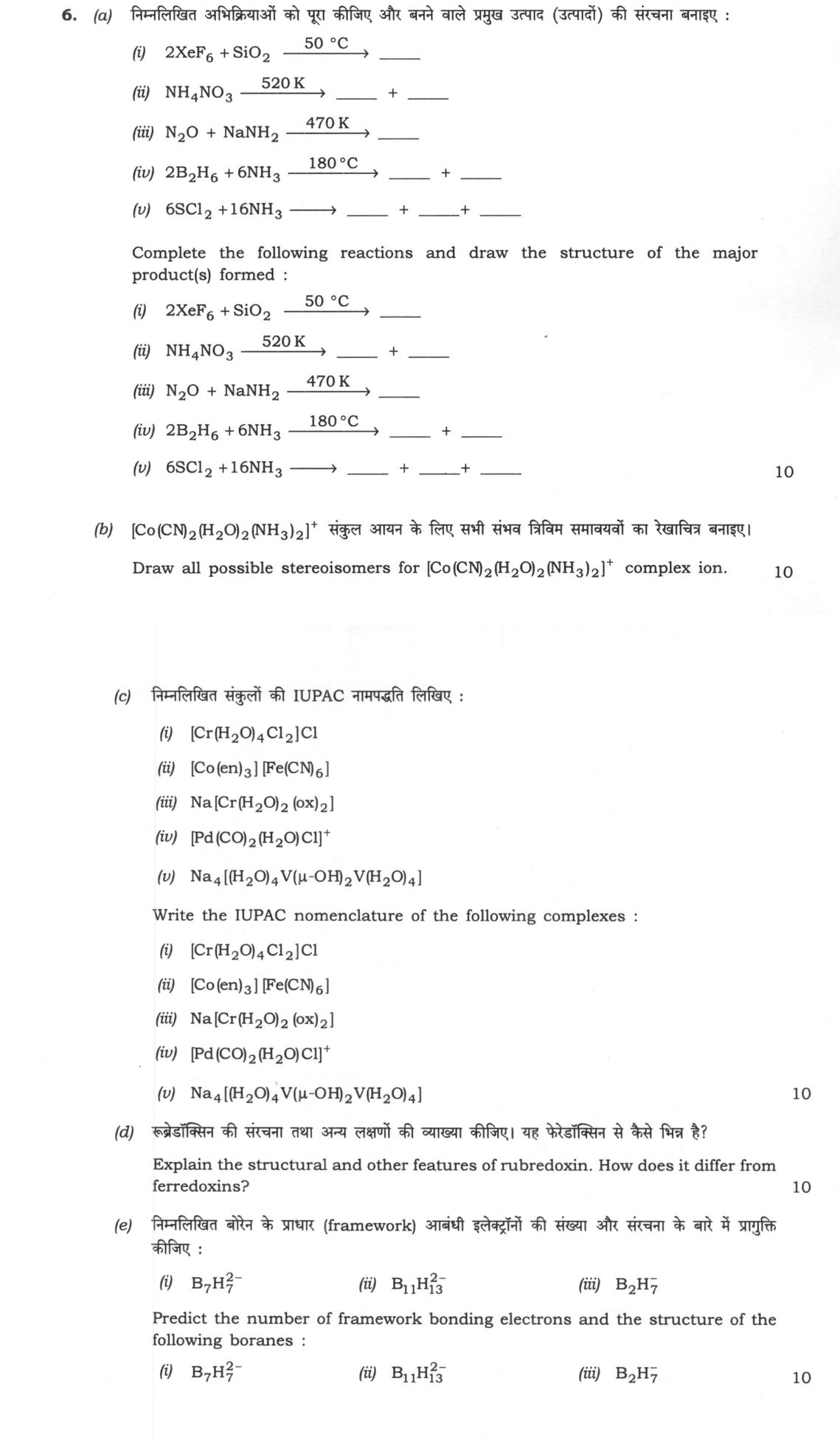
Complete the following reactions and draw the structure of the major product(s) formed: (i) 2XeF₆ + SiO₂ → ____ 50 °C (ii)…
Complete the following reactions and draw the structure of the major product(s) formed:
2XeF₆ + SiO₂ → ____ 50 °C
NH₄NO₃ → ____ + ____ 520 K
N₂O + NaNH₂ → ____ 470 K
2B₂H₆ + 6NH₃ → ____ + ____ 180°C
6SCl₂ + 16NH₃ → ____ + ____ + ____
Draw all possible stereoisomers for [Co(CN)₂(H₂O)₂(NH₃)₂]⁺ complex ion.
Write the IUPAC nomenclature of the following complexes:
[Cr(H₂O)₄Cl₂]Cl
[Co(en)₃][Fe(CN)₆]
Na[Cr(H₂O)₂(ox)₂]
[Pd(CO)₂(H₂O)Cl]⁺
Na₄[(H₂O)₄V(μ-OH)₂V(H₂O)₄]
Explain the structural and other features of rubredoxin. How does it differ from ferredoxins?
Predict the number of framework bonding electrons and the structure of the following boranes:
B₇H₇²⁻ (ii) B₁₁H₁₃²⁻ (iii) B₂H₇⁻
हिंदी में प्रश्न पढ़ें
निम्नलिखित अभिक्रियाओं को पूरा कीजिए और बनने वाले प्रमुख उत्पाद (उत्पादों) की संरचना बनाइए :
2XeF₆ + SiO₂ → ____ 50 °C
NH₄NO₃ → ____ + ____ 520 K
N₂O + NaNH₂ → ____ 470 K
2B₂H₆ + 6NH₃ → ____ + ____ 180°C
6SCl₂ + 16NH₃ → ____ + ____ + ____
[Co(CN)₂(H₂O)₂(NH₃)₂]⁺ संकुल आयन के लिए सभी संभव त्रिविम समावयवों का रेखाचित्र बनाइए।
निम्नलिखित संकुलों की IUPAC नामपद्धति लिखिए :
[Cr(H₂O)₄Cl₂]Cl
[Co(en)₃][Fe(CN)₆]
Na[Cr(H₂O)₂(ox)₂]
[Pd(CO)₂(H₂O)Cl]⁺
Na₄[(H₂O)₄V(μ-OH)₂V(H₂O)₄]
रुब्रेडॉक्सिन की संरचना तथा अन्य लक्षणों की व्याख्या कीजिए। यह फेरडॉक्सिन से कैसे भिन्न है?
निम्नलिखित बोरेन के प्राधार (framework) आबंधी इलेक्ट्रॉनों की संख्या और संरचना के बारे में प्रागुक्ति कीजिए :
B₇H₇²⁻ (ii) B₁₁H₁₃²⁻ (iii) B₂H₇⁻
The figure this question refers to, in words
The question paper is a scan and the diagram did not survive as text. This is the figure as read from the original page — every component, value and label — so the question can be worked from the text below.
(a) Reaction (i): 2XeF6 + SiO2, with reaction condition 50 degrees C written above the arrow, followed by a blank line for the product. Reaction (ii): NH4NO3, with reaction condition 520 K written above the arrow, followed by a blank line, a plus sign, and a second blank line for products. Reaction (iii): N2O + NaNH2, with reaction condition 470 K written above the arrow, followed by a blank line for the product. Reaction (iv): 2B2H6 + 6NH3, with reaction condition 180 degrees C written above the arrow, followed by a blank line, a plus sign, and a second blank line for products. Reaction (v): 6SCl2 + 16NH3, followed by an arrow and three blank lines separated by plus signs for products.
(b) The chemical formula for a complex ion: [Co(CN)2(H2O)2(NH3)2]+. The text asks to draw all possible stereoisomers for this complex ion.
What "Draw" is asking you to do
Produce the diagram as the answer, not as an ornament to it. Where the question lists several items — circuit, function table, logic symbol, structure — each is separately marked, and the lines of text must refer to the diagram through its own labels.
Structure that answers it
Diagram drawn large and clean → every part, axis and terminal labelled → caption → two or three lines tying it to what was asked
Where marks are lost
Delivering part of the list and leaving the rest, which forfeits those marks directly. In chemistry, a flat sketch where the geometry or stereochemistry was the point; in engineering, unlabelled terminals, missing polarity, or no sign convention stated.
How this answer will be evaluated
Approach
(a) enumerate: list the items in order > one line each > no commentary | (b) enumerate: list the items in order > one line each > no commentary | (c) enumerate: list the items in order > one line each > no commentary | (d) explain: definition/context > points in order > small example > short close | (e) calculate: given > formula > substitution > result with units > interpretation Full marks: All parts fully correct with mechanisms, structures, and reasoning; no errors in nomenclature or electron counting
Key points expected
- Correct products for all five reactions
- Structure drawn for major product(s) where applicable
- Correct stoichiometry and balancing
- Correct reaction conditions noted
- All geometric isomers drawn
- All optical isomers (enantiomers) shown
- Correct coordination geometry (octahedral)
- Stereochemical notation (wedge/dash) used
Evaluation rubric
Each sub-part is marked on its own, against the marks and word limit printed on the paper.
- (a) Complete five inorganic reactions and draw the structure of the major product(s). 10 marks
enumerate— list the items in order → one line each → no commentary
Must cover
- Correct products for all five reactions
- Structure drawn for major product(s) where applicable
- Correct stoichiometry and balancing
- Correct reaction conditions noted
Loses marks
- Wrong product without mechanism
- Unbalanced equations
- Missing structures for major products
Earns more
- Mechanism or intermediate shown for complex reactions
- Correct oxidation states indicated
- Stereochemistry shown where relevant
- By-products correctly identified
Extra mark
- Named reaction mechanism cited
- Alternative valid products mentioned
- (b) Draw all possible stereoisomers for [Co(CN)₂(H₂O)₂(NH₃)₂]⁺ complex ion. 10 marks
enumerate— list the items in order → one line each → no commentary
Must cover
- All geometric isomers drawn
- All optical isomers (enantiomers) shown
- Correct coordination geometry (octahedral)
- Stereochemical notation (wedge/dash) used
Loses marks
- Missing enantiomer pairs
- Incorrect coordination geometry
- Confusing ligand positions
Earns more
- Isomer names or labels provided
- Symmetry elements identified
- Chirality clearly indicated
- Trans/cis relationships labeled
Extra mark
- Magnetic properties mentioned
- Spectroscopic distinctions noted
- (c) Write the IUPAC nomenclature of five given coordination complexes. 10 marks
enumerate— list the items in order → one line each → no commentary
Must cover
- Correct IUPAC name for each complex
- Ligands named in correct order
- Oxidation state of metal indicated
- Counter ions named correctly
Loses marks
- Wrong ligand order
- Missing oxidation state
- Incorrect counter ion naming
Earns more
- Correct use of prefixes (di, tri, etc.)
- Bidentate ligands named properly
- Anionic ligands with -o suffix
- Correct punctuation and spacing
Extra mark
- Alternative valid names mentioned
- Structural formula drawn alongside
- (d) Explain structural and other features of rubredoxin and how it differs from ferredoxins. 10 marks
explain— definition/context → points in order → small example → short close
Must cover
- Rubredoxin structure described (Fe-S cluster)
- Key features of rubredoxin explained
- Clear comparison with ferredoxins
- Differences in structure/function highlighted
Loses marks
- Confusing rubredoxin with ferredoxin
- Missing structural details
- No clear comparison made
Earns more
- Redox properties discussed
- Biological role mentioned
- Electron transfer mechanism explained
- Spectroscopic properties noted
Extra mark
- Specific protein examples named
- Evolutionary significance mentioned
- (e) Predict the number of framework bonding electrons and structure of three boranes. 10 marks
calculate— given → formula → substitution → result with units → interpretation
Must cover
- Correct electron count for each borane
- Structure predicted using Wade's rules
- Framework bonding electrons calculated
- Correct polyhedral geometry assigned
Loses marks
- Wrong electron count
- Incorrect structure assignment
- Missing framework electron calculation
Earns more
- Step-by-step electron counting shown
- Wade's rules explicitly applied
- 3D structure drawn or described
- Charge correctly accounted for
Extra mark
- Molecular orbital diagram sketched
- Comparison with related boranes
Model answer coming soon
Every evaluation on this site is marked against a verified model answer. This question's answer is still being written; evaluation opens the moment it lands.
More from Chemistry 2023 Paper I
- Q3 (a) Determine the electronic and molecular geometry of [BrF₅] and [ICl₂]⁻ interhalogen co…
- Q4 (a) The volume of a certain gas is found to be 5.0×10⁻⁴ m³ mol⁻¹ at 273 K and 3.0×10⁶ Pa.…
- Q5 The decomposition of AB₂ to AB and B is a first-order reaction with k = 2·8 × 10⁻⁷ s⁻¹ at…
- Q6 Complete the following reactions and draw the structure of the major product(s) formed: (…
- Q7 (a) Explain the common structural features of two major iron-containing proteins—haemoglo…
- Q8 (a) Sketch the synthesis of [Fe(η⁵-C₅H₅)(η⁵-C₅H₄COCH₃)] and [Fe(η⁵-C₅H₅)(η⁵-C₅H₄COOH)] co…