Paper I — Q5
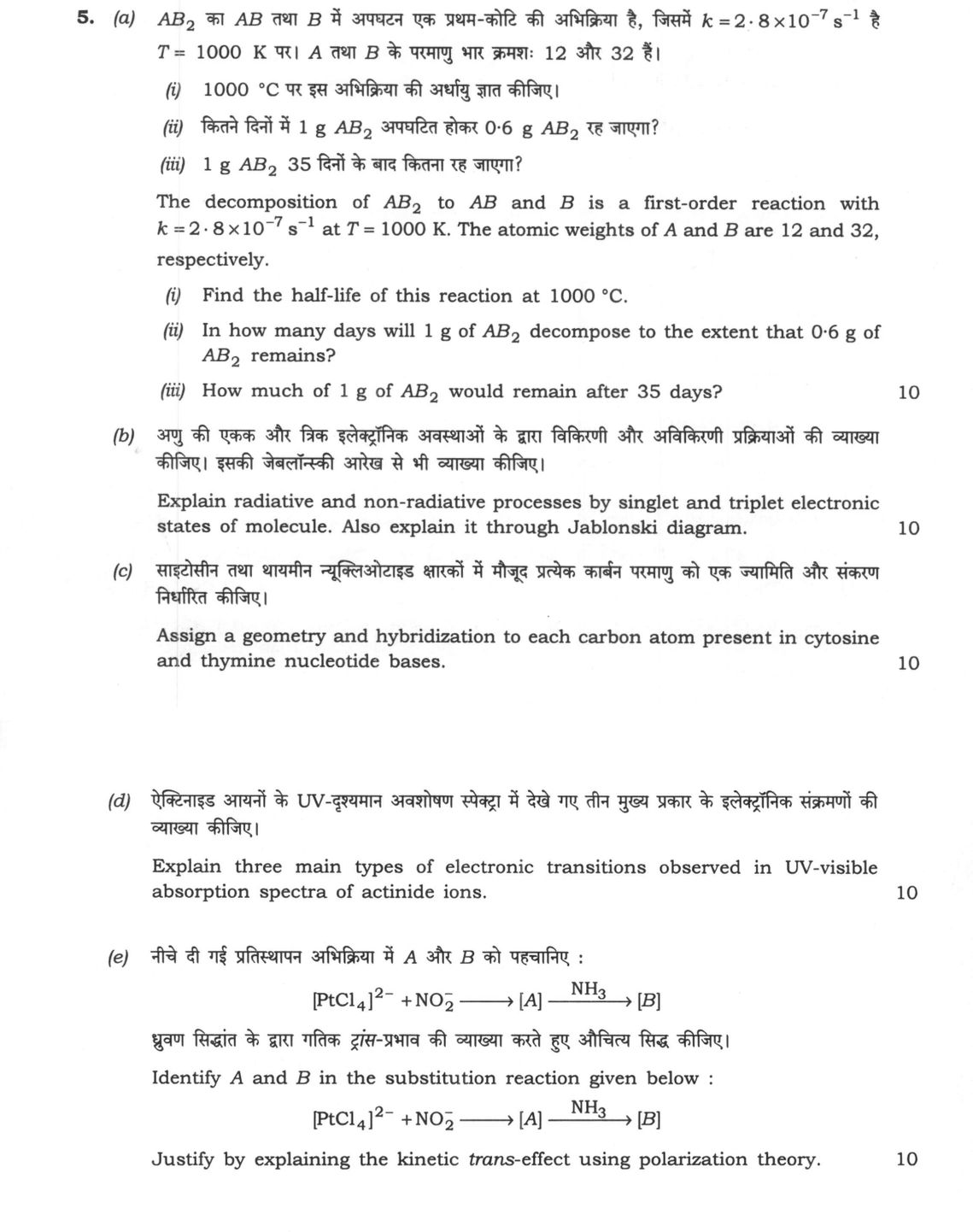
The decomposition of AB₂ to AB and B is a first-order reaction with k = 2·8 × 10⁻⁷ s⁻¹ at T = 1000 K. The atomic weights of A and…
The decomposition of AB₂ to AB and B is a first-order reaction with k = 2·8 × 10⁻⁷ s⁻¹ at T = 1000 K. The atomic weights of A and B are 12 and 32, respectively.
Find the half-life of this reaction at 1000 °C.
In how many days will 1 g of AB₂ decompose to the extent that 0·6 g of AB₂ remains?
How much of 1 g of AB₂ would remain after 35 days?
Explain radiative and non-radiative processes by singlet and triplet electronic states of molecule. Also explain it through Jablonski diagram.
Assign a geometry and hybridization to each carbon atom present in cytosine and thymine nucleotide bases.
Explain three main types of electronic transitions observed in UV-visible absorption spectra of actinide ions.
Identify A and B in the substitution reaction given below: [PtCl₄]²⁻ + NO₂⁻ → [A] → [B] NH₃ Justify by explaining the kinetic trans-effect using polarization theory.
हिंदी में प्रश्न पढ़ें
AB₂ का AB तथा B में अपघटन एक प्रथम-कोटि की अभिक्रिया है, जिसमें k = 2·8 × 10⁻⁷ s⁻¹ है T = 1000 K पर। A तथा B के परमाणु भार क्रमशः 12 और 32 हैं।
1000 °C पर इस अभिक्रिया की अर्धायु ज्ञात कीजिए।
कितने दिनों में 1 g AB₂ अपघटित होकर 0·6 g AB₂ रह जाएगा?
1 g AB₂ 35 दिनों के बाद कितना रह जाएगा?
अणु की एकक और त्रिक इलेक्ट्रॉनिक अवस्थाओं के द्वारा विकिरणी और अविकिरणी प्रक्रियाओं की व्याख्या कीजिए। इसकी जेब्लॉन्स्की आरेख से भी व्याख्या कीजिए।
साइटोसीन तथा थाइमीन न्यूक्लियोटाइड क्षारकों में मौजूद प्रत्येक कार्बन परमाणु को एक ज्यामिति और संकरण निर्धारित कीजिए।
ऐक्टिनाइड आयनों के UV-दृश्यमान अवशोषण स्पेक्ट्रा में देखे गए तीन मुख्य प्रकार के इलेक्ट्रॉनिक संक्रमणों की व्याख्या कीजिए।
नीचे दी गई प्रतिस्थापन अभिक्रिया में A और B को पहचानिए : [PtCl₄]²⁻ + NO₂⁻ → [A] → [B] NH₃ क्षुब्ध सिद्धांत के द्वारा गतिक ट्रांस-प्रभाव की व्याख्या करते हुए औचित्य सिद्ध कीजिए।
Model answer
Written by UPSC Answer Check against this question's marking rubric, to the expected length. UPSC does not publish answers for Mains — this is one way to score well, not an official key.
(i) For a first-order reaction, t₁/₂ = (ln 2)/k. Using the given k = 2·8 × 10⁻⁷ s⁻¹ at 1000 K (the question's “1000 °C” appears to be a typographical slip; no k is supplied at 1000 °C): t₁/₂ = 0·693147/(2·8 × 10⁻⁷ s⁻¹) = 2·48 × 10⁶ s. In days: t₁/₂ = (2·48 × 10⁶ s)/(86400 s day⁻¹) = 28·7 days. t₁/₂ = 2·48 × 10⁶ s = 28·7 days.
(ii) First-order integrated law: ln([AB₂]₀/[AB₂]ₜ) = kt. With [AB₂]ₜ/[AB₂]₀ = 0·6/1·0 = 0·6: t = −(1/k) ln(0·6) = 0·5108256/(2·8 × 10⁻⁷ s⁻¹) = 1·824 × 10⁶ s. In days: t = (1·824 × 10⁶)/(86400) = 21·1 days. t = 21·1 days.
(iii) 35 days = 35 × 86400 = 3·024 × 10⁶ s. For first order, m = m₀ e^(−kt) = 1 × e^(−2·8 × 10⁻⁷ × 3·024 × 10⁶) = e^(−0·84672) = 0·429 g. Mass of AB₂ remaining = 0·429 g.
(a) Singlet states have all electron spins paired: total spin S = 0, multiplicity 2S + 1 = 1. Triplet states have two unpaired electrons with parallel spins: S = 1, multiplicity 3. Radiative processes involve photon emission: fluorescence is S₁ → S₀, spin-allowed, short-lived (≈10⁻⁹–10⁻⁷ s); phosphorescence is T₁ → S₀, spin-forbidden, long-lived (≈10⁻³–10² s). Non-radiative processes emit no photon: vibrational relaxation (VR) within a state, internal conversion (IC) between same-multiplicity states, intersystem crossing (ISC) between different multiplicities such as S₁ → T₁, and non-radiative T₁ → S₀ decay. In a Jablonski diagram, energy is vertical. Absorption raises S₀ → S₁, S₂; IC and VR bring S₂ → S₁; fluorescence returns S₁ → S₀; ISC populates T₁; phosphorescence returns T₁ → S₀. Wavy arrows denote non-radiative transitions, straight arrows radiative ones.
(b) Cytosine and thymine are pyrimidine bases with conjugated rings. In cytosine, the ring carbons C2, C4, C5 and C6 are each sp² hybridized and trigonal planar; C2 is carbonyl, C4 bears NH₂, and C5/C6 bear H. In thymine, the ring carbons C2, C4, C5 and C6 are sp² hybridized and trigonal planar; C2 and C4 are carbonyl carbons, C5 bears a methyl group, and C6 bears H. The methyl carbon attached to C5 in thymine is sp³ hybridized and tetrahedral. Thus all ring carbons are planar sp²; only the thymine methyl carbon is sp³.
(c) The three main electronic transitions in UV-visible spectra of actinide ions are:
- 5f–5f transitions: within the 5fⁿ configuration; Laporte-forbidden and weak, but broader and more intense than lanthanide f–f bands because 5f orbitals are less shielded and mix with 6d.
- 5f–6d transitions: 5fⁿ → 5fⁿ⁻¹6d; Laporte-allowed, broad and intense, often in the UV-visible region.
- Charge-transfer transitions: ligand-to-metal (LMCT) or metal-to-ligand (MLCT), especially intense for actinyl ions such as UO₂²⁺ and NpO₂⁺, giving broad UV-visible bands.
(d) The reaction is: [PtCl₄]²⁻ + NO₂⁻ → A A + NH₃ → B First substitution gives A = [PtCl₃(NO₂)]²⁻. Since NO₂⁻ has a strong kinetic trans-effect, the Cl trans to NO₂ is labilized. NH₃ therefore substitutes that Cl, giving B = trans-[PtCl₂(NO₂)(NH₃)]⁻, with NH₃ trans to NO₂. By polarization theory, a strongly polarizing or π-accepting ligand such as NO₂⁻ polarizes the Pt(II) centre, creating a dipole that weakens the Pt–Cl bond opposite to it and stabilizes the five-coordinate trigonal-bipyramidal transition state. Thus the leaving Cl is the one trans to NO₂, while NH₃ enters opposite NO₂.
What "Solve" is asking you to do
Choose the method, then carry it through to a final answer. Identifying what kind of problem this is and why that method applies is the first thing marked; a correct figure arrived at invisibly earns almost nothing.
Structure that answers it
Given data and what is required → method chosen, with the reason it applies → set-up (equation, circuit, free body, trial balance) → working, step by step → answer with units and any condition of validity
Where marks are lost
Doing the middle steps mentally and writing only the result. In mathematics papers, a further loss comes from giving a decimal where the exact value in surds or fractions was wanted, or from skipping the justification a part explicitly asks for.
How this answer will be evaluated
Approach
(a(i)) calculate: given > formula > substitution > result with units > interpretation | (a(ii)) calculate: given > formula > substitution > result with units > interpretation | (a(iii)) calculate: given > formula > substitution > result with units > interpretation | (b) explain: definition/context > points in order > small example > short close | (c) map: locate accurately > label > one line on why it matters | (d) explain: definition/context > points in order > small example > short close | (e) justify: claim > 3-4 reasons > evidence > conclusion Full marks: All parts complete with correct calculations, mechanisms, and diagrams; full justification provided.
Key points expected
- Use formula t1/2 = 0.693/k
- Substitute k = 2.8 × 10⁻⁷ s⁻¹
- Show calculation steps
- State final answer with units
- Use integrated rate law ln([A]0/[A]) = kt
- Substitute [A]0 = 1g, [A] = 0.6g
- Solve for t in seconds
- Convert t to days
Evaluation rubric
Each sub-part is marked on its own, against the marks and word limit printed on the paper.
- (a(i)) Numerical value of half-life in seconds or days.
calculate— given → formula → substitution → result with units → interpretation
Must cover
- Use formula t1/2 = 0.693/k
- Substitute k = 2.8 × 10⁻⁷ s⁻¹
- Show calculation steps
- State final answer with units
Loses marks
- Using wrong formula for first-order reaction
- Arithmetic error in division
- Omitting units in final answer
Earns more
- Convert seconds to days for clarity
- Mention first-order reaction context
Extra mark
- Provide answer in both seconds and days
- (a(ii)) Time in days for 1g to decompose to 0.6g.
calculate— given → formula → substitution → result with units → interpretation
Must cover
- Use integrated rate law ln([A]0/[A]) = kt
- Substitute [A]0 = 1g, [A] = 0.6g
- Solve for t in seconds
- Convert t to days
Loses marks
- Using log base 10 instead of natural log
- Forgetting to convert seconds to days
- Incorrect substitution of mass values
Earns more
- Show natural log calculation
- Verify units consistency
Extra mark
- Cross-check with half-life approximation
- (a(iii)) Mass of AB2 remaining after 35 days.
calculate— given → formula → substitution → result with units → interpretation
Must cover
- Convert 35 days to seconds
- Use [A] = [A]0 * e^(-kt)
- Substitute k and t values
- Calculate final mass in grams
Loses marks
- Using wrong time unit in exponent
- Calculation error in exponential term
- Confusing mass with concentration
Earns more
- Show exponential calculation
- State assumption of constant temperature
Extra mark
- Compare result with half-life multiples
- (b) Mechanism of radiative/non-radiative processes via Jablonski diagram. 10 marks
explain— definition/context → points in order → small example → short close
Must cover
- Define singlet and triplet states
- Describe radiative transitions (fluorescence/phosphorescence)
- Describe non-radiative processes (internal conversion/ISC)
- Draw Jablonski diagram with labelled states
Loses marks
- Confusing singlet and triplet transitions
- Missing Jablonski diagram
- Incorrect energy level ordering
Earns more
- Explain spin multiplicity rules
- Mention quantum yield concepts
Extra mark
- Include specific molecular examples
- Discuss temperature dependence
- (c) Geometry and hybridization of carbons in cytosine/thymine. 10 marks
map— locate accurately → label → one line on why it matters
Must cover
- Draw structures of cytosine and thymine
- Identify all carbon atoms in ring
- Assign sp2 hybridization to ring carbons
- State trigonal planar geometry for sp2 carbons
Loses marks
- Incorrect hybridization assignment
- Missing structural diagrams
- Confusing carbon with nitrogen atoms
Earns more
- Mention exocyclic carbon hybridization
- Note bond angles (~120°)
Extra mark
- Compare with purine base structures
- Discuss aromaticity implications
- (d) Three types of electronic transitions in actinide UV-vis spectra. 10 marks
explain— definition/context → points in order → small example → short close
Must cover
- Identify f-f transitions
- Describe charge transfer transitions
- Mention d-d or ligand-to-metal transitions
- Explain selection rules for each type
Loses marks
- Confusing actinide with transition metal transitions
- Missing selection rule explanations
- Incorrect transition type identification
Earns more
- Discuss Laporte and spin selection rules
- Mention intensity differences
Extra mark
- Provide specific actinide examples
- Discuss crystal field effects
- (e) Identify A and B using kinetic trans-effect theory. 10 marks
justify— claim → 3-4 reasons → evidence → conclusion
Must cover
- Identify A as trans-[PtCl3(NO2)]2-
- Identify B as trans-[PtCl2(NO2)(NH3)]2-
- Explain trans-effect of NO2- vs Cl-
- Apply polarization theory to mechanism
Loses marks
- Wrong isomer identification
- Missing trans-effect explanation
- Incorrect polarization theory application
Earns more
- Draw intermediate structures
- Mention nucleophilic attack position
Extra mark
- Compare with cis-isomer formation
- Discuss rate-determining step
Practice this exact question
Write your answer and it is marked point by point against the model answer above — what you covered, what you missed, what you got wrong.
Evaluate my answer →More from Chemistry 2023 Paper I
- Q2 (a) Using the Gibbs equation for a closed system in the absence of non-expansion work at…
- Q3 (a) Determine the electronic and molecular geometry of [BrF₅] and [ICl₂]⁻ interhalogen co…
- Q4 (a) The volume of a certain gas is found to be 5.0×10⁻⁴ m³ mol⁻¹ at 273 K and 3.0×10⁶ Pa.…
- Q5 The decomposition of AB₂ to AB and B is a first-order reaction with k = 2·8 × 10⁻⁷ s⁻¹ at…
- Q6 Complete the following reactions and draw the structure of the major product(s) formed: (…
- Q7 (a) Explain the common structural features of two major iron-containing proteins—haemoglo…
- Q8 (a) Sketch the synthesis of [Fe(η⁵-C₅H₅)(η⁵-C₅H₄COCH₃)] and [Fe(η⁵-C₅H₅)(η⁵-C₅H₄COOH)] co…