Paper I — Q4
(a) The volume of a certain gas is found to be 5.0×10⁻⁴ m³ mol⁻¹ at 273 K and 3.0×10⁶ Pa. This gas obeys the van der Waals'…
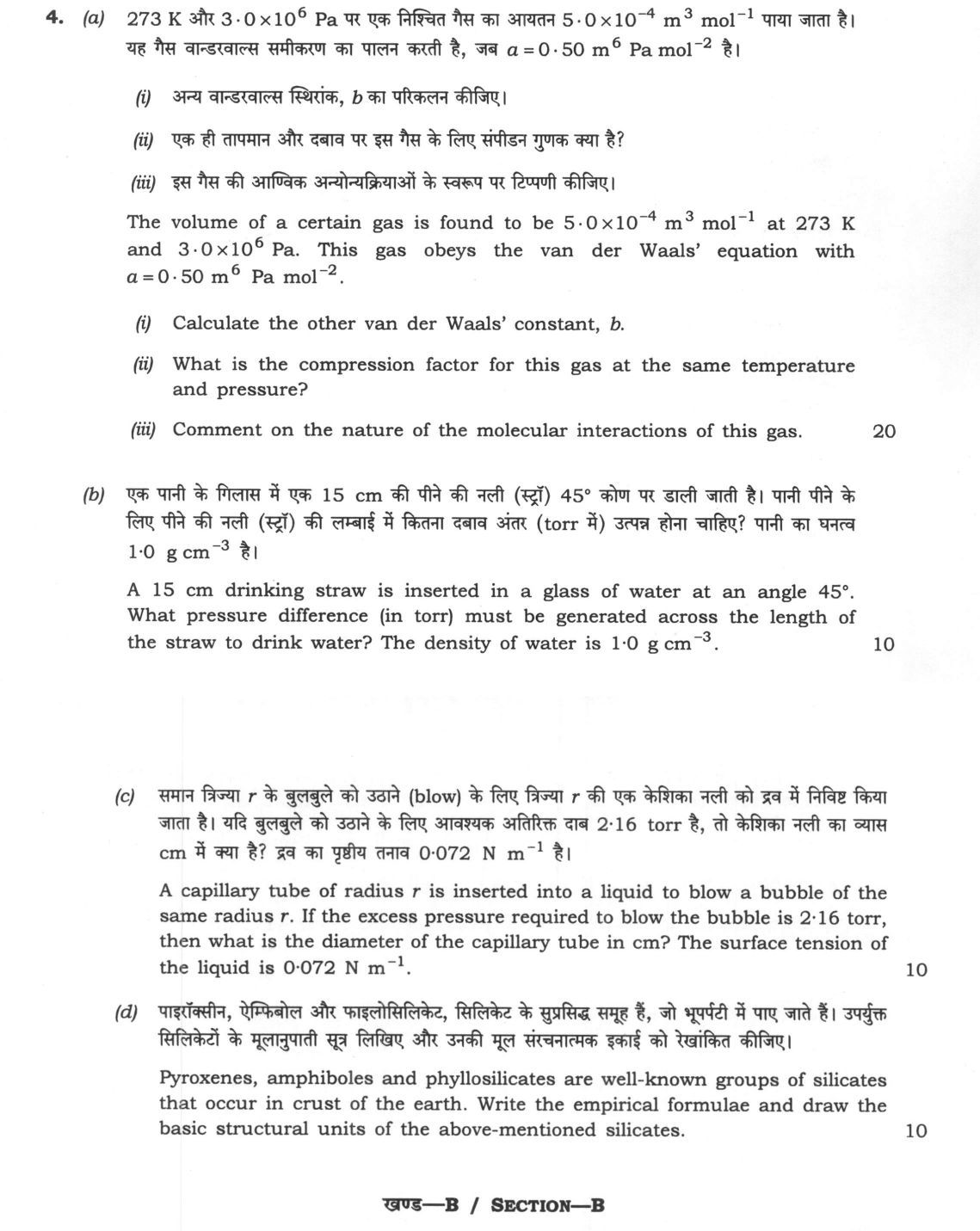
The volume of a certain gas is found to be 5.0×10⁻⁴ m³ mol⁻¹ at 273 K and 3.0×10⁶ Pa. This gas obeys the van der Waals' equation with a = 0.50 m⁶ Pa mol⁻². Calculate the other van der Waals' constant, b.
What is the compression factor for this gas at the same temperature and pressure?
Comment on the nature of the molecular interactions of this gas. 20 marks
A 15 cm drinking straw is inserted in a glass of water at an angle 45°. What pressure difference (in torr) must be generated across the length of the straw to drink water? The density of water is 1.0 g cm⁻³. 10 marks
A capillary tube of radius r is inserted into a liquid to blow a bubble of the same radius r. If the excess pressure required to blow the bubble is 2·16 torr, then what is the diameter of the capillary tube in cm? The surface tension of the liquid is 0·072 N m⁻¹. 10 marks
Pyroxenes, amphiboles and phyllosilicates are well-known groups of silicates that occur in crust of the earth. Write the empirical formulae and draw the basic structural units of the above-mentioned silicates. 10 marks
हिंदी में प्रश्न पढ़ें
273 K और 3.0×10⁶ Pa पर एक निश्चित गैस का आयतन 5.0×10⁻⁴ m³ mol⁻¹ पाया जाता है। यह गैस वान्डरवाल्स समीकरण का पालन करती है, जब a = 0.50 m⁶ Pa mol⁻² है। अन्य वान्डरवाल्स स्थिरांक, b का परिकलन कीजिए।
एक ही तापमान और दबाव पर इस गैस के लिए संपीडन गुणांक क्या है?
इस गैस की आणविक अन्योन्यक्रियाओं के स्वरूप पर टिप्पणी कीजिए। 20
एक पानी के गिलास में एक 15 cm की पीने की नली (स्ट्रॉ) 45° कोण पर डाली जाती है। पानी पीने के लिए पीने की नली (स्ट्रॉ) की लंबाई में कितना दबाव अंतर (torr में) उत्पन्न होना चाहिए? पानी का घनत्व 1.0 g cm⁻³ है। 10
समान त्रिज्या r के बुलबुले को उड़ाने (blow) के लिए त्रिज्या r की एक केशिका नली को द्रव में निविष्ट किया जाता है। यदि बुलबुले को उड़ाने के लिए आवश्यक अतिरिक्त दाब 2·16 torr है, तो केशिका नली का व्यास cm में क्या है? द्रव का पृष्ठीय तनाव 0·072 N m⁻¹ है। 10
पाइरॉक्सीन, ऐम्फीबोल और फाइल्लोसिलिकेट, सिलिकेट के सुप्रसिद्ध समूह हैं, जो भूपर्पटी में पाए जाते हैं। उपर्युक्त सिलिकेटों के मूलगुप्त सूत्र लिखिए और उनकी मूल संरचनात्मक इकाई को रेखांकित कीजिए। 10
Model answer
Written by UPSC Answer Check against this question's marking rubric, to the expected length. UPSC does not publish answers for Mains — this is one way to score well, not an official key.
(a) For one mole, the van der Waals equation is (P + a/Vₘ²)(Vₘ − b) = RT. Given: Vₘ = 5.0×10⁻⁴ m³ mol⁻¹, T = 273 K, P = 3.0×10⁶ Pa, a = 0.50 m⁶ Pa mol⁻², R = 8.314 J mol⁻¹ K⁻¹ = 8.314 Pa m³ mol⁻¹ K⁻¹. RT = 8.314 × 273 = 2269.722 Pa m³ mol⁻¹. a/Vₘ² = 0.50/(5.0×10⁻⁴)² = 0.50/(2.5×10⁻⁷) = 2.0×10⁶ Pa. Therefore P + a/Vₘ² = 3.0×10⁶ + 2.0×10⁶ = 5.0×10⁶ Pa.
(i) Using the van der Waals equation, Vₘ − b = RT/(P + a/Vₘ²) = 2269.722/(5.0×10⁶) = 4.53944×10⁻⁴ m³ mol⁻¹. Thus b = Vₘ − (Vₘ − b) = 5.0×10⁻⁴ − 4.53944×10⁻⁴ = 4.6056×10⁻⁵ m³ mol⁻¹. b = 4.61×10⁻⁵ m³ mol⁻¹ = 46.1 cm³ mol⁻¹.
(ii) The compression factor is defined as Z = PVₘ/(RT). So Z = (3.0×10⁶ × 5.0×10⁻⁴)/2269.722 = 1500/2269.722 = 0.66087. Z = 0.661, dimensionless.
(iii) Since Z < 1, the gas is more compressible than an ideal gas under the same conditions. The attractive-pressure term a/Vₘ² = 2.0×10⁶ Pa is comparable with the applied pressure P = 3.0×10⁶ Pa, so attractive intermolecular forces are significant and dominate over repulsive excluded-volume effects at this temperature and pressure. The positive value of b = 4.61×10⁻⁵ m³ mol⁻¹ shows that the molecules do have finite size and short-range repulsion, but the net molecular interaction here is predominantly attractive.
(b) Let L = 15 cm = 0.15 m and the straw make an angle θ = 45° with either the horizontal or vertical. Since sin 45° = cos 45°, the vertical rise of water is h = L sin 45° = 0.15/√2 = 0.106066 m. Density of water ρ = 1.0 g cm⁻³ = 1000 kg m⁻³. Taking g = 9.8 m s⁻², the hydrostatic pressure difference is ΔP = ρgh = 1000 × 9.8 × 0.106066 = 1.03945×10³ Pa. Now 1 torr = 133.322 Pa, so ΔP = 1.03945×10³/133.322 = 7.796 torr. ΔP ≈ 7.80 torr. Condition: static water column, neglecting viscosity and dynamic suction losses.
(c) For a bubble formed inside a liquid, there is one liquid–gas interface, so the Young–Laplace excess pressure is ΔP = 2γ/r. Given ΔP = 2.16 torr = 2.16 × 133.322 = 287.976 Pa, and γ = 0.072 N m⁻¹. Thus r = 2γ/ΔP = (2 × 0.072)/287.976 = 0.144/287.976 = 5.000×10⁻⁴ m. Diameter d = 2r = 1.000×10⁻³ m = 0.100 cm. d = 0.100 cm. Condition: bubble radius equals capillary radius, and the bubble is inside the liquid.
(d) All these silicates are built from SiO₄ tetrahedra. The basic tetrahedral unit has Si at the centre and four O atoms at the corners. Condensation occurs by sharing corner O atoms.
- Pyroxenes: single-chain silicates. Empirical silicate formula: (SiO₃)ₙ²ⁿ⁻, commonly written [SiO₃]²⁻; a two-tetrahedron repeat is [Si₂O₆]⁴⁻. General mineral formula approximately M²⁺SiO₃, e.g. MgSiO₃. Structural unit: each SiO₄ tetrahedron shares two corner O atoms with neighbouring tetrahedra, forming an infinite single chain. Schematic connectivity: –O–Si(O₂)–O–Si(O₂)–O–, with non-bridging O atoms above and below the chain.
- Amphiboles: double-chain silicates. Empirical silicate formula: (Si₄O₁₁)ₙ⁶ⁿ⁻, commonly written [Si₄O₁₁]⁶⁻. General formula approximately A₀₋₁B₂C₅T₈O₂₂(OH)₂. Structural unit: two single SiO₄ chains are cross-linked by sharing additional corner O atoms, forming an infinite double chain. Schematic connectivity: two parallel –O–Si(O₂)–O–Si(O₂)–O– chains joined by bridging O atoms.
- Phyllosilicates: sheet silicates. Empirical silicate formula: (Si₂O₅)ₙ²ⁿ⁻, commonly written [Si₂O₅]²⁻. Examples: micas, clays, talc. Structural unit: each SiO₄ tetrahedron shares three corner O atoms, forming an infinite two-dimensional hexagonal sheet. Schematic connectivity: a hexagonal net of SiO₄ tetrahedra, with one non-bridging O per tetrahedron.
What "Calculate" is asking you to do
Apply the standard formula or schedule to data the question has already supplied — a table of readings, cost records, a balance sheet — and produce the number. The method is rarely in doubt; the marks sit in the named intermediate quantities, each of which has to appear as a labelled line.
Structure that answers it
Data as given → formula or standard treatment, named → substitution → each intermediate, labelled → result with units
Where marks are lost
Omitting an intermediate the marking scheme pays for separately, or rounding at an intermediate line so the final figure drifts. In commerce and accountancy, any figure in a statement that no numbered working note supports is treated as unearned.
How this answer will be evaluated
Approach
(a(i)) calculate: given > formula > substitution > result with units > interpretation | (a(ii)) calculate: given > formula > substitution > result with units > interpretation | (a(iii)) comment: context > arguments both sides > judgment > close | (b) calculate: given > formula > substitution > result with units > interpretation | (c) calculate: given > formula > substitution > result with units > interpretation | (d) describe: define > structure or process in order > labelled diagram > significance Full marks: All calculations correct with units; clear structural diagrams; precise terminology.
Key points expected
- State van der Waals equation
- Substitute given values for P, V, T, a
- Solve algebraically for b
- Report b with correct units
- Define Z = PV/RT
- Substitute given P, V, T values
- Calculate numerical value of Z
- Link Z value to attractive/repulsive forces
Evaluation rubric
Each sub-part is marked on its own, against the marks and word limit printed on the paper.
- (a(i)) Determine the van der Waals constant b using the given P, V, T, and a.
calculate— given → formula → substitution → result with units → interpretation
Must cover
- State van der Waals equation
- Substitute given values for P, V, T, a
- Solve algebraically for b
- Report b with correct units
Loses marks
- Arithmetic error in substitution
- Omitting units for b
Earns more
- Show unit consistency check
- Identify R value used
Extra mark
- Mention physical significance of b
- (a(ii)) Compute the compression factor Z for the gas at the given conditions.
calculate— given → formula → substitution → result with units → interpretation
Must cover
- Define Z = PV/RT
- Substitute given P, V, T values
- Calculate numerical value of Z
Loses marks
- Using wrong R value
- Calculation error in PV/RT
Earns more
- Compare Z to 1 explicitly
Extra mark
- State if gas is ideal or non-ideal based on Z
- (a(iii)) Interpret the nature of molecular interactions based on the calculated Z and constants.
comment— context → arguments both sides → judgment → close
Must cover
- Link Z value to attractive/repulsive forces
- Relate 'a' to intermolecular attraction
- Relate 'b' to molecular volume/repulsion
Loses marks
- Generic statement without linking to Z
- Confusing attraction with repulsion
Earns more
- Mention deviation from ideal gas behavior
Extra mark
- Reference specific gas behavior (e.g., CO2)
- (b) Determine the pressure difference required to drink water through the angled straw. 10 marks
calculate— given → formula → substitution → result with units → interpretation
Must cover
- Calculate vertical height (h = L sin 45°)
- Use hydrostatic pressure formula ΔP = ρgh
- Convert result to torr
Loses marks
- Using total length L instead of vertical height
- Incorrect unit conversion to torr
Earns more
- Show unit conversion steps
- State assumption of atmospheric pressure
Extra mark
- Mention effect of straw diameter
- (c) Find the diameter of the capillary tube given the excess pressure and surface tension. 10 marks
calculate— given → formula → substitution → result with units → interpretation
Must cover
- Use Young-Laplace equation for bubble (ΔP = 2γ/r)
- Convert pressure to SI units (Pa)
- Solve for radius r
- Calculate diameter (2r) in cm
Loses marks
- Using ΔP = γ/r (for meniscus) instead of 2γ/r
- Unit conversion error in pressure
Earns more
- Show unit conversions clearly
Extra mark
- Mention assumption of spherical bubble
- (d) Provide empirical formulae and structural units for pyroxenes, amphiboles, and phyllosilicates. 10 marks
describe— define → structure or process in order → labelled diagram → significance
Must cover
- List empirical formula for each silicate group
- Describe chain/sheet structure for each
- Draw or describe basic structural unit (SiO4 tetrahedra linkage)
Loses marks
- Confusing chain types (single vs double)
- Omitting structural diagram/description
Earns more
- Label shared oxygen atoms in structures
- Mention cation types (e.g., Mg, Fe, Al)
Extra mark
- Name specific minerals (e.g., Olivine, Mica)
Practice this exact question
Write your answer and it is marked point by point against the model answer above — what you covered, what you missed, what you got wrong.
Evaluate my answer →More from Chemistry 2023 Paper I
- Q1 (a) (i) Find the wavelength of the emitted light when 1.0×10⁻²⁷ g particle in a one-dimen…
- Q2 (a) Using the Gibbs equation for a closed system in the absence of non-expansion work at…
- Q3 (a) Determine the electronic and molecular geometry of [BrF₅] and [ICl₂]⁻ interhalogen co…
- Q4 (a) The volume of a certain gas is found to be 5.0×10⁻⁴ m³ mol⁻¹ at 273 K and 3.0×10⁶ Pa.…
- Q5 The decomposition of AB₂ to AB and B is a first-order reaction with k = 2·8 × 10⁻⁷ s⁻¹ at…
- Q6 Complete the following reactions and draw the structure of the major product(s) formed: (…
- Q7 (a) Explain the common structural features of two major iron-containing proteins—haemoglo…