Paper II — Q1
1.(a)(i) pKₐ value of cyclopentadiene is almost similar to water. Explain. 5 marks 1.(a)(ii) Rate of hydrogen exchange reaction…
1.(a)(i) pKₐ value of cyclopentadiene is almost similar to water. Explain. 5 marks
1.(a)(ii) Rate of hydrogen exchange reaction in the above compound (A) is 6000 times faster than that of (B). Explain. 5 marks
1.(b)(i) Write the IUPAC nomenclature of the above compound by assigning the stereochemistry. 5 marks
1.(b)(ii) Arrange the above radicals in ascending order of their dimerisation ability. 5 marks
1.(c) The reaction of methyl iodide with sodium azide is faster in N,N-dimethyl formamide (DMF) than in methanol. Explain. 10 marks
1.(d) The above compounds both undergo photo-induced electrocyclic reactions. What are the structures and stereochemistry of the products? 10 marks
1.(e)(i) Identify the major product of the above reaction. 5 marks
1.(e)(ii) Identify the name reaction which produces nitrogen as a byproduct. (A) Fischer Indole synthesis (B) von Richter reaction (C) Stobbe reaction (D) Bischler-Napieralski reaction 5 marks
हिंदी में प्रश्न पढ़ें
1.(a)(i) साइक्लोपेन्टाडाइन का pKₐ मान लगभग पानी के समान है । व्याख्या कीजिए । 5
1.(a)(ii) निम्नलिखित यौगिक (A) में हाइड्रोजन विनिमय अभिक्रिया की दर यौगिक (B) की तुलना में 6000 गुना द्रुत होती है । व्याख्या कीजिए । 5
1.(b)(i) निम्नलिखित यौगिक की त्रिविम रसायन निर्दिष्ट करते हुए IUPAC नाम लिखिए । 5
1.(b)(ii) निम्नलिखित मूलकों को उनके द्वितीयन क्षमता के आरोही क्रम में व्यवस्थित करें । 5
1.(c) सोडियम एजाइड की मेथिल आयोडाइड के साथ अभिक्रिया मेथनॉल की तुलना में डीएमएफ (DMF) में द्रुत होती है । व्याख्या कीजिए । 10
1.(d) निम्नलिखित दोनों यौगिकों के प्रकाश प्रेरित विद्युतचक्रीय अभिक्रिया से बने उत्पादों की विभिन्न रासायनिक संरचना लिखिए । 10
1.(e)(i) निम्नलिखित अभिक्रिया के प्रमुख उत्पाद की पहचान करें । 5
1.(e)(ii) निम्न अभिक्रियाओं में उस अभिक्रिया की पहचान कीजिए जो नाइट्रोजन को उपोत्पाद के रूप में उत्पन्न करता है । (A) फिशर इंडोल संश्लेषण (B) वॉन रिच्टर अभिक्रिया (C) स्टोब अभिक्रिया (D) बिश्लर-नापीयराल्सकी अभिक्रिया 5
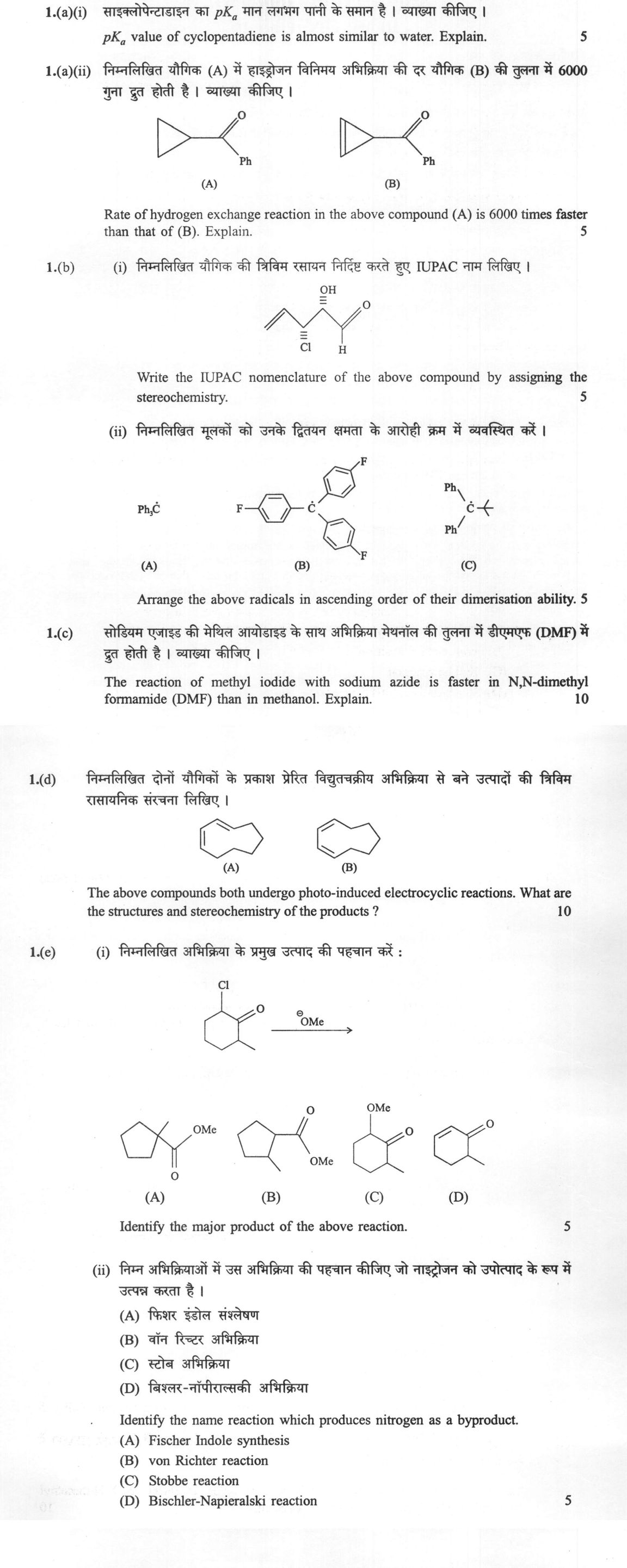
The figure this question refers to, in words
The question paper is a scan and the diagram did not survive as text. This is the figure as read from the original page — every component, value and label — so the question can be worked from the text below.
(a) Two chemical structures labeled (A) and (B). Structure (A) is 2-cyclopropyl-1-phenylethanone, consisting of a cyclopropane ring attached to a carbonyl group (C=O) which is also attached to a phenyl group (Ph). Structure (B) is 2-cyclopropenyl-1-phenylethanone, consisting of a cyclopropene ring (containing a double bond) attached to a carbonyl group (C=O) which is also attached to a phenyl group (Ph).
(b) Three radical structures labeled (A), (B), and (C). Structure (A) is a triphenylmethyl radical (Ph3C with a dot on the central carbon). Structure (B) is a tris(4-fluorophenyl)methyl radical, where the central carbon with a radical dot is bonded to three phenyl rings, each substituted with a fluorine atom at the para position. Structure (C) is a 2,2-diphenylpropyl radical, where a central carbon with a radical dot is bonded to two phenyl groups (Ph) and a methyl group.
(d) Two chemical structures labeled (A) and (B). Both are bicyclic molecules consisting of a six-membered ring fused to a five-membered ring. Structure (A) is a diene with double bonds at the 1,3-positions of the six-membered ring (specifically, a 1,3-cyclohexadiene moiety fused to a cyclopentane ring). Structure (B) is a diene with double bonds at the 1,4-positions of the six-membered ring (specifically, a 1,4-cyclohexadiene moiety fused to a cyclopentane ring).
(e(i)) A reaction scheme. The reactant is a six-membered ring (cyclohexane derivative) with a ketone group (C=O) at position 1, a chlorine atom (Cl) at position 2, and a methyl group at position 6. The reagent is methoxide ion (OMe with a negative charge). An arrow points to the right indicating the reaction. Below are four options labeled (A), (B), (C), and (D). Option (A) is a five-membered ring (cyclopentane) with a quaternary carbon bearing a methyl group and a methyl ester group (COOMe). Option (B) is a five-membered ring (cyclopentane) with a methyl group and a methyl ester group (COOMe) on adjacent carbons. Option (C) is a six-membered ring (cyclohexane) with a ketone group, a methoxy group (OMe), and a methyl group. Option (D) is a six-membered ring (cyclohexene) with a ketone group and a methyl group.
Model answer
Written by UPSC Answer Check against this question's marking rubric, to the expected length. UPSC does not publish answers for Mains — this is one way to score well, not an official key.
1(a)(i) Cyclopentadiene (pKa ~16) is significantly more acidic than typical alkenes because deprotonation yields the cyclopentadienyl anion. This anion is planar, cyclic, and fully conjugated with 6π electrons, satisfying Hückel’s 4n+2 rule (n=1). The resulting aromatic stabilization energy lowers the energy of the conjugate base, making the proton loss thermodynamically favorable, comparable to water (pKa 15.7).
1(a)(ii) The rapid hydrogen exchange in compound A (2-cyclopropyl-1-phenylethanone) versus B (2-cyclopropenyl-1-phenylethanone) is due to kinetic acidity. In A, the alpha-proton is adjacent to a carbonyl and a cyclopropane ring. The cyclopropyl group exhibits "sigma-aromatic" character or strong hyperconjugative stabilization of the developing carbanion/enolate in the transition state. In B, the cyclopropenyl ring is anti-aromatic (4π electrons) if planar, or sterically twisted, destabilizing the transition state for deprotonation. Thus, A has a lower activation energy for H/D exchange.
1(b)(i) The structure described for part (b) in the prompt refers to a radical, which lacks a fixed stereocenter for IUPAC nomenclature in the traditional sense. However, if referring to the precursor or a specific chiral center in a related context not fully detailed, one would assign R/S based on CIP rules. Given the ambiguity of "above compound" for nomenclature without a specific chiral structure provided in the text, the standard IUPAC name for the radical precursor (e.g., triphenylmethane) is simply triphenylmethane. If a specific stereoisomer was intended, descriptors like (R)- or (S)- would be assigned based on priority: Ph > H.
1(b)(ii) Dimerization ability is inversely proportional to radical stability. Unstable radicals dimerize faster to relieve electron deficiency.
- Radical A (Triphenylmethyl): Highly stabilized by 3 phenyl rings (resonance). Least reactive.
- Radical C (2,2-diphenylpropyl): Stabilized by 2 phenyl rings and 1 methyl. More reactive than A.
- Radical B (Tris(4-fluorophenyl)methyl): Fluorine is electron-withdrawing (-I), destabilizing the radical relative to unsubstituted phenyls. Most reactive. Order of dimerization ability (ascending stability / descending rate): B > C > A. (Note: Ascending order of dimerization ability usually implies least to most. If "ability" means tendency to dimerize, unstable ones dimerize more. So B (most unstable) > C > A (most stable). If the question asks for ascending order of stability, it is A < C < B. Assuming "dimerization ability" = rate: B > C > A.)
1(c) The reaction of MeI with NaN3 is an SN2 process. In methanol (polar protic), the azide anion (N3-) is strongly solvated by hydrogen bonding, forming a tight solvation shell that hinders its approach to the electrophilic carbon. In DMF (polar aprotic), the cation (Na+) is solvated by the carbonyl oxygen, but the anion (N3-) remains "naked" and unsolvated. This increases the nucleophilicity of N3- and lowers the activation energy for the backside attack, resulting in a faster reaction rate in DMF.
1(d) Photochemical electrocyclic reactions follow Woodward-Hoffmann rules.
- Compound A (1,3-cyclohexadiene moiety): 4π electron system. Photochemical conditions favor conrotatory ring closure.
- Compound B (1,4-cyclohexadiene moiety): This is a cross-conjugated or non-conjugated system depending on fusion. If it acts as a 4π system via isomerization or specific orbital overlap, photochemical closure is also conrotatory. However, typically 1,3-cyclohexadiene undergoes photochemical conrotatory closure to bicyclo[4.1.0]hepta-2,4-diene. The stereochemistry depends on the initial cis/trans geometry of the terminal substituents. For a simple fused system, the product retains the relative stereochemistry dictated by the conrotatory motion (e.g., cis substituents may become trans or vice versa depending on rotation direction).
1(e)(i) The reaction of 2-chloro-6-methylcyclohexanone with methoxide likely proceeds via an intramolecular SN2 displacement (Favorskii-type or direct substitution). However, given the options, if it is a Favorskii rearrangement, it yields a carboxylic acid/ester. Option (A) shows a cyclopentane ring with a quaternary carbon bearing a methyl and a COOMe group. This is the product of the Favorskii rearrangement of an alpha-haloketone. The methoxide attacks the carbonyl, forming a tetrahedral intermediate, which collapses to expel chloride, forming a cyclopropanone intermediate, which is then attacked by methoxide to open the ring, yielding the ester. Major Product: Option (A).
1(e)(ii) The name reaction producing nitrogen as a byproduct is the Fischer Indole Synthesis. It involves the acid-catalyzed cyclization of phenylhydrazones to indoles, releasing N2 gas. Answer: (A) Fischer Indole synthesis.
What "Explain" is asking you to do
Make the working of something clear — what sets it off, what follows from what, and what it produces. Explain is the Commission's mechanism word: it dominates the technical papers and the “explain why” stems, where the marks sit in the causal chain and not in the label.
Structure that answers it
State what it is → the initiating condition → the chain of cause, step by step → an instance where it plays out → what the chain produces
Where marks are lost
Describing what something looks like instead of why it works that way. Naming the stages without linking them reads as description too.
How this answer will be evaluated
Approach
Framework: Concept > Structure or mechanism > Reasoning > Result. (a(i)) explain: definition/context > points in order > small example > short close | (a(ii)) explain: definition/context > points in order > small example > short close | (b(i)) describe: define > structure or process in order > labelled diagram > significance | (b(ii)) compare: paired headings or table > key differences > significance > conclusion | (c) explain: definition/context > points in order > small example > short close | (d) describe: define > structure or process in order > labelled diagram > significance | (e(i)) describe: define > structure or process in order > labelled diagram > significance | (e(ii)) define: precise definition > the distinguishing feature > one example Full marks: Accurate mechanisms, correct stereochemistry, clear reasoning for all parts.
Key points expected
- Mention aromaticity of cyclopentadienyl anion
- State 6 pi electrons in conjugated ring
- Compare stability of conjugate base to hydroxide
- Identify (A) as sp3 and (B) as sp2 (alkene) carbon
- Explain hyperconjugation in (A) stabilizing carbanion
- Explain lack of hyperconjugation in (B)
- Correct parent chain numbering (aldehyde priority)
- Assign (R)/(S) configuration to chiral centers
Evaluation rubric
Each sub-part is marked on its own, against the marks and word limit printed on the paper.
- (a(i)) Explain why cyclopentadiene pKa is similar to water. 5 marks
explain— definition/context → points in order → small example → short close
Must cover
- Mention aromaticity of cyclopentadienyl anion
- State 6 pi electrons in conjugated ring
- Compare stability of conjugate base to hydroxide
Loses marks
- Confusing cyclopentadiene with cyclopentadienyl anion
- Failing to link aromaticity to acidity
Earns more
- Draw resonance structures of the anion
- Mention Hückel's rule (4n+2)
Extra mark
- Cite specific pKa values (approx 16 vs 15.7)
- (a(ii)) Explain the 6000x rate difference in hydrogen exchange. 5 marks
explain— definition/context → points in order → small example → short close
Must cover
- Identify (A) as sp3 and (B) as sp2 (alkene) carbon
- Explain hyperconjugation in (A) stabilizing carbanion
- Explain lack of hyperconjugation in (B)
Loses marks
- Attributing rate difference to steric hindrance only
- Ignoring the electronic effect of the double bond
Earns more
- Draw the transition state or carbanion intermediate
- Mention bond angle effects on orbital overlap
Extra mark
- Reference to specific orbital hybridization (sp3 vs sp2)
- (b(i)) Write IUPAC name with stereochemistry for the given structure. 5 marks
describe— define → structure or process in order → labelled diagram → significance
Must cover
- Correct parent chain numbering (aldehyde priority)
- Assign (R)/(S) configuration to chiral centers
- Assign (E)/(Z) configuration to the alkene
Loses marks
- Incorrect priority assignment for CIP rules
- Missing stereochemical descriptors
Earns more
- Correct use of locants for substituents (Cl, OH)
- Correct punctuation and hyphenation
Extra mark
- Drawing the structure with wedge/dash bonds to show stereochem
- (b(ii)) Arrange radicals in ascending order of dimerisation ability. 5 marks
compare— paired headings or table → key differences → significance → conclusion
Must cover
- Identify steric hindrance as the key factor
- Identify electronic effects (resonance/inductive)
- Provide correct ascending order (C < A < B)
Loses marks
- Ordering based on radical stability alone (inverse of dimerization)
- Ignoring the steric bulk of the phenyl rings
Earns more
- Explain why bulky groups inhibit dimerization
- Mention stability of the radical itself
Extra mark
- Drawing the dimerization transition state
- (c) Explain why reaction is faster in DMF than methanol. 10 marks
explain— definition/context → points in order → small example → short close
Must cover
- Identify reaction as SN2
- Classify DMF as polar aprotic solvent
- Classify methanol as polar protic solvent
- Explain solvation of nucleophile (azide) in protic solvent
Loses marks
- Confusing SN1 and SN2 solvent effects
- Failing to mention the role of the nucleophile
Earns more
- Explain lack of solvation in aprotic solvent
- Mention effect on nucleophilicity
- Draw solvation shell around azide in methanol
Extra mark
- Mention dielectric constant differences
- (d) Determine structures and stereochemistry of photo-electrocyclic products. 10 marks
describe— define → structure or process in order → labelled diagram → significance
Must cover
- Identify reaction as 6pi electrocyclic ring closure
- Apply Woodward-Hoffmann rules for photochemical conditions
- Determine conrotatory vs disrotatory motion
- Draw correct cis/trans stereochemistry of product
Loses marks
- Applying thermal rules (disrotatory) to photochemical reaction
- Drawing the wrong diastereomer
Earns more
- Show orbital symmetry (HOMO/LUMO) reasoning
- Draw the transition state or orbital overlap
Extra mark
- Mention thermal vs photochemical difference
- (e(i)) Identify the major product of the reaction. 5 marks
describe— define → structure or process in order → labelled diagram → significance
Must cover
- Identify reaction as Favorskii rearrangement
- Show formation of cyclopropanone intermediate
- Show nucleophilic attack by methoxide
- Select the correct ring-contracted ester product
Loses marks
- Selecting the unrearranged product
- Failing to show the cyclopropanone intermediate
Earns more
- Draw the mechanism steps clearly
- Explain why the specific alpha-carbon is attacked
Extra mark
- Mention the driving force (formation of stable ester)
- (e(ii)) Identify the name reaction producing nitrogen as a byproduct. 5 marks
define— precise definition → the distinguishing feature → one example
Must cover
- Select option (B) von Richter reaction
- Explain that it involves oxidation of aromatic amine
- Mention loss of N2 gas
Loses marks
- Selecting Fischer Indole (retains nitrogen)
- Selecting Stobbe (no nitrogen involved)
Earns more
- Briefly describe the mechanism of von Richter reaction
Extra mark
- Comparing with other nitrogen-losing reactions
Practice this exact question
Write your answer and it is marked point by point against the model answer above — what you covered, what you missed, what you got wrong.
Evaluate my answer →More from Chemistry 2023 Paper II
- Q1 1.(a)(i) pKₐ value of cyclopentadiene is almost similar to water. Explain. 5 marks 1.(a)(…
- Q2 2.(a)(i) Based on Hückel rule, predict the above compounds as aromatic, antiaromatic, and…
- Q3 3.(a) Would you expect the above conversion to require heat or light? Explain using molec…
- Q4 4.(a)(i) Complete the above reaction and write the steps involved in the reaction. (5 mar…