Paper II — Q7
(a) (i) Draw the structure of 2'-deoxycytidine-3'-monophosphate. (ii) Why nucleotides and nucleic acids are acidic ? Mention the…
Draw the structure of 2'-deoxycytidine-3'-monophosphate.
Why nucleotides and nucleic acids are acidic ? Mention the factor(s) that stabilize the DNA duplex.
Show the hydrogen bonding in between cytosine and guanine base pair. 15 marks
Identify all the possible products in the above reaction showing the sequential pathways of their formation : 10 marks
1,3-Butadiene solution on irradiation with UV light follows path I. However, irradiating 1,3-butadiene in the presence of benzophenone at 366 nm follows path II. Give a suitable explanation. 5 marks
Write the structure of the compounds (A), (B), (C), (D) and (E). 10 marks
From the reaction sequence below, answer the following questions :
(I) Write structure of (A) and (B)
(II) Write the oxidation state of Osmium in the intermediate (A) and its geometry. 5 marks
Write the structure of (A) and (B) in the above reactions. 5 marks
हिंदी में प्रश्न पढ़ें
(क) (i) 2'-डिऑक्सीसाइटिडिन-3'-मोनोफॉस्फेट की संरचना लिखिए।
न्यूक्लिओटाइड तथा न्यूक्लिक अम्ल अम्लीय क्यों होते हैं ? DNA डबल हेलिक्स संरचना को स्थिर करने वाले कारकों का उल्लेख कीजिए।
साइटोसीन व गुआनिन शार युग्म के मध्य हाइड्रोजन आबंधन को दिखाइए। 15
(ख)(i) निम्नलिखित अभिक्रिया में सभी संभावित उत्पादों की पहचान करें जो उनके गठन का अनुक्रमिक मार्ग दिखाते हैं। 10
(ख)(ii) 1,3-ब्यूटाडाइन विलयन पराबैंगनी किरण पर पथ I का अनुसरण करता है। हालांकि बेंजोफेनॉन की उपस्थिति में 366 nm पर 1,3-ब्यूटाडाइन का पराबैंगनी किरण पथ II का अनुसरण करता है। उपयुक्त स्पष्टीकरण दीजिए। 5
(ग)(i) यौगिकों (A), (B), (C), (D) तथा (E) की संरचना लिखिए। 10
(ग)(ii) नीचे दिए गए अभिक्रिया क्रम से, निम्नलिखित प्रश्नों का उत्तर दें :
(I) (A) तथा (B) की संरचना लिखिए ।
(II) मध्यवर्ती (A) में ऑस्मियम की ऑक्सीकरण अवस्था तथा ज्यामिति लिखिए । 5
(ग)(iii) निम्नलिखित अभिक्रियाओं में (A) तथा (B) की संरचना लिखिए । 5
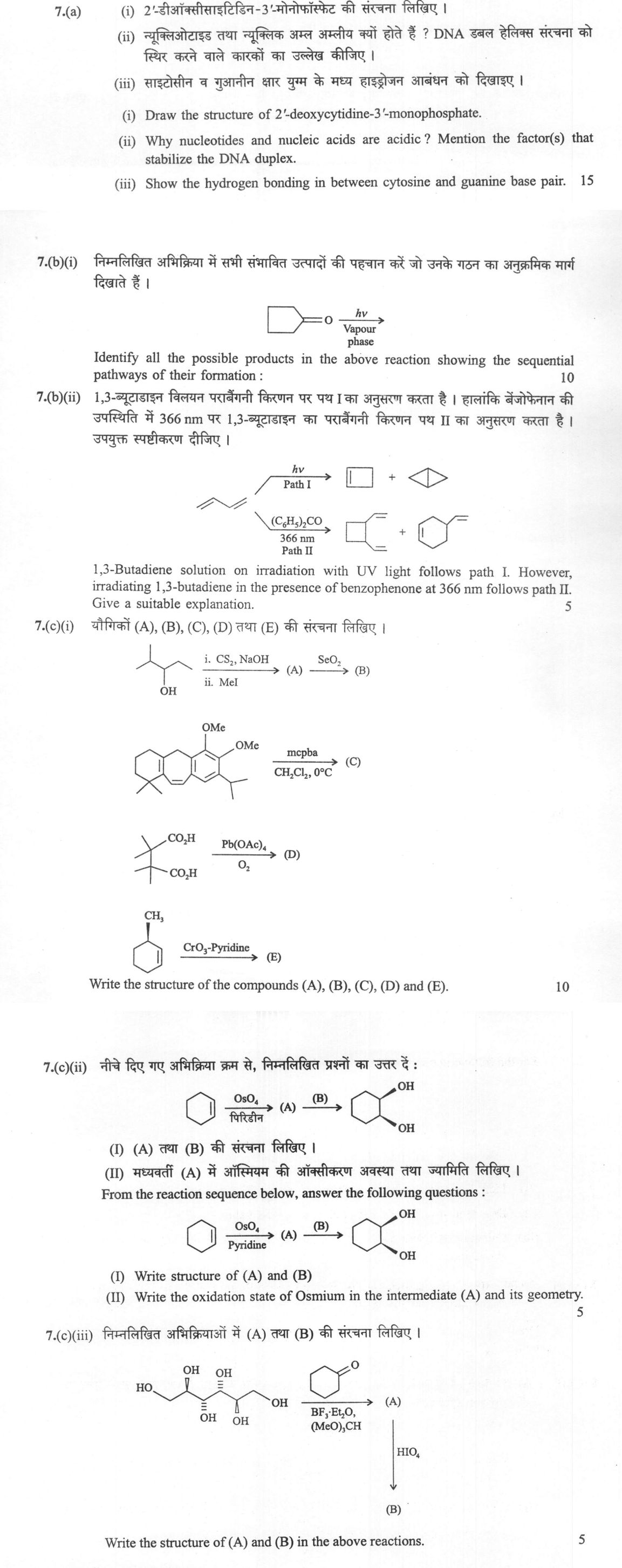
The figure this question refers to, in words
The question paper is a scan and the diagram did not survive as text. This is the figure as read from the original page — every component, value and label — so the question can be worked from the text below.
(b) A reaction scheme starting with 1,3-butadiene (a four-carbon chain with double bonds at positions 1 and 3). It branches into two pathways: Path I shows reaction with 'hv' to yield cyclobutene (a four-membered ring with one double bond) plus bicyclo[1.1.0]butane (a structure with two fused three-membered rings). Path II shows reaction with '(C6H5)2CO' (benzophenone) at '366 nm' to yield 3,4-dimethylenecyclobutane (a four-membered ring with two exocyclic double bonds) plus 1-ethylcyclohexene (a six-membered ring with one double bond and an ethyl group attached to a double-bonded carbon).
(c) A reaction scheme: 3-methylcyclohexene (a six-membered ring with a double bond and a methyl group at the allylic position) reacts with 'CrO3-Pyridine' to form compound (E).
(c(ii)) A reaction scheme starting with a cyclohexene ring. An arrow points to the right, labeled above with 'OsO4' and below with 'Pyridine', leading to an intermediate labeled '(A)'. A second arrow points from '(A)' to the right, labeled above with '(B)', leading to a final product. The final product is a cyclohexane ring with two hydroxyl (OH) groups attached to adjacent carbons. Both OH groups are shown with solid wedges, indicating they are on the same side of the ring (cis-1,2-cyclohexanediol).
(c(iii)) A reaction scheme showing two reactants on the left. The first reactant is a complex sugar molecule (a polyhydroxylated chain with multiple chiral centers and OH groups). The second reactant is a cyclohexanone ring (a six-membered ring with a ketone group). An arrow points to the right, labeled above with 'BF3.Et2O' and below with '(MeO)3CH', leading to an intermediate labeled '(A)'. A vertical arrow points down from '(A)', labeled with 'HIO4', leading to a final product labeled '(B)'.
What "Draw" is asking you to do
Produce the diagram as the answer, not as an ornament to it. Where the question lists several items — circuit, function table, logic symbol, structure — each is separately marked, and the lines of text must refer to the diagram through its own labels.
Structure that answers it
Diagram drawn large and clean → every part, axis and terminal labelled → caption → two or three lines tying it to what was asked
Where marks are lost
Delivering part of the list and leaving the rest, which forfeits those marks directly. In chemistry, a flat sketch where the geometry or stereochemistry was the point; in engineering, unlabelled terminals, missing polarity, or no sign convention stated.
How this answer will be evaluated
Approach
Framework: Concept > Structure or mechanism > Reasoning > Result. (a(i)) describe: define > structure or process in order > labelled diagram > significance | (a(ii)) explain: definition/context > points in order > small example > short close | (a(iii)) describe: define > structure or process in order > labelled diagram > significance | (b(i)) trace: start point > the stages in sequence > end point > what changed | (b(ii)) explain: definition/context > points in order > small example > short close | (c(i)) describe: define > structure or process in order > labelled diagram > significance | (c(ii)) describe: define > structure or process in order > labelled diagram > significance | (c(iii)) describe: define > structure or process in order > labelled diagram > significance Full marks: All structures drawn correctly with mechanisms and reasoning; all parts fully addressed with no errors.
Key points expected
- Cytosine base attached to sugar
- 2'-deoxyribose sugar (no OH at 2')
- Phosphate group at 3' position
- Correct glycosidic linkage
- Acidity due to phosphate group ionization
- Stabilization by base stacking interactions
- Stabilization by hydrogen bonding
- Hydrophobic effect of base pairs
Evaluation rubric
Each sub-part is marked on its own, against the marks and word limit printed on the paper.
- (a(i)) Draw the chemical structure of 2'-deoxycytidine-3'-monophosphate.
describe— define → structure or process in order → labelled diagram → significance
Must cover
- Cytosine base attached to sugar
- 2'-deoxyribose sugar (no OH at 2')
- Phosphate group at 3' position
- Correct glycosidic linkage
Loses marks
- Drawing ribose instead of deoxyribose
- Phosphate at 5' instead of 3'
Earns more
- Correct stereochemistry at chiral centers
- Clear labeling of 5' and 3' ends
Extra mark
- Mention of tautomeric form
- (a(ii)) Explain the acidic nature of nucleotides and factors stabilizing the DNA duplex.
explain— definition/context → points in order → small example → short close
Must cover
- Acidity due to phosphate group ionization
- Stabilization by base stacking interactions
- Stabilization by hydrogen bonding
- Hydrophobic effect of base pairs
Loses marks
- Attributing acidity to nitrogenous bases
- Omitting base stacking as a stabilizer
Earns more
- Mention of electrostatic repulsion
- Role of cations in shielding phosphate
Extra mark
- Reference to B-DNA vs Z-DNA stability
- (a(iii)) Show the hydrogen bonding pattern between cytosine and guanine.
describe— define → structure or process in order → labelled diagram → significance
Must cover
- Three hydrogen bonds shown
- Correct donor/acceptor sites on C and G
- N3-H...O2 bond
- O2...H-N1 bond
Loses marks
- Drawing only two hydrogen bonds
- Incorrect atom pairing
Earns more
- N4-H...N7 bond shown
- Clear labeling of atoms involved
Extra mark
- Comparison with A-T pair
- (b(i)) Identify products and pathways for the photochemical reaction of cyclopentanone. 10 marks
trace— start point → the stages in sequence → end point → what changed
Must cover
- Norrish Type I cleavage product
- Norrish Type II product
- Sequential pathway shown
- Correct radical intermediates
Loses marks
- Missing one of the two pathways
- Incorrect radical formation
Earns more
- Mechanism of alpha-cleavage
- Mechanism of 1,4-H abstraction
Extra mark
- Mention of solvent effects
- (b(ii)) Explain why 1,3-butadiene follows different paths with and without benzophenone. 5 marks
explain— definition/context → points in order → small example → short close
Must cover
- Path I: Direct excitation to singlet state
- Path II: Sensitization by benzophenone
- Role of triplet state in Path II
- Energy transfer mechanism
Loses marks
- Confusing singlet and triplet states
- Omitting the role of benzophenone
Earns more
- Mention of intersystem crossing
- Difference in product distribution
Extra mark
- Diagram of energy levels
- (c(i)) Write the structures of compounds (A), (B), (C), (D), and (E). 10 marks
describe— define → structure or process in order → labelled diagram → significance
Must cover
- Structure of (A) from first reaction
- Structure of (B) from second reaction
- Structure of (C) from third reaction
- Structure of (D) from fourth reaction
Loses marks
- Missing any of the five structures
- Incorrect functional group transformation
Earns more
- Structure of (E) from fifth reaction
- Correct stereochemistry where applicable
Extra mark
- Naming of any intermediate
- (c(ii)) Write structures of (A) and (B) and the oxidation state/geometry of Osmium in (A). 5 marks
describe— define → structure or process in order → labelled diagram → significance
Must cover
- Structure of (A) as osmate ester
- Structure of (B) as diol
- Oxidation state of Osmium in (A)
- Geometry of Osmium in (A)
Loses marks
- Wrong oxidation state for Osmium
- Incorrect geometry (e.g., tetrahedral instead of octahedral)
Earns more
- Mention of syn-addition
- Role of pyridine in reaction
Extra mark
- Mechanism of osmium tetroxide reaction
- (c(iii)) Write the structures of (A) and (B) in the given reaction sequence. 5 marks
describe— define → structure or process in order → labelled diagram → significance
Must cover
- Structure of (A) as acetal/ketal
- Structure of (B) as diol
- Correct regiochemistry of reaction
- Role of BF3 and (MeO)3CH
Loses marks
- Missing the acetal intermediate (A)
- Incorrect product (B) after periodate cleavage
Earns more
- Mention of periodate cleavage
- Stereochemical outcome of reaction
Extra mark
- Mechanism of acetal formation
Model answer coming soon
Every evaluation on this site is marked against a verified model answer. This question's answer is still being written; evaluation opens the moment it lands.
More from Chemistry 2023 Paper II
- Q4 4.(a)(i) Complete the above reaction and write the steps involved in the reaction. (5 mar…
- Q5 (a) How many signals would you expect in the ¹H NMR spectrum of above compounds ? Mark th…
- Q6 (a)(i) The frequencies of vibration of the following molecules in their v = 0 states are…
- Q7 (a) (i) Draw the structure of 2'-deoxycytidine-3'-monophosphate. (ii) Why nucleotides and…
- Q8 (a)(i) For the following compound : (i) Identify the site of initial ionization under EI…