Paper II — Q6
(a)(i) The frequencies of vibration of the following molecules in their v = 0 states are HCl : 2885 cm⁻¹; D₂ : 2990 cm⁻¹; DCl …
The frequencies of vibration of the following molecules in their v = 0 states are HCl : 2885 cm⁻¹; D₂ : 2990 cm⁻¹; DCl : 1990 cm⁻¹ and HD : 3627 cm⁻¹. Calculate the energy change of the following reaction : HCl + D₂ → DCl + HD. Determine whether energy is liberated or absorbed. [Given : h = 6·626 × 10⁻³⁴ Js, c = 2·998 × 10⁸ ms⁻¹, Nₐ = 6·022 × 10²³ mol⁻¹] 10 marks
The IR spectra of butyric acid and ethyl butyrate show sharp strong singlet absorption at 1725 cm⁻¹ and 1740 cm⁻¹, respectively. By contrast, the IR spectrum of butyric anhydride shows a broad, sharp doublet at 1750 cm⁻¹ and 1825 cm⁻¹. Why are these so different ? 5 marks
Write the structure of product(s) in the above reactions : 10 marks
What is meant by 'Tacticity' of a polymer ? Distinguish among isotactic, syndiotactic and atactic polymers. 5 marks
An organic compound having molecular formula C₁₆H₂₅NO gave following IR and ¹H NMR data : IR(cm⁻¹) = 1690; ¹H NMR(CDCl₃, 400 MHz) : δ 1·11(t, J = 7Hz, 6H), 1·29(d, J = 7Hz 6H), 2·40 (q, J = 7Hz, 4H), 2·55(t, J = 7Hz, 2H), 2·65(t, J = 7 Hz, 2H), 3·12(septet, 1H), 7·21(d, J = 8Hz, 2H), 7·81(d, J = 8Hz, 2H). Determine the structure of the compound. 10 marks
Assign and arrange the lettered protons in the increasing order of their chemical shift value in ¹H NMR spectrum. 10 marks
हिंदी में प्रश्न पढ़ें
ब्यूटिरिक एसिड व एथिल ब्यूटिरेट अवरक्त (IR) स्पेक्ट्रम में क्रमशः: 1725 cm⁻¹ व 1740 cm⁻¹ पर एक प्रबल अवशोषण दिखाते हैं। इसके विपरीत, ब्यूटिरिक एनहाइड्राइड अवरक्त (IR) स्पेक्ट्रम में 1750 cm⁻¹ व 1825 cm⁻¹ पर द्विक अवशोषण दिखाता है। ये इतने अलग क्यों हैं ? 5 marks
निम्नलिखित अभिक्रियाओं में उत्पाद(ओं) की संरचना लिखिए : 10 marks
बहुलक की टैक्टिसिटी (व्यवस्था) से क्या अभिप्राय है ? समव्यवस्थ (आइसोटैक्टिक), एकान्तर व्यवस्थ (सिन्डियोटैक्टिक) तथा अव्यवस्थ (एटैक्टिक) बहुलकों के बीच अंतर बताएं। 5
एक कार्बनिक यौगिक जिसका आण्विक सूत्र C₁₆H₂₅NO है वह निम्नलिखित IR व ¹H NMR आँकड़ा देता है : IR(cm⁻¹) = 1690; ¹H NMR(CDCl₃, 400 MHz) : δ 1·11(t, J = 7Hz, 6H), 1·29(d, J = 7Hz 6H), 2·40 (q, J = 7Hz, 4H), 2·55(t, J = 7Hz, 2H), 2·65(t, J = 7 Hz, 2H), 3·12(septet, 1H), 7·21(d, J = 8Hz, 2H), 7·81(d, J = 8Hz, 2H). यौगिक की संरचना निर्धारित कीजिए। 10
अक्षरों से चिह्नित प्रोटोनों को उनके ¹H NMR स्पेक्ट्रम में रासायनिक सृति मानों के अनुसार आरोही क्रम में लिखें। 10
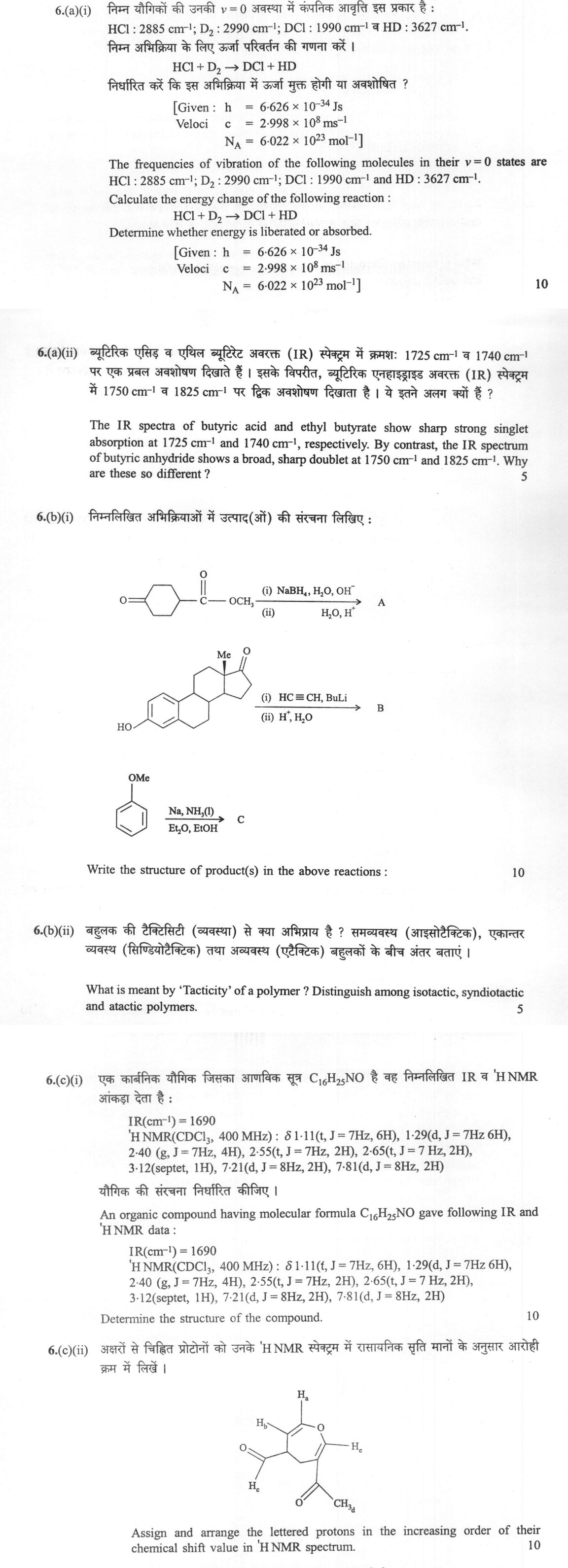
The figure this question refers to, in words
The question paper is a scan and the diagram did not survive as text. This is the figure as read from the original page — every component, value and label — so the question can be worked from the text below.
(b) Reaction 3: Anisole (a benzene ring with a methoxy group, -OMe). The reaction conditions are Na, NH3(l) in Et2O, EtOH. The product is labeled C.
(c) A chemical structure of a bicyclic molecule consisting of a six-membered ring fused to a five-membered ring. The six-membered ring contains an oxygen atom and two double bonds. The five-membered ring contains a double bond. Specific protons are labeled with subscripts: Ha is attached to a carbon in the six-membered ring; Hb is attached to a carbon in the six-membered ring; Hc appears twice, once on a carbon in the five-membered ring and once on a methyl group attached to a carbonyl group; Hd is attached to a methyl group (CH3d) which is part of an acetyl group (C=O) attached to the five-membered ring. Another acetyl group (C=O) is attached to the six-membered ring.
What "Solve" is asking you to do
Choose the method, then carry it through to a final answer. Identifying what kind of problem this is and why that method applies is the first thing marked; a correct figure arrived at invisibly earns almost nothing.
Structure that answers it
Given data and what is required → method chosen, with the reason it applies → set-up (equation, circuit, free body, trial balance) → working, step by step → answer with units and any condition of validity
Where marks are lost
Doing the middle steps mentally and writing only the result. In mathematics papers, a further loss comes from giving a decimal where the exact value in surds or fractions was wanted, or from skipping the justification a part explicitly asks for.
How this answer will be evaluated
Approach
(a(i)) calculate: given > formula > substitution > result with units > interpretation | (a(ii)) explain: definition/context > points in order > small example > short close | (b(i)) map: locate accurately > label > one line on why it matters | (b(ii)) define: precise definition > the distinguishing feature > one example | (c(i)) map: locate accurately > label > one line on why it matters | (c(ii)) map: locate accurately > label > one line on why it matters Full marks: All parts answered with correct mechanisms, structures, and full working.
Key points expected
- Energy formula E = hν or E = hc/λ
- Calculation of ΔE = ΣE(products) - ΣE(reactants)
- Correct sign indicating energy liberated or absorbed
- Final value in J/mol with correct units
- Identification of symmetric and asymmetric C=O stretching modes
- Explanation of coupling between two carbonyl groups
- Contrast with single carbonyl in acid/ester
- Product A: Reduction of ketone to alcohol, ester intact
Evaluation rubric
Each sub-part is marked on its own, against the marks and word limit printed on the paper.
- (a(i)) Energy change of the reaction and its sign (liberated/absorbed). 10 marks
calculate— given → formula → substitution → result with units → interpretation
Must cover
- Energy formula E = hν or E = hc/λ
- Calculation of ΔE = ΣE(products) - ΣE(reactants)
- Correct sign indicating energy liberated or absorbed
- Final value in J/mol with correct units
Loses marks
- Omitting Avogadro's number for molar energy
- Incorrect sign convention for ΔE
Earns more
- Explicit conversion of wavenumbers to frequency
- Step-by-step substitution of constants
Extra mark
- Comparison of bond strengths qualitatively
- (a(ii)) Reason for the doublet in anhydride vs singlet in acid/ester. 5 marks
explain— definition/context → points in order → small example → short close
Must cover
- Identification of symmetric and asymmetric C=O stretching modes
- Explanation of coupling between two carbonyl groups
- Contrast with single carbonyl in acid/ester
Loses marks
- Attributing doublet to impurities
- Ignoring the coupling mechanism
Earns more
- Mention of Fermi resonance if applicable
- Specific wavenumber assignment to modes
Extra mark
- Diagram of normal modes
- (b(i)) Structures of products A, B, and C. 10 marks
map— locate accurately → label → one line on why it matters
Must cover
- Product A: Reduction of ketone to alcohol, ester intact
- Product B: Alkyne addition to ketone forming propargylic alcohol
- Product C: Birch reduction of anisole to 1-methoxy-1,4-cyclohexadiene
- Correct regiochemistry and stereochemistry where applicable
Loses marks
- Reducing the ester in product A
- Wrong regioisomer for Birch reduction
Earns more
- Mechanism for Birch reduction electron transfer
- Explanation of chemoselectivity in NaBH4 reaction
Extra mark
- IUPAC names of products
- (b(ii)) Definition of tacticity and distinction between isotactic, syndiotactic, atactic. 5 marks
define— precise definition → the distinguishing feature → one example
Must cover
- Definition of tacticity as spatial arrangement of substituents
- Isotactic: all substituents on same side
- Syndiotactic: alternating sides
- Atactic: random arrangement
Loses marks
- Confusing tacticity with regiochemistry
- Vague descriptions without spatial reference
Earns more
- Schematic representation of the three types
- Mention of crystallinity differences
Extra mark
- Example of a specific polymer for each type
- (c(i)) Structure of the organic compound C16H25NO. 10 marks
map— locate accurately → label → one line on why it matters
Must cover
- Identification of para-substituted aromatic ring from NMR
- Assignment of isopropyl group from septet and doublet
- Assignment of ethyl group from triplet and quartet
- Identification of amide linkage from IR and NMR
Loses marks
- Ignoring the integration values
- Incorrect placement of substituents on ring
Earns more
- Calculation of degree of unsaturation
- Logical assembly of fragments
Extra mark
- IUPAC name of the compound
- (c(ii)) Order of protons Ha, Hb, Hc, Hd by increasing chemical shift. 10 marks
map— locate accurately → label → one line on why it matters
Must cover
- Identification of deshielding effects of carbonyl groups
- Assignment of Hc as most downfield (alpha to C=O)
- Assignment of Ha/Hb based on alkene position
- Correct ordering of all four protons
Loses marks
- Ignoring the effect of the ring oxygen
- Incorrect relative order of Ha and Hb
Earns more
- Explanation of anisotropic effects
- Comparison of alpha vs beta protons
Extra mark
- Approximate chemical shift values
Model answer coming soon
Every evaluation on this site is marked against a verified model answer. This question's answer is still being written; evaluation opens the moment it lands.
More from Chemistry 2023 Paper II
- Q3 3.(a) Would you expect the above conversion to require heat or light? Explain using molec…
- Q4 4.(a)(i) Complete the above reaction and write the steps involved in the reaction. (5 mar…
- Q5 (a) How many signals would you expect in the ¹H NMR spectrum of above compounds ? Mark th…
- Q6 (a)(i) The frequencies of vibration of the following molecules in their v = 0 states are…
- Q7 (a) (i) Draw the structure of 2'-deoxycytidine-3'-monophosphate. (ii) Why nucleotides and…
- Q8 (a)(i) For the following compound : (i) Identify the site of initial ionization under EI…