Paper II — Q8
(a)(i) For the following compound : (i) Identify the site of initial ionization under EI conditions. (ii) Draw the structure of…
For the following compound :
Identify the site of initial ionization under EI conditions.
Draw the structure of ion having m/z = 58 value.
Calculate the m/z value of metastable ion formed during the formation of above ion. 10 marks
Draw the structural formula of a ketone with MF C₇H₁₂O that absorbs in the UV with λₘₐₓ = 249 nm. 5 marks
(A) Which of the above molecule(s) will show a microwave rotational spectrum ? Justify your answer.
H₂, HCl, BrF, CH₄ and H₂O
(B) The first rotational absorption of ¹²C¹⁶O was observed at 3·84235 cm⁻¹ while that of ¹³C¹⁶O was observed at 3·67337 cm⁻¹. Find their rotational constants. 10 marks
Estimate the expected splitting (J in Hz) for the lettered protons in the above compounds : 5 marks
In the ¹H NMR spectrum of acetyl acetone the height of the integration curve at methylene (–CH₂) signal was found to be 10 mm and that of methine (=CH) signal was 22 mm. Calculate the percentage of keto and enol form in the sample. 10 marks
How could the above pair of isomeric compounds be differentiated by mass spectrometry ? 5 marks
How many fundamental vibrational frequencies would be expected to be observed in the IR spectrum of CO₂ ? Sketch them. Identify the IR-active vibrations with justification. 5 marks
हिंदी में प्रश्न पढ़ें
(क)(i) निम्नलिखित यौगिक में :
ई आई (EI) अवस्था के तहत प्रारंभिक आयनन स्थल की पहचान करें ।
m/z = 58 मान वाले आयन की संरचना बनाइए ।
उपरोक्त आयन के निर्माण के दौरान बनने वाले (metastable) मितस्थायी आयन के m/z मान की गणना करें । 10
(क)(ii) आणविक सूत्र C₇H₁₂O वाले एक कीटोन का संरचनात्मक सूत्र बनाइए जो पराबैंगनी प्रकाश में λₘₐₓ = 249 nm पर अवशोषित करता है । 5
(ख)(i) (A) निम्नलिखित में से कौन सा अणु सूक्ष्मतरंग घूर्णनात्मक स्पेक्ट्रम दिखाएगा ? अपने उत्तर का औचित्य दीजिए ।
H₂, HCl, BrF, CH₄ and H₂O
(B) ¹²C¹⁶O का प्रथम घूर्णनात्मक अवशोषण 3·84235 cm⁻¹ पर देखा गया जबकि ¹³C¹⁶O का 3·67337 cm⁻¹ पर दिखा । उनका घूर्णनात्मक स्थिरांक ज्ञात कीजिए । 10
(ख)(ii) निम्नलिखित यौगिकों में अक्षरित प्रोटोनों के लिए अपेक्षित विपाटन (J in Hz) का अनुमान लगाइए । 5
(ग)(i) एसिटाइल एसीटोन के ¹H NMR स्पेक्ट्रम की समाकलन वक्र रेखा में मेथिलीन (–CH₂) सिग्नल की ऊँचाई 10 mm और मेथाइन (=CH) सिग्नल की ऊँचाई 22 mm पाई गई है । प्रतिदर्श में कीटो और एनोल रूप के प्रतिशत की गणना करें । 10
(ग)(ii) मास स्पेक्ट्रोमेट्री द्वारा समावयवी यौगिकों की निम्नलिखित जोड़ी को कैसे विभेदित किया जा सकता है ? 5 marks
(ग)(iii) CO₂ के अवरक्त स्पेक्ट्रम में कितनी मौलिक कंपन आवृत्तियों की अपेक्षा की जा सकती है ? उनका आरेख (स्केच) बनाइए । ओचित्य के साथ अवरक्त सक्रिय कंपनों की पहचान करें । 5
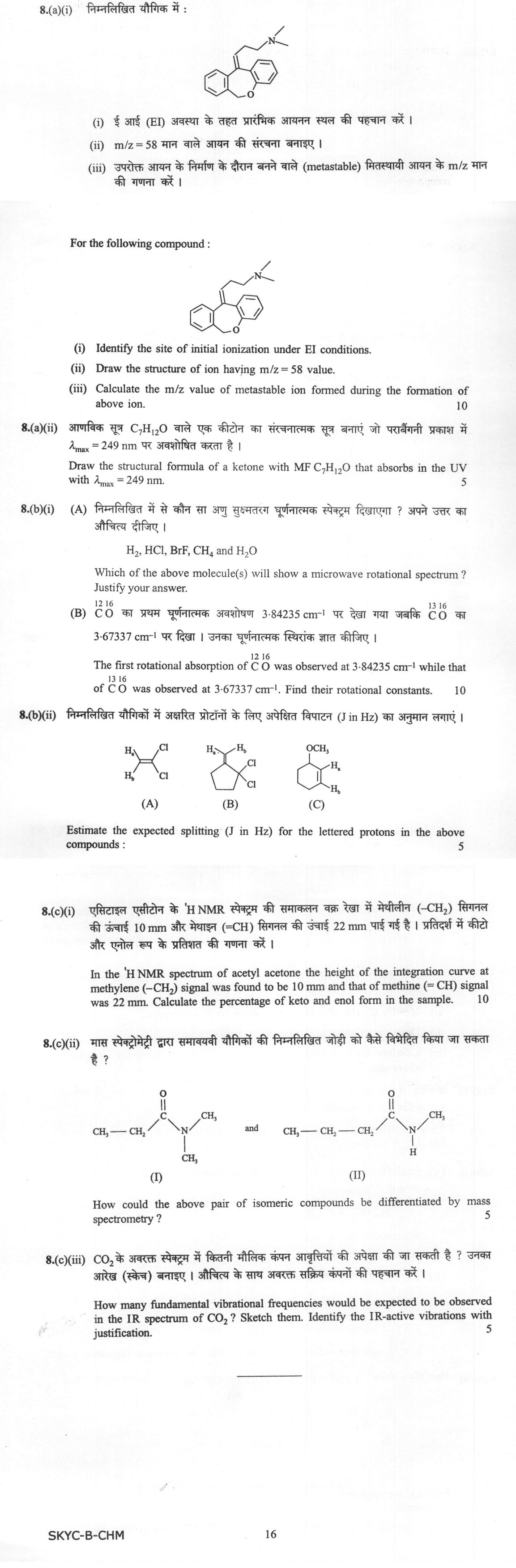
The figure this question refers to, in words
The question paper is a scan and the diagram did not survive as text. This is the figure as read from the original page — every component, value and label — so the question can be worked from the text below.
(a) Chemical structure of a tricyclic organic molecule. The core is a dibenzopyran system (two benzene rings fused to a central six-membered ring containing an oxygen atom at the bottom). The central ring is saturated at the bottom (CH2-O-CH2) and has a double bond at the top connecting the two benzene rings. Attached to the top carbon of the central ring (the one not part of the benzene rings) is a side chain: a double bond to a CH group, which is single-bonded to a CH2 group, which is single-bonded to a Nitrogen atom. The Nitrogen atom is bonded to two methyl groups (N,N-dimethylamino group).
(b) Three chemical structures labeled (A), (B), and (C) showing specific protons labeled Ha and Hb.
(A) 1,1-dichloroethene. A double bond connects two carbons. The left carbon is bonded to Ha (top) and Hb (bottom). The right carbon is bonded to two Cl atoms.
(B) 2,2-dichloro-1-methylcyclopentene. A five-membered ring with a double bond at the top. The top-left carbon of the double bond is bonded to Ha. The top-right carbon of the double bond is bonded to Hb. The carbon adjacent to the top-right carbon (clockwise) is bonded to two Cl atoms.
(C) 1-methoxy-2,3-dihydro-1H-indene derivative (specifically 1-methoxy-2,3-dihydro-1H-indene is not quite right, it's a cyclohexene ring). A six-membered ring with a double bond on the right side. The top carbon of the double bond is bonded to an OCH3 group and Ha. The bottom carbon of the double bond is bonded to Hb.
(c) Two isomeric amide structures labelled (I) and (II). Structure (I): CH3-CH2-C(=O)-N(CH3)-CH3, i.e. an ethyl group bonded to a carbonyl carbon, which is bonded to a nitrogen; the nitrogen bears two methyl groups. Structure (II): CH3-CH2-CH2-C(=O)-N(H)-CH3, i.e. a propyl group bonded to a carbonyl carbon, which is bonded to a nitrogen; the nitrogen bears one hydrogen and one methyl group. The two structures are joined by the word 'and'.
(c(ii)) Two chemical structures labeled (I) and (II) are shown side-by-side. Structure (I) is N,N-dimethylpropanamide: a carbonyl group (C=O) is bonded to an ethyl group (CH3-CH2-) on one side and a nitrogen atom on the other. The nitrogen atom is bonded to two methyl groups (CH3). Structure (II) is N-methylbutanamide: a carbonyl group (C=O) is bonded to a propyl group (CH3-CH2-CH2-) on one side and a nitrogen atom on the other. The nitrogen atom is bonded to one methyl group (CH3) and one hydrogen atom (H).
(c(ii)) Two chemical structures labeled (I) and (II) are shown side-by-side. Structure (I) is N,N-dimethylpropanamide: a carbonyl group (C=O) is bonded to an ethyl group (CH3-CH2-) on one side and a nitrogen atom on the other. The nitrogen atom is bonded to two methyl groups (CH3). Structure (II) is N-methylbutanamide: a carbonyl group (C=O) is bonded to a propyl group (CH3-CH2-CH2-) on one side and a nitrogen atom on the other. The nitrogen atom is bonded to one methyl group (CH3) and one hydrogen atom (H).
What "Solve" is asking you to do
Choose the method, then carry it through to a final answer. Identifying what kind of problem this is and why that method applies is the first thing marked; a correct figure arrived at invisibly earns almost nothing.
Structure that answers it
Given data and what is required → method chosen, with the reason it applies → set-up (equation, circuit, free body, trial balance) → working, step by step → answer with units and any condition of validity
Where marks are lost
Doing the middle steps mentally and writing only the result. In mathematics papers, a further loss comes from giving a decimal where the exact value in surds or fractions was wanted, or from skipping the justification a part explicitly asks for.
How this answer will be evaluated
Approach
(a(i)) explain: definition/context > points in order > small example > short close | (a(ii)) describe: define > structure or process in order > labelled diagram > significance | (b(i)) justify: claim > 3-4 reasons > evidence > conclusion | (b(ii)) calculate: given > formula > substitution > result with units > interpretation | (c(i)) calculate: given > formula > substitution > result with units > interpretation | (c(ii)) compare: paired headings or table > key differences > significance > conclusion | (c(iii)) describe: define > structure or process in order > labelled diagram > significance Full marks: Accurate mechanisms, correct calculations, and clear justifications for all parts.
Key points expected
- Identify tertiary amine as initial ionization site
- Draw structure of m/z 58 ion (e.g., iminium)
- Calculate metastable m/z using m* = m2²/m1
- Show fragmentation pathway to m/z 58
- Draw a conjugated ketone structure
- Ensure formula matches C7H12O
- Structure must account for λmax 249 nm
- Identify HCl, BrF, H2O as active (dipole moment)
Evaluation rubric
Each sub-part is marked on its own, against the marks and word limit printed on the paper.
- (a(i)) Identify ionization site, draw m/z 58 ion, and calculate metastable m/z. 10 marks
explain— definition/context → points in order → small example → short close
Must cover
- Identify tertiary amine as initial ionization site
- Draw structure of m/z 58 ion (e.g., iminium)
- Calculate metastable m/z using m* = m2²/m1
- Show fragmentation pathway to m/z 58
Loses marks
- Wrong site of ionization
- Incorrect m/z calculation formula
Earns more
- Mention charge localization on nitrogen
- Label the specific bond cleavage
Extra mark
- Draw resonance structures of the fragment
- (a(ii)) Draw structural formula of C7H12O ketone with λmax 249 nm. 5 marks
describe— define → structure or process in order → labelled diagram → significance
Must cover
- Draw a conjugated ketone structure
- Ensure formula matches C7H12O
- Structure must account for λmax 249 nm
Loses marks
- Non-conjugated structure
- Incorrect molecular formula
Earns more
- Mention Woodward-Fieser rules application
Extra mark
- Calculate expected λmax to verify
- (b(i)) Identify microwave active molecules and calculate rotational constants. 10 marks
justify— claim → 3-4 reasons → evidence → conclusion
Must cover
- Identify HCl, BrF, H2O as active (dipole moment)
- Justify H2 and CH4 as inactive (no dipole)
- Calculate B for 12C16O from 3.84235 cm-1
- Calculate B for 13C16O from 3.67337 cm-1
Loses marks
- Listing inactive molecules as active
- Calculation errors in B values
Earns more
- Show formula B = h/8π²Ic
Extra mark
- Calculate bond length from B
- (b(ii)) Estimate coupling constants (J) for lettered protons. 5 marks
calculate— given → formula → substitution → result with units → interpretation
Must cover
- Estimate J for trans protons in (A)
- Estimate J for cis protons in (B)
- Estimate J for allylic protons in (C)
Loses marks
- Confusing cis and trans values
- No numerical estimate provided
Earns more
- Cite typical J ranges (e.g., 12-18 Hz trans)
Extra mark
- Mention Karplus equation
- (c(i)) Calculate percentage of keto and enol forms from NMR data. 10 marks
calculate— given → formula → substitution → result with units → interpretation
Must cover
- Identify 10 mm as CH2 (keto) and 22 mm as CH (enol)
- Normalize heights to number of protons (2 vs 1)
- Calculate mole ratio of keto to enol
- Convert ratio to percentage
Loses marks
- Failing to normalize for proton count
- Arithmetic errors in percentage
Earns more
- Show step-by-step calculation
Extra mark
- Mention intramolecular H-bonding in enol
- (c(ii)) Differentiate isomeric amides by mass spectrometry. 5 marks
compare— paired headings or table → key differences → significance → conclusion
Must cover
- Identify alpha-cleavage patterns for both
- Distinguish based on N-methyl vs N-H fragments
- Predict specific m/z peaks for each isomer
Loses marks
- Failing to distinguish N-substitution effects
- Vague description without m/z values
Earns more
- Draw fragmentation schemes
Extra mark
- Mention McLafferty rearrangement if applicable
- (c(iii)) Describe CO2 vibrational modes and IR activity. 5 marks
describe— define → structure or process in order → labelled diagram → significance
Must cover
- List 4 fundamental modes (3N-6)
- Identify symmetric stretch as IR inactive
- Identify asymmetric stretch and bends as active
- Justify based on dipole moment change
Loses marks
- Marking symmetric stretch as IR active
- Missing vibrational modes
Earns more
- Sketch the vibrational modes
Extra mark
- Mention Raman activity of symmetric stretch
Model answer coming soon
Every evaluation on this site is marked against a verified model answer. This question's answer is still being written; evaluation opens the moment it lands.
More from Chemistry 2023 Paper II
- Q5 (a) How many signals would you expect in the ¹H NMR spectrum of above compounds ? Mark th…
- Q6 (a)(i) The frequencies of vibration of the following molecules in their v = 0 states are…
- Q7 (a) (i) Draw the structure of 2'-deoxycytidine-3'-monophosphate. (ii) Why nucleotides and…
- Q8 (a)(i) For the following compound : (i) Identify the site of initial ionization under EI…