Paper II — Q5
(a) How many signals would you expect in the ¹H NMR spectrum of above compounds ? Mark these protons. 10 marks (b) Compare the…
How many signals would you expect in the ¹H NMR spectrum of above compounds ? Mark these protons. 10 marks
Compare the C=C stretching vibrations in the above compounds and give a suitable explanation for your answer. 10 marks
Identify A and B. The polymerisation of the rearranged product of B, unaided by any catalyst, gives rise to a 'synthetic rubber'. Name this rubber along with its structural formula. 2 CH≡CH →[Cu₂Cl₂/NH₄Cl] A →[HCl] B
When rubber balls and other objects made of rubber are exposed to the air for long periods of time, they turn brittle and crack. This does not happen to objects made of polyethylene. Explain. 10 marks
Reduction of camphor with LiAlH₄ leads to 90% of the isomer in which the OH group is cis to the bridge. Give a suitable explanation of this observation. 10 marks
Identify the products in the above reactions with plausible mechanism. CH₃—C(=O)—CH₃ →[hν/Vapour phase]
CH₃—C(=O)—CH₃ →[hν/Room temperature] 10 marks
हिंदी में प्रश्न पढ़ें
आप निम्न यौगिकों के ¹H NMR स्पेक्ट्रम में कितने शीर्ष (सिग्नल) का अनुमान लगाते हैं ? इन प्रोटोनों को चिह्नित कीजिए । 10
निम्न यौगिकों में C=C तनन आवृत्ति की तुलना कीजिए तथा अपने उत्तर का औचित्य सिद्ध करने के लिए उपयुक्त स्पष्टीकरण दीजिए । 10
निम्नलिखित अभिक्रिया अनुक्रम में A तथा B यौगिकों को पहचानिए । किसी भी उत्प्रेरक की सहायता के बिना B के पुनर्व्यवस्थित उत्पाद के बहुलकन से एक सिंथेटिक रबड़ बनता है । इस रबड़ का संरचनात्मक सूत्र सहित नाम लिखिए । 2 CH≡CH →[Cu₂Cl₂/NH₄Cl] A →[HCl] B
जब रबड़ की गेंदों और रबड़ से बनी अन्य वस्तुओं को ज्यादा समय के लिए हवा के संपर्क में रखा जाता है, तो वे भंगुर हो जाती हैं और टूट जाती हैं । पॉलीथीन से बनी वस्तुओं के साथ ऐसा नहीं होता है । व्याख्या कीजिए । 10
कपूर (camphor) को LiAlH₄ द्वारा अपचयन करने पर 90% मात्रा में एक ऐसा समावयव मिलता है जिसमें हाइड्रोक्सल (OH) सेतु के समीप है। इस अवलोकन के लिए एक उपयुक्त स्पष्टीकरण दें। 10
निम्न अभिक्रियाओं में उत्पादों की पहचान कीजिए व क्रियाविधि लिखिए। CH₃—C(=O)—CH₃ →[hν/Vapour phase]
CH₃—C(=O)—CH₃ →[hν/Room temperature] 10
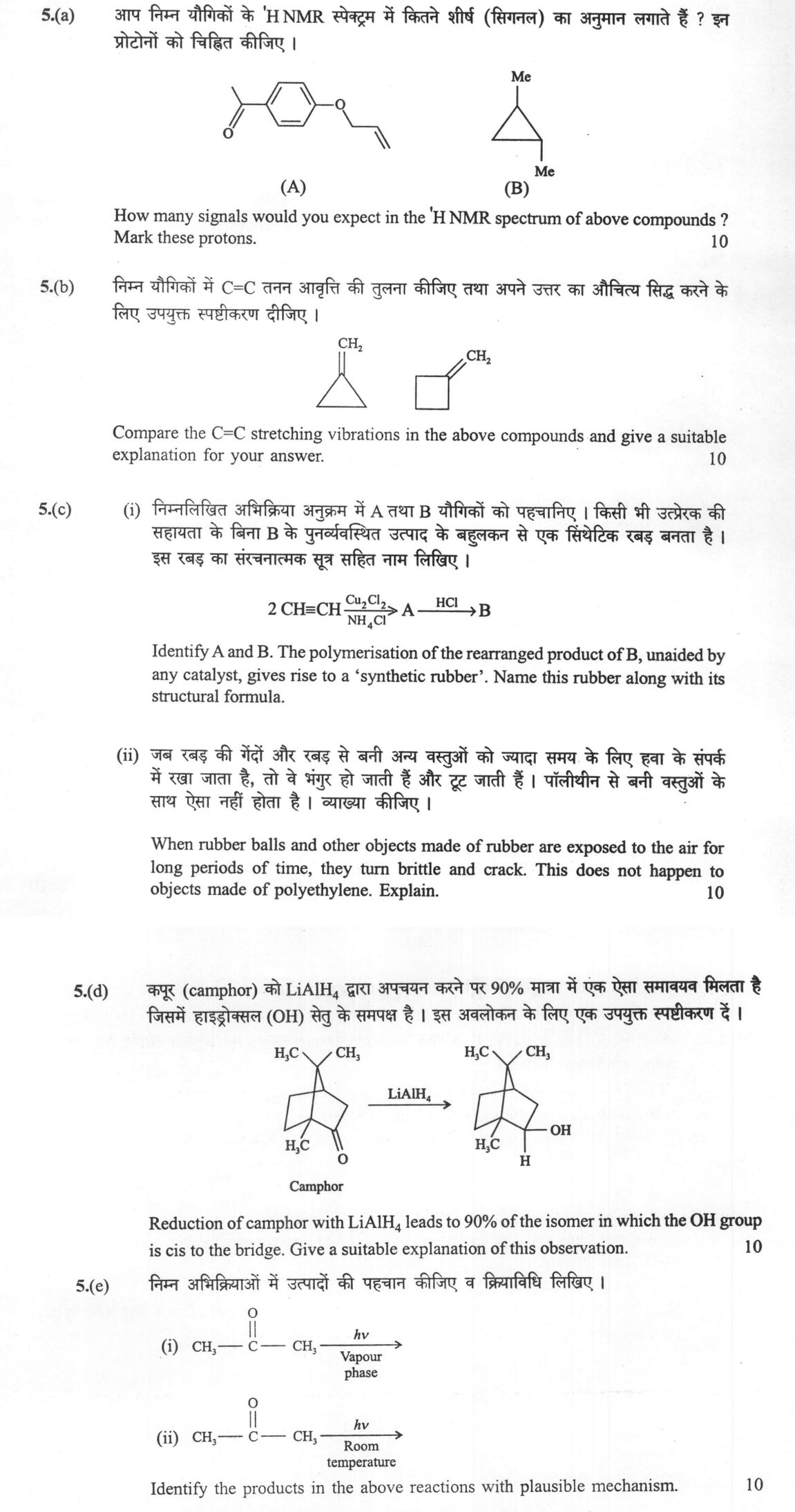
The figure this question refers to, in words
The question paper is a scan and the diagram did not survive as text. This is the figure as read from the original page — every component, value and label — so the question can be worked from the text below.
(a) Two chemical structures labeled (A) and (B). Structure (A) is a benzene ring substituted at the 1-position with an acetyl group (a carbonyl group bonded to a methyl group) and at the 4-position with an allyloxy group (an oxygen atom bonded to a prop-2-enyl group). Structure (B) is a cyclopropane ring with a methyl group attached to the top carbon and another methyl group attached to the bottom-right carbon.
(b) Two chemical structures. The left structure is methylenecyclopropane, consisting of a three-membered carbon ring with an exocyclic double bond to a CH2 group. The right structure is methylenecyclobutane, consisting of a four-membered carbon ring with an exocyclic double bond to a CH2 group.
(c) A reaction scheme: 2 molecules of acetylene (CH≡CH) react with Cu2Cl2 and NH4Cl to form product A. Product A then reacts with HCl to form product B.
(d) A chemical reaction scheme showing the reduction of camphor. On the left is the reactant, labeled 'Camphor', which is a bicyclic ketone structure (bicyclo[2.2.1]heptan-2-one) with a gem-dimethyl group at the bridgehead (C7) and a methyl group at C4. An arrow points to the right with the reagent 'LiAlH4' written above it. On the right is the product, a bicyclic alcohol (isoborneol) where the carbonyl oxygen has been reduced to a hydroxyl group (-OH). The stereochemistry is explicitly shown with the -OH group on a solid wedge (pointing up) and the hydrogen atom on a dashed wedge (pointing down), indicating the OH group is cis to the bridge.
(e) Two separate reaction schemes labeled (i) and (ii). Both start with the reactant acetone, drawn as CH3-C(=O)-CH3. In scheme (i), an arrow points to the right with 'hv' above and 'Vapour phase' below. In scheme (ii), an arrow points to the right with 'hv' above and 'Room temperature' below. The products are not shown.
Model answer
Written by UPSC Answer Check against this question's marking rubric, to the expected length. UPSC does not publish answers for Mains — this is one way to score well, not an official key.
The spectroscopic and photochemical behaviour of the given structures follows from symmetry, ring strain, radical stability and cage effects.
(a) ¹H NMR signals. For 4-allyloxyacetophenone (A), the para-disubstituted ring has a mirror plane, so H-2/H-6 and H-3/H-5 are each equivalent; these give two aromatic signals, usually an AA′BB′ pair of doublets from ortho coupling. The acetyl methyl is one singlet. In the allyloxy chain, the OCH₂ protons are enantiotopic and equivalent in an achiral solvent, giving one doublet coupled to the vinyl CH; the internal vinyl CH is one multiplet, often a ddq; and the terminal =CH₂ protons are nonequivalent (cis and trans to the CH), giving two dd signals. Thus A shows seven signals. Mark them as Hₐ = Ar-H ortho to COCH₃, H_b = Ar-H ortho to O-allyl, H_c = COCH₃, H_d = OCH₂, H_e = CH=, H_f/H_g = =CH₂. For B, 1,2-dimethylcyclopropane, the count depends on the stereochemistry actually drawn. If the common cis isomer is shown, the two methyl groups are equivalent (6H, doublet), the two substituted ring CH protons are equivalent (2H), and the C-3 CH₂ protons are diastereotopic, one cis and one trans to the methyls, so B gives four signals. If the drawing is trans, the C-3 CH₂ protons are related by a C₂ axis and are equivalent, so B gives three signals; the methyl and ring-CH assignments remain the same. The usual cis drawing therefore gives four signals.
(b) C=C stretching. Methylenecyclopropane shows a higher C=C stretching frequency (about 1650 cm⁻¹) than methylenecyclobutane (about 1620 cm⁻¹). Both have an exocyclic terminal C=C and similar reduced mass, so the difference is mainly force constant; since ν ∝ √(k/μ), a higher wavenumber means a larger force constant. In methylenecyclopropane the three-membered ring is highly strained; the bent C–C bonds force the ring carbon to use orbitals with greater s-character for the exocyclic double bond, strengthening and shortening the C=C and raising the force constant. In methylenecyclobutane the ring strain is smaller, the exocyclic C=C is less strengthened, and the stretching frequency is lower. Conjugation is absent in both, so ring strain/rehybridization controls the order.
(c)(i) A and B. 2 CH≡CH dimerizes in the presence of Cu₂Cl₂/NH₄Cl to A, vinylacetylene (but-1-en-3-yne), CH₂=CH–C≡CH. The Cu₂Cl₂/NH₄Cl system promotes coupling of acetylene molecules. Addition of HCl to the terminal alkyne gives a resonance-stabilized allenyl cation; chloride capture at the terminal carbon gives B, 4-chloro-1,2-butadiene, CH₂=C=CH–CH₂Cl. B is not the final rubber monomer; it rearranges by an allylic/allenic shift to the more stable conjugated diene 2-chloro-1,3-butadiene, chloroprene, CH₂=CCl–CH=CH₂. The rearranged product polymerizes without a catalyst by 1,4-addition to give neoprene, poly(chloroprene), –[CH₂–CCl=CH–CH₂]–ₙ.
(c)(ii) Rubber embrittlement. Rubber objects contain unsaturated C=C bonds and allylic C–H bonds. Exposure to air, light and heat initiates radical autoxidation: an allylic H is abstracted, O₂ adds to the allylic radical to give peroxyl and hydroperoxide species, and these decompose to carbonyls, chain ends and crosslinks. Chain scission reduces molecular weight and elasticity, while crosslinking makes the material stiff; hence rubber balls crack. Polyethylene has a saturated –CH₂–CH₂– backbone, no C=C and no weak allylic C–H bonds. Oxidation requires stronger C–H cleavage and does not generate the same conjugated peroxide chain reactions, so it remains comparatively flexible.
(d) Camphor reduction. Camphor is a rigid bicyclic ketone. The C-7 gem-dimethyl bridge and the C-4 methyl group shield the face of the C-2 carbonyl that is syn to the bridge. LiAlH₄ therefore delivers hydride preferentially from the less hindered exo face, opposite the bridge. The new C–H bond is formed on that exo face, while the alkoxide/oxygen remains on the bridge side; after work-up the OH is cis to the bridge, giving isoborneol as the major (about 90%) product. The minor product, borneol, arises from attack on the more hindered face. This steric approach control is consistent with the Cieplak model: the nucleophile approaches anti to the larger σ* orbital of the adjacent C–C bond, and in camphor that preferred trajectory coincides with the less hindered exo approach. The rigid framework prevents conformational averaging, so facial selectivity is high.
(e) Photochemical products. (i) In the vapour phase, hν excites acetone to an n,π* state. The vapour-phase reaction follows the Norrish Type II cleavage pattern (excited-state C–C cleavage with H-transfer): α-cleavage gives CH₃• and CH₃CO•, and subsequent H-transfer gives methane. Because the vapour is dilute, there is no solvent cage and the radicals escape. Acetyl radicals recombine to biacetyl: 2 CH₃CO• → CH₃COCOCH₃. Methyl radicals abstract H from another acetone molecule: CH₃• + CH₃COCH₃ → CH₄ + CH₃COCH₂•, so methane is formed. Thus the characteristic vapour-phase products are biacetyl and methane. (ii) At room temperature acetone is liquid, and the same excited-state chemistry is trapped in a solvent cage. Intermolecular H-transfer, for example (CH₃)₂C=O* + (CH₃)₂C=O → (CH₃)₂C•–OH + CH₃COCH₂•, gives ketyl radicals, (CH₃)₂C•–OH. The cage effect suppresses radical escape and favours coupling of two ketyl radicals at carbon: 2 (CH₃)₂C•–OH → (CH₃)₂C(OH)–C(OH)(CH₃), pinacol. Hence liquid-phase/room-temperature photolysis gives pinacol as the major product, whereas vapour-phase photolysis gives cage-escape products such as biacetyl and methane.
What "Explain" is asking you to do
Make the working of something clear — what sets it off, what follows from what, and what it produces. Explain is the Commission's mechanism word: it dominates the technical papers and the “explain why” stems, where the marks sit in the causal chain and not in the label.
Structure that answers it
State what it is → the initiating condition → the chain of cause, step by step → an instance where it plays out → what the chain produces
Where marks are lost
Describing what something looks like instead of why it works that way. Naming the stages without linking them reads as description too.
How this answer will be evaluated
Approach
(a) map: locate accurately > label > one line on why it matters | (b) compare: paired headings or table > key differences > significance > conclusion | (c(i)) trace: start point > the stages in sequence > end point > what changed | (c(ii)) explain: definition/context > points in order > small example > short close | (d) justify: claim > 3-4 reasons > evidence > conclusion | (e) trace: start point > the stages in sequence > end point > what changed Full marks: Accurate structures, mechanisms, and reasoning for all parts.
Key points expected
- Identify symmetry elements in each structure
- Count distinct proton environments for A
- Count distinct proton environments for B
- Label or mark the specific protons on the structures
- Identify ring strain in both compounds
- Relate ring strain to C=C bond order
- Predict relative wavenumbers of C=C stretch
- Explain the electronic/steric basis for the difference
Evaluation rubric
Each sub-part is marked on its own, against the marks and word limit printed on the paper.
- (a) Determine number of 1H NMR signals and identify unique protons for compounds A and B. 10 marks
map— locate accurately → label → one line on why it matters
Must cover
- Identify symmetry elements in each structure
- Count distinct proton environments for A
- Count distinct proton environments for B
- Label or mark the specific protons on the structures
Loses marks
- Fails to account for molecular symmetry
- Counts non-equivalent protons as equivalent
Earns more
- Correctly identifies equivalent protons in A
- Correctly identifies equivalent protons in B
Extra mark
- Predicts relative integration values
- (b) Compare C=C stretching vibrations of methylenecyclopropane and methylenecyclobutane with explanation. 10 marks
compare— paired headings or table → key differences → significance → conclusion
Must cover
- Identify ring strain in both compounds
- Relate ring strain to C=C bond order
- Predict relative wavenumbers of C=C stretch
- Explain the electronic/steric basis for the difference
Loses marks
- Confuses C=C stretch with C-C stretch
- Ignores the effect of ring size on bond strength
Earns more
- Mentions specific wavenumber ranges
- Discusses angle strain effects on hybridization
Extra mark
- References specific IR data values
- (c(i)) Identify intermediates A and B and the final synthetic rubber product with structure.
trace— start point → the stages in sequence → end point → what changed
Must cover
- Identify A as vinylacetylene (but-1-en-3-yne)
- Identify B as chloroprene (2-chloro-1,3-butadiene)
- Name the rubber as Neoprene (polychloroprene)
- Draw the structural formula of the polymer
Loses marks
- Confuses the structure of A or B
- Fails to draw the polymer chain correctly
Earns more
- Shows the mechanism of the Cu-catalyzed coupling
- Shows the addition of HCl to form B
Extra mark
- Mentions the specific catalyst conditions
- (c(ii)) Explain why rubber degrades in air while polyethylene does not.
explain— definition/context → points in order → small example → short close
Must cover
- Identify the presence of C=C double bonds in rubber
- Explain oxidative degradation of double bonds
- Contrast with the saturated C-C backbone of polyethylene
- Mention the role of oxygen/air in the process
Loses marks
- Attributes degradation to heat alone
- Claims polyethylene has double bonds
Earns more
- Describes the formation of peroxides or hydroperoxides
- Mentions cross-linking or chain scission
Extra mark
- Mentions specific antioxidants used in rubber
- (d) Justify the 90% formation of the cis-OH isomer in camphor reduction. 10 marks
justify— claim → 3-4 reasons → evidence → conclusion
Must cover
- Identify the steric hindrance on the exo face
- Identify the steric hindrance on the endo face
- Explain the approach of the hydride reagent
- Relate the approach to the observed stereochemistry
Loses marks
- Claims the reagent attacks the more hindered face
- Fails to identify the specific steric groups
Earns more
- Draws the transition state or Newman projection
- Mentions the specific bulky groups (gem-dimethyl)
Extra mark
- Mentions the Curtin-Hammett principle
- (e) Identify products and mechanisms for acetone photolysis in vapor vs room temp. 10 marks
trace— start point → the stages in sequence → end point → what changed
Must cover
- Identify the Norrish Type I product for (i)
- Identify the Norrish Type II product for (ii)
- Draw the mechanism for the vapor phase reaction
- Draw the mechanism for the room temperature reaction
Loses marks
- Confuses Norrish Type I and Type II
- Fails to show the radical intermediates
Earns more
- Shows the radical intermediates
- Explains the role of solvent/phase in the mechanism
Extra mark
- Mentions the specific wavelengths of light
Practice this exact question
Write your answer and it is marked point by point against the model answer above — what you covered, what you missed, what you got wrong.
Evaluate my answer →More from Chemistry 2023 Paper II
- Q2 2.(a)(i) Based on Hückel rule, predict the above compounds as aromatic, antiaromatic, and…
- Q3 3.(a) Would you expect the above conversion to require heat or light? Explain using molec…
- Q4 4.(a)(i) Complete the above reaction and write the steps involved in the reaction. (5 mar…
- Q5 (a) How many signals would you expect in the ¹H NMR spectrum of above compounds ? Mark th…
- Q6 (a)(i) The frequencies of vibration of the following molecules in their v = 0 states are…
- Q7 (a) (i) Draw the structure of 2'-deoxycytidine-3'-monophosphate. (ii) Why nucleotides and…
- Q8 (a)(i) For the following compound : (i) Identify the site of initial ionization under EI…