Paper II — Q2
2.(a)(i) Based on Hückel rule, predict the above compounds as aromatic, antiaromatic, and nonaromatic. 5 marks 2.(a)(ii)…
2.(a)(i) Based on Hückel rule, predict the above compounds as aromatic, antiaromatic, and nonaromatic. 5 marks
2.(a)(ii) Identify the above reactions that show primary kinetic isotope effect and secondary kinetic isotope effect. 5 marks
2.(a)(iii) Identify (A) and (B) in the above reactions and explain the mechanism. 5 marks
2.(b)(i) The rate of hydrolysis (k₁ and k₂) of the reaction (A) is much faster than that of (B). Explain. 5 marks
2.(b)(ii) The reaction of the compounds (A) and (B) with AgClO₄ in MeOH gives the same product (C). Explain. 5 marks
2.(b)(iii) Write the major product of the above reaction showing proper stereochemistry and explain the mechanism. 10 marks
2.(c)(i) Write the structure of the product of the above reaction and provide suitable mechanism. 10 marks
2.(c)(ii) Write the preferred position (C-2 or C-3) in electrophilic substitution of indole. Explain your observation with the help of resonance structures. 5 marks
हिंदी में प्रश्न पढ़ें
2.(a)(i) हकल नियम के अनुप्रयोग से निम्न यौगिकों का उनके ऐरोमैटिक, एंटी-ऐरोमैटिक, तथा नॉन-ऐरोमैटिक आधार पर पहचान करें । 5
2.(a)(ii) निम्नलिखित अभिक्रियाओं की प्राथमिक गतिक समस्थानिक प्रभाव व द्वितीयक गतिक समस्थानिक प्रभाव दर्शाने के आधार पर पहचान करें । 5
2.(a)(iii) निम्नलिखित अभिक्रियाओं में उत्पाद (A) तथा (B) को पहचानिए एवं संमिलित क्रियाविधि की व्याख्या कीजिए । 5
2.(b)(i) अभिक्रिया (A) की जल अपघटन दर (k₁ व k₂) अभिक्रिया (B) से बहुत द्रुत है । व्याख्या कीजिए । 5
2.(b)(ii) MeOH में AgClO₄ के साथ यौगिक (A) और (B) की अभिक्रियाएँ समान उत्पाद (C) देती हैं । व्याख्या कीजिए । 5
2.(b)(iii) विभिन्न रसायन दर्शाते हुए निम्नलिखित अभिक्रिया के मुख्य उत्पाद की संरचना लिखिए एवं क्रियाविधि की व्याख्या कीजिए । 10
2.(c)(i) निम्नलिखित अभिक्रिया के उत्पाद की संरचना लिखिए व क्रियाविधि की व्याख्या कीजिए । 10
2.(c)(ii) इंडोल के इलेक्ट्रॉनरागी प्रतिस्थापन अभिक्रिया में अधिमान्य स्थान (C-2 या C-3) की पहचान कीजिए । अनुनादी संरचनाओं की सहायता से अपने प्रेक्षण की व्याख्या कीजिए । 5
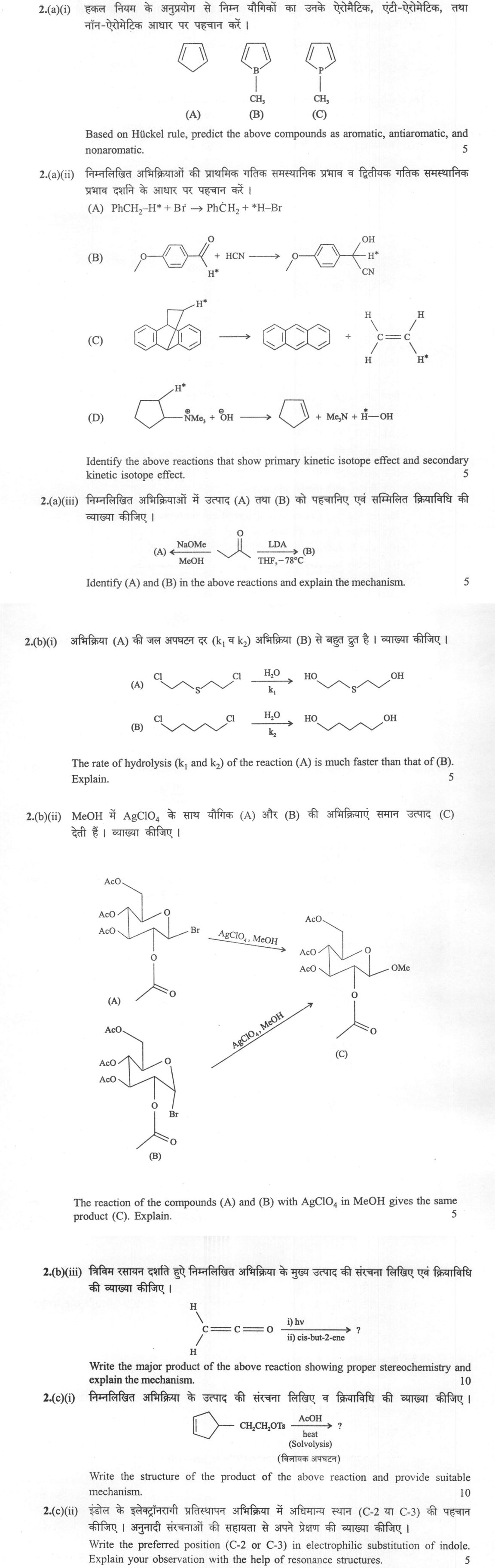
The figure this question refers to, in words
The question paper is a scan and the diagram did not survive as text. This is the figure as read from the original page — every component, value and label — so the question can be worked from the text below.
(a(i)) Three chemical structures labeled (A), (B), and (C). Structure (A) is a five-membered ring with two double bonds (cyclopentadiene). Structure (B) is a five-membered ring with two double bonds and a boron atom at the bottom vertex bonded to a methyl group (CH3). Structure (C) is a five-membered ring with two double bonds and a phosphorus atom at the bottom vertex bonded to a methyl group (CH3).
(a(ii)) Four reaction schemes labeled (A), (B), (C), and (D). Reaction (A) shows PhCH2-H* reacting with Br- to form PhCH2- and H-Br. Reaction (B) shows 4-methoxybenzaldehyde with a labeled aldehydic hydrogen (H) reacting with HCN to form a cyanohydrin product where the original aldehydic hydrogen is now attached to the chiral center. Reaction (C) shows a bicyclic compound (a norbornene derivative) with a labeled hydrogen (H*) on the bridge carbon undergoing a reaction to form anthracene and ethene (H2C=CH2) with one labeled hydrogen (H*). Reaction (D) shows a cyclopentane ring with a labeled hydrogen (H*) on one carbon and a trimethylammonium group (N+Me3) on the adjacent carbon reacting with hydroxide ion (OH-) to form cyclopentene, trimethylamine (Me3N), and water with a labeled hydrogen (*H-OH).
(a(iii)) A reaction scheme starting with 2-butanone (methyl ethyl ketone). An arrow points to the left labeled (A) with reagents NaOMe and MeOH. An arrow points to the right labeled (B) with reagents LDA and THF, -78 degrees C.
(b) A reaction scheme showing ketene, represented with H2C=C=O (two single bonds from H to C, which is double-bonded to C, which is double-bonded to O), reacting over an arrow with conditions: 'i) hv' and 'ii) cis-but-2-ene', leading to a question mark ('?').
(b(i)) Two chemical reactions are shown: Reaction (A): Bis(2-chloroethyl) sulfide, Cl-CH2-CH2-S-CH2-CH2-Cl, reacts with H2O over an arrow labelled 'k1' to form bis(2-hydroxyethyl) sulfide, HO-CH2-CH2-S-CH2-CH2-OH. Reaction (B): 1,5-Dichloropentane, Cl-CH2-CH2-CH2-CH2-CH2-Cl, reacts with H2O over an arrow labelled 'k2' to form 1,5-pentanediol, HO-CH2-CH2-CH2-CH2-CH2-OH.
(b(ii)) A reaction scheme showing two stereoisomers (A) and (B) both reacting with AgClO4 in MeOH to give the same product (C): Compound (A): A pyranose sugar derivative in chair conformation with ring oxygen in the back-right. Substituents are: C5 has an equatorial -CH2OAc group; C4 has an equatorial -OAc group; C3 has an equatorial -OAc group; C2 has an axial -OC(=O)CH3 group pointing downwards; C1 (anomeric position) has an equatorial -Br group. An arrow with reagents 'AgClO4, MeOH' points to Product (C). Compound (B): The same pyranose chair conformation and substituents as (A) at C2, C3, C4, and C5, but at C1 the -Br group is axial (pointing straight down). An arrow labelled 'AgClO4, MeOH' points upwards-right to the same Product (C). Product (C): The same pyranose derivative in chair conformation, with C5 equatorial -CH2OAc, C4 equatorial -OAc, C3 equatorial -OAc, C2 axial -OC(=O)CH3, and at C1 an equatorial -OMe group.
(b(i)) Two chemical reaction schemes labeled (A) and (B). Reaction (A) shows 1,4-bis(chloromethyl)thiane (a six-membered ring containing a sulfur atom, with a -CH2-Cl group attached to the carbon adjacent to the sulfur on both sides) reacting with H2O to form 1,4-bis(hydroxymethyl)thiane (the corresponding diol), with the rate constant labeled k1. Reaction (B) shows 1,5-dichloropentane (a linear chain of 5 carbons with a Cl atom at each end) reacting with H2O to form 1,5-pentanediol (a linear chain of 5 carbons with an OH group at each end), with the rate constant labeled k2.
(b(ii)) A reaction scheme showing two reactants (A) and (B) converting to a single product (C). Reactant (A) is a pyranose derivative (specifically a 2-deoxy-2-bromopyranose) with an acetyl group (AcO) at the C-3 and C-4 positions, a CH2-OAc group at C-5, and an acetoxy group (O-C(=O)CH3) at C-1. The C-2 position has a Br atom. Reactant (B) is the epimer of (A) at the C-2 position, where the Br atom is in the opposite orientation (axial vs equatorial). Both reactants are shown reacting with AgClO4 in MeOH (methanol) to form product (C). Product (C) is the corresponding 2-methoxy derivative, where the Br atom at C-2 has been replaced by an OMe (methoxy) group. The stereochemistry of the other substituents (AcO groups and ring oxygen) remains unchanged.
(b(iii)) A reaction scheme showing the starting material formaldehyde (H2C=O) reacting with cis-but-2-ene. The reaction conditions are listed as i) hv (light) and ii) cis-but-2-ene. An arrow points to a question mark indicating the product is to be determined.
(b(i)) Two chemical reaction schemes labeled (A) and (B). Reaction (A) shows 1,4-bis(chloromethyl)thioether (Cl-CH2-CH2-S-CH2-CH2-Cl) reacting with H2O to form 1,4-bis(hydroxymethyl)thioether (HO-CH2-CH2-S-CH2-CH2-OH). The rate constant for this reaction is labeled k1. Reaction (B) shows 1,6-dichlorohexane (Cl-CH2-CH2-CH2-CH2-CH2-CH2-Cl) reacting with H2O to form 1,6-hexanediol (HO-CH2-CH2-CH2-CH2-CH2-CH2-OH). The rate constant for this reaction is labeled k2.
(b(ii)) A reaction scheme involving two reactants (A) and (B) and one product (C). Reactant (A) is a pyranose derivative (specifically a 2-deoxy-2-bromopyranose derivative) with an acetyl group (AcO) at C-3, C-4, and C-5, and an acetoxy group (OAc) at C-6. The C-2 position has a bromine atom (Br) in an axial orientation. Reactant (B) is the epimer of (A) at C-2, where the bromine atom is in an equatorial orientation. Both reactants react with AgClO4 in MeOH to form the same product (C). Product (C) is the corresponding 2-methoxy derivative, where the bromine atom at C-2 has been replaced by a methoxy group (OMe) in an equatorial orientation.
(b(iii)) A reaction scheme showing the starting material formaldehyde (H2C=O) reacting with cis-but-2-ene. The reaction conditions are listed as i) hv (light) and ii) cis-but-2-ene. An arrow points to a question mark, indicating the product is to be determined.
(c) A reaction scheme showing a cyclopent-3-en-1-yl ring attached at position 1 to a -CH2CH2OTs group (2-(cyclopent-3-en-1-yl)ethyl tosylate). The reaction arrow is labeled above with 'AcOH' and below with 'heat / (Solvolysis) / (विलायक अपघटन)', leading to a question mark ('?').
(c(i)) A reaction scheme showing a starting material: a cyclopentene ring substituted at the 3-position with a 2-tosylethyl group (-CH2CH2OTs). The reaction conditions are AcOH (acetic acid) and heat, with the label '(Solvolytic)'. An arrow points to a question mark indicating the product is to be determined.
(c(i)) A reaction scheme showing a starting material: a cyclopentene ring substituted at the 3-position with a -CH2CH2OTs group (where OTs is a tosylate leaving group). The reaction conditions are AcOH (acetic acid) and heat, with the label '(Solvolytic)'. An arrow points to a question mark, indicating the product is to be determined.
Model answer
Written by UPSC Answer Check against this question's marking rubric, to the expected length. UPSC does not publish answers for Mains — this is one way to score well, not an official key.
2(a)(i) Aromaticity Prediction Applying Hückel’s rule (4n+2π electrons for aromaticity):
- Compound (A) Cyclopentadiene: Contains 4 π electrons in the conjugated diene system, but the sp³ carbon interrupts full cyclic conjugation. It is non-aromatic.
- Compound (B) 1-Methylcyclopentadienylborane: The boron atom is sp² hybridized with an empty p-orbital, allowing cyclic conjugation of the 4 π electrons. Since 4n(n=1)π electrons in a planar system define anti-aromaticity, this is anti-aromatic.
- Compound (C) 1-Methylcyclopentadienylphosphine: Phosphorus has a lone pair in a p-orbital that participates in conjugation, contributing 2 electrons to the 4 π electrons of the diene, totaling 6 π electrons (4n+2,n=1). This is aromatic.
2(a)(ii) Kinetic Isotope Effects
- Primary KIE: Observed in Reaction (A) (PhCH₂-H^* + Br⁻). The C-H bond is broken in the rate-determining step.
- Secondary KIE: Observed in Reaction (D) (Cyclopentane derivative + OH⁻). The C-H bond is not broken, but the carbon changes hybridization from sp³ to sp² in the transition state.
- Reactions (B) and (C) do not exhibit significant KIE under standard conditions as the labeled H is not involved in the RDS or hybridization change.
2(a)(iii) Identification of (A) and (B)
- (A) is the Enolate: Formed by NaOMe/MeOH (equilibrating base). Mechanism: Methoxide abstracts the α-proton of 2-butanone, forming a resonance-stabilized enolate.
- (B) is the Kinetic Enolate: Formed by LDA/THF at -78°C (strong, bulky, non-nucleophilic base). Mechanism: LDA abstracts the less hindered terminal α-proton irreversibly, yielding the less substituted enolate.
2(b)(i) Hydrolysis Rate (k₁ gg k₂) Reaction (A) involves a thioether where the sulfur atom provides neighboring group participation (anchimeric assistance). The sulfur lone pair attacks the adjacent carbon, forming a stable cyclic sulfonium ion intermediate, which lowers the activation energy for water attack. Reaction (B) (1,5-dichloropentane) lacks such assistance, proceeding via a slower S_N2 or unassisted S_N1 pathway.
2(b)(ii) Common Product (C) AgClO₄ acts as a halide scavenger, abstracting Br⁻ to form a carbocation at C-1 (anomeric position). Since both stereoisomers (A and B) form the same planar carbocation intermediate, methanol attacks from the less hindered side (or via anomeric effect stabilization) to yield the same α-methyl glycoside (C).
2(b)(iii) Product and Mechanism
- Product: The major product is the β-methyl glycoside (equatorial OMe) due to the anomeric effect, where the lone pair on the ring oxygen stabilizes the axial C-OMe bond, or simply the thermodynamic stability of the equatorial substituent in the chair form. Correction based on standard glycoside chemistry: Ag-assisted solvolysis often yields the anomeric mixture, but if (C) is specified as equatorial OMe, the mechanism involves S_N1 with ion-pair retention or specific stereoelectronic control. The mechanism is: 1) Ag⁺ coordinates with Br, 2) C-Br bond breaks to form carbocation, 3) MeOH attacks.
2(c)(i) Product and Mechanism
- Reaction: Solvolysis of 2-(cyclopent-3-en-1-yl)ethyl tosylate in AcOH.
- Mechanism: The tosylate leaves, forming a secondary carbocation. This cation is stabilized by the adjacent double bond (allylic cation). AcOH attacks the carbocation.
- Product: The major product is 2-(cyclopent-3-en-1-yl)ethyl acetate (or the corresponding ether/ester depending on exact substrate, typically an acetate ester if AcOH is solvent/nucleophile). The mechanism proceeds via an S_N1 pathway involving a resonance-stabilized allylic carbocation.
2(c)(ii) Electrophilic Substitution in Indole
- Preferred Position: C-2.
- Resonance Explanation: Electrophilic attack at C-2 generates a carbocation intermediate where the positive charge is delocalized onto the nitrogen atom (forming an iminium ion). This intermediate is more stable than the one formed by attack at C-3, where the positive charge is delocalized only over the carbon framework and does not utilize the nitrogen's lone pair as effectively for stabilization. Therefore, C-2 is kinetically and thermodynamically favored.
What "Explain" is asking you to do
Make the working of something clear — what sets it off, what follows from what, and what it produces. Explain is the Commission's mechanism word: it dominates the technical papers and the “explain why” stems, where the marks sit in the causal chain and not in the label.
Structure that answers it
State what it is → the initiating condition → the chain of cause, step by step → an instance where it plays out → what the chain produces
Where marks are lost
Describing what something looks like instead of why it works that way. Naming the stages without linking them reads as description too.
How this answer will be evaluated
Approach
(a(i)) examine: intro > how/why with reasoning > evidence > conclusion | (a(ii)) examine: intro > how/why with reasoning > evidence > conclusion | (a(iii)) examine: intro > how/why with reasoning > evidence > conclusion | (b(i)) explain: definition/context > points in order > small example > short close | (b(ii)) explain: definition/context > points in order > small example > short close | (b(iii)) examine: intro > how/why with reasoning > evidence > conclusion | (c(i)) examine: intro > how/why with reasoning > evidence > conclusion | (c(ii)) examine: intro > how/why with reasoning > evidence > conclusion Full marks: All mechanisms drawn with correct arrow-pushing, stereochemistry shown, and electronic reasoning provided for each part.
Key points expected
- Identify electron count for each ring system
- Apply 4n+2 rule for aromaticity
- Apply 4n rule for antiaromaticity
- Distinguish nonaromatic based on planarity or conjugation
- Define primary KIE (bond to isotope broken)
- Define secondary KIE (bond to isotope not broken)
- Correctly classify each reaction A-D
- Justify classification based on rate-determining step
Evaluation rubric
Each sub-part is marked on its own, against the marks and word limit printed on the paper.
- (a(i)) Classify compounds A, B, and C as aromatic, antiaromatic, or nonaromatic using Hückel's rule. 5 marks
examine— intro → how/why with reasoning → evidence → conclusion
Must cover
- Identify electron count for each ring system
- Apply 4n+2 rule for aromaticity
- Apply 4n rule for antiaromaticity
- Distinguish nonaromatic based on planarity or conjugation
Loses marks
- Confusing antiaromatic with nonaromatic
- Incorrect electron counting
Earns more
- Explicit mention of planarity requirement
- Correct identification of heteroatom lone pairs
Extra mark
- Drawing of resonance structures
- (a(ii)) Identify which reactions show primary and which show secondary kinetic isotope effects. 5 marks
examine— intro → how/why with reasoning → evidence → conclusion
Must cover
- Define primary KIE (bond to isotope broken)
- Define secondary KIE (bond to isotope not broken)
- Correctly classify each reaction A-D
- Justify classification based on rate-determining step
Loses marks
- Misidentifying the isotope position
- Confusing primary and secondary effects
Earns more
- Mention of C-H vs C-D bond strength
- Reference to transition state theory
Extra mark
- Calculation of kH/kD ratio
- (a(iii)) Identify products A and B and explain the mechanism of the reaction. 5 marks
examine— intro → how/why with reasoning → evidence → conclusion
Must cover
- Identify product A (thermodynamic enolate)
- Identify product B (kinetic enolate)
- Show mechanism for enolate formation
- Explain role of LDA and temperature
Loses marks
- Wrong product identification
- Missing mechanism steps
Earns more
- Drawing of transition states
- Mention of steric vs electronic control
Extra mark
- Energy profile diagram
- (b(i)) Explain why the hydrolysis rate of reaction A is faster than reaction B. 5 marks
explain— definition/context → points in order → small example → short close
Must cover
- Identify neighboring group participation by sulfur
- Show formation of cyclic sulfonium ion
- Explain stabilization of transition state
- Compare with simple SN2 in reaction B
Loses marks
- Ignoring sulfur's role
- Incorrect mechanism for B
Earns more
- Drawing of cyclic intermediate
- Mention of anchimeric assistance
Extra mark
- Energy diagram comparison
- (b(ii)) Explain why compounds A and B give the same product C with AgClO4 in MeOH. 5 marks
explain— definition/context → points in order → small example → short close
Must cover
- Identify formation of common carbocation intermediate
- Show ionization of C-Br bond
- Explain role of Ag+ in promoting ionization
- Show nucleophilic attack by MeOH
Loses marks
- Assuming SN2 mechanism
- Missing carbocation intermediate
Earns more
- Drawing of carbocation resonance structures
- Mention of SN1 mechanism
Extra mark
- Stereochemical analysis of product
- (b(iii)) Write the major product with stereochemistry and explain the mechanism of the photochemical reaction. 10 marks
examine— intro → how/why with reasoning → evidence → conclusion
Must cover
- Identify [2+2] cycloaddition mechanism
- Show excitation of carbonyl to triplet state
- Draw product with correct stereochemistry
- Explain orbital symmetry requirements
Loses marks
- Wrong stereochemistry
- Missing excitation step
Earns more
- Drawing of excited state orbitals
- Mention of Paternò-Büchi reaction
Extra mark
- Energy diagram of photochemical process
- (c(i)) Write the product structure and provide a suitable mechanism for the solvolysis reaction. 10 marks
examine— intro → how/why with reasoning → evidence → conclusion
Must cover
- Identify formation of carbocation intermediate
- Show intramolecular cyclization
- Draw final product structure
- Explain role of AcOH as solvent
Loses marks
- Missing cyclization step
- Wrong product structure
Earns more
- Drawing of all intermediates
- Mention of neighboring group participation
Extra mark
- Stereochemical analysis
- (c(ii)) Write the preferred position for electrophilic substitution in indole and explain with resonance structures. 5 marks
examine— intro → how/why with reasoning → evidence → conclusion
Must cover
- Identify C-3 as preferred position
- Draw resonance structures for C-3 attack
- Draw resonance structures for C-2 attack
- Compare stability of intermediates
Loses marks
- Wrong position identification
- Missing resonance structures
Earns more
- Mention of aromaticity preservation
- Drawing of all resonance contributors
Extra mark
- Energy comparison of intermediates
Practice this exact question
Write your answer and it is marked point by point against the model answer above — what you covered, what you missed, what you got wrong.
Evaluate my answer →More from Chemistry 2023 Paper II
- Q1 1.(a)(i) pKₐ value of cyclopentadiene is almost similar to water. Explain. 5 marks 1.(a)(…
- Q2 2.(a)(i) Based on Hückel rule, predict the above compounds as aromatic, antiaromatic, and…
- Q3 3.(a) Would you expect the above conversion to require heat or light? Explain using molec…
- Q4 4.(a)(i) Complete the above reaction and write the steps involved in the reaction. (5 mar…
- Q5 (a) How many signals would you expect in the ¹H NMR spectrum of above compounds ? Mark th…