Paper II — Q3
3.(a) Would you expect the above conversion to require heat or light? Explain using molecular orbital diagram. (15 marks) 3.(b)…
3.(a) Would you expect the above conversion to require heat or light? Explain using molecular orbital diagram. 15 marks
3.(b) 3-Phenyl-4-pentenal is synthesised in the following manner: Identify the type of pericyclic reaction involved in the formation of unsaturated intermediate.
What elements are lost when the intermediate is converted to 3-phenyl-4-pentenal?
Identify the carbon atom in the starting acrylic acid that becomes the aldehyde carbon in the pentenal.
Write the steps involved for this transformation. 15 marks
3.(c) Explain the regioselectivity of a Hoffmann elimination reaction with the help of Newman projection formula. 10 marks
3.(d) Write down the structure(s) of the product(s) obtained in the above reactions. Provide suitable justification and propose the mechanisms.
H₃CO + △
OCH₃ + △ 10 marks
हिंदी में प्रश्न पढ़ें
3.(a) आप क्या प्रत्याशा करेंगे कि निम्नलिखित रूपांतरण के लिए ऊष्मा या प्रकाश की आवश्यकता होगी? आण्विक कक्षित आरेख का उपयोग करते हुए व्याख्या कीजिए। (15 अंक)
3.(b) 3-फेनिल-4-पेंटेनल को निम्नलिखित तरीके से संश्लेषित किया जाता है: असंतृप्त मध्यवर्ती यौगिक के निर्माण में शामिल परिचक्रिय अभिक्रिया के प्रकार की पहचान करें।
मध्यवर्ती को 3-फेनिल-4-पेंटेनल में परिवर्तित करने पर कौन से तत्वों का ह्रास (Loss) होता है?
शुरुआती ऐक्रेलिक अम्ल में कार्बन परमाणु की पहचान करें जो पेंटेनल में ऐल्डिहाइड कार्बन बन जाता है।
इस रूपांतरण में शामिल चरणों को लिखिए। (15 अंक)
3.(c) न्यूमन प्रक्षेपण सूत्र की सहायता से हॉफमैन निराकरण अभिक्रिया की प्रक्षेत्रीय चयनात्मकता (रेजियोसिलेक्टिविटी) की व्याख्या कीजिए। (10 अंक)
3.(d) निम्नलिखित अभिक्रियाओं में प्राप्त उत्पाद/उत्पादों की संरचना लिखिए। उपयुक्त औचित्य दीजिए तथा क्रियाविधि प्रस्तावित कीजिए।
H₃CO + △
OCH₃ + △ (10 अंक)
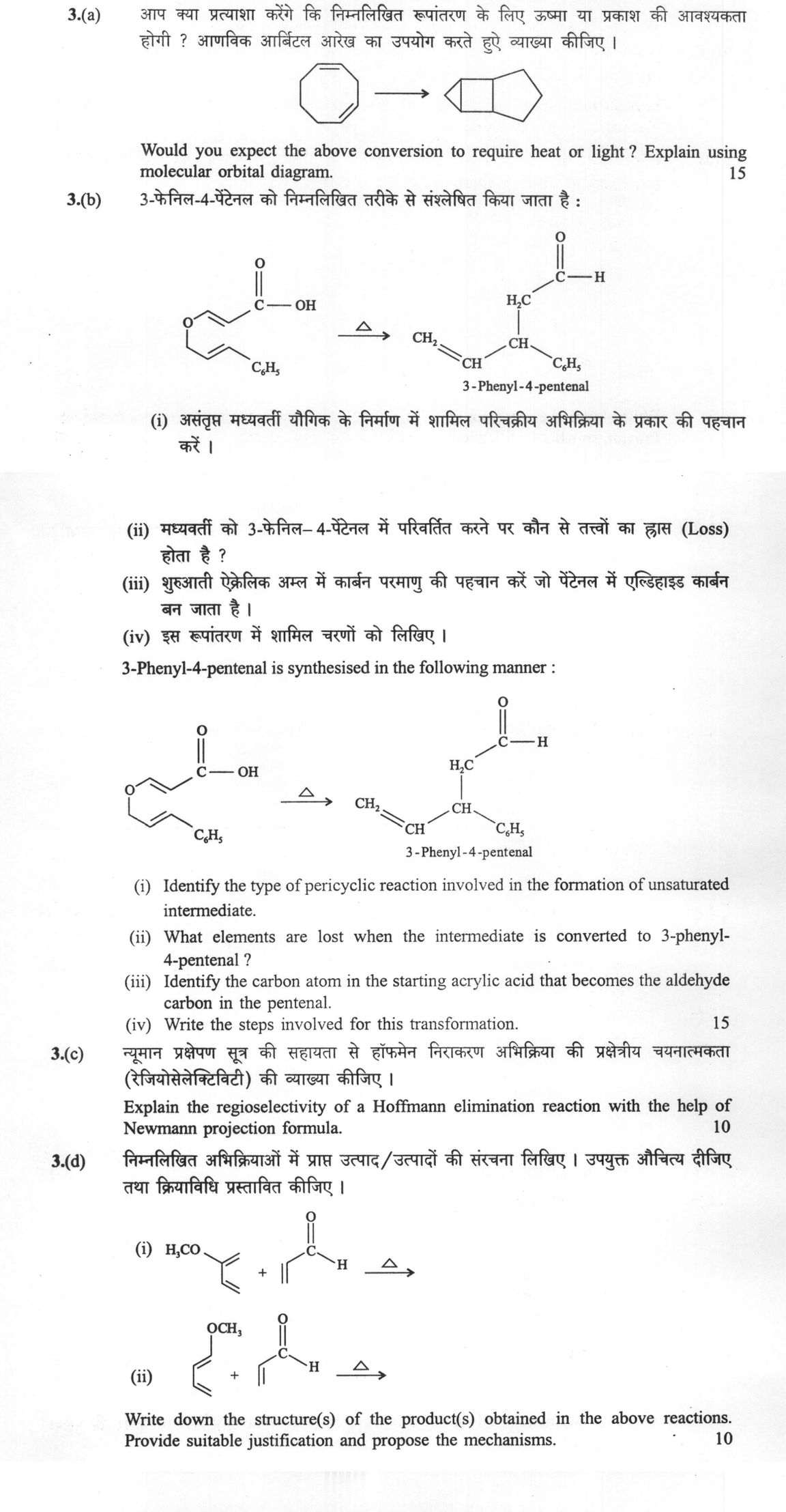
The figure this question refers to, in words
The question paper is a scan and the diagram did not survive as text. This is the figure as read from the original page — every component, value and label — so the question can be worked from the text below.
(a) A chemical reaction scheme showing the conversion of a cyclic diene to a bicyclic alkane. The reactant is a seven-membered ring containing two double bonds (cycloheptadiene). An arrow points to the right, leading to the product, which is a bicyclic structure consisting of a three-membered ring fused to a five-membered ring (bicyclo[3.1.0]hexane).
(b) A reaction scheme showing the synthesis of 3-Phenyl-4-pentenal. The starting material is a cyclic unsaturated lactone (a 6-membered ring containing an oxygen atom and a double bond). The ring is substituted with a phenyl group (C6H5) and a carboxylic acid group (C(=O)OH). An arrow labeled with a delta symbol (heat) points to the product, which is labeled '3-Phenyl-4-pentenal'. The product structure is an acyclic molecule with a terminal alkene (CH2=CH-), a chiral center bearing a phenyl group (C6H5) and a hydrogen, and an aldehyde group (-CH2-CHO) attached to the chiral center.
(d) Two separate reaction schemes labeled (i) and (ii). Reaction (i) shows a diene with a methoxy group (H3CO-) attached to one of the double bond carbons reacting with an aldehyde (acrolein, CH2=CH-CHO) in the presence of heat (delta symbol). Reaction (ii) shows a diene with a methoxy group (OCH3) attached to the terminal carbon of the diene system reacting with the same aldehyde (acrolein) in the presence of heat (delta symbol). Both reactions have arrows pointing to the right, indicating products are to be determined.
Model answer
Written by UPSC Answer Check against this question's marking rubric, to the expected length. UPSC does not publish answers for Mains — this is one way to score well, not an official key.
3(a) The conversion of cycloheptadiene to bicyclo[3.1.0]hexane is a [2+2] cycloaddition involving 4 π electrons ($4n, wheren=1). According to the Woodward-Hoffmann rules, thermal [2+2] cycloadditions are symmetry-forbidden because the HOMO of one alkene (ψ₂) and the LUMO of the other (ψ₃^*) have mismatched phases at the termini, preventing constructive overlap. Under photochemical conditions, an electron is promoted to the LUMO, making the excited-state HOMO (ψ₃^*$) symmetry-matched with the ground-state LUMO of the partner. Thus, this reaction requires light (photochemical conditions) to proceed via a suprafacial-suprafacial pathway.
3(b) (i) The formation of the unsaturated intermediate from the cyclic lactone involves a [3,3]-sigmatropic rearrangement (specifically an oxy-Cope or Claisen-type variant), which is thermally allowed. (ii) The elements lost are CO₂ (carbon dioxide). The decarboxylation of the β-keto acid intermediate formed after the sigmatropic shift releases CO₂. (iii) The carboxyl carbon (C-1) of the starting acrylic acid derivative becomes the aldehyde carbon in 3-phenyl-4-pentenal. The carbon mapping shows that the carbonyl carbon of the acid is retained as the carbonyl carbon of the aldehyde after the loss of the adjacent carbon as CO₂. (iv) The steps are: (1) Thermal [3,3]-sigmatropic rearrangement of the lactone to form an open-chain β-keto acid intermediate; (2) Decarboxylation of the β-keto acid to lose CO₂, yielding the final aldehyde product.
3(c) In a Hofmann elimination, the bulky leaving group (e.g., quaternary ammonium) favors the removal of the most accessible β-hydrogen. Using a Newman projection along the Cα-Cβ bond, the anti-periplanar geometry is required for the E2 mechanism. The β-hydrogen on the less substituted carbon is sterically less hindered and more accessible to the base than the hydrogens on the more substituted carbon. Consequently, the transition state leading to the less substituted (terminal) alkene is lower in energy, resulting in Hofmann regioselectivity.
3(d) (i) The reaction of 1-methoxy-1,3-butadiene with acrolein under heat is a Diels-Alder [4+2] cycloaddition. The methoxy group is an electron-donating group (EDG), activating the diene. The major product is the ortho-derivative (1-methoxy-4-formylcyclohexene derivative, specifically 4-methoxy-1-cyclohexene-1-carbaldehyde isomer depending on numbering, typically the 1,2-disubstituted product relative to the new ring junction). The mechanism involves the HOMO of the diene interacting with the LUMO of the dienophile, with the EDG stabilizing the developing positive charge in the transition state, directing the regiochemistry. (ii) The reaction of 2-methoxy-1,3-butadiene with acrolein also undergoes a Diels-Alder reaction. Here, the methoxy group is at the 2-position. The product is the para-derivative (1-methoxy-4-formylcyclohexene derivative, specifically the 1,4-disubstituted product). The regioselectivity is governed by the polarization of the diene HOMO, where the largest coefficient is at C-1, interacting with the largest LUMO coefficient of acrolein at the β-carbon, leading to the 1,4-product.
What "Explain" is asking you to do
Make the working of something clear — what sets it off, what follows from what, and what it produces. Explain is the Commission's mechanism word: it dominates the technical papers and the “explain why” stems, where the marks sit in the causal chain and not in the label.
Structure that answers it
State what it is → the initiating condition → the chain of cause, step by step → an instance where it plays out → what the chain produces
Where marks are lost
Describing what something looks like instead of why it works that way. Naming the stages without linking them reads as description too.
How this answer will be evaluated
Approach
Framework: Pericyclic Reaction Mechanism & Selectivity. (a) explain: definition/context > points in order > small example > short close | (b(i)) enumerate: list the items in order > one line each > no commentary | (b(ii)) enumerate: list the items in order > one line each > no commentary | (b(iii)) enumerate: list the items in order > one line each > no commentary | (b(iv)) trace: start point > the stages in sequence > end point > what changed | (c) explain: definition/context > points in order > small example > short close | (d) justify: claim > 3-4 reasons > evidence > conclusion Full marks: Accurate MO diagrams, complete mechanisms with arrow pushing, and clear stereochemical/regiochemical justification.
Key points expected
- Identify reaction as [4+2] cycloaddition
- Draw HOMO-LUMO interaction diagram
- Show symmetry matching for thermal path
- Conclude heat is required
- Identify as [3,3]-sigmatropic rearrangement
- Name as Claisen rearrangement
- Identify loss of water (H2O)
- Mention decarboxylation (loss of CO2)
Evaluation rubric
Each sub-part is marked on its own, against the marks and word limit printed on the paper.
- (a) Determine thermal vs photochemical conditions for the Diels-Alder reaction using MO theory. 15 marks
explain— definition/context → points in order → small example → short close
Must cover
- Identify reaction as [4+2] cycloaddition
- Draw HOMO-LUMO interaction diagram
- Show symmetry matching for thermal path
- Conclude heat is required
Loses marks
- Confusing HOMO/LUMO of diene/dienophile
- Missing orbital phase labels
Earns more
- Mention Woodward-Hoffmann rules
- Label orbital phases correctly
Extra mark
- Draw photochemical forbidden path
- (b(i)) Name the pericyclic reaction forming the intermediate.
enumerate— list the items in order → one line each → no commentary
Must cover
- Identify as [3,3]-sigmatropic rearrangement
- Name as Claisen rearrangement
Loses marks
- Calling it a simple isomerization
Earns more
- Mention concerted mechanism
- (b(ii)) State the elements lost during conversion to the final product.
enumerate— list the items in order → one line each → no commentary
Must cover
- Identify loss of water (H2O)
- Mention decarboxylation (loss of CO2)
Loses marks
- Missing one of the two losses
Earns more
- Link loss to specific functional groups
- (b(iii)) Trace the carbon atom that becomes the aldehyde carbon.
enumerate— list the items in order → one line each → no commentary
Must cover
- Identify the carboxyl carbon of the starting acid
- Show its position in the final aldehyde
Loses marks
- Identifying the wrong carbon atom
Earns more
- Label carbons on the structures
- (b(iv)) Write the stepwise mechanism for the transformation.
trace— start point → the stages in sequence → end point → what changed
Must cover
- Show Claisen rearrangement step
- Show decarboxylation step
- Show dehydration step
- Use correct arrow pushing
Loses marks
- Missing intermediate structures
- Incorrect arrow pushing
Earns more
- Draw intermediate structures clearly
Extra mark
- Mention transition state geometry
- (c) Explain Hofmann elimination regioselectivity using Newman projections. 10 marks
explain— definition/context → points in order → small example → short close
Must cover
- Draw Newman projection of substrate
- Show anti-periplanar geometry
- Explain steric hindrance of bulky base
- Show formation of less substituted alkene
Loses marks
- Drawing syn-periplanar geometry
- Failing to show steric clash
Earns more
- Compare with Zaitsev product
Extra mark
- Mention specific bulky base (e.g., t-BuOK)
- (d) Draw products and justify regioselectivity for the Diels-Alder reactions. 10 marks
justify— claim → 3-4 reasons → evidence → conclusion
Must cover
- Draw correct regioisomer for (i)
- Draw correct regioisomer for (ii)
- Justify using resonance/electronic effects
- Propose mechanism (cycloaddition)
Loses marks
- Drawing wrong regioisomer
- Missing electronic justification
Earns more
- Label ortho/para/meta relationship
- Show HOMO-LUMO coefficients
Extra mark
- Mention endo/exo selectivity
Practice this exact question
Write your answer and it is marked point by point against the model answer above — what you covered, what you missed, what you got wrong.
Evaluate my answer →More from Chemistry 2023 Paper II
- Q1 1.(a)(i) pKₐ value of cyclopentadiene is almost similar to water. Explain. 5 marks 1.(a)(…
- Q2 2.(a)(i) Based on Hückel rule, predict the above compounds as aromatic, antiaromatic, and…
- Q3 3.(a) Would you expect the above conversion to require heat or light? Explain using molec…
- Q4 4.(a)(i) Complete the above reaction and write the steps involved in the reaction. (5 mar…
- Q5 (a) How many signals would you expect in the ¹H NMR spectrum of above compounds ? Mark th…
- Q6 (a)(i) The frequencies of vibration of the following molecules in their v = 0 states are…