Paper II — Q4
4.(a)(i) Complete the above reaction and write the steps involved in the reaction. (5 marks) 4.(a)(ii) Arrange the above alkenes…
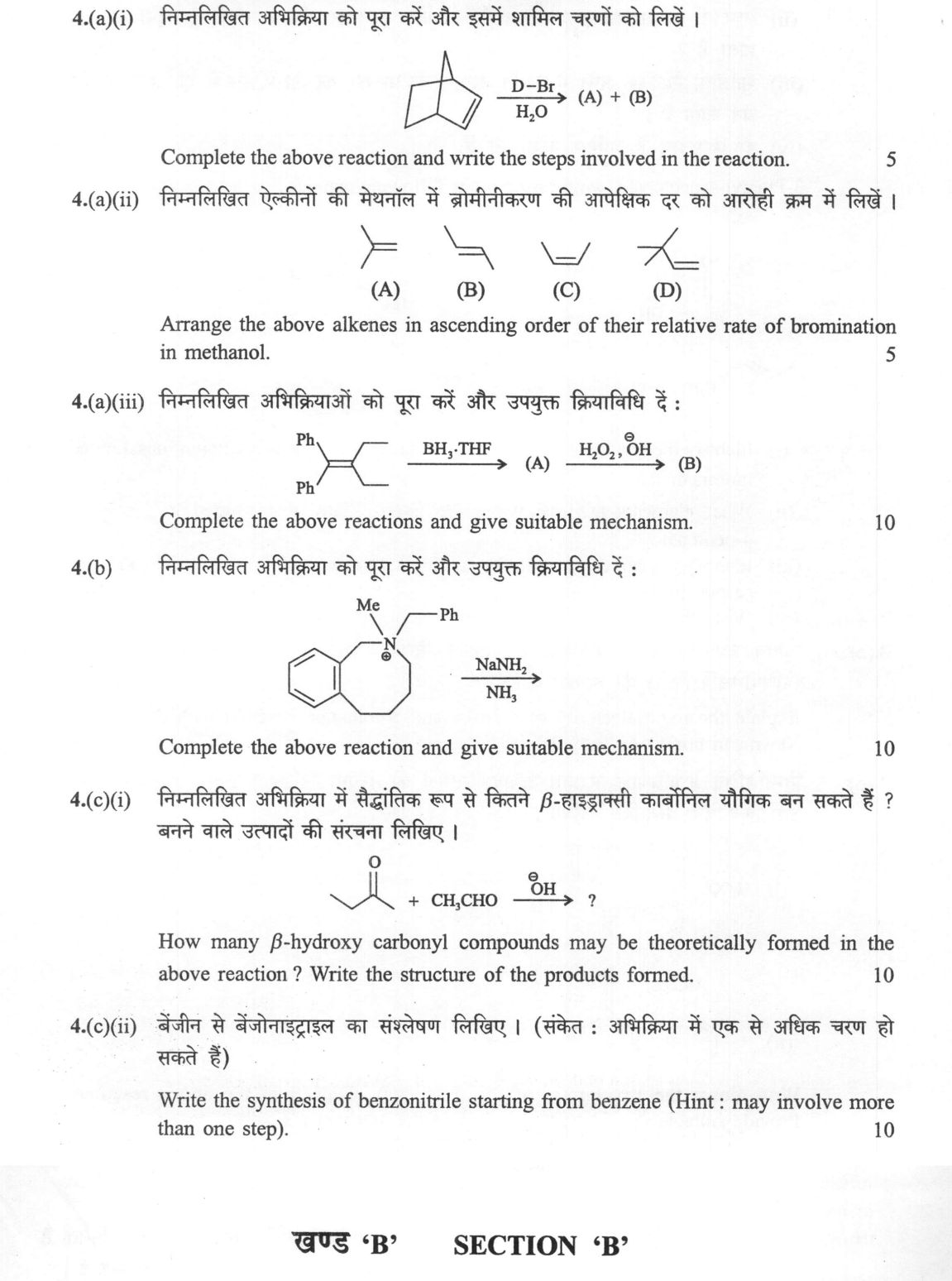
4.(a)(i) Complete the above reaction and write the steps involved in the reaction. 5 marks
4.(a)(ii) Arrange the above alkenes in ascending order of their relative rate of bromination in methanol. 5 marks
4.(a)(iii) Complete the above reactions and give suitable mechanism. 10 marks
4.(b) Complete the above reaction and give suitable mechanism. 10 marks
4.(c)(i) How many β-hydroxy carbonyl compounds may be theoretically formed in the above reaction? Write the structure of the products formed. 10 marks
4.(c)(ii) Write the synthesis of benzonitrile starting from benzene (Hint: may involve more than one step). 10 marks
हिंदी में प्रश्न पढ़ें
4.(a)(i) निम्नलिखित अभिक्रिया को पूरा करें और इसमें शामिल चरणों को लिखें। (5 अंक)
4.(a)(ii) निम्नलिखित एल्कीनों की मेथनॉल में ब्रोमीनकरण की आपेक्षिक दर को आरोही क्रम में लिखें। (A) (B) (C) (D) (5 अंक)
4.(a)(iii) निम्नलिखित अभिक्रियाओं को पूरा करें और उपयुक्त क्रियाविधि दें: (10 अंक)
4.(b) निम्नलिखित अभिक्रिया को पूरा करें और उपयुक्त क्रियाविधि दें: (10 अंक)
4.(c)(i) निम्नलिखित अभिक्रिया में सैद्धांतिक रूप से कितने β-हाइड्रॉक्सी कार्बोनिल यौगिक बन सकते हैं? बनने वाले उत्पादों की संरचना लिखिए। (10 अंक)
4.(c)(ii) बेंजीन से बेंजोनाइट्राइल का संश्लेषण लिखिए। (संकेत: अभिक्रिया में एक से अधिक चरण हो सकते हैं) (10 अंक)
The figure this question refers to, in words
The question paper is a scan and the diagram did not survive as text. This is the figure as read from the original page — every component, value and label — so the question can be worked from the text below.
(a) Alkene substrate: 1,1-diphenyl-2-ethyl-1-butene, structure Ph2C=C(Et)2 where Ph = phenyl and Et = ethyl. Reaction sequence: first arrow with BH3-THF above, giving intermediate (A); second arrow with H2O2, OH- above, giving product (B).
(a(i)) A bicyclic alkene structure (specifically 1-methyl-2-norbornene) is shown on the left. An arrow points to the right, with 'D-Br' written above the arrow and 'H2O' written below the arrow. The products are indicated as '(A) + (B)'.
(a(ii)) Four skeletal structures of alkenes are displayed in a row, labeled (A), (B), (C), and (D) from left to right. (A) is 2-methylpropene (isobutylene). (B) is trans-2-butene. (C) is cis-2-butene. (D) is 2-methyl-1-butene.
(a(iii)) A reaction scheme is shown. The starting material is 3,4-diphenyl-3-hexene (an alkene with a phenyl group and an ethyl group on each of the two double-bonded carbons). An arrow points to the right with 'BH3, THF' written above it, leading to an intermediate labeled '(A)'. A second arrow points from (A) to the right with 'H2O2, OH-' written above it, leading to a product labeled '(B)'.
(a(i)) A bicyclic alkene structure (specifically 1-methyl-2-norbornene) is shown on the left. An arrow points to the right, labeled with 'D-Br' above and 'H2O' below. The products are indicated as '(A) + (B)'.
(a(ii)) Four alkene structures are displayed in a row, labeled (A), (B), (C), and (D) from left to right. (A) is 2-methylpropene (isobutylene). (B) is trans-2-butene. (C) is cis-2-butene. (D) is 2-methyl-1-butene.
(a(iii)) A reaction scheme is shown. The starting material is 3,4-diphenyl-3-hexene (an alkene with a phenyl group and an ethyl group on each of the double-bonded carbons). An arrow points to the right labeled 'BH3, THF' leading to intermediate '(A)'. A second arrow points to the right labeled 'H2O2, OH-' leading to product '(B)'.
(b) A reaction scheme is shown. The starting material is a quaternary ammonium salt, specifically a benzazepinium ion (a seven-membered ring containing a nitrogen atom fused to a benzene ring). The nitrogen atom is bonded to a methyl group (Me) and a benzyl group (CH2-Ph) and carries a positive charge. An arrow points to the right labeled 'NaNH2' above and 'NH3' below.
(c) Reaction: 2-butanone (CH3COCH2CH3) plus acetaldehyde (CH3CHO) with hydroxide ion (OH-) above the arrow, pointing to products. The question asks how many beta-hydroxy carbonyl compounds may be theoretically formed.
(c(i)) A chemical equation is shown. On the left, the structure of 2-butanone (methyl ethyl ketone) is shown, followed by a plus sign and the formula 'CH3CHO' (acetaldehyde). An arrow points to the right with 'OH-' written above it, leading to a question mark '?'.
(c(i)) A reaction scheme is shown. The reactants are butanone (methyl ethyl ketone) and acetaldehyde (CH3CHO). An arrow points to the right labeled with 'OH-' (hydroxide ion) above the arrow. The product is indicated by a question mark '?'.
What "Solve" is asking you to do
Choose the method, then carry it through to a final answer. Identifying what kind of problem this is and why that method applies is the first thing marked; a correct figure arrived at invisibly earns almost nothing.
Structure that answers it
Given data and what is required → method chosen, with the reason it applies → set-up (equation, circuit, free body, trial balance) → working, step by step → answer with units and any condition of validity
Where marks are lost
Doing the middle steps mentally and writing only the result. In mathematics papers, a further loss comes from giving a decimal where the exact value in surds or fractions was wanted, or from skipping the justification a part explicitly asks for.
How this answer will be evaluated
Approach
(a(i)) describe: define > structure or process in order > labelled diagram > significance | (a(ii)) compare: paired headings or table > key differences > significance > conclusion | (a(iii)) describe: define > structure or process in order > labelled diagram > significance | (b) describe: define > structure or process in order > labelled diagram > significance | (c(i)) analyse: intro > causes > effects > stakeholders/linkages > way forward | (c(ii)) trace: start point > the stages in sequence > end point > what changed Full marks: Complete mechanisms with correct intermediates and stereochemistry.
Key points expected
- Identify the reaction as electrophilic addition of D-Br
- Draw the bridged bromonium ion intermediate
- Show nucleophilic attack by water at the more substituted carbon
- Draw the final deuterated alcohol product (A) and (B)
- Provide the correct ascending order of alkenes
- Justify the order based on carbocation stability
- Identify the rate-determining step as carbocation formation
- Identify the reaction as hydroboration-oxidation
Evaluation rubric
Each sub-part is marked on its own, against the marks and word limit printed on the paper.
- (a(i)) Complete the reaction and write the steps involved. 5 marks
describe— define → structure or process in order → labelled diagram → significance
Must cover
- Identify the reaction as electrophilic addition of D-Br
- Draw the bridged bromonium ion intermediate
- Show nucleophilic attack by water at the more substituted carbon
- Draw the final deuterated alcohol product (A) and (B)
Loses marks
- Omitting the bridged bromonium ion intermediate
- Incorrect regiochemistry of the deuterium or hydroxyl group
Earns more
- Mention Markovnikov's rule for regioselectivity
- Indicate stereochemistry of the addition (anti-addition)
Extra mark
- Explicitly label the deuterium atom in the product
- (a(ii)) Arrange the alkenes in ascending order of bromination rate. 5 marks
compare— paired headings or table → key differences → significance → conclusion
Must cover
- Provide the correct ascending order of alkenes
- Justify the order based on carbocation stability
- Identify the rate-determining step as carbocation formation
Loses marks
- Providing the order in descending sequence
- Failing to link stability to the reaction rate
Earns more
- Mention the role of hyperconjugation in stability
- Identify the specific carbocation type for each alkene
Extra mark
- Draw the carbocation intermediate for the most stable alkene
- (a(iii)) Complete the reactions and give a suitable mechanism. 10 marks
describe— define → structure or process in order → labelled diagram → significance
Must cover
- Identify the reaction as hydroboration-oxidation
- Draw the organoborane intermediate (A)
- Show the concerted four-membered transition state
- Draw the final anti-Markovnikov alcohol product (B)
Loses marks
- Drawing a carbocation intermediate
- Incorrect regiochemistry of the hydroxyl group
Earns more
- Mention the syn-addition stereochemistry
- Explain the regioselectivity based on steric and electronic factors
Extra mark
- Explicitly show the migration of the C-H bond to boron
- (b) Complete the reaction and give a suitable mechanism. 10 marks
describe— define → structure or process in order → labelled diagram → significance
Must cover
- Identify the reaction as a base-induced elimination
- Show the deprotonation of the alpha-carbon by amide
- Draw the resulting neutral amine product
- Indicate the formation of the double bond
Loses marks
- Failing to show the deprotonation step
- Incorrect product structure
Earns more
- Mention the role of the strong base (NaNH2)
- Show the arrow pushing for the elimination step
Extra mark
- Discuss the stability of the resulting amine
- (c(i)) Determine the number and structure of beta-hydroxy carbonyl products. 10 marks
analyse— intro → causes → effects → stakeholders/linkages → way forward
Must cover
- Identify the reaction as an Aldol condensation
- Show the enolate formation from the ketone
- Draw the nucleophilic attack on the aldehyde
- Draw the final beta-hydroxy ketone product
Loses marks
- Failing to show the enolate intermediate
- Incorrect product structure
Earns more
- Mention the role of the base in enolate formation
- Show the protonation of the alkoxide intermediate
Extra mark
- Discuss the possibility of self-condensation of the aldehyde
- (c(ii)) Write the synthesis of benzonitrile starting from benzene. 10 marks
trace— start point → the stages in sequence → end point → what changed
Must cover
- Show the nitration of benzene to nitrobenzene
- Show the reduction of nitrobenzene to aniline
- Show the diazotization of aniline to diazonium salt
- Show the Sandmeyer reaction to form benzonitrile
Loses marks
- Skipping the reduction step
- Incorrect reagents for the Sandmeyer reaction
Earns more
- List the specific reagents for each step
- Mention the conditions for the Sandmeyer reaction
Extra mark
- Draw the structure of the diazonium salt intermediate
Model answer coming soon
Every evaluation on this site is marked against a verified model answer. This question's answer is still being written; evaluation opens the moment it lands.
More from Chemistry 2023 Paper II
- Q1 1.(a)(i) pKₐ value of cyclopentadiene is almost similar to water. Explain. 5 marks 1.(a)(…
- Q2 2.(a)(i) Based on Hückel rule, predict the above compounds as aromatic, antiaromatic, and…
- Q3 3.(a) Would you expect the above conversion to require heat or light? Explain using molec…
- Q4 4.(a)(i) Complete the above reaction and write the steps involved in the reaction. (5 mar…
- Q5 (a) How many signals would you expect in the ¹H NMR spectrum of above compounds ? Mark th…
- Q6 (a)(i) The frequencies of vibration of the following molecules in their v = 0 states are…
- Q7 (a) (i) Draw the structure of 2'-deoxycytidine-3'-monophosphate. (ii) Why nucleotides and…