Paper I — Q1
(a) (i) Determine the distance from the nucleus at which the electron is most expected in the hydrogen atom in its ground state…
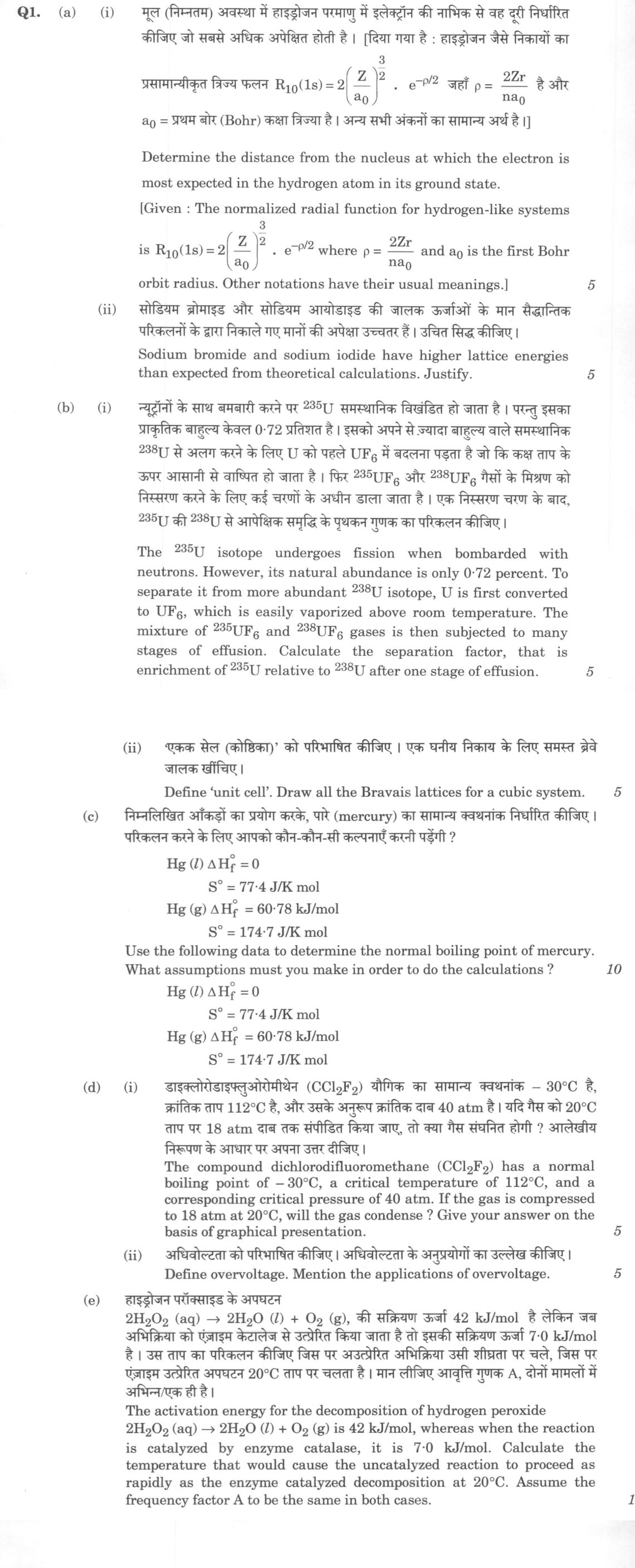
Determine the distance from the nucleus at which the electron is most expected in the hydrogen atom in its ground state. [Given : The normalized radial function for hydrogen-like systems is R₁₀(1s) = 2(Z/a₀)^(3/2) · e^(-ρ/2) where ρ = 2Zr/na₀ and a₀ is the first Bohr orbit radius. Other notations have their usual meanings.] 5 marks
Sodium bromide and sodium iodide have higher lattice energies than expected from theoretical calculations. Justify. 5 marks
The ²³⁵U isotope undergoes fission when bombarded with neutrons. However, its natural abundance is only 0·72 percent. To separate it from more abundant ²³⁸U isotope, U is first converted to UF₆, which is easily vaporized above room temperature. The mixture of ²³⁵UF₆ and ²³⁸UF₆ gases is then subjected to many stages of effusion. Calculate the separation factor, that is enrichment of ²³⁵U relative to ²³⁸U after one stage of effusion. 5 marks
Define 'unit cell'. Draw all the Bravais lattices for a cubic system. 5 marks
Use the following data to determine the normal boiling point of mercury. What assumptions must you make in order to do the calculations ? Hg (l) ΔH°f = 0, S° = 77·4 J/K mol; Hg (g) ΔH°f = 60·78 kJ/mol, S° = 174·7 J/K mol 10 marks
The compound dichlorodifluoromethane (CCl2F2) has a normal boiling point of – 30°C, a critical temperature of 112°C, and a corresponding critical pressure of 40 atm. If the gas is compressed to 18 atm at 20°C, will the gas condense ? Give your answer on the basis of graphical presentation. 5 marks
Define overvoltage. Mention the applications of overvoltage. 5 marks
The activation energy for the decomposition of hydrogen peroxide 2H2O2 (aq) → 2H2O (l) + O2 (g) is 42 kJ/mol, whereas when the reaction is catalyzed by enzyme catalase, it is 7·0 kJ/mol. Calculate the temperature that would cause the uncatalyzed reaction to proceed as rapidly as the enzyme catalized decomposition at 20°C. Assume the frequency factor A to be the same in both cases. 10 marks
हिंदी में प्रश्न पढ़ें
मूल (निम्नतम) अवस्था में हाइड्रोजन परमाणु में इलेक्ट्रॉन की नाभिक से वह दूरी निर्धारित कीजिए जो सबसे अधिक अपेक्षित होती है। [दिया गया है : हाइड्रोजन जैसे निकायों का प्रसामान्यीकृत त्रिज्य फलन R₁₀(1s) = 2(Z/a₀)^(3/2) · e^(-ρ/2) जहाँ ρ = 2Zr/na₀ है और a₀ = प्रथम बोर (Bohr) कक्षा त्रिज्या है। अन्य सभी अंकों का सामान्य अर्थ है।] (5 अंक)
सोडियम ब्रोमाइड और सोडियम आयोडाइड की जालक ऊर्जाओं के मान सैद्धांतिक परिकलनों के द्वारा निकाले गए मानों की अपेक्षा उच्चतर हैं। उचित सिद्ध कीजिए। (5 अंक)
न्यूट्रॉनों के साथ बमबारी करने पर ²³⁵U समस्थानिक विखंडित हो जाता है। परंतु इसका प्राकृतिक बाहुल्य केवल 0·72 प्रतिशत है। इसको अपने से ज्यादा बाहुल्य वाले समस्थानिक ²³⁸U से अलग करने के लिए U को पहले UF₆ में बदलना पड़ता है जो कि कक्ष ताप के ऊपर आसानी से वाष्पित हो जाता है। फिर ²³⁵UF₆ और ²³⁸UF₆ गैसों के मिश्रण को निस्सरण करने के लिए कई चरणों के अधीन डाला जाता है। एक निस्सरण चरण के बाद, ²³⁵U की ²³⁸U से अपेक्षिक समृद्धि के पृथक्करण गुणांक का परिकलन कीजिए। (5 अंक)
एकक सेल (कोषिका)' को परिभाषित कीजिए । एक घनीय निकाय के लिए समस्त ब्रेवे जालक खींचिए । (5 अंक)
निम्नलिखित आँकड़ों का प्रयोग करके, पारे (mercury) का सामान्य क्वथनांक निर्धारित कीजिए । परिकलन करने के लिए आपको कौन-कौन-सी कल्पनाएँ करनी पड़ेंगी ? Hg (l) ΔH°f = 0, S° = 77·4 J/K mol; Hg (g) ΔH°f = 60·78 kJ/mol, S° = 174·7 J/K mol (10 अंक)
डाइक्लोरोडाइफ्लुओरोमेथेन (CCl2F2) यौगिक का सामान्य क्वथनांक – 30°C है, क्रांतिक ताप 112°C है, और उसके अनुरूप क्रांतिक दाब 40 atm है । यदि गैस को 20°C ताप पर 18 atm दाब तक संपीड़ित किया जाए, तो क्या गैस संघनित होगी ? आलेखीय निरूपण के आधार पर अपना उत्तर दीजिए । (5 अंक)
अधिवोल्टता को परिभाषित कीजिए । अधिवोल्टता के अनुप्रयोगों का उल्लेख कीजिए । (5 अंक)
हाइड्रोजन परॉक्साइड के अपघटन 2H2O2 (aq) → 2H2O (l) + O2 (g), की सक्रियण ऊर्जा 42 kJ/mol है लेकिन जब अभिक्रिया को एंजाइम कैटलेज से उत्प्रेरित किया जाता है तो इसकी सक्रियण ऊर्जा 7·0 kJ/mol है । उस ताप का परिकलन कीजिए जिस पर अनुत्प्रेरित अभिक्रिया उसी शीघ्रता पर चले, जिस पर एंजाइम उत्प्रेरित अपघटन 20°C ताप पर चलता है । मान लीजिए आवृत्ति गुणक A, दोनों मामलों में अभिन्न/एक ही है । (10 अंक)
Model answer
Written by UPSC Answer Check against this question's marking rubric, to the expected length. UPSC does not publish answers for Mains — this is one way to score well, not an official key.
(a)(i) For hydrogen ground state, Z=1, n=1. ρ = 2r/a₀. R₁₀ = 2(1/a₀)^(3/2) e^(-ρ/2) = 2a₀^(-3/2) e^(-r/a₀). Radial probability density D(r) = r² |R₁₀|² = 4r²/a₀³ e^(-2r/a₀). Set dD/dr = 0: dD/dr = 4/a₀³ [2r e^(-2r/a₀) + r²(-2/a₀)e^(-2r/a₀)] = 8r/a₀³ e^(-2r/a₀)(1 - r/a₀) = 0. Solutions r=0 or r=a₀. r=0 is minimum, r=a₀ is maximum. Thus most probable distance r = a₀ = 0.529 Å = 52.9 pm. Valid for non-relativistic hydrogen-like 1s orbital with point nucleus.
(a)(ii) Theoretical lattice energies from Born-Landé/Born-Mayer assume purely electrostatic point charges and spherical non-polarizable ions. In NaBr and NaI, the large Br⁻ and I⁻ ions are highly polarizable. The small Na⁺ ion polarizes their electron clouds, introducing partial covalent character and additional attractive interaction. Also London dispersion forces between large halide ions contribute. Hence experimental lattice energies are higher in magnitude than purely electrostatic theoretical values.
(b)(i) Graham's law: rate ∝ 1/√M. M(²³⁵UF₆) = 235 + 6(19) = 349 g/mol. M(²³⁸UF₆) = 238 + 6(19) = 352 g/mol. Separation factor α = Rate(²³⁵UF₆)/Rate(²³⁸UF₆) = √[M(²³⁸UF₆)/M(²³⁵UF₆)] = √(352/349) = 1.00429. Thus α = 1.0043, i.e., ²³⁵U/²³⁸U ratio increases by about 0.43% per effusion stage.
(b)(ii) A unit cell is the smallest repeating parallelepiped of a crystal lattice which, by translation along the three crystal axes, generates the entire crystal. It is defined by a, b, c and α, β, γ.
For cubic system, a = b = c and α = β = γ = 90°. There are three Bravais lattices:
- Simple cubic (primitive): lattice points only at the eight corners, at (0,0,0) plus translations.
- Body-centred cubic: corners plus one point at body centre (1/2,1/2,1/2).
- Face-centred cubic: corners plus points at centres of all six faces: (1/2,1/2,0), (1/2,0,1/2), (0,1/2,1/2) and their opposite-face equivalents.
Diagrammatically, simple cubic has points at cube corners only; body-centred cubic has corner points plus one central point; face-centred cubic has corner points plus six face-centre points.
(c) For Hg(l) ⇌ Hg(g), at normal boiling point, pure liquid and vapour are at equilibrium at 1 atm, so ΔG° = 0. Using ΔG° = ΔH° - TΔS° = 0, T_b = ΔH°vap/ΔS°vap.
ΔH°vap = ΔH°f(g) - ΔH°f(l) = 60.78 kJ/mol - 0 = 60.78 kJ/mol = 60780 J/mol. ΔS°vap = S°(g) - S°(l) = 174.7 - 77.4 = 97.3 J/K mol.
T_b = 60780/97.3 = 624.7 K. In °C: 624.7 - 273.15 = 351.5°C.
Thus T_b ≈ 624.7 K ≈ 351.5°C.
Assumptions: ΔH°vap and ΔS°vap are constant over the temperature range; mercury vapour behaves ideally; liquid is pure; boiling occurs at 1 atm; liquid volume is negligible compared with vapour.
(d)(i) On a pressure–temperature phase diagram, the liquid–vapour equilibrium curve runs from the normal boiling point (–30°C at 1 atm) to the critical point (112°C at 40 atm). At 20°C, the saturation vapour pressure lies on this curve, approximately 5–6 atm. Since 18 atm is greater than this saturation pressure at 20°C, the point (20°C, 18 atm) lies above the liquid–vapour curve, in the liquid region. Also 20°C < critical temperature 112°C, so a liquid phase can exist. Therefore, when the gas is compressed isothermally at 20°C, condensation begins at the saturation pressure, and at 18 atm the gas will condense. Yes, the gas will condense.
(d)(ii) Overvoltage (overpotential) is the extra electrode potential above the reversible thermodynamic electrode potential required to make an electrode reaction proceed at a finite rate. η = E_applied - E_reversible. It arises from activation barriers, concentration gradients and surface effects, and depends on current density, electrode material, temperature and surface condition.
Applications:
- In electrolysis, high hydrogen overvoltage at mercury or lead cathodes allows selective reduction of metal ions instead of hydrogen evolution, as in the mercury-cell chlor-alkali process.
- In electroplating and electrowinning, overvoltage helps control deposition of metals such as zinc, nickel and chromium and suppresses unwanted hydrogen evolution.
- In lead–acid batteries, oxygen and hydrogen overvoltages reduce self-discharge and allow efficient charging.
- In corrosion studies, overvoltage determines rates of cathodic and anodic corrosion reactions.
- In electro-organic synthesis, overvoltage can control product selectivity by favouring one electrode reaction over another.
(e) Arrhenius equation: k = A e^(-Ea/RT). Let enzyme-catalyzed decomposition at 20°C = 293.15 K have rate constant k_cat, and let uncatalyzed reaction at temperature T have k_uncat = k_cat. Since A is same: A e^(-Ea_uncat/RT) = A e^(-Ea_cat/R×293.15). Cancel A and take natural logarithms: -Ea_uncat/RT = -Ea_cat/(R × 293.15). Therefore Ea_uncat/T = Ea_cat/293.15. So T = 293.15 × Ea_uncat/Ea_cat = 293.15 × 42/7.0 = 293.15 × 6 = 1758.9 K. In °C: 1758.9 - 273.15 = 1485.75°C. Thus T = 1758.9 K ≈ 1486°C.
Assumptions: frequency factor A is the same for both reactions; activation energies are constant over the temperature range; rate is proportional to k in both cases; catalase remains fully active and no change in mechanism occurs.
What "Calculate" is asking you to do
Apply the standard formula or schedule to data the question has already supplied — a table of readings, cost records, a balance sheet — and produce the number. The method is rarely in doubt; the marks sit in the named intermediate quantities, each of which has to appear as a labelled line.
Structure that answers it
Data as given → formula or standard treatment, named → substitution → each intermediate, labelled → result with units
Where marks are lost
Omitting an intermediate the marking scheme pays for separately, or rounding at an intermediate line so the final figure drifts. In commerce and accountancy, any figure in a statement that no numbered working note supports is treated as unearned.
How this answer will be evaluated
Approach
Framework: Concept > Structure or mechanism > Reasoning > Result. (a(i)) calculate: given > formula > substitution > result with units > interpretation | (a(ii)) justify: claim > 3-4 reasons > evidence > conclusion | (b(i)) calculate: given > formula > substitution > result with units > interpretation | (b(ii)) describe: define > structure or process in order > labelled diagram > significance | (c) calculate: given > formula > substitution > result with units > interpretation | (d(i)) explain: definition/context > points in order > small example > short close | (d(ii)) define: precise definition > the distinguishing feature > one example | (e) calculate: given > formula > substitution > result with units > interpretation Full marks: All parts answered with correct methods, clear reasoning, and accurate calculations.
Key points expected
- Formulate radial probability density P(r) = r²R²
- Differentiate P(r) with respect to r
- Set dP/dr = 0 to find maximum
- Result is r = a₀
- Mention polarizability of Br⁻ and I⁻
- Cite Fajans' rules
- Explain covalent character contribution
- Link covalency to increased lattice energy
Evaluation rubric
Each sub-part is marked on its own, against the marks and word limit printed on the paper.
- (a(i)) Determine the distance from the nucleus for maximum electron probability in H ground state. 5 marks
calculate— given → formula → substitution → result with units → interpretation
Must cover
- Formulate radial probability density P(r) = r²R²
- Differentiate P(r) with respect to r
- Set dP/dr = 0 to find maximum
- Result is r = a₀
Loses marks
- Maximizing R(r) instead of P(r)
- Algebraic errors in differentiation
Earns more
- Correct substitution of Z=1, n=1
- Explicit definition of ρ
Extra mark
- Mention of Bohr radius value
- (a(ii)) Explain why NaBr and NaI lattice energies exceed theoretical predictions. 5 marks
justify— claim → 3-4 reasons → evidence → conclusion
Must cover
- Mention polarizability of Br⁻ and I⁻
- Cite Fajans' rules
- Explain covalent character contribution
- Link covalency to increased lattice energy
Loses marks
- Ignoring covalent character
- Confusing lattice energy with bond energy
Earns more
- Comparison with NaF or NaCl
- Mention of cation polarizing power
Extra mark
- Quantitative data on lattice energy
- (b(i)) Calculate the separation factor for ²³⁵U enrichment via effusion. 5 marks
calculate— given → formula → substitution → result with units → interpretation
Must cover
- Use Graham's Law of Effusion
- Calculate molar masses of ²³⁵UF₆ and ²³⁸UF₆
- Apply ratio of rates ∝ 1/√M
- Calculate final separation factor
Loses marks
- Using atomic masses instead of molecular
- Inverting the rate ratio
Earns more
- Correct molar mass calculation
- Clear statement of Graham's Law
Extra mark
- Mention of industrial application
- (b(ii)) Define unit cell and draw all cubic Bravais lattices. 5 marks
describe— define → structure or process in order → labelled diagram → significance
Must cover
- Define unit cell as smallest repeating unit
- Draw simple cubic (SC)
- Draw body-centered cubic (BCC)
- Draw face-centered cubic (FCC)
Loses marks
- Missing any of the three lattices
- Incorrect labeling of centers
Earns more
- Labeling lattice points correctly
- Mentioning coordination numbers
Extra mark
- Mentioning packing efficiency
- (c) Determine normal boiling point of mercury and state assumptions. 10 marks
calculate— given → formula → substitution → result with units → interpretation
Must cover
- Calculate ΔH°vap from given data
- Calculate ΔS°vap from given data
- Use ΔG = 0 at boiling point
- Solve for T = ΔH/ΔS
Loses marks
- Unit mismatch in ΔH and ΔS
- Forgetting to set ΔG = 0
Earns more
- Correct unit conversion (kJ to J)
- Explicit statement of assumptions
Extra mark
- Comparison with experimental value
- (d(i)) Determine if CCl₂F₂ condenses at 18 atm and 20°C using graphical method. 5 marks
explain— definition/context → points in order → small example → short close
Must cover
- Plot P vs T phase diagram
- Mark critical point (112°C, 40 atm)
- Mark normal boiling point (-30°C, 1 atm)
- Locate 20°C, 18 atm relative to curve
Loses marks
- Incorrect placement of critical point
- Failing to draw the phase boundary
Earns more
- Correct identification of gas region
- Clear labeling of axes
Extra mark
- Mention of supercritical region
- (d(ii)) Define overvoltage and mention its applications. 5 marks
define— precise definition → the distinguishing feature → one example
Must cover
- Define overvoltage as extra potential needed
- Explain cause (activation barrier)
- Mention application in electrolysis
- Mention application in batteries
Loses marks
- Confusing with overpotential
- Vague definition without context
Earns more
- Example of electrode material
- Mention of Tafel equation
Extra mark
- Mention of industrial electrolysis
- (e) Calculate temperature for uncatalyzed reaction to match catalyzed rate at 20°C. 10 marks
calculate— given → formula → substitution → result with units → interpretation
Must cover
- Use Arrhenius equation k = Ae^(-Ea/RT)
- Set k_uncat(T) = k_cat(293K)
- Substitute given Ea values
- Solve for T
Loses marks
- Using log base 10 without adjustment
- Incorrect temperature conversion
Earns more
- Correct use of natural log
- Clear algebraic steps
Extra mark
- Mention of enzyme efficiency
Practice this exact question
Write your answer and it is marked point by point against the model answer above — what you covered, what you missed, what you got wrong.
Evaluate my answer →More from Chemistry 2024 Paper I
- Q1 (a) (i) Determine the distance from the nucleus at which the electron is most expected in…
- Q2 (a) State Heisenberg's uncertainty principle. Show that for a particle in a one-dimension…
- Q3 (a) (i) Calculate the coefficient of viscosity of air at temperatures : (I) 298 K and (II…
- Q4 (a) A new drug has been synthesized and its phase diagram is explored. It is found that n…