Paper I — Q4
(a) A new drug has been synthesized and its phase diagram is explored. It is found that near its triple point, vapour pressure…
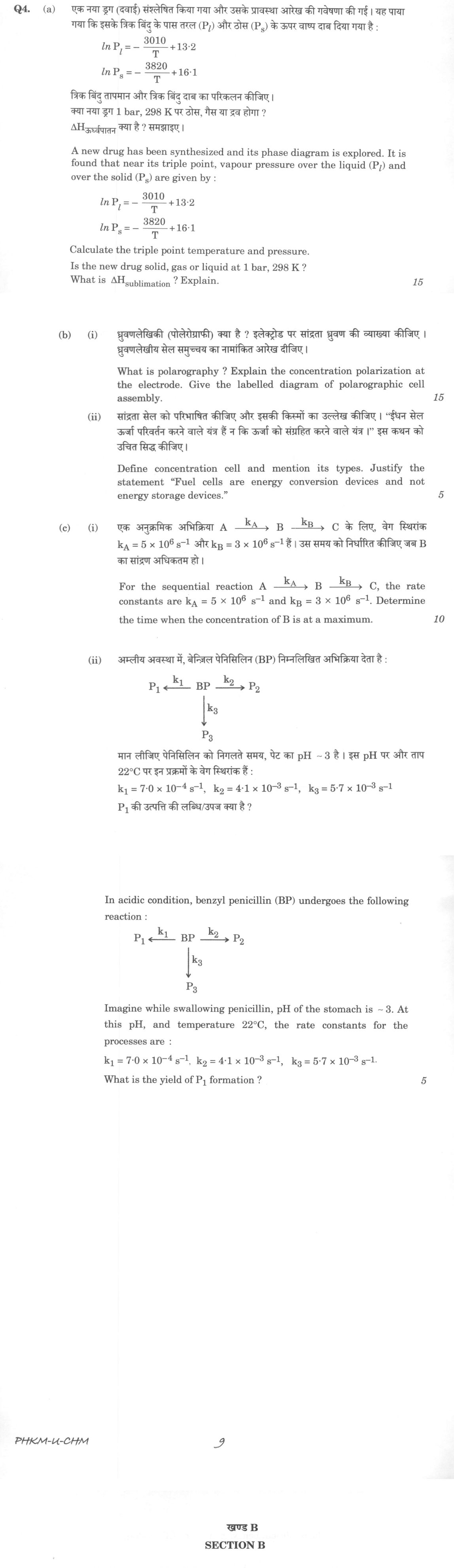
A new drug has been synthesized and its phase diagram is explored. It is found that near its triple point, vapour pressure over the liquid (Pl) and over the solid (Ps) are given by : ln Pl = − 3010/T + 13·2 and ln Ps = − 3820/T + 16·1. Calculate the triple point temperature and pressure. Is the new drug solid, gas or liquid at 1 bar, 298 K ? What is ΔHsublimation ? Explain. 15 marks
What is polarography ? Explain the concentration polarization at the electrode. Give the labelled diagram of polarographic cell assembly. 15 marks
Define concentration cell and mention its types. Justify the statement "Fuel cells are energy conversion devices and not energy storage devices." 5 marks
For the sequential reaction A → B → C, the rate constants are kA = 5 × 10⁶ s⁻¹ and kB = 3 × 10⁶ s⁻¹. Determine the time when the concentration of B is at a maximum. 10 marks
In acidic condition, benzyl penicillin (BP) undergoes the following reaction : P₁ ← BP → P₂ (with k₁, k₂) and BP → P₃ (with k₃). Imagine while swallowing penicillin, pH of the stomach is ~3. At this pH, and temperature 22°C, the rate constants for the processes are : k₁ = 7·0 × 10⁻⁴ s⁻¹, k₂ = 4·1 × 10⁻³ s⁻¹, k₃ = 5·7 × 10⁻³ s⁻¹. What is the yield of P₁ formation ? 5 marks
हिंदी में प्रश्न पढ़ें
एक नया ड्रग (दवाई) संश्लेषित किया गया और उसके प्रावस्था आरेख की गवेषणा की गई। यह पाया गया कि इसके त्रिक बिंदु के पास तरल (Pl) और ठोस (Ps) के ऊपर वाष्प दाब दिया गया है : ln Pl = − 3010/T + 13·2 और ln Ps = − 3820/T + 16·1। त्रिक बिंदु तापमान और त्रिक बिंदु दाब का परिकलन कीजिए। क्या नया ड्रग 1 bar, 298 K पर ठोस, गैस या द्रव होगा ? ΔHउर्ध्वपातन क्या है ? समझाइए। (15 अंक)
ध्रुवणलेखिकी (पोलैरोग्राफी) क्या है ? इलेक्ट्रोड पर सांद्रता ध्रुवण की व्याख्या कीजिए। ध्रुवणलेखीय सेल समुच्चय का नामांकित आरेख दीजिए। (15 अंक)
सांद्रता सेल को परिभाषित कीजिए और इसकी किस्मों का उल्लेख कीजिए। "ईंधन सेल ऊर्जा परिवर्तन करने वाले यंत्र हैं न कि ऊर्जा को संग्रहित करने वाले यंत्र।" इस कथन को उचित सिद्ध कीजिए। (5 अंक)
एक अनुक्रमिक अभिक्रिया A → B → C के लिए, वेग स्थिरांक kA = 5 × 10⁶ s⁻¹ और kB = 3 × 10⁶ s⁻¹ हैं। उस समय को निर्धारित कीजिए जब B का सांद्रण अधिकतम हो। (10 अंक)
अम्लीय अवस्था में, बेंजिल पेनिसिलिन (BP) निम्नलिखित अभिक्रिया देता है : P₁ ← BP → P₂ (k₁, k₂ से) और BP → P₃ (k₃ से)। मान लीजिए पेनिसिलिन को निगलते समय, पेट का pH ~ 3 है। इस pH पर और ताप 22°C पर इन प्रक्रमों के वेग स्थिरांक हैं : k₁ = 7·0 × 10⁻⁴ s⁻¹, k₂ = 4·1 × 10⁻³ s⁻¹, k₃ = 5·7 × 10⁻³ s⁻¹। P₁ की उत्पत्ति की लंबिथ/उपज क्या है ? (5 अंक)
Model answer
Written by UPSC Answer Check against this question's marking rubric, to the expected length. UPSC does not publish answers for Mains — this is one way to score well, not an official key.
(a) At the triple point, the vapour pressures over liquid and solid are equal: Pl = Ps.
−3010/T + 13.2 = −3820/T + 16.1
(3820 − 3010)/T = 16.1 − 13.2 = 2.9
810/T = 2.9
T = 810/2.9 = 8100/29 = 279.31 K
Using the liquid equation:
ln P = −3010/(8100/29) + 13.2 = −8729/810 + 13.2 = 2.42346
P = e^2.42346 = 11.28 (in the pressure unit used in the given log equations; taking it as bar gives 11.28 bar)
At 298 K:
ln Pl = −3010/298 + 13.2 = 3.0993, so Pl ≈ 22.2 bar
ln Ps = −3820/298 + 16.1 = 3.2812, so Ps ≈ 26.6 bar
Both equilibrium vapour pressures exceed 1 bar at 298 K. Also, 298 K is above the triple-point temperature 279.31 K, while the liquid-vapour equilibrium pressure at 298 K is about 22.2 bar, much higher than 1 bar. Hence at 1 bar, 298 K the drug is gas.
For sublimation, ln Ps = −ΔH_sublimation/(RT) + constant. The slope is −3820 K. Therefore:
ΔH_sublimation = 3820 × R = 3820 × 8.314 J mol⁻¹
= 31759 J mol⁻¹ = 31.76 kJ mol⁻¹
This assumes ideal-gas behaviour and constant ΔH_sublimation over the temperature range.
(b)(i) Polarography is a voltammetric electroanalytical method in which current is measured as a function of applied potential using a dropping mercury electrode (DME). The DME gives a fresh mercury surface, and the current is usually diffusion-limited; the diffusion current is proportional to concentration of the electroactive species.
Concentration polarization occurs when mass transport of the electroactive species to or from the electrode is slower than electron transfer. Then the concentration at the electrode surface differs from that in the bulk. The electrode potential no longer corresponds exactly to the bulk Nernst equation, and a concentration overpotential is set up. When the surface concentration becomes effectively zero, the current reaches a limiting diffusion current.
Labelled polarographic cell assembly:
`` Potentiometer/voltage source | microammeter | Dropping mercury electrode (Hg reservoir → capillary → Hg drop) | Sample solution + supporting electrolyte N₂ inlet; thermostat | Reference electrode (SCE/Ag-AgCl) [Pt auxiliary electrode in 3-electrode mode] ``
(b)(ii) A concentration cell is a galvanic cell in which the two half-cells are chemically identical but differ in concentration of the electroactive species. Its emf arises from the concentration difference.
Types:
- Electrode concentration cells, e.g. amalgam or gas electrodes at different concentrations/pressures.
- Electrolyte concentration cells, which may be with transference or without transference.
Fuel cells are energy conversion devices, not energy storage devices, because the fuel and oxidant are supplied continuously from outside. They convert chemical energy directly into electrical energy as long as reactants are fed. Unlike a battery, they do not store a fixed amount of chemical energy inside the cell itself.
(c)(i) For A → B → C, with first-order constants kA and kB, and initial [B] = 0:
[B] = [A]₀ kA/(kB − kA) (e^(−kA t) − e^(−kB t))
At maximum [B], d[B]/dt = 0:
kA e^(−kA t) = kB e^(−kB t)
e^((kA − kB)t) = kA/kB
t_max = ln(kA/kB)/(kA − kB) (for kA ≠ kB)
Given kA = 5 × 10⁶ s⁻¹, kB = 3 × 10⁶ s⁻¹:
t_max = ln(5/3)/(2 × 10⁶)
= 0.5108256/(2 × 10⁶)
= 2.554 × 10⁻⁷ s
= 0.2554 μs
(c)(ii) For parallel first-order reactions:
BP → P₁ with k₁, BP → P₂ with k₂, BP → P₃ with k₃
Total rate constant for disappearance of BP is:
Σk = k₁ + k₂ + k₃
= 7.0 × 10⁻⁴ + 4.1 × 10⁻³ + 5.7 × 10⁻³
= 1.05 × 10⁻² s⁻¹
The fraction of BP forming P₁ is:
k₁/Σk = (7.0 × 10⁻⁴)/(1.05 × 10⁻²)
= 0.06667
= 1/15
Therefore, the yield of P₁ formation is:
6.67% or 0.0667 mol P₁ per mol BP at long time, assuming P₁ does not undergo further reaction.
What "Calculate" is asking you to do
Apply the standard formula or schedule to data the question has already supplied — a table of readings, cost records, a balance sheet — and produce the number. The method is rarely in doubt; the marks sit in the named intermediate quantities, each of which has to appear as a labelled line.
Structure that answers it
Data as given → formula or standard treatment, named → substitution → each intermediate, labelled → result with units
Where marks are lost
Omitting an intermediate the marking scheme pays for separately, or rounding at an intermediate line so the final figure drifts. In commerce and accountancy, any figure in a statement that no numbered working note supports is treated as unearned.
How this answer will be evaluated
Approach
Framework: Concept > Structure or mechanism > Reasoning > Result. (a) calculate: given > formula > substitution > result with units > interpretation | (b(i)) describe: define > structure or process in order > labelled diagram > significance | (b(ii)) justify: claim > 3-4 reasons > evidence > conclusion | (c(i)) calculate: given > formula > substitution > result with units > interpretation | (c(ii)) calculate: given > formula > substitution > result with units > interpretation Full marks: All calculations correct with full working; diagrams labelled; concepts clearly explained with proper justification.
Key points expected
- Equate ln Pl and ln Ps to find T
- Substitute T to calculate triple point pressure
- Compare 298 K with triple point T for phase
- Calculate ΔH_sublimation using Clausius-Clapeyron slope
- Definition of polarography as voltammetry
- Explanation of concentration polarization at DME
- Labelled diagram of polarographic cell
- Identification of DME and reference electrode
Evaluation rubric
Each sub-part is marked on its own, against the marks and word limit printed on the paper.
- (a) Determine triple point T and P, phase at 298 K, and ΔH_sublimation. 15 marks
calculate— given → formula → substitution → result with units → interpretation
Must cover
- Equate ln Pl and ln Ps to find T
- Substitute T to calculate triple point pressure
- Compare 298 K with triple point T for phase
- Calculate ΔH_sublimation using Clausius-Clapeyron slope
Loses marks
- Arithmetic errors in T or P
- Confusing ΔH_vap with ΔH_sub
Earns more
- Correct units for T and P
- Explicit statement of phase logic
Extra mark
- Sketch of phase diagram
- (b(i)) Define polarography, explain concentration polarization, and draw cell assembly. 15 marks
describe— define → structure or process in order → labelled diagram → significance
Must cover
- Definition of polarography as voltammetry
- Explanation of concentration polarization at DME
- Labelled diagram of polarographic cell
- Identification of DME and reference electrode
Loses marks
- Missing labels on diagram
- Confusing polarography with polarimetry
Earns more
- Mention of dropping mercury electrode
- Description of polarogram shape
Extra mark
- Equation for limiting current
- (b(ii)) Define concentration cell, list types, and justify fuel cell statement. 5 marks
justify— claim → 3-4 reasons → evidence → conclusion
Must cover
- Definition of concentration cell
- Mention of types (electrode/solution)
- Argument that fuel cells convert chemical to electrical energy
- Distinction from energy storage (batteries)
Loses marks
- Treating fuel cell as a battery
- Missing types of concentration cells
Earns more
- Example of concentration cell EMF
Extra mark
- Comparison table of fuel cell vs battery
- (c(i)) Determine time for maximum concentration of B in sequential reaction. 10 marks
calculate— given → formula → substitution → result with units → interpretation
Must cover
- Use formula t_max = ln(kA/kB) / (kA - kB)
- Substitute kA = 5×10⁶ and kB = 3×10⁶
- Calculate numerical value of t_max
- State units of time
Loses marks
- Using wrong formula for t_max
- Calculation error in logarithm
Earns more
- Derivation of t_max formula
Extra mark
- Graph of [B] vs t
- (c(ii)) Calculate yield of P1 formation from benzyl penicillin. 5 marks
calculate— given → formula → substitution → result with units → interpretation
Must cover
- Identify k1 as rate constant for P1 formation
- Calculate total rate constant k_total = k1 + k2 + k3
- Calculate yield as k1 / k_total
- Express yield as percentage
Loses marks
- Using wrong rate constant for P1
- Arithmetic error in yield calculation
Earns more
- Correct summation of rate constants
Extra mark
- Discussion of pH effect on stability
Practice this exact question
Write your answer and it is marked point by point against the model answer above — what you covered, what you missed, what you got wrong.
Evaluate my answer →More from Chemistry 2024 Paper I
- Q1 (a) (i) Determine the distance from the nucleus at which the electron is most expected in…
- Q2 (a) State Heisenberg's uncertainty principle. Show that for a particle in a one-dimension…
- Q3 (a) (i) Calculate the coefficient of viscosity of air at temperatures : (I) 298 K and (II…
- Q4 (a) A new drug has been synthesized and its phase diagram is explored. It is found that n…
- Q5 (a) Indicating 'Fluorescence' and 'Phosphorescence' processes in Jablonski diagram, disti…
- Q6 (a) (i) Calculate the number of moles of HCl (g) produced by the absorption of one Joule…
- Q7 (a) Show the splitting of 'd' orbitals in square planar field according to Crystal Field…