Paper I — Q5
(a) Indicating 'Fluorescence' and 'Phosphorescence' processes in Jablonski diagram, distinguish between both processes. (10…
Indicating 'Fluorescence' and 'Phosphorescence' processes in Jablonski diagram, distinguish between both processes. 10 marks
How does water condense onto glass? 5 marks
How long will it take for about one-half of a monolayer to form on the surface if the surface is exposed to a pressure of 2·0 × 10⁻¹¹ torr? Assume that a monolayer formation needs an exposure of 1 Langmuir. Also give reason for using such low pressure in cleaning the surface. 5 marks
Write the IUPAC nomenclature of the following complexes: (10 marks) Na₂[ZnCl₄]
[PtCl₆]²⁻
[Pt(py)₄] [PtCl₄]
[(H₃N)₄Co Co(NH₃)₄]⁴⁺ H₂N \ O / H
Ni(CO)₄
What is Zeise's salt? Outline its synthesis method. Describe its structure. 10 marks
Explain lanthanide contraction. 5 marks
Hf is placed below Zr in the periodic table. Justify the statement. 5 marks
हिंदी में प्रश्न पढ़ें
'प्रतिदीप्ति' और 'स्फुरदीप्ति' प्रक्रमों को जाब्लोन्स्की आरेख में सूचित करते हुए दोनों प्रक्रमों में भेद कीजिए। (10 अंक)
जल काँच पर संघनित कैसे होता है? (5 अंक)
यदि एक पृष्ठ को 2·0 × 10⁻¹¹ torr के दाब से उद्वाषित किया जाए, तो उस पृष्ठ पर एकल परत (मोनोलेयर) की लगभग आधी परत बनाने के लिए कितना समय लगेगा? मान लीजिए एकल परत बनाने के लिए 1 लैंगम्यूर उद्वाषन की आवश्यकता है। उस पृष्ठ को साफ करने के लिए इतने कम दाब का प्रयोग क्यों किया जाता है, कारण भी दीजिए। (5 अंक)
निम्नलिखित संकुलों का IUPAC नामपद्धति के अनुसार नाम लिखिए: (10 अंक) Na₂[ZnCl₄]
[PtCl₆]²⁻
[Pt(py)₄] [PtCl₄]
[(H₃N)₄Co Co(NH₃)₄]⁴⁺ H₂ N \ O / H
Ni(CO)₄
जाइसे लवण क्या है? इसकी संश्लेषण विधि को प्रस्तुत कीजिए। इसकी संरचना का वर्णन कीजिए। (10 अंक)
लैन्थेनाइड आकुंचन की व्याख्या कीजिए। (5 अंक)
आवर्त सारणी में Hf को Zr के नीचे रखा गया है। इस कथन को उचित सिद्ध कीजिए। (5 अंक)
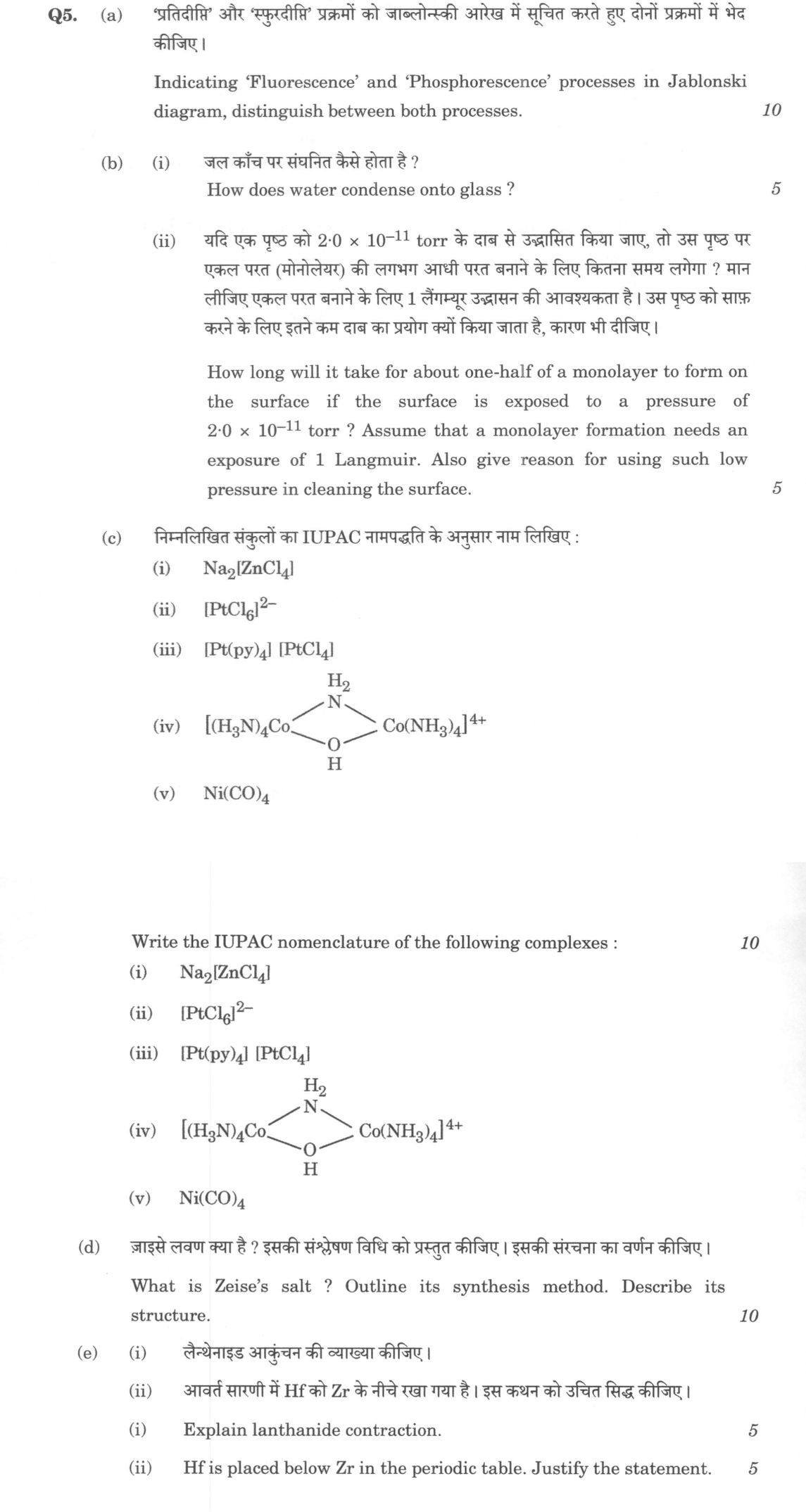
The figure this question refers to, in words
The question paper is a scan and the diagram did not survive as text. This is the figure as read from the original page — every component, value and label — so the question can be worked from the text below.
(c) Part (c)(iv) shows a chemical structure for a complex ion with the formula [(H3N)4Co Co(NH3)4]4+. The structure depicts two central Cobalt (Co) atoms. The left Cobalt is bonded to four Ammonia (H3N) groups. The right Cobalt is bonded to four Ammonia (NH3) groups. The two Cobalt atoms are bridged by two ligands: an Amine bridge (labeled H2N) and an Oxygen bridge (labeled O). The H2N bridge connects the top of the left Co to the top of the right Co. The O bridge connects the bottom of the left Co to the bottom of the right Co. The entire complex carries a 4+ charge.
Model answer
Written by UPSC Answer Check against this question's marking rubric, to the expected length. UPSC does not publish answers for Mains — this is one way to score well, not an official key.
(a) Fluorescence and phosphorescence. In a Jablonski diagram, the ground singlet state S0 is drawn at the bottom, the first excited singlet S1 above it, and the first excited triplet T1 below S1 but above S0. The relevant transitions are S0 to S1 for absorption, S1 to S0 for fluorescence, S1 to T1 for intersystem crossing, and T1 to S0 for phosphorescence. Fluorescence is a singlet-to-singlet, spin-allowed emission, whereas phosphorescence is a triplet-to-singlet, spin-forbidden emission. This spin difference is the key property that distinguishes the two: fluorescence can occur readily because the initial and final states have the same spin multiplicity, while phosphorescence has a small transition probability because the spin changes. Consequently, fluorescence has a short lifetime, usually 10⁻⁸ to 10⁻⁴ s, and phosphorescence has a much longer lifetime, usually 10⁻⁴ to 10² s, so phosphorescence may persist after the excitation source is switched off. Fluorescence is generally observed at room temperature and is relatively less temperature dependent; phosphorescence is strongly temperature dependent because heating increases non-radiative decay and quenching of the triplet state. Phosphorescence is also more readily quenched by oxygen and other paramagnetic species. Since T1 lies lower than S1, phosphorescence usually has a larger Stokes shift than fluorescence, and emission often occurs from the lowest vibrational level of T1 to various vibrational levels of S0.
(b) Water condensation and Langmuir exposure. (i) Water condenses onto glass because the glass surface is hydrophilic and contains surface silanol, Si-OH, groups. Water vapour molecules first adsorb by hydrogen bonding to these hydroxyl groups. Once a few molecules are held, they hydrogen bond to one another, forming a monolayer and then a thin liquid film. At higher relative humidity, capillary condensation and multilayer growth spread the film over the surface. (ii) One Langmuir is defined as an exposure of 10⁻⁶ torr s. For about one-half of a monolayer, the required exposure is 0.5 × 10⁻⁶ torr s. At a pressure of 2.0 × 10⁻¹¹ torr, the time is t = exposure/pressure = (0.5 × 10⁻⁶ torr s)/(2.0 × 10⁻¹¹ torr) = 2.5 × 10⁴ s, which is about 6.9 h, i.e. roughly 7 h. Such low pressure is used in cleaning the surface because ultra-high vacuum minimises residual gas impurities, prevents re-contamination of the freshly cleaned surface, gives a long mean free path for controlled adsorption and desorption, and avoids oxidation or adsorption of unwanted species.
(c) IUPAC names. The complexes are named as follows, using chlorido rather than chloro according to current IUPAC. (i) Na2[ZnCl4] is sodium tetrachloridozincate(II), because the four chloride ligands give Zn a +2 oxidation state. (ii) [PtCl6]2- is hexachloridoplatinate(IV). (iii) [Pt(py)4][PtCl4] is tetrapyridineplatinum(II) tetrachloridoplatinate(II); pyridine is neutral, so the cationic Pt is +2, and the anionic Pt is also +2. (iv) The bridged cation shown, with four ammine ligands on each Co, a μ-amido bridge and a μ-hydroxido bridge, is the μ-amido-μ-hydroxido-bis[tetraamminecobalt(III)] ion; the μ prefix shows that each bridge links the two cobalt centres, and the two negative bridging ligands make each Co +3. (v) Ni(CO)4 is tetracarbonylnickel(0), because CO is a neutral ligand.
(d) Zeise's salt. Zeise's salt is potassium trichlorido(ethylene)platinate(II) monohydrate, K[PtCl3(C2H4)]·H2O, and it is historically important as one of the first organometallic compounds. It is prepared by passing ethylene gas through an aqueous solution of potassium tetrachloroplatinate(II), K2[PtCl4], so that ethylene displaces one chloride from the square-planar Pt(II) complex; yellow crystals of the monohydrate separate. The reaction may be written K2[PtCl4] + C2H4 → K[PtCl3(C2H4)]·H2O + KCl. Structurally, Pt is d8 and essentially square planar, coordinated by three chloride ligands and one η2-ethylene ligand. The ethylene is bound side-on through its π bond, with the C=C axis perpendicular to the PtCl3 plane and the midpoint of the C=C bond occupying the fourth coordination site. The bonding is described by the Dewar-Chatt-Duncanson model: the filled C=C π orbital donates electron density to an empty orbital on Pt, while filled Pt dπ orbitals back-donate into the C=C π* orbital. This back-bonding weakens the C=C bond, lengthens it relative to free ethylene, and lowers its stretching frequency.
(e) Lanthanide contraction and Hf-Zr. (i) Lanthanide contraction is the gradual decrease in atomic and ionic radii from La to Lu. Across the lanthanide series the nuclear charge increases steadily, but the added 4f electrons shield the outer electrons poorly. The ineffective shielding allows the valence electrons to experience a greater effective nuclear charge, so the 5d and 6s orbitals contract steadily. The result is a reduction of about 15% in radius from La to Lu and very similar sizes of the lanthanide ions. This contraction also explains similarities among 3d, 4d and 5d transition metal ions. (ii) Hf is placed below Zr in Group 4 because, although Hf is in the 5d series and would normally be expected to be larger than Zr, the lanthanide contraction across the 4f series preceding Hf almost cancels the normal increase in size down the group. The metallic or ionic radii are nearly the same, for example Zr about 160 pm and Hf about 159 pm, and both have the same outer d2s2 valence configuration and common +4 oxidation state. Consequently their chemical properties, complex formation and ionic behaviour are so similar that Hf and Zr are difficult to separate, often requiring ion-exchange or solvent-extraction methods, and Hf is correctly placed directly below Zr.
What "Distinguish" is asking you to do
Name the property that separates the items and say which side holds it. Distinguish is marked exactly as differentiate is, with no difference in expectation, but its stems more often line up three terms rather than two — gender equality, gender equity and empowerment — and every pair in the set has to be separated.
Structure that answers it
The category they all sit in → the property dividing the first pair → the second pair → the third → why the boundary matters in practice
Where marks are lost
Separating the two obviously different items and leaving the middle term unplaced. A description of each side from which the line must be inferred is marked as description, not as a distinction.
How this answer will be evaluated
Approach
(a) compare: paired headings or table > key differences > significance > conclusion | (b(i)) explain: definition/context > points in order > small example > short close | (b(ii)) calculate: given > formula > substitution > result with units > interpretation | (c) enumerate: list the items in order > one line each > no commentary | (d) describe: define > structure or process in order > labelled diagram > significance | (e(i)) explain: definition/context > points in order > small example > short close | (e(ii)) justify: claim > 3-4 reasons > evidence > conclusion Full marks: Accurate diagrams, calculations, and nomenclature with clear reasoning.
Key points expected
- Jablonski diagram with S1, T1, S0 levels
- Fluorescence shown as S1 to S0 transition
- Phosphorescence shown as T1 to S0 transition
- Distinction based on spin multiplicity and lifetime
- Role of surface energy and wettability
- Nucleation of water droplets
- Interaction with surface hydroxyl groups
- Calculation of time using 1 Langmuir = 10^-6 torr-s
Evaluation rubric
Each sub-part is marked on its own, against the marks and word limit printed on the paper.
- (a) Jablonski diagram showing both processes and a distinction table. 10 marks
compare— paired headings or table → key differences → significance → conclusion
Must cover
- Jablonski diagram with S1, T1, S0 levels
- Fluorescence shown as S1 to S0 transition
- Phosphorescence shown as T1 to S0 transition
- Distinction based on spin multiplicity and lifetime
Loses marks
- Missing Jablonski diagram
- Confusing singlet and triplet states
- No distinction between the two processes
Earns more
- Mention of intersystem crossing
- Note on 'forbidden' nature of phosphorescence
- Indication of vibrational relaxation
Extra mark
- Quantitative values for typical lifetimes
- (b(i)) Mechanism of water condensation on glass surfaces. 5 marks
explain— definition/context → points in order → small example → short close
Must cover
- Role of surface energy and wettability
- Nucleation of water droplets
- Interaction with surface hydroxyl groups
Loses marks
- Vague description without mechanism
- Ignoring surface properties of glass
Earns more
- Mention of contact angle
- Distinction between clean and dirty glass
Extra mark
- Reference to specific surface chemistry of glass
- (b(ii)) Time for 0.5 monolayer formation at 2.0 x 10^-11 torr and reason for low pressure. 5 marks
calculate— given → formula → substitution → result with units → interpretation
Must cover
- Calculation of time using 1 Langmuir = 10^-6 torr-s
- Correct unit conversion and substitution
- Reason: low pressure prevents re-contamination
- Reason: high mean free path for cleaning
Loses marks
- Incorrect calculation of time
- Missing reason for low pressure
- Wrong definition of Langmuir
Earns more
- Explicit definition of Langmuir
- Mention of UHV requirements
Extra mark
- Reference to specific surface cleaning techniques
- (c) IUPAC names for five coordination complexes. 10 marks
enumerate— list the items in order → one line each → no commentary
Must cover
- Correct name for Na2[ZnCl4]
- Correct name for [PtCl6]2-
- Correct name for [Pt(py)4][PtCl4]
- Correct name for the Co-bridged complex
Loses marks
- Wrong oxidation state in name
- Incorrect ligand names
- Missing counter-ion in name
Earns more
- Correct name for Ni(CO)4
- Correct oxidation states in names
- Correct ligand nomenclature
Extra mark
- Mention of specific isomerism if applicable
- (d) Definition, synthesis, and structure of Zeise's salt. 10 marks
describe— define → structure or process in order → labelled diagram → significance
Must cover
- Definition of Zeise's salt
- Synthesis from K2PtCl4 and ethylene
- Description of the Pt-C2H4 bond
- Mention of the sandwich structure
Loses marks
- Missing synthesis method
- Incorrect description of the structure
- Confusing with other platinum complexes
Earns more
- Details of the reaction conditions
- Explanation of the Dewar-Chatt-Duncanson model
- Mention of the historical significance
Extra mark
- Reference to the first organometallic compound
- (e(i)) Explanation of lanthanide contraction. 5 marks
explain— definition/context → points in order → small example → short close
Must cover
- Definition of lanthanide contraction
- Cause: poor shielding by 4f electrons
- Effect: steady decrease in ionic radius
Loses marks
- Vague definition
- Missing cause of the contraction
- Confusing with other periodic trends
Earns more
- Mention of the effective nuclear charge
- Comparison with transition metals
Extra mark
- Reference to specific ionic radii values
- (e(ii)) Justification for placing Hf below Zr in the periodic table. 5 marks
justify— claim → 3-4 reasons → evidence → conclusion
Must cover
- Similarity in ionic radii of Hf and Zr
- Role of lanthanide contraction
- Similar chemical properties
Loses marks
- Missing link to lanthanide contraction
- Vague statement without justification
- Confusing with other group 4 elements
Earns more
- Mention of the 'lanthanide effect'
- Comparison of oxidation states
Extra mark
- Reference to specific chemical reactions
Practice this exact question
Write your answer and it is marked point by point against the model answer above — what you covered, what you missed, what you got wrong.
Evaluate my answer →More from Chemistry 2024 Paper I
- Q2 (a) State Heisenberg's uncertainty principle. Show that for a particle in a one-dimension…
- Q3 (a) (i) Calculate the coefficient of viscosity of air at temperatures : (I) 298 K and (II…
- Q4 (a) A new drug has been synthesized and its phase diagram is explored. It is found that n…
- Q5 (a) Indicating 'Fluorescence' and 'Phosphorescence' processes in Jablonski diagram, disti…
- Q6 (a) (i) Calculate the number of moles of HCl (g) produced by the absorption of one Joule…
- Q7 (a) Show the splitting of 'd' orbitals in square planar field according to Crystal Field…
- Q8 (a) 'All the F atoms appear indistinguishable in the ¹⁹F NMR spectrum of sp³d hybridized…