Paper I — Q6
(a) (i) Calculate the number of moles of HCl (g) produced by the absorption of one Joule of radiant energy of wavelength 480 nm…
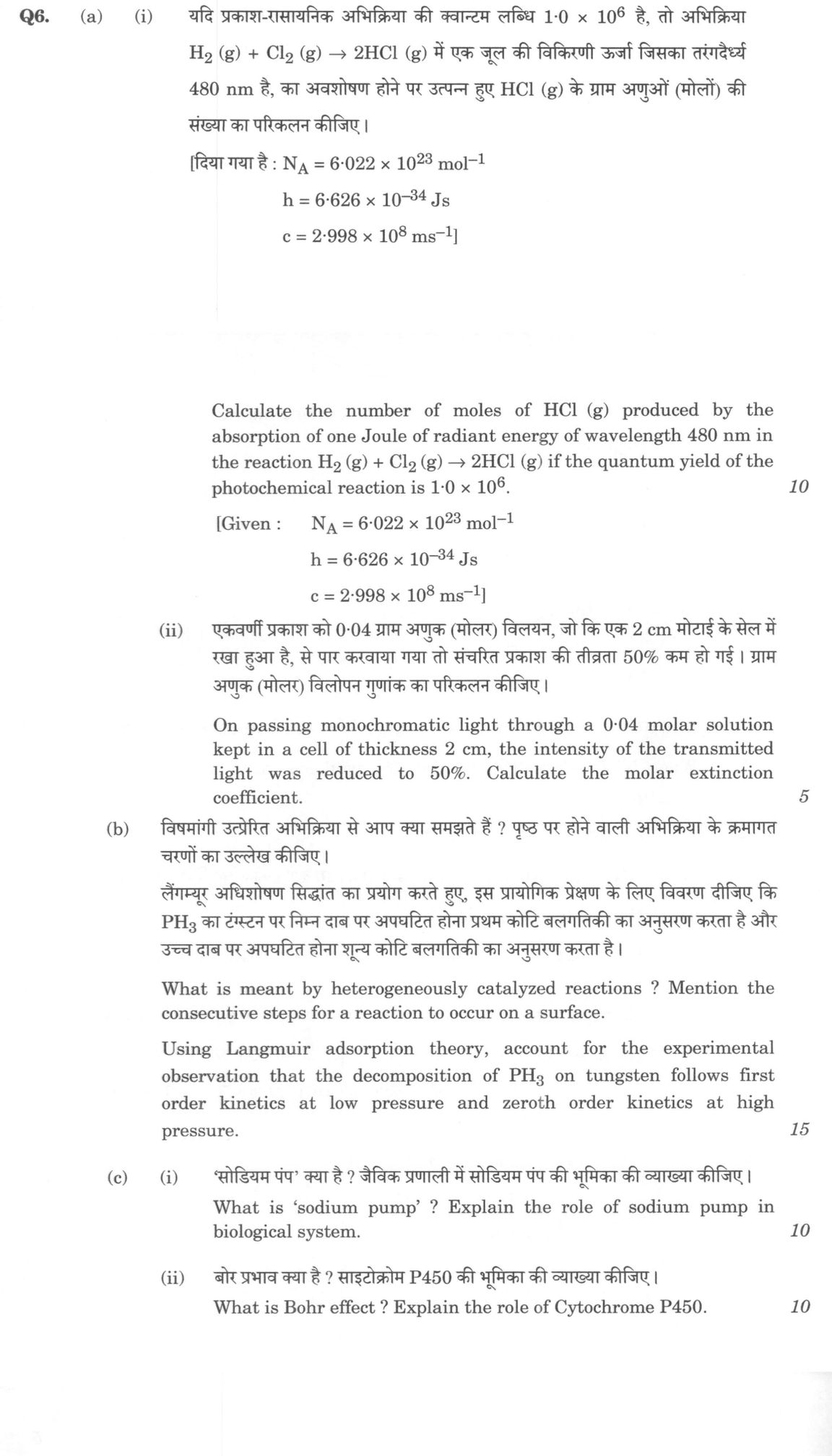
Calculate the number of moles of HCl (g) produced by the absorption of one Joule of radiant energy of wavelength 480 nm in the reaction H₂ (g) + Cl₂ (g) → 2HCl (g) if the quantum yield of the photochemical reaction is 1·0 × 10⁶. [Given: Nₐ = 6·022 × 10²³ mol⁻¹, h = 6·626 × 10⁻³⁴ Js, c = 2·998 × 10⁸ ms⁻¹] 10 marks
On passing monochromatic light through a 0·04 molar solution kept in a cell of thickness 2 cm, the intensity of the transmitted light was reduced to 50%. Calculate the molar extinction coefficient. 5 marks
What is meant by heterogeneously catalyzed reactions? Mention the consecutive steps for a reaction to occur on a surface.
Using Langmuir adsorption theory, account for the experimental observation that the decomposition of PH₃ on tungsten follows first order kinetics at low pressure and zeroth order kinetics at high pressure. 15 marks
What is 'sodium pump'? Explain the role of sodium pump in biological system. 10 marks
What is Bohr effect? Explain the role of Cytochrome P450. 10 marks
हिंदी में प्रश्न पढ़ें
यदि प्रकाश-रासायनिक अभिक्रिया की क्वांटम लाभ 1·0 × 10⁶ है, तो अभिक्रिया H₂ (g) + Cl₂ (g) → 2HCl (g) में एक जूल की विकिरणी ऊर्जा जिसका तरंगदैर्घ्य 480 nm है, का अवशोषण होने पर उत्पन्न हुए HCl (g) के ग्राम अणुओं (मोलों) की संख्या का परिकलन कीजिए। [दिया गया है: Nₐ = 6·022 × 10²³ mol⁻¹, h = 6·626 × 10⁻³⁴ Js, c = 2·998 × 10⁸ ms⁻¹] (10 अंक)
एकवर्णी प्रकाश को 0·04 ग्राम अणुक (मोलर) विलयन, जो कि एक 2 cm मोटाई के सेल में रखा हुआ है, से पार करवाया गया तो संचरित प्रकाश की तीव्रता 50% कम हो गई। ग्राम अणुक (मोलर) विलोपन गुणांक का परिकलन कीजिए। (5 अंक)
विषमांगी उत्प्रेरित अभिक्रिया से आप क्या समझते हैं? पृष्ठ पर होने वाली अभिक्रिया के क्रमागत चरणों का उल्लेख कीजिए।
लैंगमूर अधिशोषण सिद्धांत का प्रयोग करते हुए, इस प्रायोगिक प्रेक्षण के लिए विवरण दीजिए कि PH₃ का टंगस्टन पर निम्न दाब पर अपघटित होना प्रथम कोटि बलगतिकी का अनुसरण करता है और उच्च दाब पर अपघटित होना शून्य कोटि बलगतिकी का अनुसरण करता है। (15 अंक)
'सोडियम पंप' क्या है? जैविक प्रणाली में सोडियम पंप की भूमिका की व्याख्या कीजिए। (10 अंक)
बोर प्रभाव क्या है? साइटोक्रोम P450 की भूमिका की व्याख्या कीजिए। (10 अंक)
Model answer
Written by UPSC Answer Check against this question's marking rubric, to the expected length. UPSC does not publish answers for Mains — this is one way to score well, not an official key.
(a)(i) In photochemistry, quantum yield φ is the number of product molecules formed per photon absorbed. Here φ = 1.0×10⁶ molecules of HCl per photon. Energy of one photon by Planck relation E = hc/λ. λ = 480 nm = 480×10⁻⁹ m. E = (6.626×10⁻³⁴ J s × 2.998×10⁸ m s⁻¹)/(480×10⁻⁹ m) = 4.138×10⁻¹⁹ J. Number of photons in 1 J = 1/(4.138×10⁻¹⁹ J) = 2.416×10¹⁸ photons. These photons correspond to (2.416×10¹⁸)/(6.022×10²³ mol⁻¹) = 4.012×10⁻⁶ mol photons. Since each photon produces 1.0×10⁶ HCl molecules, n_HCl = (4.012×10⁻⁶ mol photons) × (1.0×10⁶ mol HCl/mol photons) = 4.01 mol HCl. Direct formula: n_HCl = I λ φ/(h c Nₐ). Answer: 4.01 mol HCl.
(a)(ii) Beer-Lambert law: A = log₁₀(I₀/I_t) = ε c l. Transmitted intensity is 50%, so I_t/I₀ = 0.50. A = log₁₀(1/0.50) = log₁₀2 = 0.3010. Given c = 0.04 mol L⁻¹ and l = 2 cm, ε = A/(c l) = 0.3010/(0.04×2) = 3.76 L mol⁻¹ cm⁻¹, assuming no scattering or reflection. Answer: ε ≈ 3.76 L mol⁻¹ cm⁻¹.
(b) Heterogeneously catalysed reactions are reactions in which the catalyst and reactants exist in different phases, usually a solid catalyst with gaseous or liquid reactants. The reaction takes place on the catalyst surface, especially at active sites. The consecutive steps are:
- External diffusion of reactant molecules from the bulk fluid to the catalyst surface.
- Internal diffusion through pores of the catalyst to active sites.
- Adsorption of reactants on active sites.
- Surface reaction between adsorbed species or between an adsorbed species and a bulk molecule to form products.
- Desorption of products from the surface.
- Diffusion of products away from active sites and pores into the bulk fluid. Langmuir adsorption theory assumes equivalent surface sites, monolayer adsorption, dynamic adsorption-desorption equilibrium, and negligible interaction between adsorbed molecules. For PH₃ on tungsten, let P be PH₃ pressure and θ the fraction of surface covered. The Langmuir isotherm is θ = K P/(1+K P), where K is the adsorption equilibrium constant. If the decomposition rate is proportional to covered surface, rate = k θ = k K P/(1+K P). At low pressure, K P<<1, so θ≈K P and rate≈k K P; the reaction is first order in PH₃. At high pressure, K P>>1, so θ≈1 and rate≈k; the surface is saturated, and the reaction is zeroth order. At intermediate pressure the order lies between 0 and 1. Thus Langmuir adsorption explains the observed pressure dependence of PH₃ decomposition on tungsten.
(c)(i) The sodium pump is the Na⁺/K⁺-ATPase, an integral membrane protein and active transport system. By hydrolysing one ATP, it pumps three Na⁺ ions out of the cell and two K⁺ ions into the cell, both against their concentration gradients. Because one net positive charge is moved out per cycle, the pump is electrogenic. Its roles include maintaining high intracellular K⁺ and high extracellular Na⁺ concentrations; establishing and restoring the resting membrane potential needed for nerve impulse conduction and muscle contraction; maintaining cell volume and osmotic balance; providing the Na⁺ gradient for secondary active transport of glucose, amino acids and other solutes; and regulating intracellular pH and ionic homeostasis. It requires ATP and Mg²⁺, and is inhibited by ouabain/digitalis.
(c)(ii) The Bohr effect is the decrease in oxygen affinity of haemoglobin when pH decreases or pCO₂ increases. H⁺ and CO₂ bind to haemoglobin, stabilising the low-affinity T-state and shifting the oxygen dissociation curve to the right, so oxygen is released more readily in actively respiring tissues. In lungs, low CO₂ and higher pH favour oxygen binding. Cytochrome P450 is a superfamily of heme-thiolate monooxygenase enzymes, mainly located in the liver endoplasmic reticulum and in mitochondria of steroidogenic tissues. Using NADPH and molecular oxygen, it inserts one oxygen atom into a substrate: RH + O₂ + NADPH + H⁺ → ROH + H₂O + NADP⁺. It carries out Phase I oxidative metabolism of drugs, xenobiotics and toxins, and also participates in biosynthesis of steroids, bile acids, vitamin D and fatty acids. The name P450 comes from the reduced CO-bound complex absorbing near 450 nm.
What "Calculate" is asking you to do
Apply the standard formula or schedule to data the question has already supplied — a table of readings, cost records, a balance sheet — and produce the number. The method is rarely in doubt; the marks sit in the named intermediate quantities, each of which has to appear as a labelled line.
Structure that answers it
Data as given → formula or standard treatment, named → substitution → each intermediate, labelled → result with units
Where marks are lost
Omitting an intermediate the marking scheme pays for separately, or rounding at an intermediate line so the final figure drifts. In commerce and accountancy, any figure in a statement that no numbered working note supports is treated as unearned.
How this answer will be evaluated
Approach
Framework: Concept > Structure or mechanism > Reasoning > Result. (a(i)) calculate: given > formula > substitution > result with units > interpretation | (a(ii)) calculate: given > formula > substitution > result with units > interpretation | (b) account for: state the phenomenon > the causes in order of weight > conclusion | (c(i)) explain: definition/context > points in order > small example > short close | (c(ii)) explain: definition/context > points in order > small example > short close Full marks: Full derivations for kinetics and calculations; precise biological mechanisms.
Key points expected
- Calculate energy of one photon (E = hc/λ)
- Determine number of photons in 1 J
- Apply quantum yield to find molecules reacted
- Convert to moles of HCl using stoichiometry
- Use Beer-Lambert Law (A = εcl)
- Calculate Absorbance from 50% transmission (A = 0.301)
- Substitute concentration (0.04 M) and path length (2 cm)
- Define heterogeneous catalysis (different phases)
Evaluation rubric
Each sub-part is marked on its own, against the marks and word limit printed on the paper.
- (a(i)) Moles of HCl produced from 1 J of 480 nm light with given quantum yield. 10 marks
calculate— given → formula → substitution → result with units → interpretation
Must cover
- Calculate energy of one photon (E = hc/λ)
- Determine number of photons in 1 J
- Apply quantum yield to find molecules reacted
- Convert to moles of HCl using stoichiometry
Loses marks
- Incorrect photon energy calculation
- Ignoring stoichiometry (1:1 vs 1:2)
Earns more
- Correct unit conversion for wavelength (nm to m)
- Explicit use of Avogadro's number
Extra mark
- Mention of chain reaction mechanism for H2 + Cl2
- (a(ii)) Molar extinction coefficient from 50% transmission through 2 cm cell. 5 marks
calculate— given → formula → substitution → result with units → interpretation
Must cover
- Use Beer-Lambert Law (A = εcl)
- Calculate Absorbance from 50% transmission (A = 0.301)
- Substitute concentration (0.04 M) and path length (2 cm)
Loses marks
- Using T instead of A in Beer's law
- Unit error in path length (cm vs m)
Earns more
- Correct logarithmic conversion for T=0.5
Extra mark
- Mention of units for molar extinction coefficient (L mol⁻¹ cm⁻¹)
- (b) Heterogeneous catalysis steps and Langmuir kinetics for PH3 decomposition. 15 marks
account for— state the phenomenon → the causes in order of weight → conclusion
Must cover
- Define heterogeneous catalysis (different phases)
- List surface reaction steps (adsorption, reaction, desorption)
- Derive rate law using Langmuir isotherm (θ = KP/1+KP)
- Show limit for low P (1st order) and high P (0th order)
Loses marks
- Missing the derivation of the rate expression
- Confusing homogeneous and heterogeneous steps
Earns more
- Specific mention of PH3 on Tungsten (W) surface
- Clear distinction between low and high pressure regimes
Extra mark
- Mention of Eley-Rideal vs Langmuir-Hinshelwood mechanisms
- (c(i)) Definition of sodium pump and its biological role. 10 marks
explain— definition/context → points in order → small example → short close
Must cover
- Define Na+/K+ ATPase mechanism (3 Na+ out, 2 K+ in)
- Explain active transport against gradient
- Link to maintenance of membrane potential
- Mention role in nerve impulse transmission
Loses marks
- Describing passive diffusion instead of active transport
- Incorrect ion ratio (e.g., 1:1)
Earns more
- Mention of ATP hydrolysis as energy source
Extra mark
- Reference to specific biological system (e.g., neurons)
- (c(ii)) Definition of Bohr effect and role of Cytochrome P450. 10 marks
explain— definition/context → points in order → small example → short close
Must cover
- Define Bohr effect (pH/CO2 effect on O2 affinity)
- Explain shift in O2 dissociation curve
- Define Cytochrome P450 (monooxygenase)
- Explain role in drug metabolism/detoxification
Loses marks
- Confusing Bohr effect with Haldane effect
- Describing P450 as a simple oxidase without oxygen activation
Earns more
- Mention of hemoglobin as the protein for Bohr effect
- Mention of liver microsomes for P450
Extra mark
- Specific example of drug metabolized by P450
Practice this exact question
Write your answer and it is marked point by point against the model answer above — what you covered, what you missed, what you got wrong.
Evaluate my answer →More from Chemistry 2024 Paper I
- Q3 (a) (i) Calculate the coefficient of viscosity of air at temperatures : (I) 298 K and (II…
- Q4 (a) A new drug has been synthesized and its phase diagram is explored. It is found that n…
- Q5 (a) Indicating 'Fluorescence' and 'Phosphorescence' processes in Jablonski diagram, disti…
- Q6 (a) (i) Calculate the number of moles of HCl (g) produced by the absorption of one Joule…
- Q7 (a) Show the splitting of 'd' orbitals in square planar field according to Crystal Field…
- Q8 (a) 'All the F atoms appear indistinguishable in the ¹⁹F NMR spectrum of sp³d hybridized…