Paper I — Q7
(a) Show the splitting of 'd' orbitals in square planar field according to Crystal Field Theory (CFT). Comment on the following…
Show the splitting of 'd' orbitals in square planar field according to Crystal Field Theory (CFT). Comment on the following statement : 'The difference in energy between the dₓ²₋ᵧ² and dₓᵧ orbitals in square planar field is identical to the difference between the same orbitals in the octahedral field.' 10 marks
The bond orders of some metal carbonyls are : M – C bond order | C – O bond order Ni(CO)₄ | 1·33 | 2·64 [Co(CO)₄]⁻ | 1·89 | 2·14 [Fe(CO)₄]²⁻ | 2·16 | 1·85 Explain the above facts. 10 marks
Identify A, B and C. What is the relationship between A and B ? [Co(NH₃)₅Cl]Cl₂ → A (NaNO₂) A ⇄ B (Let stand or warm, HCl / UV ray) [Co(NH₃)₅Cl]Cl₂ → C (Dilute NH₃ aqueous) C → B (NaNO₂, concentrated HCl) 13 marks
On the basis of Crystal Field Theory, account for the following statement : While [CoF₆]³⁻ is paramagnetic, [Co(CN)₆]³⁻ is diamagnetic. 10 marks
Elucidate the structure(s) of Co₂(CO)₈. Comment on its magnetic behaviour. 15 marks
हिंदी में प्रश्न पढ़ें
क्रिस्टल क्षेत्र सिद्धांत (CFT) के अनुसार वर्ग समतली क्षेत्र में 'd' कक्षकों के विपाटन को प्रदर्शित कीजिए। निम्नलिखित कथन पर टिप्पणी कीजिए : 'वर्ग समतली क्षेत्र में dₓ²₋ᵧ² और dₓᵧ कक्षकों के मध्य ऊर्जा का अंतर, अष्टफलकीय क्षेत्र में समान कक्षकों के मध्य अंतर के समरूप है।' (10 अंक)
कुछ धातु कार्बोनिलों के आबंध क्रम हैं : M – C आबंध क्रम | C – O आबंध क्रम Ni(CO)₄ | 1·33 | 2·64 [Co(CO)₄]⁻ | 1·89 | 2·14 [Fe(CO)₄]²⁻ | 2·16 | 1·85 उपर्युक्त तथ्यों की व्याख्या कीजिए। (10 अंक)
A, B और C को पहचानिए। A और B के बीच में क्या संबंध है ? [Co(NH₃)₅Cl]Cl₂ → A (NaNO₂) A ⇄ B (शांत छोड़ें या गर्म, HCl / UV किरण) [Co(NH₃)₅Cl]Cl₂ → C (तनु NH₃ जलीय) C → B (NaNO₂, सांद्र HCl) (13 अंक)
क्रिस्टल क्षेत्र सिद्धांत के आधार पर, निम्नलिखित कथन का विवरण दीजिए : जबकि [CoF₆]³⁻ अनुचुंबकीय है, [Co(CN)₆]³⁻ प्रतिचुंबकीय है । (10 अंक)
Co₂(CO)₈ की संरचना/संरचनाओं को स्पष्ट कीजिए । इसके चुंबकीय आचरण पर टिप्पणी कीजिए । (15 अंक)
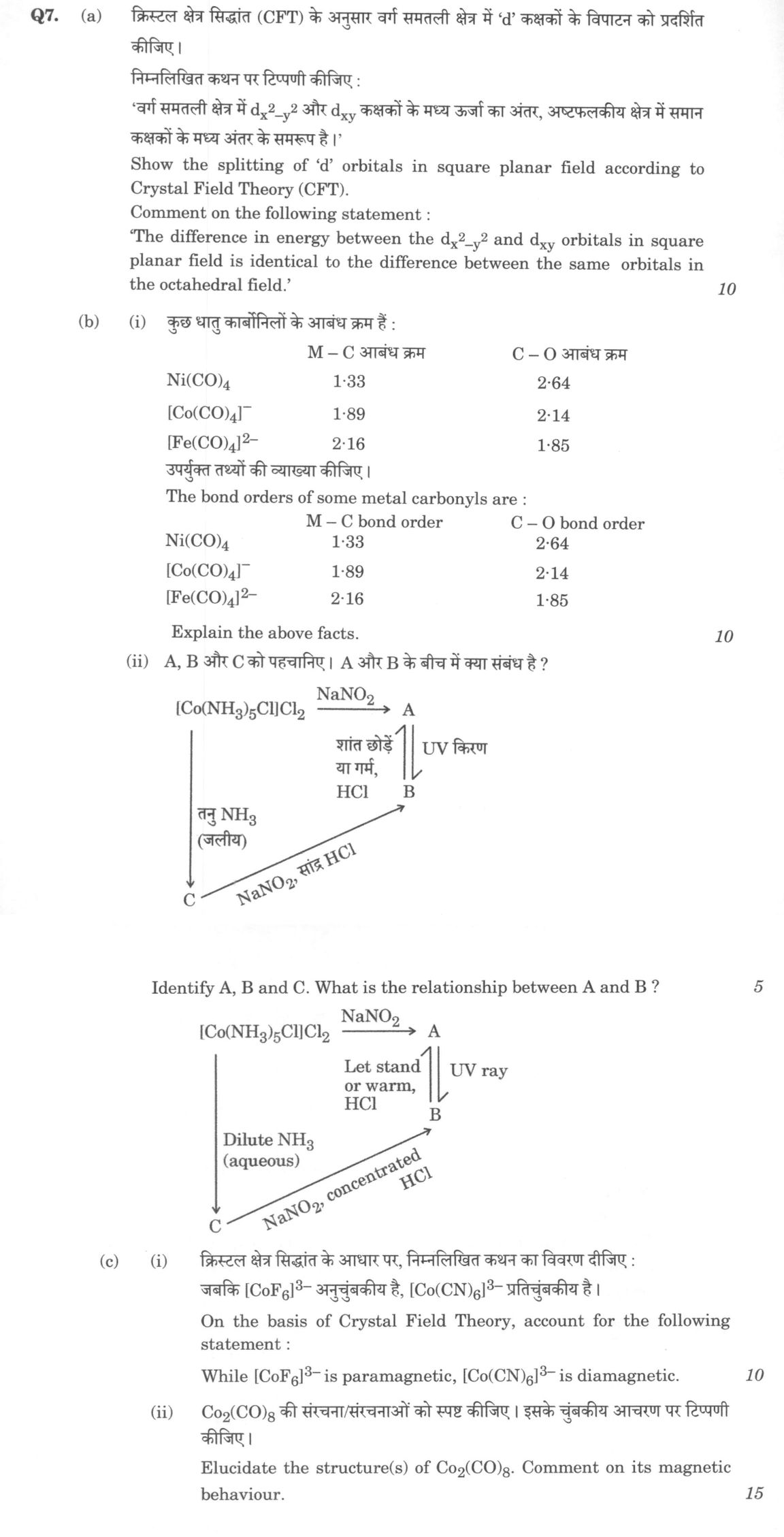
The figure this question refers to, in words
The question paper is a scan and the diagram did not survive as text. This is the figure as read from the original page — every component, value and label — so the question can be worked from the text below.
(b) Reaction scheme starting with the complex [Co(NH3)5Cl]Cl2. An arrow labeled 'NaNO2' points from the starting material to a product labeled 'A'. A second arrow labeled 'Dilute NH3 (aqueous)' points from the starting material to a product labeled 'C'. A double-headed arrow connects 'A' and 'B'; the arrow from A to B is labeled 'Let stand or warm, HCl' and the arrow from B to A is labeled 'UV ray'. A diagonal arrow points from 'C' to 'B' and is labeled 'NaNO2, concentrated HCl'.
Model answer
Written by UPSC Answer Check against this question's marking rubric, to the expected length. UPSC does not publish answers for Mains — this is one way to score well, not an official key.
Part (a) In a square-planar D₄ₕ field the four ligands lie in the xy plane. The CFT splitting is therefore: dₓ²₋ᵧ² (highest) > dₓᵧ > d_z² > dₓz = d_yz (lowest). In Δₒ units the approximate energies are dₓ²₋ᵧ² ≈ +1.228Δₒ, dₓᵧ ≈ +0.228Δₒ, d_z² ≈ −0.428Δₒ and dₓz/d_yz ≈ −0.514Δₒ. Hence the dₓ²₋ᵧ²–dₓᵧ gap is 1.000Δₒ, the same as the e_g–t₂g gap in an octahedral field, where dₓ²₋ᵧ² (e_g) and dₓᵧ (t₂g) are separated by Δₒ. The statement is therefore correct for that particular pair in the ideal CFT limit. It must not, however, be read as saying the whole square-planar pattern is octahedral: the overall square-planar spread, dₓ²₋ᵧ² to dₓz/d_yz, is about 1.742Δₒ, and d_z² is raised above dₓz/d_yz.
Part (b)(i) Metal carbonyl bonding is synergic: CO σ-donates to the metal and metal dπ electrons π-back-donate into CO π* orbitals. The more negative the metal centre, the greater the M→CO back-donation. Ni(CO)₄ contains Ni(0), [Co(CO)₄]⁻ contains Co(−I), and [Fe(CO)₄]²⁻ contains Fe(−II); all are 18-electron d¹⁰ species. Increasing negative charge from Ni to Co to Fe increases back-donation, giving partial M=C double-bond character and weakening the C–O bond. Thus M–C bond order rises (1.33, 1.89, 2.16) while C–O bond order falls (2.64, 2.14, 1.85). The same trend is seen in IR spectra as lower C–O stretching frequencies for more back-donated carbonyls.
Part (b)(ii) A is the O-linked nitrito complex, [Co(NH₃)₅(ONO)]Cl₂; B is the N-linked nitro complex, [Co(NH₃)₅(NO₂)]Cl₂. C is [Co(NH₃)₆]Cl₃, formed by replacement of coordinated Cl by NH₃. A and B are linkage isomers: they have the same composition, but the ambidentate NO₂⁻ ligand is attached through O in A and through N in B. A converts to B on standing or warming in HCl, and B reverts to A under UV light; C also gives B with NaNO₂/concentrated HCl.
Part (c)(i) Co(III) is d⁶. In [CoF₆]³⁻, F⁻ is a weak-field ligand, so Δₒ < P and the complex is high spin: t₂g⁴e_g² with four unpaired electrons, hence paramagnetic. Its CFSE is 4(−0.4Δₒ)+2(+0.6Δₒ)=−0.4Δₒ plus one pairing energy. In [Co(CN)₆]³⁻, CN⁻ is a strong-field ligand, so Δₒ > P and the complex is low spin: t₂g⁶e_g⁰ with no unpaired electrons, hence diamagnetic. Its CFSE is 6(−0.4Δₒ)=−2.4Δₒ plus three pairing energies; the large Δₒ more than compensates the extra pairing.
Part (c)(ii) Co₂(CO)₈ exists as two isomers in equilibrium. The bridged isomer has C₂v symmetry, two μ-CO ligands and six terminal CO ligands; each Co is counted as d⁹ + 6e⁻ from three terminal CO + 2e⁻ from two μ-CO + 1e⁻ from a Co–Co bond = 18e⁻. The non-bridged isomer has D₃d symmetry and eight terminal CO ligands; each Co is d⁹ + 8e⁻ from four terminal CO + 1e⁻ from a Co–Co bond = 18e⁻. Co(0) is d⁹, so each Co has one unpaired d electron. In the bridged isomer these pair in the Co–Co σ bond, so it is diamagnetic. In the non-bridged isomer the Co–Co interaction is weaker; in the CFT description one unpaired electron remains on each Co, so it is paramagnetic. Thus the magnetic behaviour reflects the degree of metal–metal bonding and electron pairing in the two structures.
What "Elucidate" is asking you to do
Make a stated proposition plain and then prove it with instances. Elucidate stems almost always carry a claim or a named concept, and very often the words “with examples” or “with suitable diagrams” — the illustration is part of the directive, not decoration.
Structure that answers it
Plain-language statement of what the proposition means → the part that is obscure, resolved → first illustration → second illustration → why the proposition holds
Where marks are lost
Adding terminology; elucidate rewards removing it. The commoner loss is a clean explanation with no example, when the stem asked for examples.
How this answer will be evaluated
Approach
Framework: Crystal Field Theory (CFT) and Ligand Field Theory. (a) comment: context > arguments both sides > judgment > close | (b(i)) explain: definition/context > points in order > small example > short close | (b(ii)) map: locate accurately > label > one line on why it matters | (c(i)) account for: state the phenomenon > the causes in order of weight > conclusion | (c(ii)) explain: definition/context > points in order > small example > short close Full marks: Accurate diagrams, clear reasoning, correct identification of species, and thorough explanation of mechanisms.
Key points expected
- Correct energy level diagram for square planar field
- Identification of dx2-y2 as highest energy orbital
- Comparison of energy gap with octahedral field
- Justification based on ligand position (z-axis)
- Explanation of pi-back bonding mechanism
- Link between negative charge and back-bonding strength
- Correlation of M-C bond order with back-bonding
- Correlation of C-O bond order with back-bonding
Evaluation rubric
Each sub-part is marked on its own, against the marks and word limit printed on the paper.
- (a) Diagram of d-orbital splitting in square planar field and evaluation of the energy difference statement. 10 marks
comment— context → arguments both sides → judgment → close
Must cover
- Correct energy level diagram for square planar field
- Identification of dx2-y2 as highest energy orbital
- Comparison of energy gap with octahedral field
- Justification based on ligand position (z-axis)
Loses marks
- Confusing square planar with tetrahedral splitting
- Incorrect relative ordering of dxy and dz2
Earns more
- Mention of dz2 energy relative to dxy
- Reference to tetragonal distortion from octahedral
Extra mark
- Quantitative values of energy levels (e.g., in terms of Dq)
- (b(i)) Explanation of bond order trends in Ni(CO)4, [Co(CO)4]-, and [Fe(CO)4]2- using back-bonding. 10 marks
explain— definition/context → points in order → small example → short close
Must cover
- Explanation of pi-back bonding mechanism
- Link between negative charge and back-bonding strength
- Correlation of M-C bond order with back-bonding
- Correlation of C-O bond order with back-bonding
Loses marks
- Ignoring the effect of negative charge on back-bonding
- Incorrect relationship between M-C and C-O bond orders
Earns more
- Mention of electron density on metal center
- Reference to IR stretching frequencies
Extra mark
- Molecular orbital diagram of CO back-bonding
- (b(ii)) Identification of complexes A, B, and C and the relationship between A and B. 5 marks
map— locate accurately → label → one line on why it matters
Must cover
- Identification of A as nitro complex
- Identification of B as isonitro complex
- Identification of C as ammine complex
- Statement that A and B are linkage isomers
Loses marks
- Confusing nitro and isonitro linkages
- Incorrect identification of C
Earns more
- Correct chemical formulas for A, B, and C
- Mention of linkage isomerism
Extra mark
- Structural diagrams of nitro and isonitro linkages
- (c(i)) CFT explanation for the magnetic properties of [CoF6]3- and [Co(CN)6]3-. 10 marks
account for— state the phenomenon → the causes in order of weight → conclusion
Must cover
- Identification of Co oxidation state in both complexes
- Explanation of F- as weak field ligand
- Explanation of CN- as strong field ligand
- Correlation of ligand field strength with spin state
Loses marks
- Incorrect oxidation state of Co
- Confusing weak and strong field ligands
Earns more
- Orbital diagrams for high-spin and low-spin Co(III)
- Mention of crystal field stabilization energy (CFSE)
Extra mark
- Quantitative values of CFSE for both complexes
- (c(ii)) Structure of Co2(CO)8 and explanation of its magnetic behavior. 15 marks
explain— definition/context → points in order → small example → short close
Must cover
- Description of bridging carbonyl structure
- Mention of Co-Co bond
- Explanation of diamagnetic nature
- Reference to 18-electron rule
Loses marks
- Incorrect structure (e.g., no Co-Co bond)
- Incorrect magnetic behavior
Earns more
- Structural diagram of Co2(CO)8
- Mention of fluxional behavior
Extra mark
- Comparison with other metal carbonyl dimers
Practice this exact question
Write your answer and it is marked point by point against the model answer above — what you covered, what you missed, what you got wrong.
Evaluate my answer →More from Chemistry 2024 Paper I
- Q4 (a) A new drug has been synthesized and its phase diagram is explored. It is found that n…
- Q5 (a) Indicating 'Fluorescence' and 'Phosphorescence' processes in Jablonski diagram, disti…
- Q6 (a) (i) Calculate the number of moles of HCl (g) produced by the absorption of one Joule…
- Q7 (a) Show the splitting of 'd' orbitals in square planar field according to Crystal Field…
- Q8 (a) 'All the F atoms appear indistinguishable in the ¹⁹F NMR spectrum of sp³d hybridized…