Paper I — Q3
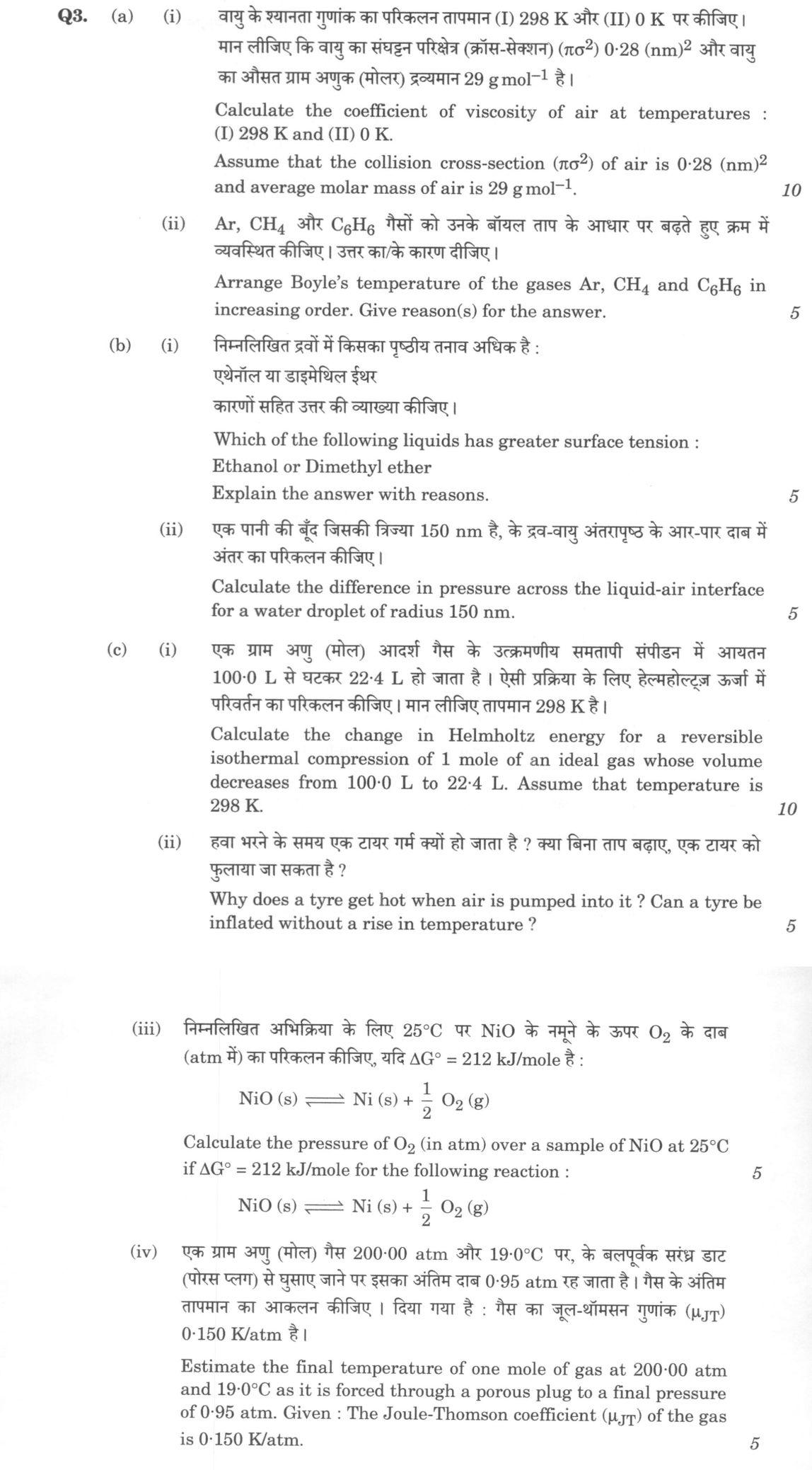
(a) (i) Calculate the coefficient of viscosity of air at temperatures : (I) 298 K and (II) 0 K. Assume that the collision…
Calculate the coefficient of viscosity of air at temperatures : (I) 298 K and (II) 0 K. Assume that the collision cross-section (πσ²) of air is 0·28 (nm)² and average molar mass of air is 29 g mol⁻¹. 10 marks
Arrange Boyle's temperature of the gases Ar, CH₄ and C₆H₆ in increasing order. Give reason(s) for the answer. 5 marks
Which of the following liquids has greater surface tension : Ethanol or Dimethyl ether. Explain the answer with reasons. 5 marks
Calculate the difference in pressure across the liquid-air interface for a water droplet of radius 150 nm. 5 marks
Calculate the change in Helmholtz energy for a reversible isothermal compression of 1 mole of an ideal gas whose volume decreases from 100·0 L to 22·4 L. Assume that temperature is 298 K. 10 marks
Why does a tyre get hot when air is pumped into it ? Can a tyre be inflated without a rise in temperature ? 5 marks
Calculate the pressure of O₂ (in atm) over a sample of NiO at 25°C if ΔG° = 212 kJ/mole for the following reaction : NiO (s) ⇌ Ni (s) + ½ O₂ (g) 5 marks
Estimate the final temperature of one mole of gas at 200·00 atm and 19·0°C as it is forced through a porous plug to a final pressure of 0·95 atm. Given : The Joule-Thomson coefficient (μJT) of the gas is 0·150 K/atm. 5 marks
हिंदी में प्रश्न पढ़ें
वायु के श्यानता गुणांक का परिकलन तापमान (I) 298 K और (II) 0 K पर कीजिए। मान लीजिए कि वायु का संघट्टन परिक्षेत्र (क्रॉस-सेक्शन) (πσ²) 0·28 (nm)² और वायु का औसत ग्राम अणुक (मोलर) द्रव्यमान 29 g mol⁻¹ है। (10 अंक)
Ar, CH₄ और C₆H₆ गैसों को उनके बॉयल ताप के आधार पर बढ़ते हुए क्रम में व्यवस्थित कीजिए। उत्तर का/के कारण दीजिए। (5 अंक)
निम्नलिखित द्रवों में किसका पृष्ठीय तनाव अधिक है : एथेनॉल या डाइमेथिल ईथर। कारणों सहित उत्तर की व्याख्या कीजिए। (5 अंक)
एक पानी की बूंद जिसकी त्रिज्या 150 nm है, के द्रव-वायु अंतरापृष्ठ के आर-पार दाब में अंतर का परिकलन कीजिए। (5 अंक)
एक ग्राम अणु (मोल) आदर्श गैस के उष्मतापी समतापी संपीडन में आयतन 100·0 L से घटकर 22·4 L हो जाता है। ऐसी प्रक्रिया के लिए हेल्महोल्ट्ज़ ऊर्जा में परिवर्तन का परिकलन कीजिए। मान लीजिए तापमान 298 K है। (10 अंक)
हवा भरने के समय एक टायर गर्म क्यों हो जाता है ? क्या बिना ताप बढ़ाए, एक टायर को फुलाया जा सकता है ? (5 अंक)
निम्नलिखित अभिक्रिया के लिए 25°C पर NiO के नमूने के ऊपर O₂ के दाब (atm में) का परिकलन कीजिए, यदि ΔG° = 212 kJ/mole है : NiO (s) ⇌ Ni (s) + ½ O₂ (g) (5 अंक)
एक ग्राम अणु (मोल) गैस 200·00 atm और 19·0°C पर, के बलपूर्वक संघ्र झार (पोरस प्लग) से घुसाए जाने पर इसका अंतिम दाब 0·95 atm रह जाता है। गैस के अंतिम तापमान का आकलन कीजिए। दिया गया है : गैस का जूल-थॉमसन गुणांक (μJT) 0·150 K/atm है। (5 अंक)
Model answer
Written by UPSC Answer Check against this question's marking rubric, to the expected length. UPSC does not publish answers for Mains — this is one way to score well, not an official key.
(a)(i) Using kinetic theory of a hard-sphere gas: η = (1/3) ρ v_avg λ, with λ = 1/(√2 n πσ²). Since ρ = n m, η = m v_avg/(3√2 πσ²), where v_avg = √(8RT/πM).
Given πσ² = 0.28 nm² = 2.8×10⁻¹⁹ m², M = 29 g mol⁻¹ = 0.029 kg mol⁻¹. m = M/N_A = 0.029/(6.022×10²³) = 4.816×10⁻²⁶ kg.
At T = 298 K: v_avg = √(8×8.314×298/(π×0.029)) = 466.4 m s⁻¹. η = (4.816×10⁻²⁶ × 466.4)/(3√2 × 2.8×10⁻¹⁹) = 1.89×10⁻⁵ Pa s.
At T = 0 K: v_avg ∝ √T, so v_avg = 0 and hence η = 0 Pa s by this model. Real air would not remain gaseous at 0 K.
Final: η(298 K) = 1.89×10⁻⁵ Pa s; η(0 K) = 0 Pa s (ideal hard-sphere extrapolation).
(a)(ii) For a van der Waals gas, B = b − a/(RT). Boyle temperature is where B = 0: T_B = a/(Rb).
T_B increases with stronger attractive forces relative to molecular size. Ar has only weak dispersion forces. CH₄ has moderate dispersion forces. C₆H₆ has a large, highly polarisable π-electron cloud, giving much stronger dispersion forces. Hence: Ar < CH₄ < C₆H₆.
Typical values also support this: T_B(Ar) ≈ 510 K, T_B(CH₄) ≈ 650 K, T_B(C₆H₆) ≈ 1900 K.
(b)(i) Ethanol has greater surface tension than dimethyl ether. Ethanol contains an −OH group and forms strong intermolecular hydrogen bonds. Dimethyl ether has no O−H bond and cannot act as a hydrogen-bond donor; it has only weaker dipole–dipole and dispersion forces. Stronger cohesive forces at the liquid–air interface give ethanol higher surface tension.
Final: Ethanol > dimethyl ether.
(b)(ii) By the Young–Laplace equation for a spherical droplet: Δp = 2γ/r.
Taking γ(water–air, 25°C) = 0.072 N m⁻¹ and r = 150 nm = 1.50×10⁻⁷ m: Δp = (2 × 0.072)/(1.50×10⁻⁷) = 9.6×10⁵ Pa.
Thus Δp = 9.6×10⁵ Pa = 9.6 bar ≈ 9.5 atm. The pressure inside the droplet is greater than outside.
(c)(i) For an ideal gas under isothermal conditions, ΔU = 0. Therefore: ΔA = ΔU − TΔS = −TΔS.
For 1 mole ideal gas: ΔS = R ln(V₂/V₁).
So: ΔA = −RT ln(V₂/V₁) = RT ln(V₁/V₂).
V₁ = 100.0 L, V₂ = 22.4 L: V₁/V₂ = 100.0/22.4 = 4.4643. ln(4.4643) = 1.4961.
RT = 8.314 × 298 = 2477.71 J mol⁻¹. ΔA = 2477.71 × 1.4961 = 3.707×10³ J mol⁻¹.
Final: ΔA = +3.71 kJ mol⁻¹.
(c)(ii) When air is pumped into a tyre, the pump does work on the air. If compression is rapid, heat exchange with surroundings is small, so the process is nearly adiabatic. Work done increases the internal energy of the air, hence its temperature rises. Friction in the pump also contributes heat.
Yes, a tyre can in principle be inflated without a net rise in temperature if the compression is done slowly and isothermally, allowing heat to escape to the surroundings. Using pre-cooled air or cooling the tyre during inflation also prevents temperature rise.
(c)(iii) For the reaction: NiO(s) ⇌ Ni(s) + ½ O₂(g).
Solids have unit activity, so: K = P_O₂^(1/2).
Using ΔG° = −RT ln K: 212000 J mol⁻¹ = −RT ln(P_O₂^(1/2)) = −(RT/2) ln P_O₂.
Thus: ln P_O₂ = −(2 × 212000)/(8.314 × 298) = −424000/2477.71 = −171.126.
P_O₂ = e^(−171.126) = 4.8×10⁻⁷⁵ atm.
Final: P_O₂ = 4.8×10⁻⁷⁵ atm.
(c)(iv) Using the Joule–Thomson coefficient: μ_JT = (∂T/∂P)_H.
For approximately constant μ_JT: ΔT = μ_JT ΔP.
ΔP = 0.95 − 200.00 = −199.05 atm. ΔT = 0.150 × (−199.05) = −29.8575 K.
Initial T = 19.0°C = 292.15 K. Final T = 292.15 − 29.8575 = 262.2925 K.
Final: T_final = 262.29 K = −10.86°C.
What "Calculate" is asking you to do
Apply the standard formula or schedule to data the question has already supplied — a table of readings, cost records, a balance sheet — and produce the number. The method is rarely in doubt; the marks sit in the named intermediate quantities, each of which has to appear as a labelled line.
Structure that answers it
Data as given → formula or standard treatment, named → substitution → each intermediate, labelled → result with units
Where marks are lost
Omitting an intermediate the marking scheme pays for separately, or rounding at an intermediate line so the final figure drifts. In commerce and accountancy, any figure in a statement that no numbered working note supports is treated as unearned.
How this answer will be evaluated
Approach
(a(i)) calculate: given > formula > substitution > result with units > interpretation | (a(ii)) justify: claim > 3-4 reasons > evidence > conclusion | (b(i)) justify: claim > 3-4 reasons > evidence > conclusion | (b(ii)) calculate: given > formula > substitution > result with units > interpretation | (c(i)) calculate: given > formula > substitution > result with units > interpretation | (c(ii)) explain: definition/context > points in order > small example > short close | (c(iii)) calculate: given > formula > substitution > result with units > interpretation | (c(iv)) calculate: given > formula > substitution > result with units > interpretation Full marks: All parts solved with correct formulas, units, and reasoning; no calculation errors.
Key points expected
- Formula η = (1/3)ρv̄λ or equivalent
- Mean free path λ = 1/(√2πσ²N/V)
- Mean speed v̄ = √(8RT/πM)
- Substitution for 298 K and 0 K
- Correct increasing order: Ar < CH₄ < C₆H₆
- Boyle's T ∝ a/b (van der Waals constants)
- Reason: increasing intermolecular forces/molecular size
- Identify Ethanol as having greater surface tension
Evaluation rubric
Each sub-part is marked on its own, against the marks and word limit printed on the paper.
- (a(i)) Viscosity coefficient of air at 298 K and 0 K using kinetic theory. 10 marks
calculate— given → formula → substitution → result with units → interpretation
Must cover
- Formula η = (1/3)ρv̄λ or equivalent
- Mean free path λ = 1/(√2πσ²N/V)
- Mean speed v̄ = √(8RT/πM)
- Substitution for 298 K and 0 K
Loses marks
- Incorrect unit conversion for nm²
- Omission of √2 in mean free path formula
Earns more
- Unit conversion for cross-section to m²
- Molar mass conversion to kg/mol
- Calculation of density ρ
Extra mark
- Comparison of calculated values with experimental data
- (a(ii)) Order of Boyle's temperature for Ar, CH₄, C₆H₆ with reasoning. 5 marks
justify— claim → 3-4 reasons → evidence → conclusion
Must cover
- Correct increasing order: Ar < CH₄ < C₆H₆
- Boyle's T ∝ a/b (van der Waals constants)
- Reason: increasing intermolecular forces/molecular size
Loses marks
- Incorrect order of gases
- No link between molecular size and T_B
Earns more
- Mention of critical temperature relation
- Specific values of a or b constants
Extra mark
- Graphical representation of Boyle's temperature
- (b(i)) Comparison of surface tension: Ethanol vs Dimethyl ether. 5 marks
justify— claim → 3-4 reasons → evidence → conclusion
Must cover
- Identify Ethanol as having greater surface tension
- Reason: Hydrogen bonding in Ethanol
- Reason: Dipole-dipole only in Dimethyl ether
Loses marks
- Incorrect identification of stronger force
- Confusing boiling point with surface tension
Earns more
- Structural difference (OH vs O)
- Mention of cohesive forces
Extra mark
- Numerical values of surface tension
- (b(ii)) Pressure difference across water droplet interface (r=150 nm). 5 marks
calculate— given → formula → substitution → result with units → interpretation
Must cover
- Formula ΔP = 2γ/r (Laplace pressure)
- Value of surface tension γ for water
- Radius conversion to meters
Loses marks
- Using ΔP = γ/r (bubble formula)
- Incorrect radius unit conversion
Earns more
- Correct unit for pressure (Pa or atm)
- Step-by-step substitution
Extra mark
- Comparison with atmospheric pressure
- (c(i)) Change in Helmholtz energy for isothermal compression. 10 marks
calculate— given → formula → substitution → result with units → interpretation
Must cover
- Formula ΔA = nRT ln(V₂/V₁)
- Substitution of V₁=100L, V₂=22.4L, T=298K
- Correct sign for compression (positive ΔA)
Loses marks
- Using ΔG instead of ΔA
- Incorrect sign convention for compression
Earns more
- Calculation of work done w = ΔA
- Use of R = 8.314 J/K/mol
Extra mark
- Relation between ΔA and maximum work
- (c(ii)) Reason for tyre heating and possibility of isothermal inflation. 5 marks
explain— definition/context → points in order → small example → short close
Must cover
- Reason: Work done on gas increases internal energy
- Adiabatic compression during pumping
- Yes, possible via slow pumping (isothermal)
Loses marks
- Attributing heat to friction only
- Saying temperature cannot be controlled
Earns more
- First Law of Thermodynamics application
- Heat dissipation to surroundings
Extra mark
- Equation of state for ideal gas
- (c(iii)) Pressure of O₂ over NiO at 25°C given ΔG°. 5 marks
calculate— given → formula → substitution → result with units → interpretation
Must cover
- Formula ΔG° = -RT ln K
- K = P(O₂)^(1/2) for the reaction
- Calculation of P(O₂) from K
Loses marks
- Ignoring the 1/2 stoichiometric coefficient
- Incorrect sign in ΔG° = -RT ln K
Earns more
- Conversion of ΔG° to J/mol
- Correct handling of 1/2 exponent
Extra mark
- Discussion of equilibrium constant magnitude
- (c(iv)) Final temperature after Joule-Thomson expansion. 5 marks
calculate— given → formula → substitution → result with units → interpretation
Must cover
- Formula ΔT = μ_JT ΔP
- Substitution of μ_JT = 0.150 K/atm
- Calculation of ΔP = P_final - P_initial
Loses marks
- Incorrect sign for pressure difference
- Unit mismatch in pressure
Earns more
- Correct sign for temperature change
- Final T = Initial T + ΔT
Extra mark
- Explanation of cooling effect
Practice this exact question
Write your answer and it is marked point by point against the model answer above — what you covered, what you missed, what you got wrong.
Evaluate my answer →More from Chemistry 2024 Paper I
- Q1 (a) (i) Determine the distance from the nucleus at which the electron is most expected in…
- Q2 (a) State Heisenberg's uncertainty principle. Show that for a particle in a one-dimension…
- Q3 (a) (i) Calculate the coefficient of viscosity of air at temperatures : (I) 298 K and (II…
- Q4 (a) A new drug has been synthesized and its phase diagram is explored. It is found that n…
- Q5 (a) Indicating 'Fluorescence' and 'Phosphorescence' processes in Jablonski diagram, disti…
- Q6 (a) (i) Calculate the number of moles of HCl (g) produced by the absorption of one Joule…