Paper I — Q2
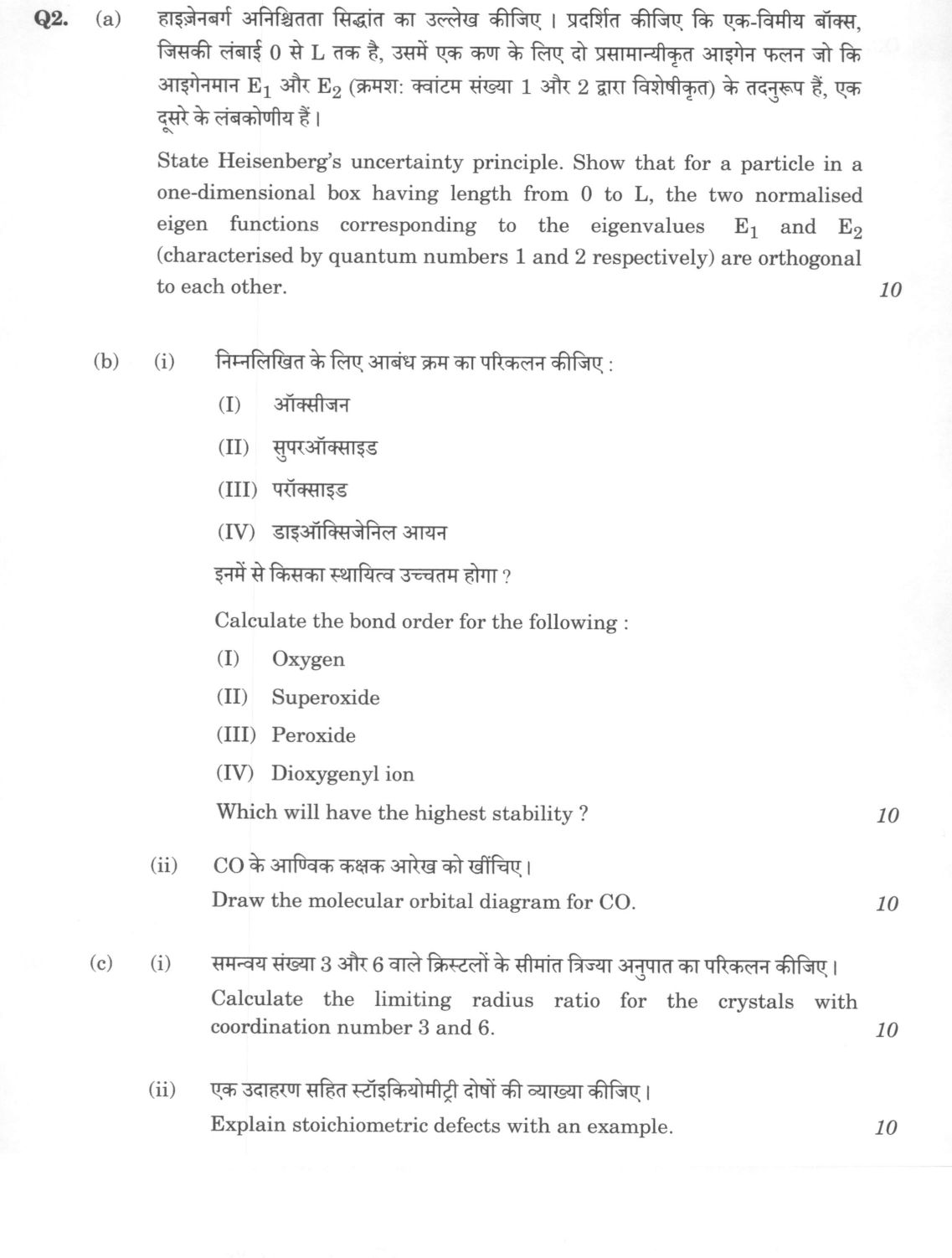
(a) State Heisenberg's uncertainty principle. Show that for a particle in a one-dimensional box having length from 0 to L, the…
State Heisenberg's uncertainty principle. Show that for a particle in a one-dimensional box having length from 0 to L, the two normalised eigen functions corresponding to the eigenvalues E₁ and E₂ (characterised by quantum numbers 1 and 2 respectively) are orthogonal to each other. 10 marks
Calculate the bond order for the following : (I) Oxygen, (II) Superoxide, (III) Peroxide, (IV) Dioxygenyl ion. Which will have the highest stability ? 10 marks
Draw the molecular orbital diagram for CO. 10 marks
Calculate the limiting radius ratio for the crystals with coordination number 3 and 6. 10 marks
Explain stoichiometric defects with an example. 10 marks
हिंदी में प्रश्न पढ़ें
हाइजेनबर्ग अनिश्चितता सिद्धांत का उल्लेख कीजिए । प्रदर्शित कीजिए कि एक-विमीय बॉक्स, जिसकी लंबाई 0 से L तक है, उसमें एक कण के लिए दो प्रसामान्यीकृत आइगेन फलन जो कि आइगेनमान E₁ और E₂ (क्रमशः क्वांटम संख्या 1 और 2 द्वारा विशेषीकृत) के तदनुसार हैं, एक दूसरे के लंबकोणीय हैं । (10 अंक)
निम्नलिखित के लिए आबंध क्रम का परिकलन कीजिए : (I) ऑक्सीजन, (II) सुपरऑक्साइड, (III) परोक्साइड, (IV) डाइऑक्सिजेनिल आयन। इनमें से किसका स्थायित्व उच्चतम होगा ? (10 अंक)
CO के आणविक कक्षक आरेख को खींचिए । (10 अंक)
समन्वय संख्या 3 और 6 वाले क्रिस्टलों के सीमांत त्रिज्या अनुपात का परिकलन कीजिए । (10 अंक)
एक उदाहरण सहित स्टॉइकियोमीट्री दोषों की व्याख्या कीजिए । (10 अंक)
Model answer
Written by UPSC Answer Check against this question's marking rubric, to the expected length. UPSC does not publish answers for Mains — this is one way to score well, not an official key.
(a) Heisenberg’s uncertainty principle states that for a particle it is impossible to determine simultaneously its exact position and exact momentum. Mathematically, Δx Δpₓ ≥ ħ/2, Δy Δp_y ≥ ħ/2, Δz Δp_z ≥ ħ/2, and for energy and time ΔE Δt ≥ ħ/2, where ħ = h/2π. It is valid in quantum mechanics because position and momentum operators do not commute.
For a particle in a one-dimensional box 0 ≤ x ≤ L, the normalised eigenfunctions are ψ₁ = √(2/L) sin(πx/L), ψ₂ = √(2/L) sin(2πx/L). Their orthogonality integral is I = ∫₀ᴸ ψ₁ψ₂ dx = (2/L) ∫₀ᴸ sin(πx/L) sin(2πx/L) dx. Using sin A sin B = 1/2[cos(A−B) − cos(A+B)], with A = πx/L and B = 2πx/L, I = (1/L) ∫₀ᴸ [cos(πx/L) − cos(3πx/L)] dx = (1/L)[(L/π) sin(πx/L) − (L/3π) sin(3πx/L)]₀ᴸ = (1/π)[sin π − sin 0] − (1/3π)[sin 3π − sin 0] = 0. Hence ψ₁ and ψ₂ are orthogonal.
(b)(i) Using molecular orbital theory, bond order = (N_b − N_a)/2, where N_b and N_a are the numbers of electrons in bonding and antibonding molecular orbitals.
- O₂: 16 electrons. Configuration: σ2s² σ*2s² σ2p(z)² π2p(x)² π2p(y)² π*2p(x)¹ π*2p(y)¹. N_b = 8, N_a = 4. Bond order = (8 − 4)/2 = 2.
- Superoxide O₂⁻: 17 electrons. One extra electron enters π*. N_b = 8, N_a = 5. Bond order = (8 − 5)/2 = 1.5.
- Peroxide O₂²⁻: 18 electrons. π* has four electrons. N_b = 8, N_a = 6. Bond order = (8 − 6)/2 = 1.
- Dioxygenyl ion O₂⁺: 15 electrons. One electron is removed from π*. N_b = 8, N_a = 3. Bond order = (8 − 3)/2 = 2.5.
Highest stability: O₂⁺, because it has the highest bond order, 2.5, hence the strongest and shortest bond among the given species.
(b)(ii) CO is a heteronuclear diatomic molecule. Carbon contributes 4 valence electrons and oxygen contributes 6 valence electrons, giving 10 valence electrons; total electrons including cores are 14. The occupied molecular orbital configuration is: (1σ)²(2σ)²(3σ)²(4σ)²(1π)⁴(5σ)². Valence configuration: (3σ)²(4σ)²(1π)⁴(5σ)². Bond order = (8 − 2)/2 = 3. The HOMO is 5σ, mainly carbon lone-pair character; the LUMO is 2π*.
Schematic MO diagram, energy increasing upward:
- 2π*: empty (LUMO)
- 5σ: ↑↓ (HOMO)
- 1π: ↑↓ ↑↓
- 4σ: ↑↓
- 3σ: ↑↓
- 2σ: ↑↓, mainly C 1s core
- 1σ: ↑↓, mainly O 1s core
Carbon 2s and 2p orbitals mix with oxygen 2s and 2p orbitals to form these MOs; oxygen atomic levels lie lower because oxygen is more electronegative.
(c)(i) Let r be cation radius and R be anion radius. At the limiting radius ratio, cation touches all anions and anions just touch each other.
For coordination number 3, the arrangement is trigonal planar. Distance from centre to each anion = r + R. For an equilateral triangle, side = √3(r + R). At the limit, anion–anion distance = 2R. Hence 2R = √3(r + R), so r/R = 2/√3 − 1 = (2√3 − 3)/3 ≈ 0.155.
For coordination number 6, the arrangement is octahedral. Distance from centre to each anion = r + R. Edge length between adjacent anions = √2(r + R). At the limit, edge = 2R. Hence 2R = √2(r + R), so r/R = √2 − 1 ≈ 0.414.
These values assume hard-sphere ions and ideal close contact.
(c)(ii) Stoichiometric defects are point defects in ionic crystals that do not change the stoichiometric ratio of cations to anions. They preserve electrical neutrality and the chemical formula of the crystal. The main types are:
- Schottky defect: Equal numbers of cation and anion vacancies are created. This occurs in highly ionic crystals with cations and anions of similar size and high coordination number, e.g. NaCl, KCl, CsCl. Density decreases, and ionic conductivity increases.
- Frenkel defect: A smaller ion, usually a cation, leaves its normal lattice site and occupies an interstitial site, leaving a vacancy. Stoichiometry is unchanged. It occurs when cations and anions differ greatly in size and coordination number is low, e.g. ZnS, AgCl, AgBr. Density remains almost unchanged.
Both are stoichiometric because an equal number of missing and displaced or vacant sites maintain the original cation–anion ratio.
What "Solve" is asking you to do
Choose the method, then carry it through to a final answer. Identifying what kind of problem this is and why that method applies is the first thing marked; a correct figure arrived at invisibly earns almost nothing.
Structure that answers it
Given data and what is required → method chosen, with the reason it applies → set-up (equation, circuit, free body, trial balance) → working, step by step → answer with units and any condition of validity
Where marks are lost
Doing the middle steps mentally and writing only the result. In mathematics papers, a further loss comes from giving a decimal where the exact value in surds or fractions was wanted, or from skipping the justification a part explicitly asks for.
How this answer will be evaluated
Approach
(a) derive: given > assumptions > stepwise derivation > result > check | (b(i)) calculate: given > formula > substitution > result with units > interpretation | (b(ii)) describe: define > structure or process in order > labelled diagram > significance | (c(i)) calculate: given > formula > substitution > result with units > interpretation | (c(ii)) explain: definition/context > points in order > small example > short close Full marks: Full derivations, correct diagrams, and clear reasoning for all parts.
Key points expected
- State ΔxΔp ≥ ħ/2
- Write normalized ψ₁ and ψ₂
- Set up integral ∫₀ᴸ ψ₁ψ₂ dx
- Evaluate integral to show zero
- Correct electron count for each
- Apply BO = (Nb-Na)/2
- Calculate values 2, 1.5, 1, 2.5
- Identify O₂⁺ as most stable
Evaluation rubric
Each sub-part is marked on its own, against the marks and word limit printed on the paper.
- (a) State Heisenberg's principle and prove orthogonality of eigenfunctions for a 1D box. 10 marks
derive— given → assumptions → stepwise derivation → result → check
Must cover
- State ΔxΔp ≥ ħ/2
- Write normalized ψ₁ and ψ₂
- Set up integral ∫₀ᴸ ψ₁ψ₂ dx
- Evaluate integral to show zero
Loses marks
- Missing normalization factor 2/L
- Incorrect limits of integration
Earns more
- Explicitly show sin(nπx/L) integration
- Mention boundary conditions
Extra mark
- General proof for n≠m
- (b(i)) Calculate bond order for O₂, O₂⁻, O₂²⁻, O₂⁺ and identify most stable. 10 marks
calculate— given → formula → substitution → result with units → interpretation
Must cover
- Correct electron count for each
- Apply BO = (Nb-Na)/2
- Calculate values 2, 1.5, 1, 2.5
- Identify O₂⁺ as most stable
Loses marks
- Wrong electron count
- Confusing bonding/antibonding orbitals
Earns more
- Show MO configuration for one species
- Mention paramagnetism
Extra mark
- Correlate bond length with BO
- (b(ii)) Draw the molecular orbital energy level diagram for CO. 10 marks
describe— define → structure or process in order → labelled diagram → significance
Must cover
- Show C and O atomic orbitals
- Correct MO energy ordering
- Fill 10 valence electrons
- Label HOMO and LUMO
Loses marks
- Wrong orbital ordering (e.g. N₂ vs O₂)
- Missing labels
Earns more
- Indicate σ/π symmetry
- Show slight energy difference C vs O
Extra mark
- Mention dipole direction
- (c(i)) Derive limiting radius ratios for coordination numbers 3 and 6. 10 marks
calculate— given → formula → substitution → result with units → interpretation
Must cover
- Draw geometry for CN=3 (triangular)
- Derive ratio 0.155
- Draw geometry for CN=6 (octahedral)
- Derive ratio 0.414
Loses marks
- Missing geometric derivation
- Wrong final values
Earns more
- Show geometric construction
- State stability condition
Extra mark
- Mention CN=4 or CN=8
- (c(ii)) Define stoichiometric defects and provide an example. 10 marks
explain— definition/context → points in order → small example → short close
Must cover
- Define stoichiometric defect
- Explain Schottky defect
- Explain Frenkel defect
- Give specific example (e.g. NaCl)
Loses marks
- Confusing with non-stoichiometric
- No example given
Earns more
- Mention density change
- Distinguish ionic vs covalent
Extra mark
- Mention F-centers
Practice this exact question
Write your answer and it is marked point by point against the model answer above — what you covered, what you missed, what you got wrong.
Evaluate my answer →More from Chemistry 2024 Paper I
- Q1 (a) (i) Determine the distance from the nucleus at which the electron is most expected in…
- Q2 (a) State Heisenberg's uncertainty principle. Show that for a particle in a one-dimension…
- Q3 (a) (i) Calculate the coefficient of viscosity of air at temperatures : (I) 298 K and (II…
- Q4 (a) A new drug has been synthesized and its phase diagram is explored. It is found that n…
- Q5 (a) Indicating 'Fluorescence' and 'Phosphorescence' processes in Jablonski diagram, disti…