Paper I — Q8
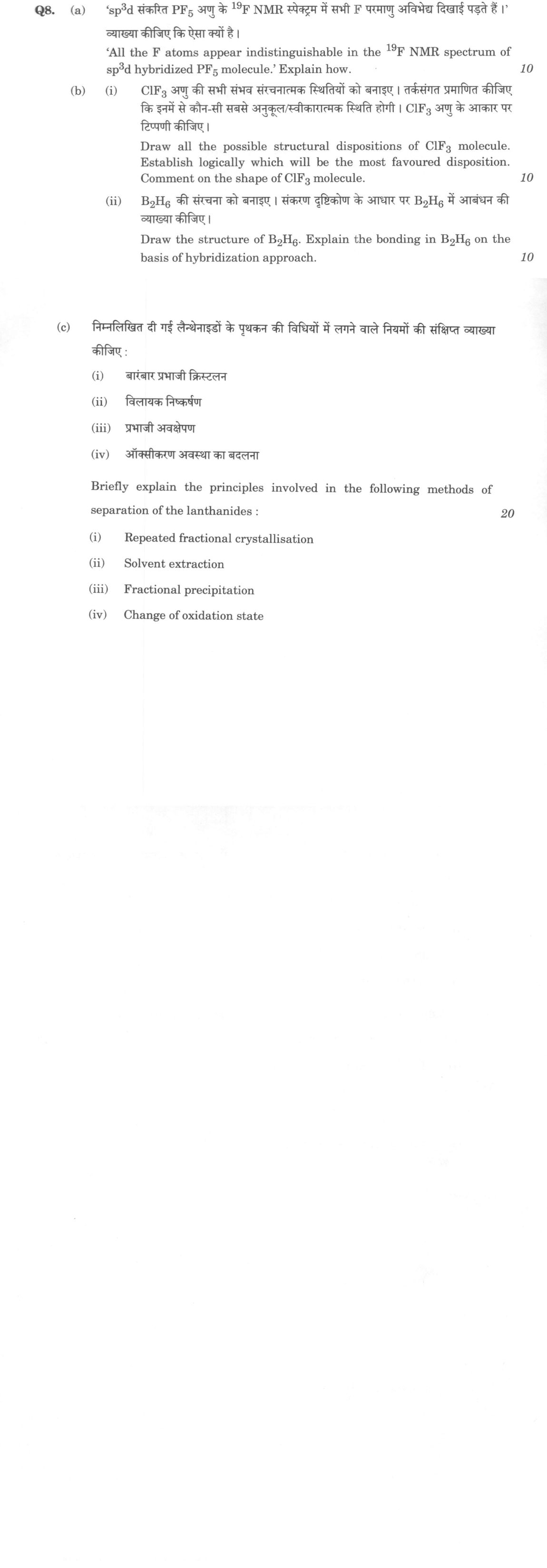
(a) 'All the F atoms appear indistinguishable in the ¹⁹F NMR spectrum of sp³d hybridized PF₅ molecule.' Explain how. (10…
'All the F atoms appear indistinguishable in the ¹⁹F NMR spectrum of sp³d hybridized PF₅ molecule.' Explain how. 10 marks
Draw all the possible structural dispositions of ClF₃ molecule. Establish logically which will be the most favoured disposition. Comment on the shape of ClF₃ molecule. 10 marks
Draw the structure of B₂H₆. Explain the bonding in B₂H₆ on the basis of hybridization approach. 10 marks
Briefly explain the principles involved in the following methods of separation of the lanthanides : (20 marks) Repeated fractional crystallisation
Solvent extraction
Fractional precipitation
Change of oxidation state
हिंदी में प्रश्न पढ़ें
'sp³d संकरित PF₅ अणु के ¹⁹F NMR स्पेक्ट्रम में सभी F परमाणु अविभेद्य दिखाई पड़ते हैं ।' व्याख्या कीजिए कि ऐसा क्यों है । (10 अंक)
ClF₃ अणु की सभी संभव संरचनात्मक स्थितियों को बनाइए । तर्कसंगत प्रमाणित कीजिए कि इनमें से कौन-सी सबसे अनुकूल/स्वीकारात्मक स्थिति होगी । ClF₃ अणु के आकार पर टिप्पणी कीजिए । (10 अंक)
B₂H₆ की संरचना को बनाइए । संकरण दृष्टिकोण के आधार पर B₂H₆ में आबंधन की व्याख्या कीजिए । (10 अंक)
निम्नलिखित दी गई लैन्थेनाइडों के पृथक्कन की विधियों में लगने वाले नियमों की संक्षिप्त व्याख्या कीजिए : (20 अंक) बारंबार प्रभाजी क्रिस्टलन
विलायक निष्कर्षण
प्रभाजी अवक्षेपण
ऑक्सीकरण अवस्था का बदलना
Model answer
Written by UPSC Answer Check against this question's marking rubric, to the expected length. UPSC does not publish answers for Mains — this is one way to score well, not an official key.
PF₅. In a static sp³d-hybridized trigonal-bipyramidal PF₅ molecule the two axial and three equatorial fluorines are not equivalent, so ¹⁹F NMR would show two resonances in a 2:3 ratio. Berry pseudorotation moves one axial fluorine through an equatorial position while two equatorial fluorines become axial, rapidly permuting all five sites. At ordinary temperatures the exchange is faster than the NMR timescale, so every fluorine experiences the same averaged environment and gives one sharp ¹⁹F signal. At low temperature the motion slows, separate axial and equatorial signals appear, and on warming they coalesce into the single room-temperature resonance.
ClF₃ dispositions. ClF₃ has five electron domains around chlorine: three bond pairs (BP) and two lone pairs (LP). In a trigonal bipyramid the LPs can be placed in three ways: both axial; one axial and one equatorial; or both equatorial. If both LPs are axial, the three fluorines are equatorial; there are six 90° LP–BP interactions and no 90° BP–BP interactions. If one LP is axial and one equatorial, there is one 90° LP–LP interaction, three 90° LP–BP interactions and two 90° BP–BP interactions. If both LPs are equatorial, there are four 90° LP–BP interactions and two 90° BP–BP interactions, but no 90° LP–LP interaction. Since 90° LP–LP repulsion is the most severe, the mixed disposition is least stable. Between the remaining two, the all-equatorial LP arrangement has fewer 90° LP–BP repulsions and is therefore most favoured. The three fluorines then occupy two axial and one equatorial positions, giving a T-shaped ClF₃ molecule with an axial F–Cl–F angle of about 180° and axial-equatorial angles near 90°.
B₂H₆. Diborane contains two boron atoms joined by two bridging hydrogen atoms; each boron also carries two terminal hydrogens. Each boron is sp³ hybridized. Two sp³ hybrids on each boron overlap with 1s orbitals of terminal hydrogen atoms to form four ordinary two-centre two-electron B–H bonds. The remaining two sp³ hybrids on the two boron atoms overlap with the 1s orbitals of the two bridging hydrogen atoms to form two three-centre two-electron B–H–B bonds. Each bridge has only two electrons shared by three atoms, the characteristic electron-deficient bonding of diborane. The twelve valence electrons are thus accounted for as eight in the four terminal bonds and two in each bridge.
Lanthanide separation. (i) Repeated fractional crystallisation uses the very small but systematic solubility differences of lanthanide double salts, classically magnesium ammonium nitrates of the Ce-group and Y-group. Because ionic radius changes slightly across the series, lattice energies and solubilities change slightly; on crystallisation the less soluble fraction is enriched, and repeated recrystallisation magnifies the separation. (ii) Solvent extraction uses an organic extractant such as TBP or D2EHPA in kerosene to form extractable lanthanide complexes from aqueous nitrate or acidic solution. The distribution coefficient, the ratio of metal concentration in organic and aqueous phases, varies systematically with ionic radius, from La³⁺ about 1.03 Å to Lu³⁺ about 0.86 Å, so counter-current extraction and selective stripping separate the ions. Indian Rare Earths Ltd’s Aluva/Udyogamandal plant uses such extraction for monazite leach liquor. (iii) Fractional precipitation uses oxalates or hydroxides under controlled pH. The solubility products of lanthanide oxalates/hydroxides vary with ionic radius and basicity across the series; as pH or oxalate concentration is adjusted, one end of the series precipitates preferentially and repeated precipitation enriches fractions. (iv) Change of oxidation state exploits the exceptional stability of Ce⁴⁺ and Eu²⁺. Most lanthanides remain trivalent, but Ce can be oxidised to Ce⁴⁺, which has different solubility, complexation and ion-exchange behaviour, while Eu can be reduced to Eu²⁺, stabilised by its half-filled 4f⁷ configuration. In Indian monazite sand processing, Ce(IV) and Eu(II) species can therefore be separated from the trivalent lanthanides. Thus each method works because a small electronic, steric or redox difference is amplified by repeated physical or chemical operations.
What "Explain" is asking you to do
Make the working of something clear — what sets it off, what follows from what, and what it produces. Explain is the Commission's mechanism word: it dominates the technical papers and the “explain why” stems, where the marks sit in the causal chain and not in the label.
Structure that answers it
State what it is → the initiating condition → the chain of cause, step by step → an instance where it plays out → what the chain produces
Where marks are lost
Describing what something looks like instead of why it works that way. Naming the stages without linking them reads as description too.
How this answer will be evaluated
Approach
(a) explain: definition/context > points in order > small example > short close | (b(i)) comment: context > arguments both sides > judgment > close | (b(ii)) explain: definition/context > points in order > small example > short close | (c(i)) explain: definition/context > points in order > small example > short close | (c(ii)) explain: definition/context > points in order > small example > short close | (c(iii)) explain: definition/context > points in order > small example > short close | (c(iv)) explain: definition/context > points in order > small example > short close Full marks: All parts answered with correct mechanisms, structures, and principles; clear diagrams and logical reasoning.
Key points expected
- Identify trigonal bipyramidal geometry of PF5
- Distinguish axial and equatorial F positions
- Explain rapid Berry pseudorotation mechanism
- State that exchange is faster than NMR timescale
- Draw all possible structural dispositions of ClF3
- Identify T-shaped structure as most favoured
- Justify using VSEPR theory (minimizing repulsion)
- State that lone pairs occupy equatorial positions
Evaluation rubric
Each sub-part is marked on its own, against the marks and word limit printed on the paper.
- (a) Explain why all F atoms are indistinguishable in the 19F NMR spectrum of PF5. 10 marks
explain— definition/context → points in order → small example → short close
Must cover
- Identify trigonal bipyramidal geometry of PF5
- Distinguish axial and equatorial F positions
- Explain rapid Berry pseudorotation mechanism
- State that exchange is faster than NMR timescale
Loses marks
- Claiming static equivalence without mentioning dynamics
- Confusing NMR timescale with chemical shift
Earns more
- Mention sp3d hybridization of central P atom
- Describe the 90° and 120° bond angles
- Note that all F atoms become equivalent on average
Extra mark
- Draw the transition state of Berry pseudorotation
- (b(i)) Draw ClF3 dispositions, identify the most favoured one, and comment on its shape. 10 marks
comment— context → arguments both sides → judgment → close
Must cover
- Draw all possible structural dispositions of ClF3
- Identify T-shaped structure as most favoured
- Justify using VSEPR theory (minimizing repulsion)
- State that lone pairs occupy equatorial positions
Loses marks
- Failing to draw all possible dispositions
- Incorrectly placing lone pairs in axial positions
Earns more
- Mention 5 electron pairs around Cl (3 bonds, 2 lone pairs)
- Explain why linear or bent structures are less stable
- Note the bond angles are slightly less than 90° and 180°
Extra mark
- Draw the transition state for pseudorotation in ClF3
- (b(ii)) Draw B2H6 structure and explain its bonding using hybridization approach. 10 marks
explain— definition/context → points in order → small example → short close
Must cover
- Draw the bridged structure of B2H6
- Identify 2 terminal B-H bonds and 2 bridging B-H-B bonds
- Explain sp3 hybridization of B atoms
- Describe 3-center-2-electron (3c-2e) bonds for bridges
Loses marks
- Drawing a linear or planar structure for B2H6
- Failing to mention 3-center-2-electron bonding
Earns more
- Mention electron-deficient nature of B2H6
- Explain that each B uses 4 sp3 orbitals
- Note that terminal bonds are normal 2c-2e bonds
Extra mark
- Draw the molecular orbital diagram for the 3c-2e bond
- (c(i)) Explain the principle of repeated fractional crystallisation for lanthanide separation.
explain— definition/context → points in order → small example → short close
Must cover
- State that it relies on slight differences in solubility
- Explain that repeated cycles amplify small differences
- Mention that it is effective for small-scale separation
Loses marks
- Confusing with simple crystallisation
- Failing to mention the role of repeated cycles
Earns more
- Give an example of a salt used (e.g., oxalates or nitrates)
- Note that it is time-consuming but simple
Extra mark
- Mention specific lanthanides separated by this method
- (c(ii)) Explain the principle of solvent extraction for lanthanide separation.
explain— definition/context → points in order → small example → short close
Must cover
- State that it uses differential distribution between two phases
- Explain that organic extractants selectively bind lanthanides
- Mention that it is efficient for large-scale separation
Loses marks
- Confusing with liquid-liquid extraction without selectivity
- Failing to mention the role of extractants
Earns more
- Name a common extractant (e.g., HDEHP or TBP)
- Explain the role of pH and ionic strength
- Note that it allows continuous processing
Extra mark
- Draw a schematic of a counter-current extraction column
- (c(iii)) Explain the principle of fractional precipitation for lanthanide separation.
explain— definition/context → points in order → small example → short close
Must cover
- State that it relies on differences in solubility products
- Explain that selective precipitation occurs with reagents
- Mention that it is less efficient than other methods
Loses marks
- Confusing with fractional crystallisation
- Failing to mention solubility product differences
Earns more
- Give an example of a precipitating agent (e.g., oxalic acid)
- Note that it is useful for preliminary separation
Extra mark
- Mention specific lanthanides that precipitate first
- (c(iv)) Explain the principle of change of oxidation state for lanthanide separation.
explain— definition/context → points in order → small example → short close
Must cover
- State that it exploits different redox potentials
- Explain that some lanthanides can be oxidized/reduced
- Mention that it is useful for specific pairs (e.g., Ce, Eu)
Loses marks
- Claiming all lanthanides can be separated this way
- Failing to mention specific examples
Earns more
- Give an example: Ce(III) to Ce(IV) or Eu(III) to Eu(II)
- Note that it requires specific redox conditions
Extra mark
- Mention the use of ion exchange after redox change
Practice this exact question
Write your answer and it is marked point by point against the model answer above — what you covered, what you missed, what you got wrong.
Evaluate my answer →More from Chemistry 2024 Paper I
- Q5 (a) Indicating 'Fluorescence' and 'Phosphorescence' processes in Jablonski diagram, disti…
- Q6 (a) (i) Calculate the number of moles of HCl (g) produced by the absorption of one Joule…
- Q7 (a) Show the splitting of 'd' orbitals in square planar field according to Crystal Field…
- Q8 (a) 'All the F atoms appear indistinguishable in the ¹⁹F NMR spectrum of sp³d hybridized…