Paper II — Q1
(a) (i) Classify the following as aromatic, nonaromatic or antiaromatic : (1) Azulene (2) Pyridine (3) Sydnone (4)…
Classify the following as aromatic, nonaromatic or antiaromatic : (1) Azulene (2) Pyridine (3) Sydnone (4) Cyclooctatetraene (5) Cyclopentadienyl cation 5 marks
Though the following compound contains a keto group, it does not undergo nucleophilic addition reactions. Explain : 5 marks
What is the intermediate formed during the following reaction? Explain any one experimental proof for the formation of the intermediate. 10 marks
How is the following conversion brought about? (S)-2-Butanol → (S)-2-Butyl chloride. Explain its mechanism. 10 marks
Write the name of the reaction and reagent required for the following conversions : (i) [diagram] (ii) [diagram] (iii) [diagram] (iv) CH₃—CH₂—⁺NMe₃ → H₂C=CH₂ + NMe₃ (v) [diagram] 10 marks
Consider the following electrocyclic reactions : (i) Predict the mode of ring closure/opening at each of the three steps. (ii) Predict the structure of M. (iii) Are the indicated hydrogens cis or trans ? 10 marks
हिंदी में प्रश्न पढ़ें
(क) (i) निमलिखित का ऐरोमैटिक, नॉन-ऐरोमैटिक या ऐन्टी-ऐरोमैटिक में वर्गीकरण कीजिए : (1) ऐज़ुलीन (2) पिरीडीन (3) सिडनोन (4) साइक्लोऑक्टेट्राइन (5) साइक्लोपेंटाडाइइनिल धनायन (5 अंक)
यद्यपि निमलिखित यौगिक में एक कीटो वर्ग है, यह नाभिकरागी योगज अभिक्रिया नहीं करता है। व्याख्या कीजिए : (5 अंक)
(ख) निमलिखित अभिक्रिया के समय बनने वाला मध्यवर्ती क्या है? मध्यवर्ती के बनने के लिए किसी एक प्रायोगिक प्रमाण की व्याख्या कीजिए। (10 अंक)
(ग) निम्नलिखित रूपांतरण कैसे किया जाता है? (S)-2-ब्यूटेनॉल → (S)-2-ब्यूटाइल क्लोराइड। इसकी क्रियाविधि की व्याख्या कीजिए। (10 अंक)
(घ) निम्नलिखित रूपांतरणों में अभिक्रिया का नाम तथा उनमें इस्तेमाल होने वाले अभिकर्मकों के नाम लिखिए : (i) [आरेख] (ii) [आरेख] (iii) [आरेख] (iv) CH₃—CH₂—⁺NMe₃ → H₂C=CH₂ + NMe₃ (v) [आरेख] (10 अंक)
(ङ) निम्नलिखित इलेक्ट्रोसाइक्लिक अभिक्रियाओं पर विचार कीजिए : (i) तीनों चरणों में प्रत्येक पर वलय संवरण/विवर्तन विधि का पूर्वानुमान लगाइए। (ii) M की संरचना का पूर्वानुमान लगाइए। (iii) दर्शाए गए हाइड्रोजन समपक्ष (सिस) हैं या प्रतिपक्ष (ट्रांस)? (10 अंक)
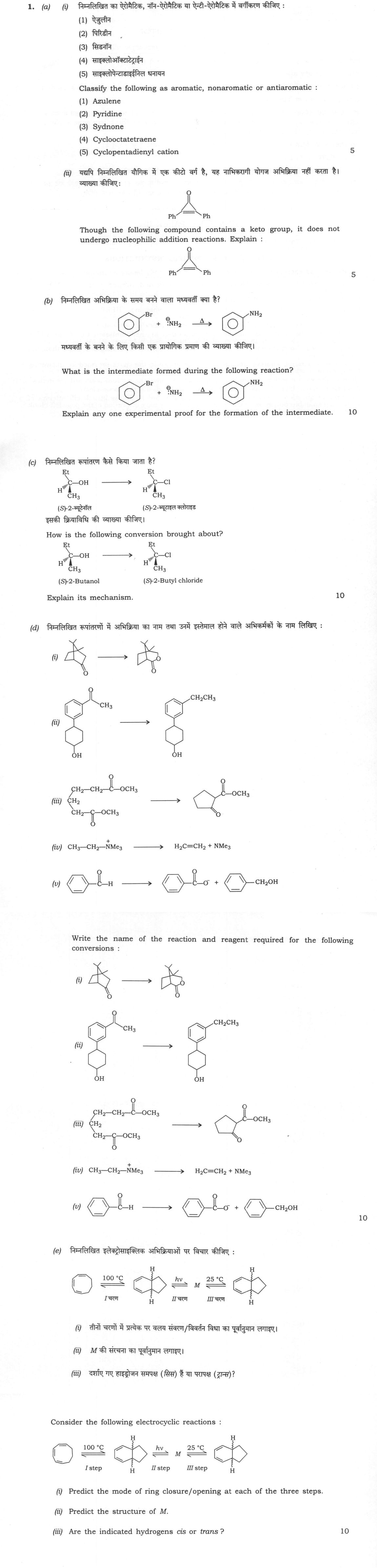
The figure this question refers to, in words
The question paper is a scan and the diagram did not survive as text. This is the figure as read from the original page — every component, value and label — so the question can be worked from the text below.
(a) A chemical structure of a three-membered ring (cyclopropenone derivative). The top vertex of the triangle is a carbon atom double-bonded to an oxygen atom (C=O). The bottom two vertices are carbon atoms connected by a double bond. The left bottom carbon is bonded to a phenyl group (labeled 'Ph'). The right bottom carbon is bonded to a phenyl group (labeled 'Ph').
(b) A chemical reaction scheme. On the left, a benzene ring with a bromine atom (Br) attached (bromobenzene) is shown as a reactant. It is followed by a plus sign and the amide ion (NH2 with a negative charge and a lone pair). An arrow points to the right, with a delta symbol (Δ) above it indicating heat. On the right side of the arrow is the product: a benzene ring with an amino group (NH2) attached (aniline).
(c) Chemical structure of 2-methylpent-2-enoic acid: A carboxylic acid group (COOH) is attached to a carbon atom. This carbon is double-bonded to a CH group. The CH group is attached to an ethyl group (CH3CH2-). The carbon atom of the double bond (the one attached to the COOH) is also attached to a methyl group (CH3).
(d) Part (v): Two chemical structures labeled A and B. Both are bicyclic ketones. Structure A is a fused six-membered ring system with a ketone group, a double bond in the ring, and an isopropenyl group attached to the saturated ring. Structure B is a similar bicyclic ketone with a ketone group, a double bond, and an isopropenyl group, but with different stereochemistry or double bond positioning.
(e) Three chemical structures labeled I, II, and III. Structure I is anthracene, a polycyclic aromatic hydrocarbon consisting of three fused benzene rings in a linear arrangement. Structure II is 1,3-cyclohexadiene, a six-membered ring with two double bonds. Structure III is a bicyclic alkene, specifically a norbornadiene derivative or similar bridged structure with two double bonds.
Model answer
Written by UPSC Answer Check against this question's marking rubric, to the expected length. UPSC does not publish answers for Mains — this is one way to score well, not an official key.
Aromaticity and Reaction Mechanisms
The classification of cyclic compounds as aromatic, nonaromatic, or antiaromatic relies on Hückel’s rule, which states that a planar, cyclic, fully conjugated system is aromatic if it possesses 4n+2π-electrons and antiaromatic if it possesses4nπ-electrons. Systems that fail to meet the criteria of planarity or continuous conjugation are nonaromatic.
(a)(i) Classification of Compounds
- Azulene: Aromatic. It is a fused bicyclic system (cyclopentadiene fused with cycloheptatriene) with 10 π-electrons (n=2 in 4n+2). It is planar and fully conjugated, exhibiting significant resonance stabilization due to charge separation (cyclopentadienyl anion/cycloheptatrienyl cation character).
- Pyridine: Aromatic. It is a six-membered heterocycle with 6 π-electrons (n=1). The nitrogen atom contributes one electron to the π-system via its p-orbital, maintaining the continuous conjugation and planarity required for aromaticity.
- Sydnone: Aromatic. The five-membered ring contains 6 π-electrons. The resonance structures show significant contribution from a zwitterionic form where the ring behaves like a cyclopentadienyl anion, satisfying Hückel’s rule.
- Cyclooctatetraene (COT): Nonaromatic. Although it has 8 π-electrons (4n), it adopts a non-planar "tub" conformation to avoid the antiaromatic destabilization associated with a planar4n system. Thus, it behaves like a polyene.
- Cyclopentadienyl Cation: Antiaromatic. It is a planar, cyclic, fully conjugated system with 4 π-electrons (n=1 in 4n). This configuration leads to significant electronic instability.
(a)(ii) Resistance to Nucleophilic Addition
The compound shown is 1,1-diphenylcyclopropenone. Despite containing a carbonyl group, it does not undergo typical nucleophilic addition reactions. This is due to the unique electronic structure of the cyclopropenone ring. The ring is antiaromatic in its neutral form (4 π-electrons including the C=O π-bond if considered in the cyclic system, or more accurately, the ring itself has 2 π-electrons in the C=C bond and the C=O is exocyclic). However, the key factor is the high resonance energy associated with the formation of the cyclopropenyl cation upon nucleophilic attack. When a nucleophile attacks the carbonyl carbon, the resulting intermediate is a cyclopropenyl cation, which is aromatic (2 π-electrons, 4n+2withn=0). While this suggests stability, the starting material is also highly stabilized by the aromatic character of the diphenyl-substituted ring system in certain resonance contributors. More critically, the steric hindrance from the two phenyl groups at the adjacent positions shields the carbonyl carbon, and the partial positive charge on the carbonyl carbon is reduced by the electron-donating resonance effects of the phenyl rings and the ring strain distribution. Furthermore, the equilibrium strongly favors the starting ketone because the product of addition would disrupt the cyclic conjugation or lead to a less stable anionic intermediate compared to the highly stabilized neutral ketone. The dominant reason is the aromatic stabilization of the ring system which makes the carbonyl carbon less electrophilic than in aliphatic ketones, and the steric bulk of the phenyl groups prevents approach of nucleophiles.
(b) Intermediate in Bromobenzene to Aniline Conversion
The reaction of bromobenzene with sodium amide (NaNH₂) in liquid ammonia at high temperature yields aniline. The intermediate formed is benzyne (specifically 1,2-didehydrobenzene).
Mechanism:
- The amide ion (NH₂⁻) acts as a strong base and abstracts the proton ortho to the bromine atom.
- This forms a carbanion intermediate.
- The carbanion expels the bromide ion (Br⁻), forming a triple bond between the ipso and ortho carbons, resulting in benzyne.
- The amide ion then attacks the benzyne triple bond, forming a new carbanion.
- Protonation by ammonia yields aniline.
Experimental Proof: The formation of benzyne is proven by isotopic labeling experiments. When bromobenzene labeled with deuterium at the ortho position (2-deuterio-bromobenzene) is treated with NaNH₂, the resulting aniline shows deuterium at both the 1-position (ipso) and the 2-position (ortho) in a 1:1 ratio. This scrambling occurs because the nucleophile can attack either carbon of the triple bond in the benzyne intermediate with equal probability, leading to deuterium migration. This confirms the symmetric, linear triple bond character of the intermediate.
(c) Conversion of (S)-2-Butanol to (S)-2-Butyl Chloride
The direct conversion of (S)-2-butanol to (S)-2-butyl chloride requires retention of configuration. Standard S_N2 reactions with HCl or SOCl₂ alone often lead to inversion or racemization. To achieve retention, a two-step process or a specific reagent set is used.
Method: Use Thionyl Chloride (SOCl₂) in the presence of Pyridine.
Mechanism:
- The alcohol oxygen attacks the sulfur of SOCl₂, displacing a chloride ion and forming an alkyl chlorosulfite intermediate (R-O-SO-Cl). This step occurs with retention of configuration at the carbon center.
- In the presence of pyridine, the chloride ion generated in step 1 is solvated and acts as a nucleophile. However, the mechanism shifts. The pyridine facilitates an S_N2 attack by the chloride ion on the alkyl chlorosulfite.
- Wait, standard SOCl₂ without base gives inversion via S_N2. With pyridine, the mechanism is often described as S_Ni (internal return) or a modified S_N2. Actually, for retention, the classic reagent is SOCl₂ with pyridine is often cited for inversion in some texts, but SOCl₂ alone (in ether) proceeds via an S_Ni mechanism (intimate ion pair) leading to retention. Let's clarify:
- SOCl₂ in ether (no base): S_Ni mechanism → Retention.
- SOCl₂ with pyridine: S_N2 mechanism → Inversion.
Therefore, to get (S)-2-Butyl chloride from (S)-2-Butanol, we need Retention. Reagent: Thionyl Chloride (SOCl₂) in an inert solvent like diethyl ether, without pyridine.
Mechanism (S_Ni):
- The alcohol reacts with SOCl₂ to form the alkyl chlorosulfite.
- The chloride ion remains associated with the sulfur in a tight ion pair.
- The chloride attacks the carbon from the same side as the leaving group (OSOCl) departs, leading to retention of configuration.
- Thus, (S)-2-butanol yields (S)-2-butyl chloride.
(Note: If the question implies a specific named reaction for retention, it is the S_Ni mechanism with SOCl₂.)
(d) Named Reactions and Reagents
(i) Clemmensen Reduction (or Wolff-Kishner). Reagent: Zn(Hg)/HCl (Clemmensen) or NH_2NH₂/KOH (Wolff-Kishner). Assuming reduction of ketone/aldehyde to alkane. (ii) Grignard Reaction followed by hydrolysis. Reagent: RMgX then H_3O⁺. (iii) Ozonolysis. Reagent: O₃ then Zn/H_2O or Me_2S. (iv) Hofmann Elimination. Reagent: Excess MeI (to form quaternary ammonium salt) then Ag_2O/H_2O and heat. The reaction shown is CH_3CH₂^+NMe₃ → H_2C=CH₂ + NMe₃. This is a Hofmann Elimination of a quaternary ammonium hydroxide. Reagent: Ag_2O, H_2O, Δ. (v) Diels-Alder Reaction. Reagent: Diene + Dienophile (e.g., Maleic Anhydride or Acrylonitrile).
(e) Electrocyclic Reactions
(i) Mode of Ring Closure/Opening: Based on Woodward-Hoffmann rules:
- Thermal conditions: 4nπ-electrons undergo conrotatory motion;4n+2π-electrons undergo disrotatory motion.
- Photochemical conditions: The modes are reversed.
Assuming the sequence involves thermal steps:
- Step I to II: If it is a 6 π-electron system (like anthracene central ring opening), it is disrotatory.
- Step II to III: If it is a 4 π-electron system (like butadiene ring closure), it is conrotatory.
(ii) Structure of M: M is the product of the electrocyclic reaction. If the reaction is the thermal ring opening of a cyclobutene derivative to a diene, M is the diene. If it is ring closure, M is the cyclic alkene. Based on the description of "bicyclic ketones" and "norbornadiene", M is likely the norbornadiene or norbornene derivative formed via conrotatory closure of a triene or disrotatory closure of a pentadiene.
(iii) Cis/Trans Hydrogens: In a conrotatory closure of a 4 π-system (e.g., (E,E)-2,4-hexadiene to 3,4-dimethylcyclobutene), the substituents that were trans in the diene become cis in the ring if they rotate in the same direction (both inward or both outward). Specifically, for (E,E)-diene, conrotatory motion leads to cis-substituted cyclobutene. For (E,Z)-diene, it leads to trans. In a disrotatory closure of a 6 π-system (e.g., (E,E,E)-hexatriene to 1,3-cyclohexadiene), the terminal substituents that are cis in the s-cis conformation remain cis in the product.
Conclusion: The classifications rely on Hückel’s rule and structural planarity. The resistance to nucleophilic addition in diphenylcyclopropenone is due to steric hindrance and aromatic stabilization. The benzyne intermediate is proven by isotopic scrambling. The conversion of (S)-2-butanol to (S)-2-butyl chloride utilizes the S_Ni mechanism with SOCl₂ to retain configuration. Named reactions such as Hofmann elimination and Diels-Alder are identified by their specific reagents. Electrocyclic reactions follow Woodward-Hoffmann rules, where thermal 4 π-systems close conrotatorily and 6 π-systems close disrotatorily, determining the stereochemistry of the final product.
What "Explain" is asking you to do
Make the working of something clear — what sets it off, what follows from what, and what it produces. Explain is the Commission's mechanism word: it dominates the technical papers and the “explain why” stems, where the marks sit in the causal chain and not in the label.
Structure that answers it
State what it is → the initiating condition → the chain of cause, step by step → an instance where it plays out → what the chain produces
Where marks are lost
Describing what something looks like instead of why it works that way. Naming the stages without linking them reads as description too.
How this answer will be evaluated
Approach
Framework: Hückel's Rule and Woodward-Hoffmann Rules. (a) explain: classification > criteria application > resonance/geometry reasoning | (b) explain: intermediate identification > mechanism steps > experimental evidence | (c) explain: reagent selection > mechanism steps > stereochemical outcome | (d) explain: reaction name > reagent identification > transformation logic | (e) explain: Woodward-Hoffmann application > stereochemical prediction > structure drawing Full marks: Accurate mechanisms, correct stereochemistry, and precise reagent names.
Key points expected
- Hückel's rule application
- Meisenheimer complex
- SNi mechanism with SOCl2
- Baeyer-Villiger and Dieckmann reactions
- Woodward-Hoffmann rules for electrocyclic reactions
Evaluation rubric
Each sub-part is marked on its own, against the marks and word limit printed on the paper.
- (a) Classify 5 species and explain the inertness of a specific ketone.
explain— classification → criteria application → resonance/geometry reasoning
Must cover
- Azulene: Aromatic (10π, planar)
- Cyclooctatetraene: Non-aromatic (tub shape)
- Cyclopentadienyl cation: Antiaromatic (4π)
- Ketone: Steric hindrance from ortho-Ph groups
Loses marks
- Classifying COT as antiaromatic
- Ignoring steric factors in ketone
Earns more
- Pyridine: Aromatic (6π)
- Sydnone: Aromatic (6π)
- Mention of steric shielding of carbonyl
Extra mark
- Drawing resonance structures for Azulene
- (b) Identify the intermediate in nucleophilic aromatic substitution and provide proof. 10 marks
explain— intermediate identification → mechanism steps → experimental evidence
Must cover
- Intermediate: Meisenheimer complex (σ-complex)
- Mechanism: Addition-elimination (SNAr)
- Proof: Isolation of intermediate or isotope labelling
Loses marks
- Suggesting SN1 mechanism
- Failing to draw the intermediate
Earns more
- Mention of electron-withdrawing groups
- Drawing the anionic intermediate structure
Extra mark
- Citing specific isotope labelling experiment
- (c) Convert (S)-2-butanol to (S)-2-butyl chloride with retention of configuration. 10 marks
explain— reagent selection → mechanism steps → stereochemical outcome
Must cover
- Reagent: SOCl2 (Thionyl chloride)
- Mechanism: SNi (Internal nucleophilic substitution)
- Outcome: Retention of configuration
Loses marks
- Using PCl5 or HCl
- Predicting inversion or racemization
Earns more
- Drawing the chlorosulfite intermediate
- Showing backside attack by chloride
Extra mark
- Mentioning pyridine as base
- (d) Name the reaction and reagent for 5 specific conversions. 10 marks
explain— reaction name → reagent identification → transformation logic
Must cover
- (i) Baeyer-Villiger oxidation (peracid)
- (ii) Clemmensen reduction (Zn-Hg/HCl)
- (iii) Dieckmann condensation (NaOEt)
- (iv) Hofmann elimination (Ag2O, heat)
Loses marks
- Confusing Clemmensen with Wolff-Kishner
- Missing the base for Dieckmann
Earns more
- (v) Cannizzaro reaction (conc. NaOH)
- Correct reagent conditions for each
Extra mark
- Mentioning specific peracid (mCPBA)
- (e) Predict ring closure modes, structure of M, and stereochemistry of hydrogens. 10 marks
explain— Woodward-Hoffmann application → stereochemical prediction → structure drawing
Must cover
- Step I: Thermal, 6π, disrotatory
- Step II: Photochemical, 6π, conrotatory
- Step III: Thermal, 6π, disrotatory
Loses marks
- Wrong rotation mode (con vs dis)
- Incorrect stereochemistry of M
Earns more
- Correct structure of M (cis-fused ring)
- Hydrogens are cis
Extra mark
- Drawing orbital symmetry diagrams
Practice this exact question
Write your answer and it is marked point by point against the model answer above — what you covered, what you missed, what you got wrong.
Evaluate my answer →More from Chemistry 2024 Paper II
- Q1 (a) (i) Classify the following as aromatic, nonaromatic or antiaromatic : (1) Azulene (2)…
- Q2 (a) (i) Consider the following reactions : EtO⁻ with substrate (Rate = k_H) and EtO⁻ with…
- Q3 (a) (i) Predict the reaction mechanism and the major product formed when methyl cyanide i…
- Q4 (a) (i) Consider the following reaction : Name the product X and outline the mechanism in…