Paper II — Q7
(a) Calculate the value of λ_max in the following compounds using Woodward-Fieser rules : [structures A, B, C] (15 marks) (b)…
Calculate the value of λ_max in the following compounds using Woodward-Fieser rules : [structures A, B, C] 15 marks
Predict the structure of X, Y and Z in the following sequence of reactions : [reaction scheme with structures] 15 marks
Given below are the NMR spectral characteristics of two isomeric compounds with molecular formula C₁₀H₁₂O₂ : (1) ¹H NMR : δ 2·0 (3H, s), 2·93 (2H, t), 4·3 (2H, t), 7·3 (5H, s) (2) ¹H NMR : δ 1·23 (3H, t), 3·72 (2H, s), 4·13 (2H, q), 7·3 (5H, s) Both of these compounds exhibit a peculiar peak in IR spectra at 1730 cm⁻¹. Deduce the structures of these two compounds. 10 marks
In the mass spectra of compounds I and II, prominent peaks at m/z 58 and m/z 92 are observed, respectively. Write the structures of the fragment ions and discuss their formation : I : [structure], m/z 58 II : [structure], m/z 92 10 marks
हिंदी में प्रश्न पढ़ें
वुडवर्ड-फीजर नियमों का उपयोग कर निम्नलिखित यौगिकों के λ_max के मान की गणना कीजिए : [संरचनाएँ A, B, C] (15 अंक)
निम्नलिखित अभिक्रिया क्रम में X, Y तथा Z की संरचना का अनुमान लगाइए : [अभिक्रिया योजना संरचनाओं सहित] (15 अंक)
दो समावयवी यौगिकों के, जिनका आण्विक सूत्र C₁₀H₁₂O₂ है, NMR स्पेक्ट्रमी अभिलक्षण नीचे दिए गए हैं : (1) ¹H NMR : δ 2·0 (3H, s), 2·93 (2H, t), 4·3 (2H, t), 7·3 (5H, s) (2) ¹H NMR : δ 1·23 (3H, t), 3·72 (2H, s), 4·13 (2H, q), 7·3 (5H, s) ये दोनों यौगिक IR स्पेक्ट्रा में 1730 cm⁻¹ पर एक विशेष शिखर दर्शाते हैं। इन दोनों यौगिकों की संरचना लिखिए। (10 अंक)
यौगिकों I तथा II के द्रव्यमान स्पेक्ट्रा में प्रमुख शिखर क्रमशः : m/z 58 तथा m/z 92 पर दर्शाते हैं। इन खंड आयनों की संरचनाएँ लिखिए तथा इनके बनने पर विवेचन कीजिए : I : [संरचना], m/z 58 II : [संरचना], m/z 92 (10 अंक)
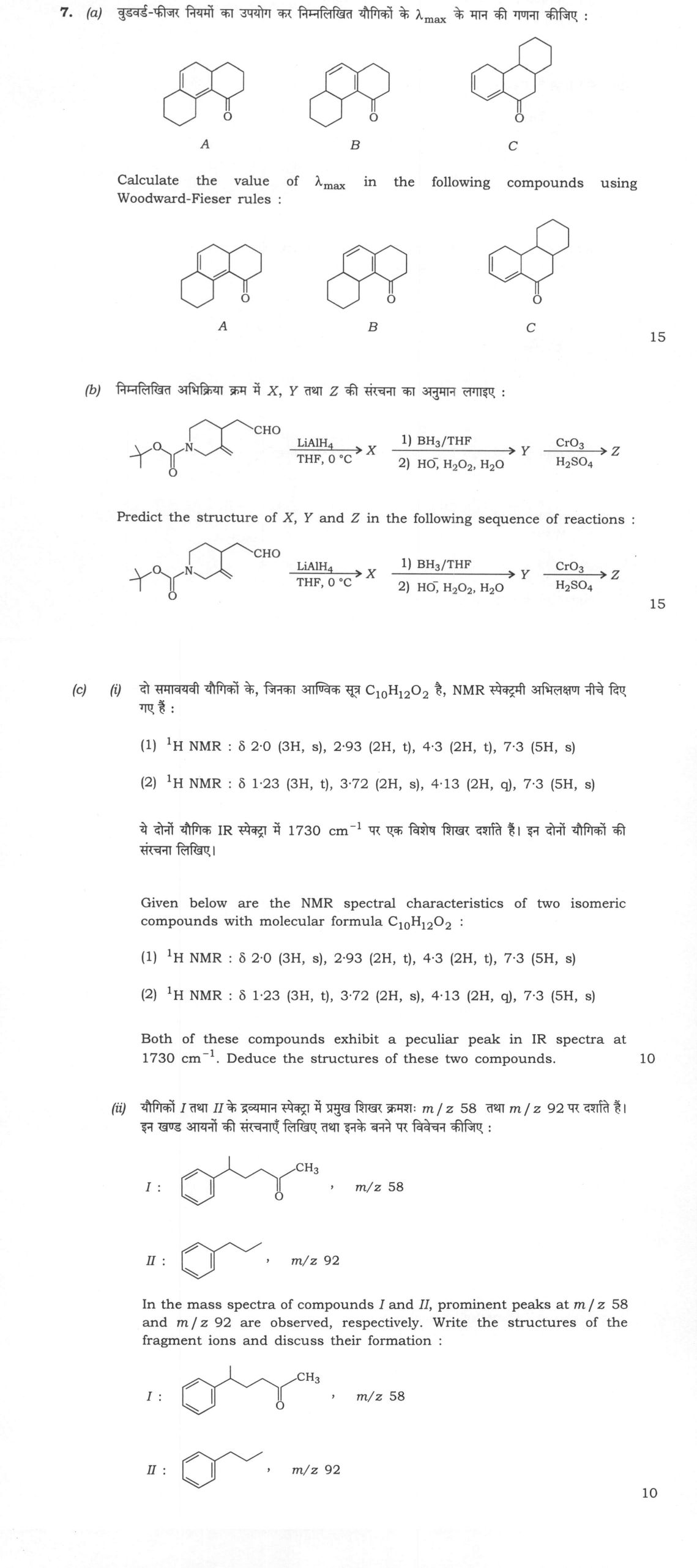
The figure this question refers to, in words
The question paper is a scan and the diagram did not survive as text. This is the figure as read from the original page — every component, value and label — so the question can be worked from the text below.
(a) Three chemical structures labeled A, B, and C. All are tricyclic ketones consisting of a six-membered ring containing a carbonyl group (C=O) fused to two other six-membered rings. Structure A: The carbonyl group is at position 1. There is a double bond at position 4 (alpha-beta unsaturated) and another double bond at position 8 (in the adjacent ring, conjugated with the first double bond). Structure B: The carbonyl group is at position 1. There is a double bond at position 4 (alpha-beta unsaturated) and another double bond at position 9 (in the adjacent ring, non-conjugated with the first double bond). Structure C: The carbonyl group is at position 1. There is a double bond at position 4 (alpha-beta unsaturated) and another double bond at position 10 (in the adjacent ring, non-conjugated with the first double bond).
(b) A reaction sequence starting with a starting material and proceeding through intermediates X and Y to product Z. Starting Material: A piperidine ring (six-membered ring with one nitrogen atom). The nitrogen atom is acylated with a tert-butoxycarbonyl (Boc) group (O-C(=O)-C(CH3)3). At position 2 of the piperidine ring, there is a double bond to a methylene group (=CH2). At position 3, there is a substituent: a -CH2-CHO group (an acetaldehyde group attached via a methylene bridge). Step 1: The starting material reacts with LiAlH4 in THF at 0 degrees Celsius to form product X. Step 2: Product X reacts with 1) BH3/THF and 2) HO-, H2O2, H2O to form product Y. Step 3: Product Y reacts with CrO3 in H2SO4 to form product Z.
(c) Structure II: A benzene ring attached to a propyl chain (specifically, propylbenzene). The text indicates a prominent peak at m/z 92.
What "Calculate" is asking you to do
Apply the standard formula or schedule to data the question has already supplied — a table of readings, cost records, a balance sheet — and produce the number. The method is rarely in doubt; the marks sit in the named intermediate quantities, each of which has to appear as a labelled line.
Structure that answers it
Data as given → formula or standard treatment, named → substitution → each intermediate, labelled → result with units
Where marks are lost
Omitting an intermediate the marking scheme pays for separately, or rounding at an intermediate line so the final figure drifts. In commerce and accountancy, any figure in a statement that no numbered working note supports is treated as unearned.
How this answer will be evaluated
Approach
Framework: Woodward-Fieser rules. (a) calculate: given > formula > substitution > result with units > interpretation | (b) trace: start point > the stages in sequence > end point > what changed | (c(i)) analyse: intro > causes > effects > stakeholders/linkages > way forward | (c(ii)) explain: definition/context > points in order > small example > short close Full marks: All parts answered with correct mechanisms, structures, and calculations
Key points expected
- Identify base value for each enone system
- Count and apply alkyl substituent increments
- Apply exocyclic double bond corrections
- Sum values to find final λmax
- Identify X as the reduced alcohol product
- Identify Y as the anti-Markovnikov alcohol
- Identify Z as the oxidized ketone
- Show correct regiochemistry for hydroboration
Evaluation rubric
Each sub-part is marked on its own, against the marks and word limit printed on the paper.
- (a) Determine λmax for compounds A, B, and C using Woodward-Fieser rules. 15 marks
calculate— given → formula → substitution → result with units → interpretation
Must cover
- Identify base value for each enone system
- Count and apply alkyl substituent increments
- Apply exocyclic double bond corrections
- Sum values to find final λmax
Loses marks
- Incorrect base value selection
- Missing exocyclic double bond correction
Earns more
- Correct identification of ring size
- Accurate counting of substituents
Extra mark
- Comparison of calculated vs experimental values
- (b) Predict structures of X, Y, and Z in the reaction sequence. 15 marks
trace— start point → the stages in sequence → end point → what changed
Must cover
- Identify X as the reduced alcohol product
- Identify Y as the anti-Markovnikov alcohol
- Identify Z as the oxidized ketone
- Show correct regiochemistry for hydroboration
Loses marks
- Markovnikov addition in hydroboration
- Incorrect oxidation state for Z
Earns more
- Mechanism for LiAlH4 reduction
- Mechanism for hydroboration-oxidation
Extra mark
- Stereochemical analysis of products
- (c(i)) Deduce structures of two isomeric compounds from NMR and IR data. 10 marks
analyse— intro → causes → effects → stakeholders/linkages → way forward
Must cover
- Identify ester functional group from IR
- Assign NMR signals to specific protons
- Distinguish between ethyl and methyl esters
- Propose structures consistent with all data
Loses marks
- Ignoring IR data
- Incorrect ester identification
Earns more
- Explanation of splitting patterns
- Integration analysis
Extra mark
- Alternative isomer structures
- (c(ii)) Explain formation of fragment ions at m/z 58 and m/z 92. 10 marks
explain— definition/context → points in order → small example → short close
Must cover
- Identify m/z 58 as McLafferty rearrangement product
- Identify m/z 92 as tropylium ion
- Show mechanism for McLafferty rearrangement
- Show mechanism for tropylium ion formation
Loses marks
- Incorrect fragment ion identification
- Missing mechanism for ion formation
Earns more
- Stability explanation for tropylium ion
- Hydrogen transfer mechanism details
Extra mark
- Other possible fragmentation pathways
Model answer coming soon
Every evaluation on this site is marked against a verified model answer. This question's answer is still being written; evaluation opens the moment it lands.
More from Chemistry 2024 Paper II
- Q4 (a) (i) Consider the following reaction : Name the product X and outline the mechanism in…
- Q5 (a) Write the structures of the bases present in DNA and RNA. Compare the stability of DN…
- Q6 (a) (i) Explain the various steps involved in benzoyl peroxide-initiated polymerization o…
- Q7 (a) Calculate the value of λ_max in the following compounds using Woodward-Fieser rules :…
- Q8 (a) Ethanolic solution of compound I on irradiation leads to the formation of compounds I…