Paper II — Q8
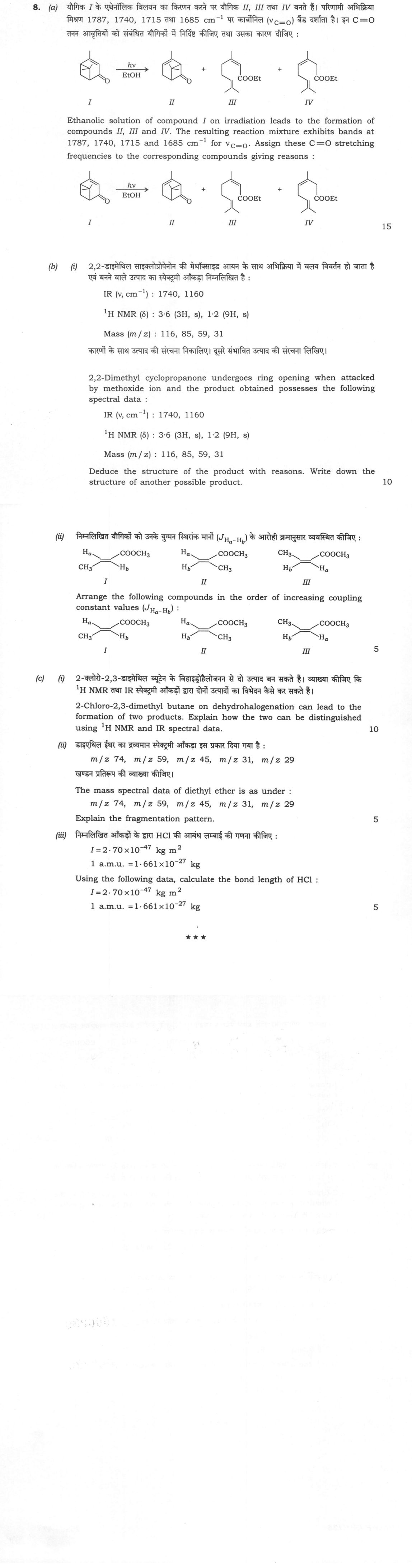
(a) Ethanolic solution of compound I on irradiation leads to the formation of compounds II, III and IV. The resulting reaction…
Ethanolic solution of compound I on irradiation leads to the formation of compounds II, III and IV. The resulting reaction mixture exhibits bands at 1787, 1740, 1715 and 1685 cm⁻¹ for νC=O. Assign these C=O stretching frequencies to the corresponding compounds giving reasons : 15 marks
2,2-Dimethyl cyclopropanone undergoes ring opening when attacked by methoxide ion and the product obtained possesses the following spectral data : IR (ν, cm⁻¹) : 1740, 1160 ¹H NMR (δ) : 3·6 (3H, s), 1·2 (9H, s) Mass (m/z) : 116, 85, 59, 31 Deduce the structure of the product with reasons. Write down the structure of another possible product. 10 marks
Arrange the following compounds in the order of increasing coupling constant values (J_Ha-Hb) : I II III 5 marks
2-Chloro-2,3-dimethyl butane on dehydrohalogenation can lead to the formation of two products. Explain how the two can be distinguished using ¹H NMR and IR spectral data. 10 marks
The mass spectral data of diethyl ether is as under : m/z 74, m/z 59, m/z 45, m/z 31, m/z 29 Explain the fragmentation pattern. 5 marks
Using the following data, calculate the bond length of HCl : I = 2·70×10⁻⁴⁷ kg m² 1 a.m.u. = 1·661×10⁻²⁷ kg 5 marks
हिंदी में प्रश्न पढ़ें
यौगिक I के एथेनॉलिक विलयन का किरणन करने पर यौगिक II, III तथा IV बनते हैं। परिणामी अभिक्रिया मिश्रण 1787, 1740, 1715 तथा 1685 cm⁻¹ पर कार्बोनिल (νC=O) बैंड दर्शाता है। इन C=O तरंग आवृत्तियों को संबंधित यौगिकों में निर्दिष्ट कीजिए तथा उसका कारण दीजिए : (15 अंक)
2,2-डाइमेथिल साइक्लोप्रोपेनोन की मेथॉक्साइड आयन के साथ अभिक्रिया में वलय विवर्तन हो जाता है एवं बनने वाले उत्पाद का स्पेक्ट्रमी आँकड़ा निम्नलिखित है : IR (ν, cm⁻¹) : 1740, 1160 ¹H NMR (δ) : 3·6 (3H, s), 1·2 (9H, s) Mass (m/z) : 116, 85, 59, 31 कारणों के साथ उत्पाद की संरचना निकालिए। दूसरे संभावित उत्पाद की संरचना लिखिए। (10 अंक)
निम्नलिखित यौगिकों को उनके युग्मन स्थिरांक मानों (J_Ha-Hb) के आरोही क्रमानुसार व्यवस्थित कीजिए : I II III (5 अंक)
2-क्लोरो-2,3-डाइमेथिल ब्यूटेन के विहाइड्रोहैलोजनन से दो उत्पाद बन सकते हैं। व्याख्या कीजिए कि ¹H NMR तथा IR स्पेक्ट्रमी आँकड़ों द्वारा दोनों उत्पादों का विभेदन कैसे कर सकते हैं। (10 अंक)
डाइएथिल ईथर का द्रव्यमान स्पेक्ट्रमी आँकड़ा इस प्रकार दिया गया है : m/z 74, m/z 59, m/z 45, m/z 31, m/z 29 खंड प्रतिरूप की व्याख्या कीजिए। (5 अंक)
निम्नलिखित आँकड़ों के द्वारा HCl की आबंध लंबाई की गणना कीजिए : I = 2·70×10⁻⁴⁷ kg m² 1 a.m.u. = 1·661×10⁻²⁷ kg (5 अंक)
The figure this question refers to, in words
The question paper is a scan and the diagram did not survive as text. This is the figure as read from the original page — every component, value and label — so the question can be worked from the text below.
(a) A chemical reaction scheme showing the photochemical transformation of compound I into a mixture of compounds II, III, and IV. The reaction is indicated by an arrow labeled 'hv' (light) over 'EtOH' (ethanol). Compound I is a bicyclic ketone, specifically 2-methylbicyclo[2.2.1]hept-5-en-2-one (a norbornene derivative with a ketone group at C2 and a methyl group at C7). Compound II is a bicyclic ketone, specifically 7-methylbicyclo[2.2.1]hept-5-en-2-one (an isomer of I where the methyl group is at C7). Compound III is an acyclic ester, specifically ethyl (E)-2,6-dimethylhepta-2,5-dienoate, featuring a central single bond flanked by two double bonds, with a COOEt group at one end and a methyl group at the other. Compound IV is an acyclic ester, specifically ethyl (Z)-2,6-dimethylhepta-2,5-dienoate, which is the geometric isomer of III.
(b) Three chemical structures of methyl 2-methylbut-2-enoate isomers, labeled I, II, and III.
Structure I: An alkene with a double bond. On the left carbon of the double bond, a methyl group (CH3) is attached pointing down and a hydrogen atom labeled Ha is attached pointing up. On the right carbon of the double bond, a methoxycarbonyl group (COOCH3) is attached pointing up and a hydrogen atom labeled Hb is attached pointing down. This is the (E)-isomer.
Structure II: An alkene with a double bond. On the left carbon of the double bond, a hydrogen atom labeled Ha is attached pointing up and a hydrogen atom labeled Hb is attached pointing down. On the right carbon of the double bond, a methoxycarbonyl group (COOCH3) is attached pointing up and a methyl group (CH3) is attached pointing down. This is the (Z)-isomer.
Structure III: An alkene with a double bond. On the left carbon of the double bond, a methyl group (CH3) is attached pointing up and a hydrogen atom labeled Hb is attached pointing down. On the right carbon of the double bond, a methoxycarbonyl group (COOCH3) is attached pointing up and a hydrogen atom labeled Ha is attached pointing down. This is the (E)-isomer.
Model answer
Written by UPSC Answer Check against this question's marking rubric, to the expected length. UPSC does not publish answers for Mains — this is one way to score well, not an official key.
(a) The spectrum is of the irradiated reaction mixture, so the four C=O bands correspond to I, II, III and IV. Compound II, the strained bicyclic ketone, gives 1787 cm⁻¹ because angle strain in the small bicyclic ring increases the C=O force constant. Compound III, the ester, gives 1740 cm⁻¹; the inductive electron-withdrawing effect of the alkoxy oxygen raises the ester C=O frequency, and in this isomer the C=C–C=O system is less planar, so resonance lowering is small. Compound IV, the more planar/conjugated carbonyl product, gives 1715 cm⁻¹ because conjugation reduces C=O bond order. The 1685 cm⁻¹ band is assigned to unreacted I, the α,β-unsaturated bicyclic ketone; conjugation of the carbonyl with the double bond lowers νC=O, and hydrogen bonding with ethanol gives a small additional red shift. Thus the three products account for 1787, 1740 and 1715 cm⁻¹, while the fourth band is due to residual I.
(b)(i) Methoxide adds to the carbonyl of 2,2-dimethylcyclopropanone; relief of ring strain then opens the C–C bond to the less substituted ring carbon, giving methyl 2,2-dimethylpropanoate, (CH₃)₃C–COOCH₃. IR bands at 1740 and 1160 cm⁻¹ indicate ester C=O and C–O stretching. The ¹H NMR shows only OCH₃ (3H, s, δ 3.6) and a tert-butyl group (9H, s, δ 1.2), excluding any CH₂/CH group. MS M⁺ at m/z 116 matches C₆H₁₂O₂; m/z 85 is (CH₃)₃C–CO⁺ from loss of OCH₃, m/z 31 is OCH₃⁺, and m/z 59 arises from further tert-butyl/oxonium fragmentation. The alternative product from cleavage of the other C–C bond is methyl 3-methylbutanoate, CH₃OOC–CH₂–CH(CH₃)₂.
(b)(ii) By the Karplus relationship, J is largest for trans/vicinal arrangements, intermediate for cis, and smallest near 90°. In the given structures, Hₐ and H_b are trans in I, cis in III, and geminal in II. Hence increasing J_Hₐ–H_b is II (geminal, ~0–2 Hz) < III (cis, ~8–12 Hz) < I (trans, ~14–18 Hz).
(c)(i) Dehydrohalogenation gives 2,3-dimethylbut-2-ene, (CH₃)₂C=C(CH₃)₂, and 2,3-dimethylbut-1-ene, CH₂=C(CH₃)CH(CH₃)CH₃. The tetrasubstituted alkene has no vinylic H; its ¹H NMR shows only methyl resonance(s), essentially a 12H singlet, and IR lacks =C–H stretch (~3080 cm⁻¹) and terminal =CH₂ out-of-plane bends (~910, 990 cm⁻¹). The terminal alkene shows two vinylic H signals from =CH₂ (δ ~4.6–5.0), an allylic CH, and methyl doublets/singlet; IR shows =C–H stretch and terminal alkene bends. Thus the presence or absence of vinylic H signals distinguishes them.
(c)(ii) m/z 74 is M⁺• of CH₃CH₂OCH₂CH₃. α-Cleavage with loss of CH₃• gives m/z 59, [CH₃CH=OCH₂CH₃]⁺. Cleavage of an O–C bond with loss of C₂H₅• gives m/z 45, [CH₃CH₂O]⁺. Further α-cleavage of the oxonium ions gives the base peak m/z 31, [CH₂=OH]⁺. m/z 29 is [C₂H₅]⁺ from ethyl cation formation.
(c)(iii) For HCl, μ = (1 × 35.5)/(1 + 35.5) amu = 0.9726 amu = 0.9726 × 1.661 × 10⁻²⁷ = 1.615 × 10⁻²⁷ kg. Since I = μr², r = (I/μ)¹ᐟ² = (2.70 × 10⁻⁴⁷ / 1.615 × 10⁻²⁷)¹ᐟ² = 1.29 × 10⁻¹⁰ m = 1.29 Å.
What "Explain" is asking you to do
Make the working of something clear — what sets it off, what follows from what, and what it produces. Explain is the Commission's mechanism word: it dominates the technical papers and the “explain why” stems, where the marks sit in the causal chain and not in the label.
Structure that answers it
State what it is → the initiating condition → the chain of cause, step by step → an instance where it plays out → what the chain produces
Where marks are lost
Describing what something looks like instead of why it works that way. Naming the stages without linking them reads as description too.
How this answer will be evaluated
Approach
(a) justify: claim > 3-4 reasons > evidence > conclusion | (b(i)) justify: claim > 3-4 reasons > evidence > conclusion | (b(ii)) justify: claim > 3-4 reasons > evidence > conclusion | (c(i)) justify: claim > 3-4 reasons > evidence > conclusion | (c(ii)) justify: claim > 3-4 reasons > evidence > conclusion | (c(iii)) calculate: given > formula > substitution > result with units > interpretation Full marks: Accurate assignments, clear mechanisms, correct calculations with units.
Key points expected
- Identify I as strained bicyclic ketone (1787 cm⁻¹)
- Identify II as less strained bicyclic ketone (1740 cm⁻¹)
- Identify III as conjugated ester (1715 cm⁻¹)
- Identify IV as non-conjugated ester (1685 cm⁻¹)
- Identifies product as methyl 3,3-dimethylbutanoate
- Links 1740 cm⁻¹ to ester C=O
- Links 1.2 ppm (9H) to gem-dimethyl group
- Links 3.6 ppm (3H) to methoxy group
Evaluation rubric
Each sub-part is marked on its own, against the marks and word limit printed on the paper.
- (a) Assign four C=O frequencies to compounds I-IV based on structural features. 15 marks
justify— claim → 3-4 reasons → evidence → conclusion
Must cover
- Identify I as strained bicyclic ketone (1787 cm⁻¹)
- Identify II as less strained bicyclic ketone (1740 cm⁻¹)
- Identify III as conjugated ester (1715 cm⁻¹)
- Identify IV as non-conjugated ester (1685 cm⁻¹)
Loses marks
- Assigns frequencies without structural reasoning
- Confuses ketone and ester frequency ranges
Earns more
- Mentions ring strain effect on frequency
- Mentions conjugation effect on frequency
- Distinguishes ketone vs ester baseline frequencies
Extra mark
- Draws structures of I-IV
- (b(i)) Deduce product structure from spectral data and propose an alternative. 10 marks
justify— claim → 3-4 reasons → evidence → conclusion
Must cover
- Identifies product as methyl 3,3-dimethylbutanoate
- Links 1740 cm⁻¹ to ester C=O
- Links 1.2 ppm (9H) to gem-dimethyl group
- Links 3.6 ppm (3H) to methoxy group
Loses marks
- Ignores mass spec data
- Fails to account for all NMR signals
Earns more
- Explains ring opening mechanism
- Identifies m/z 116 as molecular ion
- Draws structure of alternative product
Extra mark
- Provides detailed fragmentation pathway
- (b(ii)) Order compounds I-III by increasing coupling constant J_Ha-Hb. 5 marks
justify— claim → 3-4 reasons → evidence → conclusion
Must cover
- Identifies I as trans (large J)
- Identifies II as cis (medium J)
- Identifies III as geminal (small J)
- Orders as III < II < I
Loses marks
- Reverses trans and cis coupling order
- Fails to identify geminal coupling
Earns more
- Cites typical J values for each geometry
- Explains steric/electronic influence on J
Extra mark
- Draws Newman projections
- (c(i)) Distinguish two dehydrohalogenation products using NMR and IR. 10 marks
justify— claim → 3-4 reasons → evidence → conclusion
Must cover
- Identifies Product A as 2,3-dimethyl-2-butene
- Identifies Product B as 2,3-dimethyl-1-butene
- Notes Product A has no vinylic protons
- Notes Product B has terminal vinylic protons
Loses marks
- Confuses the two alkene structures
- Fails to use NMR for distinction
Earns more
- Cites specific NMR chemical shifts for vinylic H
- Mentions IR C=C stretch differences
Extra mark
- Draws structures of both products
- (c(ii)) Explain fragmentation pattern of diethyl ether. 5 marks
justify— claim → 3-4 reasons → evidence → conclusion
Must cover
- Identifies m/z 74 as molecular ion
- Identifies m/z 45 as ethoxyl cation
- Identifies m/z 31 as methoxyl cation
- Identifies m/z 29 as ethyl cation
Loses marks
- Assigns wrong ions to m/z values
- Fails to show cleavage mechanism
Earns more
- Shows alpha-cleavage mechanism
- Explains m/z 59 as loss of methyl
Extra mark
- Draws fragmentation arrows
- (c(iii)) Calculate bond length of HCl from moment of inertia. 5 marks
calculate— given → formula → substitution → result with units → interpretation
Must cover
- Calculates reduced mass of HCl
- Uses formula I = μr²
- Solves for r (bond length)
- Provides result in meters
Loses marks
- Uses total mass instead of reduced mass
- Algebraic error in solving for r
Earns more
- Shows unit conversion steps
- States final answer in Angstroms
Extra mark
- Compares with literature value
Practice this exact question
Write your answer and it is marked point by point against the model answer above — what you covered, what you missed, what you got wrong.
Evaluate my answer →More from Chemistry 2024 Paper II
- Q5 (a) Write the structures of the bases present in DNA and RNA. Compare the stability of DN…
- Q6 (a) (i) Explain the various steps involved in benzoyl peroxide-initiated polymerization o…
- Q7 (a) Calculate the value of λ_max in the following compounds using Woodward-Fieser rules :…
- Q8 (a) Ethanolic solution of compound I on irradiation leads to the formation of compounds I…