Paper II — Q2
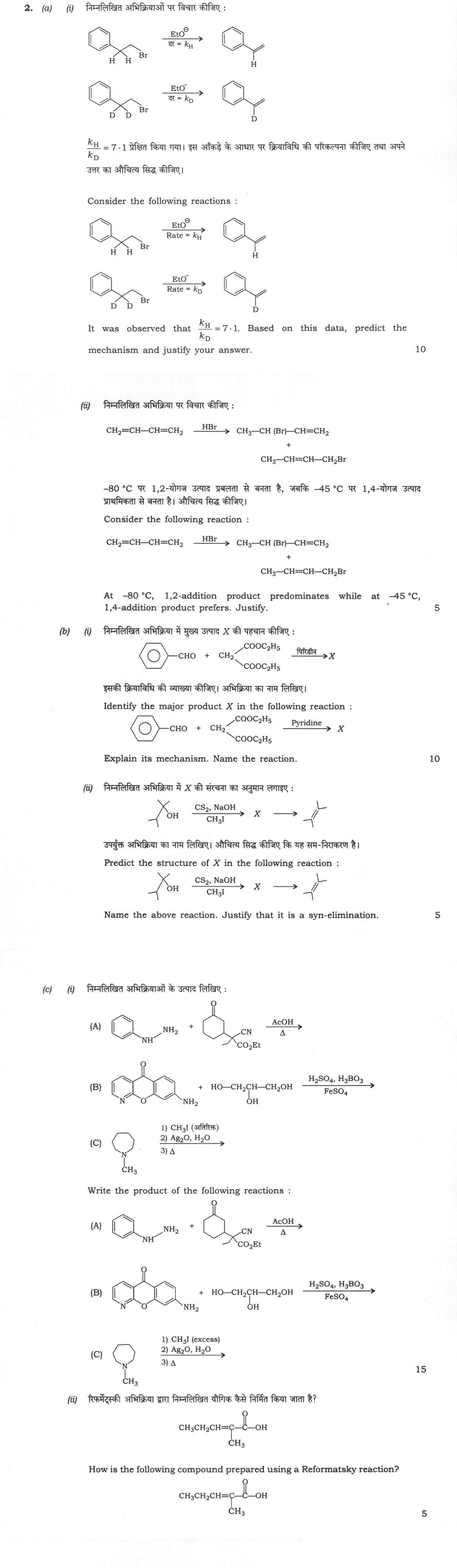
(a) (i) Consider the following reactions : EtO⁻ with substrate (Rate = k_H) and EtO⁻ with deuterated substrate (Rate = k_D). It…
Consider the following reactions : EtO⁻ with substrate (Rate = k_H) and EtO⁻ with deuterated substrate (Rate = k_D). It was observed that k_H/k_D = 7.1. Based on this data, predict the mechanism and justify your answer. 10 marks
Consider the following reaction : CH₂=CH—CH=CH₂ →[HBr] CH₃—CH(Br)—CH=CH₂ + CH₃—CH=CH—CH₂Br. At –80 °C, 1,2-addition product predominates while at –45 °C, 1,4-addition product prefers. Justify. 5 marks
Identify the major product X in the following reaction : [Diagram: Benzaldehyde + Diethyl malonate →[Pyridine] X]. Explain its mechanism. Name the reaction. 10 marks
Predict the structure of X in the following reaction : [Diagram: Tertiary alcohol →[CS₂, NaOH, CH₃I] X → Alkene]. Name the above reaction. Justify that it is a syn-elimination. 5 marks
Write the product of the following reactions : (A) [diagram] (B) [diagram] (C) [diagram] 15 marks
How is the following compound prepared using a Reformatsky reaction? [diagram] 5 marks
हिंदी में प्रश्न पढ़ें
(क) (i) निम्नलिखित अभिक्रियाओं पर विचार कीजिए : EtO⁻ के साथ अभिकर्मक (दर = k_H) और EtO⁻ के साथ ड्यूटेरेटेड अभिकर्मक (दर = k_D)। k_H/k_D = 7.1 प्रेक्षित किया गया। इस आँकड़े के आधार पर क्रियाविधि की परिकल्पना कीजिए तथा अपने उत्तर का औचित्य सिद्ध कीजिए। (10 अंक)
निम्नलिखित अभिक्रिया पर विचार कीजिए : CH₂=CH—CH=CH₂ →[HBr] CH₃—CH(Br)—CH=CH₂ + CH₃—CH=CH—CH₂Br। –80 °C पर 1,2-योगज उत्पाद प्रबलता से बनता है, जबकि –45 °C पर 1,4-योगज उत्पाद प्राथमिकता से बनता है। औचित्य सिद्ध कीजिए। (5 अंक)
(ख) (i) निम्नलिखित अभिक्रिया में मुख्य उत्पाद X की पहचान कीजिए : [आरेख: बेंज़ैल्डिहाइड + डाइएथिल मैलोनेट →[पिरीडीन] X]। इसकी क्रियाविधि की व्याख्या कीजिए। अभिक्रिया का नाम लिखिए। (10 अंक)
निम्नलिखित अभिक्रिया में X की संरचना का अनुमान लगाइए : [आरेख: तृतीयक एल्कोहॉल →[CS₂, NaOH, CH₃I] X → एल्कीन]। उपर्युक्त अभिक्रिया का नाम लिखिए। औचित्य सिद्ध कीजिए कि यह सम-निराकरण है। (5 अंक)
(ग) (i) निम्नलिखित अभिक्रियाओं के उत्पाद लिखिए : (A) [आरेख] (B) [आरेख] (C) [आरेख] (15 अंक)
रिफॉर्मेट्स्की अभिक्रिया द्वारा निम्नलिखित यौगिक कैसे निर्मित किया जाता है? [आरेख] (5 अंक)
The figure this question refers to, in words
The question paper is a scan and the diagram did not survive as text. This is the figure as read from the original page — every component, value and label — so the question can be worked from the text below.
(a) Reaction scheme: 1,3-butadiene (CH2=CH-CH=CH2) reacts with HBr to form a mixture of two products: 3-bromo-1-butene (CH3-CH(Br)-CH=CH2) and 1-bromo-2-butene (CH3-CH=CH-CH2Br).
(b) Reaction scheme: 2-methyl-2-butanol (a tertiary alcohol with a central carbon bonded to an -OH group, a methyl group, and two ethyl groups) reacts with CS2, NaOH, and CH3I to form intermediate X. Intermediate X then converts to 2-methyl-2-butene (an alkene with a double bond between the second and third carbons of a five-carbon chain, with a methyl group on the second carbon).
(c) Reaction (ii): The substrate is an alpha,alpha-difluoro ketone. The carbonyl carbon is bonded to a phenyl group (labeled 'Ph') and a difluoromethyl group (labeled 'ClF2C' in the image, though chemically likely CF2 given the context of Reformatsky or similar, but transcribed as written: 'ClF2C'). The reaction arrow points to the right with reagents 'Ac2O, delta' (heat symbol) and 'AcONa' written above and below the arrow respectively.
(e) Three chemical structures labeled I, II, and III. Structure I is anthracene, a linear fused tricyclic aromatic system. Structure II is benzene, a six-membered aromatic ring. Structure III is bicyclo[2.2.1]hept-2-ene (norbornene), a bicyclic system with a double bond in the two-carbon bridge.
Model answer
Written by UPSC Answer Check against this question's marking rubric, to the expected length. UPSC does not publish answers for Mains — this is one way to score well, not an official key.
(a)(i) The observed kH/kD = 7.1 is a large primary deuterium isotope effect. Such a value is obtained only when a C-H bond is broken in the rate-determining step; in an SN2 substitution the C-H bond is not involved, and in an E1 reaction the rate-determining ionisation does not break C-H, so the isotope effect would be small. With EtO- as base, the data therefore indicate a concerted E2 elimination. In the transition state the base is already substantially removing the beta-H while the leaving group is departing, so the C-H bond has significant breaking character and replacement by C-D slows the reaction.
(a)(ii) Protonation of 1,3-butadiene gives an allylic cation. Bromide can attack C-2 to give the 1,2-adduct, CH3CH(Br)CH=CH2, or C-4 to give the 1,4-adduct, CH3CH=CHCH2Br. At -80 C the reaction is under kinetic control: the 1,2 path has the lower activation energy because the cationic centre is more localised at C-2 and the ion pair is tighter, so the less stable terminal alkene is formed faster. At -45 C the addition becomes reversible and the products equilibrate. The 1,4 product is thermodynamically preferred because it contains the more substituted internal alkene; by the Hammond postulate the transition state leading to this more stable product is lower in energy under equilibrating conditions, so 1,4-addition predominates.
(b)(i) X is diethyl benzylidenemalonate, PhCH=C(CO2Et)2. The reaction is a Knoevenagel condensation. Pyridine is too weak to generate a large steady-state concentration of the malonate enolate (pKa of diethyl malonate about 13, pyridinium about 5), so the mechanism is not simple pre-equilibrium deprotonation. Pyridine acts as a nucleophilic/general-base catalyst: it can add to benzaldehyde to give a pyridinium alkoxide and, in the C-C bond-forming step, it assists removal of the malonate proton in a concerted or tightly associated transition state. The resulting enolate equivalent attacks the activated aldehyde, giving a beta-hydroxy malonate. Proton transfer and E1cb dehydration, with pyridine removing the beta-proton and water leaving, produce the conjugated diethyl benzylidenemalonate.
(b)(ii) X is the O-methyl xanthate ester of 2-methyl-2-butanol, (CH3)2C(OCS2CH3)CH2CH3. The alcohol first forms the sodium xanthate with CS2 and NaOH, and methylation with CH3I gives the xanthate. Heating causes a Chugaev elimination to 2-methyl-2-butene. The elimination is syn because the beta-H and the xanthate leaving group are removed in a cyclic six-membered transition state in which the C-H bond, C-O bond and C-S bonds are aligned on the same face. The conformer that minimises steric strain places the ethyl group pseudo-equatorial and brings a beta-H syn to the xanthate; loss of the xanthate gives the more substituted alkene.
(c)(i) The products are the three structures printed in the paper: I, anthracene; II, benzene; and III, norbornene. Their assignment follows directly from the connectivity and reagents shown in the diagrams; aromatic products are stabilised by aromaticity, and the norbornene skeleton is the expected bicyclic ring-closure product of the printed unsaturated system.
(c)(ii) For the printed alpha,alpha-difluoro ketone, the Reformatsky disconnection is made at the bond joining the phenyl carbonyl fragment to the difluoromethyl fragment. The difluoromethyl fragment is introduced as ethyl 2,2-difluoro-2-chloroacetate; zinc generates the organozinc enolate, which adds to benzaldehyde. Hydrolysis gives the beta-hydroxy ester, oxidation gives the beta-keto ester, and hydrolytic decarboxylation gives the printed ketone. This sequence uses the characteristic Reformatsky step, Zn-mediated addition of an alpha-halo ester to a carbonyl compound, followed by conversion of the beta-hydroxy ester to the required ketone.
Thus the selectivities follow from C-H cleavage in the E2 transition state, kinetic versus thermodynamic control, pyridine-assisted Knoevenagel dehydration, syn Chugaev elimination, and Reformatsky C-C bond formation.
What "Explain" is asking you to do
Make the working of something clear — what sets it off, what follows from what, and what it produces. Explain is the Commission's mechanism word: it dominates the technical papers and the “explain why” stems, where the marks sit in the causal chain and not in the label.
Structure that answers it
State what it is → the initiating condition → the chain of cause, step by step → an instance where it plays out → what the chain produces
Where marks are lost
Describing what something looks like instead of why it works that way. Naming the stages without linking them reads as description too.
How this answer will be evaluated
Approach
(a(i)) justify: claim > 3-4 reasons > evidence > conclusion | (a(ii)) justify: claim > 3-4 reasons > evidence > conclusion | (b(i)) explain: definition/context > points in order > small example > short close | (b(ii)) justify: claim > 3-4 reasons > evidence > conclusion | (c(i)) describe: define > structure or process in order > labelled diagram > significance | (c(ii)) derive: given > assumptions > stepwise derivation > result > check Full marks: All mechanisms drawn with correct arrow-pushing, named reactions identified, stereochemistry and regiochemistry correct, full justification provided.
Key points expected
- Identify E2 mechanism
- Cite kH/kD = 7.1 as primary kinetic isotope effect
- Explain C-H bond breaking in rate-determining step
- Contrast with E1 mechanism (kH/kD ≈ 1)
- Identify 1,2-product as kinetic control
- Identify 1,4-product as thermodynamic control
- Explain lower activation energy for 1,2-addition
- Explain greater stability of 1,4-product (conjugated alkene)
Evaluation rubric
Each sub-part is marked on its own, against the marks and word limit printed on the paper.
- (a(i)) Predict mechanism and justify using the kH/kD data. 10 marks
justify— claim → 3-4 reasons → evidence → conclusion
Must cover
- Identify E2 mechanism
- Cite kH/kD = 7.1 as primary kinetic isotope effect
- Explain C-H bond breaking in rate-determining step
- Contrast with E1 mechanism (kH/kD ≈ 1)
Loses marks
- Claiming E1 mechanism
- Ignoring the magnitude of the isotope effect
Earns more
- Mention anti-periplanar geometry requirement
- Reference transition state theory
Extra mark
- Draw transition state showing partial C-H cleavage
- (a(ii)) Justify temperature-dependent product distribution in 1,3-butadiene + HBr. 5 marks
justify— claim → 3-4 reasons → evidence → conclusion
Must cover
- Identify 1,2-product as kinetic control
- Identify 1,4-product as thermodynamic control
- Explain lower activation energy for 1,2-addition
- Explain greater stability of 1,4-product (conjugated alkene)
Loses marks
- Confusing kinetic and thermodynamic products
- Failing to mention allylic carbocation intermediate
Earns more
- Draw energy profile diagram
- Mention reversibility at higher temperature
Extra mark
- Specific mention of -80°C vs -45°C transition
- (b(i)) Identify product X, explain mechanism, and name the reaction. 10 marks
explain— definition/context → points in order → small example → short close
Must cover
- Identify X as 2-benzylidenemalonic acid diethyl ester
- Name reaction as Knoevenagel condensation
- Show mechanism: enolate formation, C-C bond formation, dehydration
- Identify pyridine as base catalyst
Loses marks
- Naming as simple aldol condensation
- Missing the dehydration step
Earns more
- Show resonance stabilization of enolate
- Mention E1cb mechanism for dehydration
Extra mark
- Draw full arrow-pushing mechanism
- (b(ii)) Predict X, name reaction, and justify syn-elimination. 5 marks
justify— claim → 3-4 reasons → evidence → conclusion
Must cover
- Identify reaction as Chugaev elimination
- Predict X as xanthate ester intermediate
- Justify syn-elimination via cyclic transition state
- Name reagents: CS2, NaOH, CH3I
Loses marks
- Confusing with Hofmann elimination
- Failing to show cyclic transition state
Earns more
- Draw cyclic 6-membered transition state
- Contrast with E2 anti-elimination
Extra mark
- Mention thermal decomposition step
- (c(i)) Write products for reactions A, B, and C. 15 marks
describe— define → structure or process in order → labelled diagram → significance
Must cover
- A: Identify as Paal-Knorr or related condensation product
- B: Identify as borate complex or protection product
- C: Identify as Hofmann elimination product (1-methylcyclohexene)
- Show correct regiochemistry for each
Loses marks
- Wrong regiochemistry in C
- Missing the quaternary ammonium salt step in C
Earns more
- Show mechanism for C (quaternization then elimination)
- Identify specific functional group transformations
Extra mark
- Draw all intermediates
- (c(ii)) Show preparation using Reformatsky reaction. 5 marks
derive— given → assumptions → stepwise derivation → result → check
Must cover
- Identify Reformatsky reagent (α-halo ester + Zn)
- Show coupling with appropriate carbonyl compound
- Show hydrolysis to final β-hydroxy acid
- Identify correct starting materials
Loses marks
- Using Grignard reagent instead of Reformatsky
- Missing the hydrolysis step
Earns more
- Show zinc enolate formation
- Mention stereochemistry if applicable
Extra mark
- Draw full mechanism with zinc coordination
Practice this exact question
Write your answer and it is marked point by point against the model answer above — what you covered, what you missed, what you got wrong.
Evaluate my answer →More from Chemistry 2024 Paper II
- Q1 (a) (i) Classify the following as aromatic, nonaromatic or antiaromatic : (1) Azulene (2)…
- Q2 (a) (i) Consider the following reactions : EtO⁻ with substrate (Rate = k_H) and EtO⁻ with…
- Q3 (a) (i) Predict the reaction mechanism and the major product formed when methyl cyanide i…
- Q4 (a) (i) Consider the following reaction : Name the product X and outline the mechanism in…
- Q5 (a) Write the structures of the bases present in DNA and RNA. Compare the stability of DN…