Paper II — Q6
(a) (i) Explain the various steps involved in benzoyl peroxide-initiated polymerization of ethylene to give polyethylene. (10…
Explain the various steps involved in benzoyl peroxide-initiated polymerization of ethylene to give polyethylene. 10 marks
Predict the physical properties of atactic, syndiotactic and isotactic polystyrenes based on their structure. 5 marks
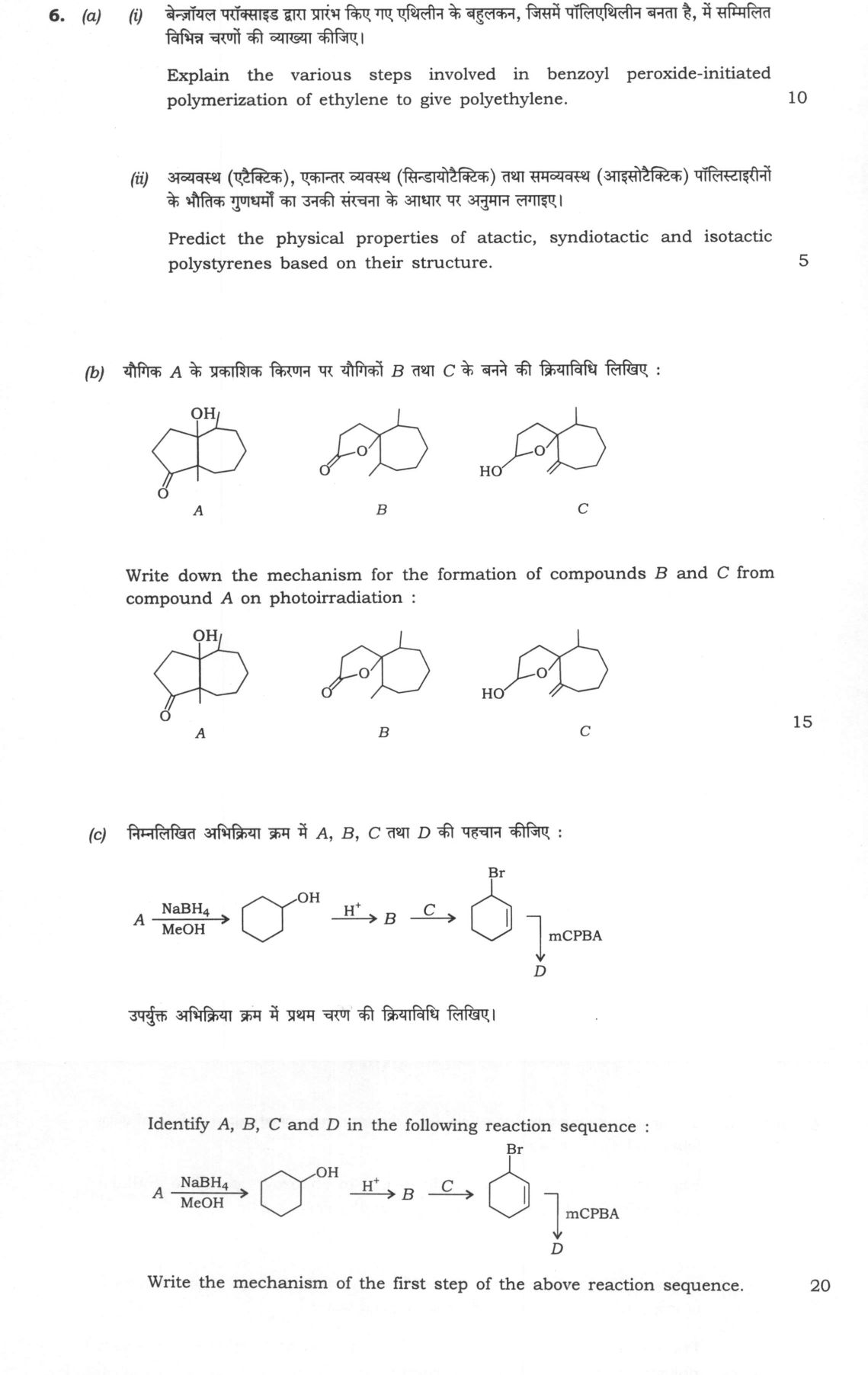
Write down the mechanism for the formation of compounds B and C from compound A on photoirradiation : 15 marks
Identify A, B, C and D in the following reaction sequence : A xrightarrow[MeOH]NaBH₄ [cyclohexanol structure] xrightarrowH⁺ B xrightarrowC [3-bromocyclohexene structure] xrightarrowmCPBA D Write the mechanism of the first step of the above reaction sequence. 20 marks
हिंदी में प्रश्न पढ़ें
बेंज़ॉयल परॉक्साइड द्वारा प्रारंभ किए गए एथिलीन के बहुलकन, जिसमें पॉलीएथिलीन बनता है, में सम्मिलित विभिन्न चरणों की व्याख्या कीजिए। (10 अंक)
अव्यवस्थ (एटैक्टिक), एकांतर व्यवस्थ (सिन्डियोटैक्टिक) तथा समव्यवस्थ (आइसोटैक्टिक) पॉलिस्टाइरीनों के भौतिक गुणधर्मों का उनकी संरचना के आधार पर अनुमान लगाइए। (5 अंक)
यौगिक A के प्रकाशिक किरणन पर यौगिकों B तथा C के बनने की क्रियाविधि लिखिए : (15 अंक)
निम्नलिखित अभिक्रिया क्रम में A, B, C तथा D की पहचान कीजिए : उपर्युक्त अभिक्रिया क्रम में प्रथम चरण की क्रियाविधि लिखिए। (20 अंक)
The figure this question refers to, in words
The question paper is a scan and the diagram did not survive as text. This is the figure as read from the original page — every component, value and label — so the question can be worked from the text below.
(b) Three chemical structures labeled A, B, and C. Structure A is a bicyclic molecule consisting of a five-membered ring fused to a seven-membered ring. The five-membered ring contains a ketone group (C=O) and a tertiary alcohol group (C-OH) at the ring junction. The seven-membered ring has a methyl group substituent. Structure B is a bicyclic acetal (lactone) formed from A, where the oxygen of the hydroxyl group has formed a bond with the carbonyl carbon, creating a five-membered ring containing an oxygen atom and a carbonyl group (C=O) is no longer present, replaced by an ether linkage. Structure C is a bicyclic enol ether formed from A, where the oxygen of the hydroxyl group has formed a bond with the alpha-carbon of the ketone, creating a double bond between the carbonyl carbon and the adjacent carbon, and the oxygen is part of a five-membered ring.
(c) A reaction sequence diagram starting with a reactant labeled 'A'. An arrow points from A to a chemical structure of cyclohexanol (a six-membered ring with a single -OH group). The reagents written above and below this first arrow are 'NaBH4' and 'MeOH'. From the cyclohexanol structure, a second arrow points to a product labeled 'B', with 'H+' written above the arrow. From 'B', a third arrow points to a chemical structure of 3-bromocyclohexene (a six-membered ring with a double bond and a -Br group on the carbon adjacent to the double bond). The reagent 'C' is written above this third arrow. From the 3-bromocyclohexene structure, a final arrow points to a product labeled 'D', with 'mCPBA' written to the right of the arrow.
Model answer
Written by UPSC Answer Check against this question's marking rubric, to the expected length. UPSC does not publish answers for Mains — this is one way to score well, not an official key.
Radical polymerization and tacticity. Benzoyl peroxide-initiated ethylene polymerization is a free-radical chain process. Heat or initiator decomposition gives (PhCOO)₂ → 2 PhCOO•; benzoyloxy radicals decarboxylate to phenyl radicals, Ph•. The phenyl radical adds to ethylene, CH₂=CH₂, to give PhCH₂CH₂•, the first propagating radical. Propagation continues as the terminal radical adds to another ethylene, Ph(CH₂CH₂)ₙCH₂CH₂•, extending the chain. Chain transfer is important in ethylene: the growing radical can abstract hydrogen from solvent/impurity or, more importantly, back-bite its own chain to form a mid-chain radical; reinitiation produces short-chain branches characteristic of LDPE, or a dead chain. Termination occurs by coupling of two chain radicals to a longer saturated chain or by disproportionation to give one saturated and one vinyl-terminated chain. Industrially this high-pressure radical route gives branched LDPE, while HDPE is made by coordination catalysts; Indian producers such as Reliance and GAIL use such polyolefin processes for packaging, films and pipes.
Tacticity controls physical properties because phenyl side groups must pack regularly. Isotactic polystyrene has all phenyl groups on the same side of the chain; it packs well, is crystalline, has a higher Tm, greater density and stiffness, and is less transparent. Syndiotactic polystyrene has alternating phenyl groups; it is less regularly packed than isotactic but still semi-crystalline, with moderate Tm and strength. Atactic polystyrene has random stereochemistry, cannot crystallize, is amorphous and transparent, has no Tm, and its Tg is about 100°C, similar to the stereoregular forms; it is softer and used for disposable cups and packaging.
Photochemical formation of B and C. For the drawn A, a bicyclic hydroxy ketone in which the tertiary alcohol at the ring junction is positioned to reach the carbonyl, hν excites the C=O to an nπ* singlet and then triplet state. The excited carbonyl is strongly polarized: the carbonyl carbon is electrophilic/radical-like and the α-carbon has enolate/radical character. In the pathway to B, the hydroxyl oxygen, hydrogen-bonded to the carbonyl, attacks the excited carbonyl carbon; the C=O π bond opens to oxygen. Proton transfer from the attacking OH to the carbonyl oxygen and radical/electron recombination give the neutral bicyclic hemiacetal/lactol B, in which a new O–C bond to the former carbonyl carbon has closed a five-membered oxygen-containing ring and the original C=O is now an ether/alkoxy linkage. In the pathway to C, the excited carbonyl undergoes intramolecular α-H abstraction (Norrish–Yang type) to a ketyl–enolate 1,4-biradical. The hydroxyl oxygen then attacks the α-carbon; collapse of the enolate and loss of the proton from oxygen form the C=C bond between the former carbonyl carbon and the α-carbon, giving bicyclic enol ether C. Thus B and C are regioisomeric photochemical cyclization products of A: B is the lactol from O–carbonyl bond formation, C is the enol ether from O–α-carbon bond formation.
Reaction sequence and NaBH₄ mechanism. A is cyclohexanone. NaBH₄/MeOH reduces it to cyclohexanol; acid-catalysed dehydration of cyclohexanol gives B, cyclohexene. Reagent C is NBS/hν (allylic bromination), converting cyclohexene to 3-bromocyclohexene. mCPBA epoxidizes the double bond to D, 3-bromocyclohexene oxide, correctly named 2-bromo-7-oxabicyclo[4.1.0]heptane. In the first step, a hydride from BH₄⁻ attacks the planar carbonyl carbon of cyclohexanone while the C=O π electrons move to oxygen, forming a tetrahedral alkoxide–boron intermediate. Methanol protonates the alkoxide to give cyclohexanol; boron remains as borate ester/borate by-products rather than being regenerated. Attack can occur from either face; in the chair-like product the equatorial alcohol is favoured, but cyclohexanol rapidly ring-flips.
The overall sequence shows how radical, photochemical and ionic mechanisms convert simple functional groups into polymers, cyclic ethers and epoxides; in Indian industry the same logic underlies polyolefin and polystyrene manufacture, where control of chain structure determines packaging, insulation and pipe performance.
What "Explain" is asking you to do
Make the working of something clear — what sets it off, what follows from what, and what it produces. Explain is the Commission's mechanism word: it dominates the technical papers and the “explain why” stems, where the marks sit in the causal chain and not in the label.
Structure that answers it
State what it is → the initiating condition → the chain of cause, step by step → an instance where it plays out → what the chain produces
Where marks are lost
Describing what something looks like instead of why it works that way. Naming the stages without linking them reads as description too.
How this answer will be evaluated
Approach
(a(i)) explain: definition/context > points in order > small example > short close | (a(ii)) justify: claim > 3-4 reasons > evidence > conclusion | (b) trace: start point > the stages in sequence > end point > what changed | (c) trace: start point > the stages in sequence > end point > what changed Full marks: Complete mechanisms with correct intermediates and stereochemistry; precise identification of all species.
Key points expected
- Initiation: peroxide homolysis to benzoyloxy radicals
- Radical addition to ethylene monomer
- Propagation: chain growth via radical addition
- Termination: coupling or disproportionation
- Isotactic: high crystallinity, high melting point
- Syndiotactic: crystalline, lower Tm than isotactic
- Atactic: amorphous, rubbery, low Tg
- Linkage of tacticity to chain packing
Evaluation rubric
Each sub-part is marked on its own, against the marks and word limit printed on the paper.
- (a(i)) Stepwise mechanism of benzoyl peroxide-initiated ethylene polymerization. 10 marks
explain— definition/context → points in order → small example → short close
Must cover
- Initiation: peroxide homolysis to benzoyloxy radicals
- Radical addition to ethylene monomer
- Propagation: chain growth via radical addition
- Termination: coupling or disproportionation
Loses marks
- Omitting initiation or termination steps
- Incorrect radical electron movement
Earns more
- Correct arrow-pushing for radical steps
- Structure of benzoyloxy radical shown
Extra mark
- Mention of chain transfer steps
- (a(ii)) Physical properties of atactic, syndiotactic, and isotactic polystyrenes based on structure. 5 marks
justify— claim → 3-4 reasons → evidence → conclusion
Must cover
- Isotactic: high crystallinity, high melting point
- Syndiotactic: crystalline, lower Tm than isotactic
- Atactic: amorphous, rubbery, low Tg
- Linkage of tacticity to chain packing
Loses marks
- Confusing isotactic and syndiotactic properties
- No structural reasoning provided
Earns more
- Mention of density differences
- Reference to solubility
Extra mark
- Specific Tm/Tg values cited
- (b) Mechanism for photochemical formation of B and C from A. 15 marks
trace— start point → the stages in sequence → end point → what changed
Must cover
- Excitation of ketone to triplet state
- 1,4-H abstraction to form 1,4-diradical
- Path to B: C-O bond formation (lactone)
- Path to C: C=C formation (enol ether)
Loses marks
- Missing diradical intermediate
- Incorrect bond connectivity in products
Earns more
- Correct diradical intermediate drawn
- Stereochemical outcome noted
Extra mark
- Mention of Norrish Type II reaction
- (c) Identify A, B, C, D and mechanism of the first step. 20 marks
trace— start point → the stages in sequence → end point → what changed
Must cover
- A: Cyclohexanone
- B: 1-bromocyclohexene
- C: HBr (reagent)
- D: 7-oxabicyclo[4.1.0]hept-2-ene
Loses marks
- Wrong identification of A or B
- Mechanism lacking electron flow arrows
Earns more
- Mechanism: hydride transfer from BH4-
- Mechanism: alkoxide protonation to alcohol
- Mechanism: E1 elimination to alkene
Extra mark
- Structure of mCPBA epoxide intermediate
Practice this exact question
Write your answer and it is marked point by point against the model answer above — what you covered, what you missed, what you got wrong.
Evaluate my answer →More from Chemistry 2024 Paper II
- Q3 (a) (i) Predict the reaction mechanism and the major product formed when methyl cyanide i…
- Q4 (a) (i) Consider the following reaction : Name the product X and outline the mechanism in…
- Q5 (a) Write the structures of the bases present in DNA and RNA. Compare the stability of DN…
- Q6 (a) (i) Explain the various steps involved in benzoyl peroxide-initiated polymerization o…
- Q7 (a) Calculate the value of λ_max in the following compounds using Woodward-Fieser rules :…
- Q8 (a) Ethanolic solution of compound I on irradiation leads to the formation of compounds I…