Paper II — Q5
(a) Write the structures of the bases present in DNA and RNA. Compare the stability of DNA and RNA. (10 marks) (b) Predict the…
Write the structures of the bases present in DNA and RNA. Compare the stability of DNA and RNA. 10 marks
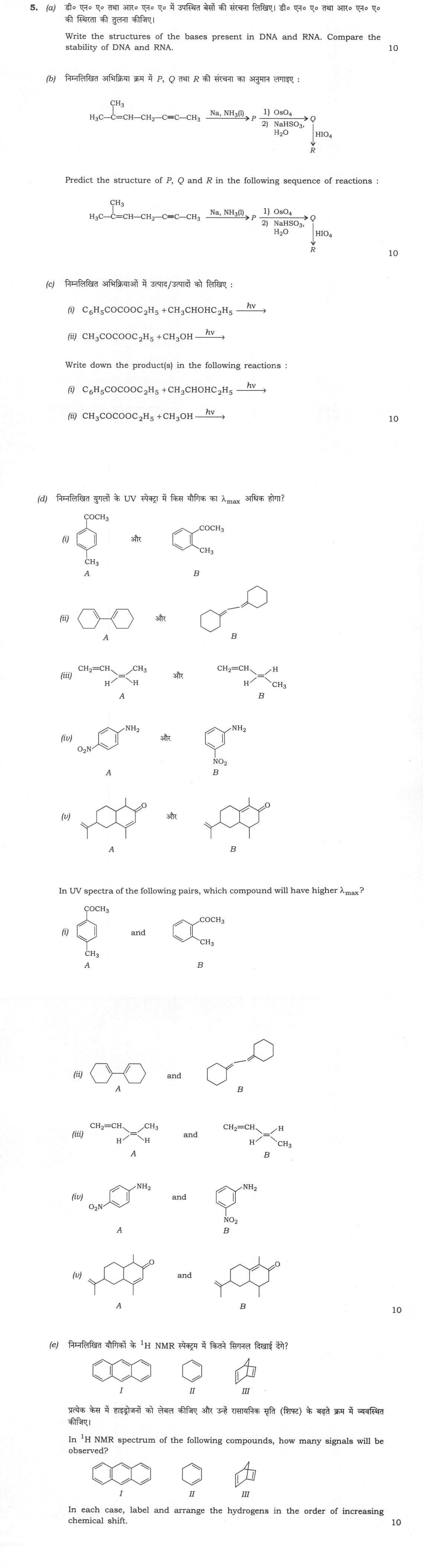
Predict the structure of P, Q and R in the following sequence of reactions : 10 marks
Write down the product(s) in the following reactions : C₆H₅COCOOC₂H₅ + CH₃CHOHC₂H₅ xrightarrowhν
CH₃COCOOC₂H₅ + CH₃OH xrightarrowhν 10 marks
In UV spectra of the following pairs, which compound will have higher λ_max? and A B
and A B
and A B
and A B
and A B 10 marks
In ¹H NMR spectrum of the following compounds, how many signals will be observed? I II III In each case, label and arrange the hydrogens in the order of increasing chemical shift. 10 marks
हिंदी में प्रश्न पढ़ें
डी० एन० ए० तथा आर० एन० ए० में उपस्थित बेसों की संरचना लिखिए। डी० एन० ए० तथा आर० एन० ए० की स्थिरता की तुलना कीजिए। (10 अंक)
निम्नलिखित अभिक्रिया क्रम में P, Q तथा R की संरचना का अनुमान लगाइए : (10 अंक)
निम्नलिखित अभिक्रियाओं में उत्पाद/उत्पादों को लिखिए : C₆H₅COCOOC₂H₅ + CH₃CHOHC₂H₅ xrightarrowhν
CH₃COCOOC₂H₅ + CH₃OH xrightarrowhν (10 अंक)
निम्नलिखित युग्मों के UV स्पेक्ट्रा में किस यौगिक का λ_max अधिक होगा? और A B
और A B
और A B
और A B
और A B (10 अंक)
निम्नलिखित यौगिकों के ¹H NMR स्पेक्ट्रम में कितने सिग्नल दिखाई देंगे? I II III प्रत्येक केस में हाइड्रोजनों को लेबल कीजिए और उन्हें रासायनिक सूति (शिफ्ट) के बढ़ते क्रम में व्यवस्थित कीजिए। (10 अंक)
The figure this question refers to, in words
The question paper is a scan and the diagram did not survive as text. This is the figure as read from the original page — every component, value and label — so the question can be worked from the text below.
(b) Reaction scheme: The starting material is 2-methyl-1-pentene-4-yne (structure: H3C-C(CH3)=CH-CH2-C≡C-CH3). It reacts with Na, NH3(l) to form intermediate P. Intermediate P reacts with 1) OsO4 and 2) NaHSO3, H2O to form intermediate Q. Intermediate Q reacts with HIO4 to form product R.
(c) Reaction (i): Ethyl benzoate (C6H5COCOOC2H5) reacts with 2-propanol (CH3CHOHC2H5) under light (hv). Reaction (ii): Ethyl acetate (CH3COCOOC2H5) reacts with methanol (CH3OH) under light (hv).
(d) Part (v): Two chemical structures labeled A and B. Both are substituted decalin (decahydronaphthalene) derivatives. Structure A is a decalin system with a ketone group (=O) on the right ring, a double bond in the right ring adjacent to the ketone, a methyl group on the double bond, a methyl group at the ring junction, and an isopropenyl group (-C(CH3)=CH2) on the left ring. Structure B is a decalin system with a ketone group (=O) on the right ring, a double bond in the right ring between the ketone and the ring junction, a methyl group at the ring junction, a methyl group on the saturated carbon of the right ring, and an isopropenyl group (-C(CH3)=CH2) on the left ring.
(e) Three chemical structures labeled I, II, and III. Structure I is anthracene, a polycyclic aromatic hydrocarbon consisting of three fused benzene rings in a linear arrangement. Structure II is 1,3-cyclohexadiene, a six-membered ring with two double bonds separated by one single bond. Structure III is a bridged bicyclic diene, specifically 1,4-methano-1,3-cyclohexadiene (norbornadiene), consisting of a cyclohexadiene ring with a methylene bridge connecting the carbons at the 1 and 4 positions.
Model answer
Written by UPSC Answer Check against this question's marking rubric, to the expected length. UPSC does not publish answers for Mains — this is one way to score well, not an official key.
(a) Bases and stability. DNA contains the four bases adenine, guanine, cytosine and thymine; RNA contains adenine, guanine, cytosine and uracil. Adenine is 6-aminopurine and guanine is 2-amino-6-oxopurine; cytosine is 4-amino-2-oxopyrimidine, thymine is 5-methyluracil and uracil is 2,4-dioxopyrimidine. The amino and carbonyl groups are arranged so that complementary base pairs form: in DNA, A–T has two hydrogen bonds and G–C has three; in RNA, A–U has two and G–C has three. DNA is more stable than RNA mainly because deoxyribose lacks the 2′-OH group. The 2′-OH of ribose makes RNA susceptible to base-catalysed hydrolysis: the 2′-oxygen can attack the adjacent phosphorus to give a 2′,3′-cyclic phosphate and strand scission. DNA also usually exists as a double helix with extensive base stacking and two-strand association, which adds thermodynamic stability; RNA is often single-stranded and more chemically reactive.
(b) P, Q and R. The starting enyne is (CH3)2C=CH–CH2–C≡C–CH3. Sodium in liquid ammonia reduces the alkyne by the dissolving-metal pathway to the trans alkene, while the pre-existing isolated alkene is not reduced. Therefore P is (CH3)2C=CH–CH2–CH=CH–CH3, with the newly formed double bond having E/trans geometry. OsO4 followed by NaHSO3/H2O gives syn dihydroxylation of the C=C bonds. With both alkenes available, Q is the tetraol CH3–C(OH)(CH3)–CH(OH)–CH2–CH(OH)–CH(OH)–CH3; the two hydroxyl groups added to each former double bond are syn, and Q is formed as a mixture of stereoisomers. Periodic acid cleaves vicinal diols through cyclic periodate esters. Cleavage of the C2–C3 diol gives acetone and an aldehyde at C3; cleavage of the C5–C6 diol gives acetaldehyde and an aldehyde at C5. The central CH2 group therefore remains as a dialdehyde. Hence R is a mixture of acetone, malonaldehyde, OHC–CH2–CHO, and acetaldehyde.
(c) Photochemical products. In both reactions the excited α-keto ester abstracts a hydrogen atom from the carbon of the alcohol. This gives a ketyl radical of the ester and an α-hydroxyalkyl radical; radical–radical coupling gives a cross-coupled α,β-dihydroxy ester. In (i), ethyl phenylglyoxylate, C6H5COCO2Et, reacts with butan-2-ol, CH3CH(OH)C2H5, to give C6H5C(OH)(CO2Et)C(OH)(CH3)C2H5, named ethyl 2,3-dihydroxy-3-methyl-2-phenylpentanoate. The product contains two new stereocentres and is obtained as a mixture of diastereomers. In (ii), ethyl pyruvate, CH3COCO2Et, reacts with methanol to give CH3C(OH)(CO2Et)CH2OH, ethyl 2,3-dihydroxy-2-methylpropanoate, as a racemate. Competing Norrish-type fragmentation or ester exchange may occur, but the principal photochemical addition product is the cross-coupled dihydroxy ester.
(d) UV λmax. The individual drawings for pairs (i)–(iv) are not available in the supplied text; assigning A or B for those four pairs would be conjecture. The Woodward–Fieser principle to apply is that the compound with the longer, more planar conjugated system, greater alkyl substitution at α/β positions, stronger auxochrome donation, or an exocyclic double bond has the higher λmax, whereas steric twisting of the enone lowers the wavelength. For the supplied decalin pair (v), A is expected to have the higher λmax. Both structures are cyclic enones, but in A the enone double bond carries the methyl substituent, giving an additional alkyl/hyperconjugative increment. In B the methyl is moved to a saturated position, so the conjugated enone is less substituted. Steric inhibition of resonance would reduce the shift if severe, but the dominant Woodward–Fieser effect is the methyl-substituted enone in A, so A absorbs at longer wavelength.
(e) 1H NMR signal count and order. Anthracene (I) has three signals by its high symmetry: H2,3,6,7, the outer β protons, about 7.4 ppm; H1,4,5,8, the outer α protons, about 7.6 ppm; and H9,10, the central protons, about 8.4 ppm. The order of increasing chemical shift is H2,3,6,7 < H1,4,5,8 < H9,10. 1,3-Cyclohexadiene (II) has four signals: the two terminal vinylic protons H1/H4, about 5.6 ppm; the two internal vinylic protons H2/H3, about 5.8 ppm; and two sets of diastereotopic allylic methylene protons, H5b/H6b about 2.55 ppm and H5a/H6a about 2.7 ppm. The increasing order is H5b/H6b < H5a/H6a < H1/H4 < H2/H3. 1,4-Methano-1,3-cyclohexadiene (III, norbornadiene) has three signals: the bridge methylene protons, about 1.8 ppm; the two equivalent bridgehead protons, about 3.0 ppm; and the four equivalent vinylic protons, about 5.8 ppm. The increasing order is bridge CH2 < bridgehead CH < vinylic CH. Thus the predicted numbers of signals are 3 for I, 4 for II and 3 for III, with the chemical-shift orders given above.
What "Predict" is asking you to do
State the outcome and show the rule or trend that produces it. In the science papers this is determinate — name the product or structure and the mechanism that yields it; in the general papers it is a projection, and the assumptions it rests on have to be named on the page.
Structure that answers it
Given inputs or present position → the governing rule or driver → the predicted outcome stated definitely → assumptions and conditions under which it holds
Where marks are lost
Hedging into a list of possibilities, which commits to nothing and is marked as description. Stating the right product without the mechanism loses the reasoning marks, which are usually the larger share.
How this answer will be evaluated
Approach
(a) compare: paired headings or table > key differences > significance > conclusion | (b) map: locate accurately > label > one line on why it matters | (c) map: locate accurately > label > one line on why it matters | (d) compare: paired headings or table > key differences > significance > conclusion | (e) map: locate accurately > label > one line on why it matters Full marks: All structures correct, mechanisms shown, reasoning precise, no errors.
Key points expected
- Draw structures of A, T, G, C, U
- Identify 2'-OH in RNA vs 2'-H in DNA
- Link 2'-OH to RNA hydrolytic instability
- Mention DNA double helix stability
- P: Alkane from Na/NH3 reduction
- Q: Diol from OsO4 oxidation
- R: Cleavage products from HIO4
- Correct carbon skeleton in all
Evaluation rubric
Each sub-part is marked on its own, against the marks and word limit printed on the paper.
- (a) Structures of DNA/RNA bases and a comparison of their stability. 10 marks
compare— paired headings or table → key differences → significance → conclusion
Must cover
- Draw structures of A, T, G, C, U
- Identify 2'-OH in RNA vs 2'-H in DNA
- Link 2'-OH to RNA hydrolytic instability
- Mention DNA double helix stability
Loses marks
- Confusing thymine with uracil
- Omitting the 2'-OH group
Earns more
- Mention base pairing (A-T, G-C)
- Mention pyrimidine vs purine structure
Extra mark
- Mention deoxyribose vs ribose sugar
- (b) Structures of P, Q, and R from the reaction sequence. 10 marks
map— locate accurately → label → one line on why it matters
Must cover
- P: Alkane from Na/NH3 reduction
- Q: Diol from OsO4 oxidation
- R: Cleavage products from HIO4
- Correct carbon skeleton in all
Loses marks
- Wrong functional group in P
- Missing carbonyl in R
Earns more
- Mention syn-dihydroxylation for Q
- Mention oxidative cleavage for R
Extra mark
- Mention stereochemistry of diol formation
- (c) Products of the two photochemical reactions. 10 marks
map— locate accurately → label → one line on why it matters
Must cover
- i: Norrish Type II product
- ii: Norrish Type I product
- Correct radical intermediates
- Correct final stable products
Loses marks
- Confusing Type I and II
- Missing radical intermediate
Earns more
- Show radical mechanism steps
- Mention alpha-cleavage for ii
Extra mark
- Mention specific radical recombination
- (d) Identify higher lambda_max for each pair with reasoning. 10 marks
compare— paired headings or table → key differences → significance → conclusion
Must cover
- Identify higher lambda_max for all 5 pairs
- Reason based on conjugation
- Reason based on auxochromes
- Reason based on ring fusion
Loses marks
- Wrong choice for any pair
- No reasoning provided
Earns more
- Mention bathochromic shift
- Mention hyperconjugation effects
Extra mark
- Mention specific wavelength values
- (e) Number of NMR signals and chemical shift order for each compound. 10 marks
map— locate accurately → label → one line on why it matters
Must cover
- Correct number of signals for I, II, III
- Label distinct protons in each
- Order by increasing chemical shift
- Justify shift based on environment
Loses marks
- Wrong signal count
- Wrong chemical shift order
Earns more
- Mention symmetry for signal count
- Mention deshielding effects
Extra mark
- Mention specific ppm ranges
Practice this exact question
Write your answer and it is marked point by point against the model answer above — what you covered, what you missed, what you got wrong.
Evaluate my answer →More from Chemistry 2024 Paper II
- Q2 (a) (i) Consider the following reactions : EtO⁻ with substrate (Rate = k_H) and EtO⁻ with…
- Q3 (a) (i) Predict the reaction mechanism and the major product formed when methyl cyanide i…
- Q4 (a) (i) Consider the following reaction : Name the product X and outline the mechanism in…
- Q5 (a) Write the structures of the bases present in DNA and RNA. Compare the stability of DN…
- Q6 (a) (i) Explain the various steps involved in benzoyl peroxide-initiated polymerization o…
- Q7 (a) Calculate the value of λ_max in the following compounds using Woodward-Fieser rules :…
- Q8 (a) Ethanolic solution of compound I on irradiation leads to the formation of compounds I…