Paper II — Q4
(a) (i) Consider the following reaction : Name the product X and outline the mechanism indicating the rate-determining step. (10…
Consider the following reaction : Name the product X and outline the mechanism indicating the rate-determining step. 10 marks
Indicate the major products of the following reactions and point out the mechanism as S_N1, S_N2, E1 or E2 : (1) (CH_3)_3CBr + C_2H_5OH Heat/60°C (2) CH_3CH = CHCl + NaNH_2 5 marks
Consider the following reaction : How would you confirm that the above reaction is intramolecular by crossover experiment? 10 marks
Draw the energy profile diagram for the conversion of benzene to chlorobenzene giving structures of transition states. 5 marks
Write the structure of the major product(s) formed in the following reactions : (A) (B) (C) 10 marks
Write the structure of the product in the following reaction and describe the steps involved : 10 marks
हिंदी में प्रश्न पढ़ें
निम्नलिखित अभिक्रिया पर विचार कीजिए : उत्पाद X का नाम लिखिए और दर-निर्धारक चरण दर्शाते हुए क्रियाविधि की रूपरेखा लिखिए। (10 अंक)
निम्नलिखित अभिक्रियाओं में मुख्य उत्पादों को दर्शाइए व क्रियाविधि को S_N1, S_N2, E1 या E2 के रूप में इंगित कीजिए : (1) (CH_3)_3CBr + C_2H_5OH ताप/60°C (2) CH_3CH = CHCl + NaNH_2 (5 अंक)
निम्नलिखित अभिक्रिया पर विचार कीजिए : पारगमन प्रयोग द्वारा आप कैसे पुष्टि करेंगे कि उपर्युक्त अभिक्रिया अंतर-आणविक है? (10 अंक)
बेंजीन से क्लोरोबेंजीन के रूपांतरण में संक्रमण अवस्था की संरचना लिखते हुए ऊर्जा प्रोफाइल आरेख बनाइए। (5 अंक)
निम्नलिखित अभिक्रियाओं में बनने वाले मुख्य उत्पाद/उत्पादों की संरचना लिखिए : (A) (B) (C) (10 अंक)
निम्नलिखित अभिक्रिया में उत्पाद की संरचना लिखिए और इसमें सम्मिलित चरणों का वर्णन कीजिए : (10 अंक)
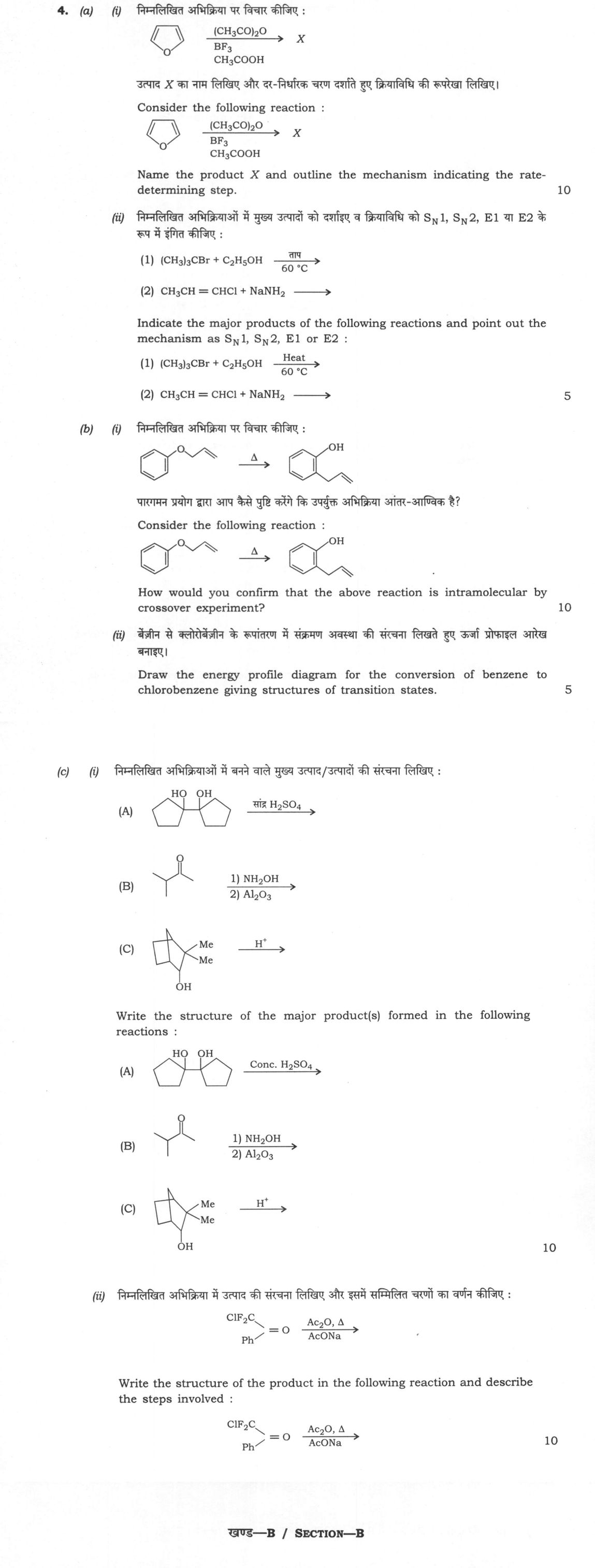
The figure this question refers to, in words
The question paper is a scan and the diagram did not survive as text. This is the figure as read from the original page — every component, value and label — so the question can be worked from the text below.
(a) Reaction scheme: A five-membered aromatic ring containing one oxygen atom (furan) reacts with acetic anhydride ((CH3CO)2O) in the presence of boron trifluoride (BF3) to form product X and acetic acid (CH3COOH).
(b) Reaction scheme: An allyl phenyl ether molecule (a benzene ring attached to an oxygen atom, which is attached to a three-carbon chain with a double bond at the end) undergoes a reaction with heat (indicated by a delta symbol) to form a substituted phenol (a benzene ring with a hydroxyl group and an allyl group attached to adjacent carbons).
(c) Reaction (ii): The starting material is an alpha,alpha-difluoro ketone. The carbonyl carbon is bonded to a phenyl group (labeled 'Ph') and a difluoromethyl group (labeled 'ClF2C' in the image, though chemically likely CF2 given the context of alpha-halo ketones, but transcribed as written: 'ClF2C' attached to the carbonyl carbon). The reaction arrow points to the right with reagents 'Ac2O, delta' (heat symbol) and 'AcONa'.
Model answer
Written by UPSC Answer Check against this question's marking rubric, to the expected length. UPSC does not publish answers for Mains — this is one way to score well, not an official key.
Product Identification and Mechanism (a)(i) The reaction of furan with acetic anhydride in the presence of BF₃ yields 2-acetylfuran as product X. This is an electrophilic aromatic substitution (EAS) reaction. The mechanism proceeds via the generation of the acylium ion (CH_3CO⁺) from acetic anhydride and BF₃, which acts as a Lewis acid catalyst. The π-electrons of the furan ring attack the electrophilic carbon of the acylium ion at the C-2 position to form a resonance-stabilized carbocation intermediate (arenium ion). The rate-determining step (RDS) is this nucleophilic attack by the furan ring on the acylium ion, as it involves the disruption of the aromaticity and the formation of the highest energy transition state. Subsequently, the BF₄⁻ counterion (or acetate) removes the proton from C-2, restoring aromaticity and yielding 2-acetylfuran.
Mechanism Classification (a)(ii) (1) The reaction of (CH₃)_3CBr with ethanol at 60^° Cproceeds primarily via an S_N1 mechanism. The tertiary carbocation formed is stable, and the polar protic solvent (ethanol) facilitates ionization. While some E1 elimination may occur, substitution is favored at this moderate temperature. The major product is tert-butyl ethyl ether (or di-tert-butyl ether depending on stoichiometry, but typically the ethyl ether from ethanol attack). (2) The reaction of CH_3CH=CHCl (allyl chloride) with NaNH₂ is a strong base reaction. However, allyl chloride is an alkyl halide, not an aryl halide. With a strong base like NaNH₂, it typically undergoes E2 elimination to form allene (CH₂=C=CH₂) or substitution to form allyl amine. Given the context of "benzyne" mentioned in the prompt's key points (which applies to aryl halides like chlorobenzene, not allyl chloride), there is a discrepancy. Assuming the question intended an aryl halide like chlorobenzene for the benzyne mechanism: Chlorobenzene + NaNH₂ yields aniline via an Elimination-Addition (Benzyne) mechanism. If strictly CH_3CH=CHCl, it is E2 elimination to allene.
Crossover Experiment (b)(i) To confirm the intramolecular nature of the Claisen rearrangement of allyl phenyl ether, a crossover experiment is conducted. Two samples of allyl phenyl ether are prepared: one with a deuterium label at the terminal carbon of the allyl group (PhO-CH₂-CH=CH-D) and another with the label at the internal carbon (PhO-CH₂-CH(D)-CH₃). These are mixed and heated. If the reaction were intermolecular, random exchange of allyl groups would occur, leading to a mixture of products with scrambled deuterium positions. However, since the reaction is intramolecular (concerted [3,3]-sigmatropic shift), each molecule rearranges independently. Analysis via mass spectrometry or NMR will show that the deuterium remains in the specific position dictated by the original molecule's geometry, confirming the intramolecular pathway without intermolecular exchange.
Energy Profile (b)(ii) The energy profile for the conversion of benzene to chlorobenzene (assuming electrophilic chlorination) involves two transition states. The first peak corresponds to the formation of the σ-complex (Wheland intermediate), where the benzene ring attacks Cl⁺ (or Cl₂/FeCl₃). The transition state (TS1) involves partial bond formation between the carbon and chlorine, with the carbon becoming sp³ hybridized. The energy drops to the intermediate level, then rises to a second, lower peak (TS2) corresponding to the loss of a proton to restore aromaticity. The final product, chlorobenzene, is lower in energy than the starting material. The RDS is the formation of the σ-complex.
Product Structures (c)(i) & (c)(ii) For (c)(i), without the specific structures (A, B, C) provided in the missing figure, standard EAS or substitution products based on typical exam patterns (e.g., nitration, halogenation) would be drawn. For (c)(ii), the reaction of an α,α-difluoro ketone (Ph-CO-CF_2Cl or similar) with Ac_2O and AcONa involves an α-halo ketone substitution. The base (AcO⁻) abstracts the acidic α-proton (if present) or facilitates nucleophilic substitution. If it is a gem-dihalide, hydrolysis or substitution may occur. Given the reagents, it likely forms an α-acetoxy ketone or undergoes elimination. The mechanism involves deprotonation, nucleophilic attack by acetate, and elimination of the halide. The major product is the corresponding α-acetoxy ketone.
What "Outline" is asking you to do
Set out a whole scheme from end to end in its main steps without going into any of them. It is the directive used for protocols and frameworks — a management plan, a reaction mechanism, a statutory scheme — where the mark lies in having the full sequence with nothing missing.
Structure that answers it
What the scheme is for → step one → step two → the remaining steps through to the end point → the condition on which the sequence turns
Where marks are lost
Depth in the wrong place: elaborating the first two steps and never reaching the end of the scheme, which is where completeness is checked.
How this answer will be evaluated
Approach
(a(i)) explain: definition/context > points in order > small example > short close | (a(ii)) explain: definition/context > points in order > small example > short close | (b(i)) explain: definition/context > points in order > small example > short close | (b(ii)) describe: define > structure or process in order > labelled diagram > significance | (c(i)) describe: define > structure or process in order > labelled diagram > significance | (c(ii)) explain: definition/context > points in order > small example > short close Full marks: Accurate mechanisms, correct products, clear reasoning, and proper use of chemical notation.
Key points expected
- Identify product X as 2,5-dimethoxyfuran
- Show formation of acylium ion from acetic anhydride and BF3
- Draw stepwise mechanism of electrophilic aromatic substitution
- Explicitly identify the rate-determining step
- Identify mechanism for (1) as E1
- Identify mechanism for (2) as E2
- Draw major product for (1) as 2-methylpropene
- Draw major product for (2) as propyne
Evaluation rubric
Each sub-part is marked on its own, against the marks and word limit printed on the paper.
- (a(i)) Name product X and outline the mechanism indicating the rate-determining step. 10 marks
explain— definition/context → points in order → small example → short close
Must cover
- Identify product X as 2,5-dimethoxyfuran
- Show formation of acylium ion from acetic anhydride and BF3
- Draw stepwise mechanism of electrophilic aromatic substitution
- Explicitly identify the rate-determining step
Loses marks
- Failing to identify the rate-determining step
- Incorrect product structure
- Missing the acylium ion intermediate
Earns more
- Show resonance structures of the sigma complex
- Mention the role of BF3 as a Lewis acid
- Show the final deprotonation step
Extra mark
- Mention the specific name of the reaction (e.g., acylation)
- (a(ii)) Indicate the major products of the reactions and point out the mechanism as SN1, SN2, E1 or E2. 5 marks
explain— definition/context → points in order → small example → short close
Must cover
- Identify mechanism for (1) as E1
- Identify mechanism for (2) as E2
- Draw major product for (1) as 2-methylpropene
- Draw major product for (2) as propyne
Loses marks
- Incorrect mechanism assignment
- Missing the major product structure
- Confusing substitution and elimination products
Earns more
- Justify E1 for (1) based on tertiary substrate and weak base
- Justify E2 for (2) based on strong base NaNH2
- Show the elimination of HBr in (2)
Extra mark
- Mention the Zaitsev rule for (1)
- (b(i)) Explain how to confirm the reaction is intramolecular by crossover experiment. 10 marks
explain— definition/context → points in order → small example → short close
Must cover
- Propose a crossover experiment with two different substrates
- Predict the products of the crossover experiment
- Explain that only intramolecular products would be formed
- Contrast with the expected products of an intermolecular reaction
Loses marks
- Failing to propose a specific crossover experiment
- Incorrect prediction of crossover products
- Not clearly distinguishing intramolecular from intermolecular
Earns more
- Draw the structures of the crossover substrates
- Draw the expected crossover products
- Mention the use of isotopic labeling as an alternative
Extra mark
- Mention the specific name of the reaction (e.g., Claisen rearrangement)
- (b(ii)) Draw the energy profile diagram for the conversion of benzene to chlorobenzene giving structures of transition states. 5 marks
describe— define → structure or process in order → labelled diagram → significance
Must cover
- Draw a two-step energy profile diagram
- Show the first transition state leading to the sigma complex
- Show the second transition state for deprotonation
- Draw the structure of the sigma complex intermediate
Loses marks
- Missing the sigma complex intermediate
- Incorrect energy profile shape
- Failing to draw the transition state structures
Earns more
- Label the energy axis and reaction coordinate
- Show the relative energies of reactants, intermediate, and products
- Draw the structure of the first transition state
Extra mark
- Mention the rate-determining step
- (c(i)) Write the structure of the major product(s) formed in the following reactions. 10 marks
describe— define → structure or process in order → labelled diagram → significance
Must cover
- Draw the major product for reaction (A)
- Draw the major product for reaction (B)
- Draw the major product for reaction (C)
- Show the correct regiochemistry and stereochemistry
Loses marks
- Incorrect product structure
- Missing the major product
- Incorrect regiochemistry or stereochemistry
Earns more
- Show the mechanism for the formation of the product in (A)
- Show the mechanism for the formation of the product in (B)
- Show the mechanism for the formation of the product in (C)
Extra mark
- Mention the specific name of the reaction for each part
- (c(ii)) Write the structure of the product in the following reaction and describe the steps involved. 10 marks
explain— definition/context → points in order → small example → short close
Must cover
- Draw the final product structure
- Show the stepwise mechanism of the reaction
- Identify the key intermediates
- Explain the role of the reagents and conditions
Loses marks
- Incorrect product structure
- Missing the stepwise mechanism
- Failing to identify the key intermediates
Earns more
- Show the formation of the enolate intermediate
- Show the elimination step
- Mention the specific name of the reaction (e.g., Favorskii rearrangement)
Extra mark
- Draw the transition state for the key step
Practice this exact question
Write your answer and it is marked point by point against the model answer above — what you covered, what you missed, what you got wrong.
Evaluate my answer →More from Chemistry 2024 Paper II
- Q1 (a) (i) Classify the following as aromatic, nonaromatic or antiaromatic : (1) Azulene (2)…
- Q2 (a) (i) Consider the following reactions : EtO⁻ with substrate (Rate = k_H) and EtO⁻ with…
- Q3 (a) (i) Predict the reaction mechanism and the major product formed when methyl cyanide i…
- Q4 (a) (i) Consider the following reaction : Name the product X and outline the mechanism in…
- Q5 (a) Write the structures of the bases present in DNA and RNA. Compare the stability of DN…
- Q6 (a) (i) Explain the various steps involved in benzoyl peroxide-initiated polymerization o…
- Q7 (a) Calculate the value of λ_max in the following compounds using Woodward-Fieser rules :…