Paper II — Q3
(a) (i) Predict the reaction mechanism and the major product formed when methyl cyanide is heated with dilute hydrochloric acid…
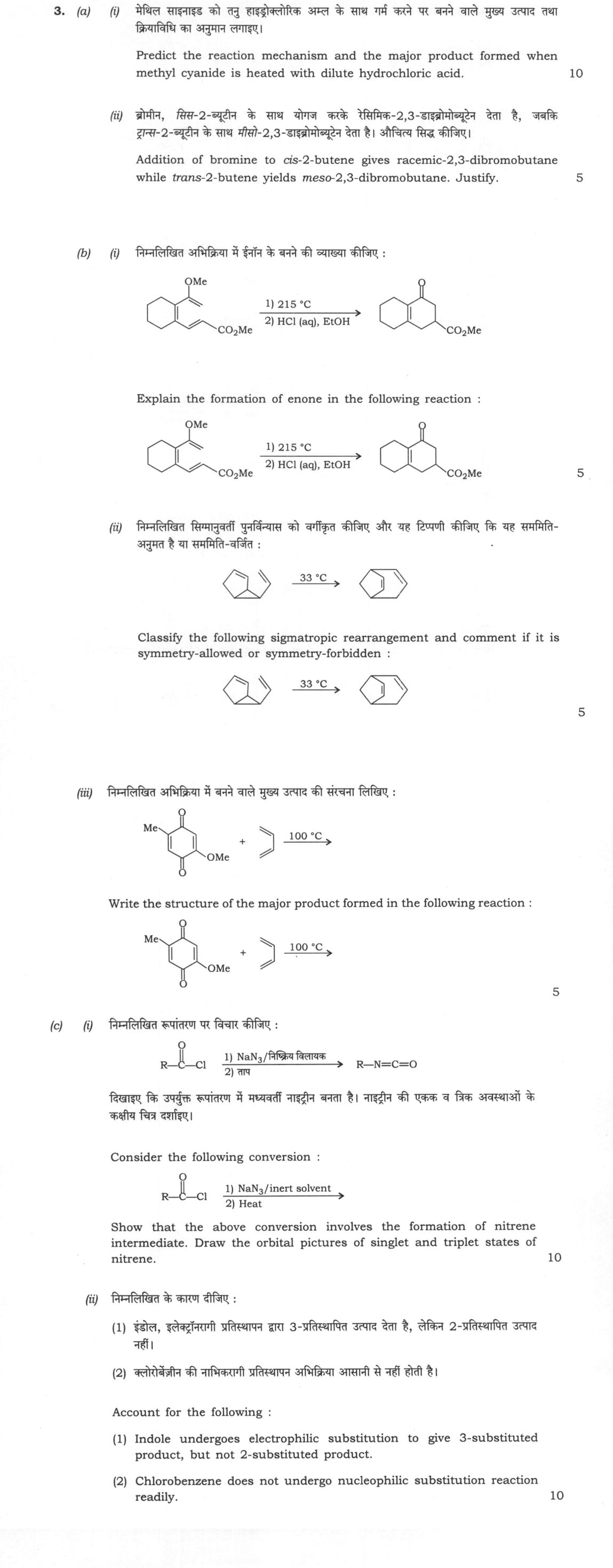
Predict the reaction mechanism and the major product formed when methyl cyanide is heated with dilute hydrochloric acid. 10 marks
Addition of bromine to cis-2-butene gives racemic-2,3-dibromobutane while trans-2-butene yields meso-2,3-dibromobutane. Justify. 5 marks
Explain the formation of enone in the following reaction : 5 marks
Classify the following sigmatropic rearrangement and comment if it is symmetry-allowed or symmetry-forbidden : 5 marks
Write the structure of the major product formed in the following reaction : 5 marks
Consider the following conversion : Show that the above conversion involves the formation of nitrene intermediate. Draw the orbital pictures of singlet and triplet states of nitrene. 10 marks
Account for the following : (1) Indole undergoes electrophilic substitution to give 3-substituted product, but not 2-substituted product. (2) Chlorobenzene does not undergo nucleophilic substitution reaction readily. 10 marks
हिंदी में प्रश्न पढ़ें
मेथिल साइनाइड को तनु हाइड्रोक्लोरिक अम्ल के साथ गर्म करने पर बनने वाले मुख्य उत्पाद तथा क्रियाविधि का अनुमान लगाइए। (10 अंक)
ब्रोमीन, सिस-2-ब्यूटीन के साथ योगज करके रेसिमिक-2,3-डाइब्रोमोब्यूटेन देता है, जबकि ट्रांस-2-ब्यूटीन के साथ मीसो-2,3-डाइब्रोमोब्यूटेन देता है। औचित्य सिद्ध कीजिए। (5 अंक)
निम्नलिखित अभिक्रिया में ईनोन के बनने की व्याख्या कीजिए : (5 अंक)
निम्नलिखित सिग्मानुवर्ती पुनर्विन्यास को वर्गीकृत कीजिए और यह टिप्पणी कीजिए कि यह सममिति-अनुमत है या सममिति-वर्जित : (5 अंक)
निम्नलिखित अभिक्रिया में बनने वाले मुख्य उत्पाद की संरचना लिखिए : (5 अंक)
निम्नलिखित रूपांतरण पर विचार कीजिए : दिखाइए कि उपर्युक्त रूपांतरण में मध्यवर्ती नाइट्रीन बनता है। नाइट्रीन की एकक व त्रिक अवस्थाओं के कक्षीय चित्र दर्शाइए। (10 अंक)
निम्नलिखित के कारण दीजिए : (1) इंडोल, इलेक्ट्रोनार्गी प्रतिस्थापन द्वारा 3-प्रतिस्थापित उत्पाद देता है, लेकिन 2-प्रतिस्थापित उत्पाद नहीं। (2) क्लोरोबेंजीन की नाभिकरागी प्रतिस्थापन अभिक्रिया आसानी से नहीं होती है। (10 अंक)
The figure this question refers to, in words
The question paper is a scan and the diagram did not survive as text. This is the figure as read from the original page — every component, value and label — so the question can be worked from the text below.
(b) Reaction scheme: A six-membered ring containing two ketone groups (a quinone) with a methyl group (Me) at the top-left position and a methoxy group (OMe) at the bottom-right position reacts with ethene (shown as a double bond) in the presence of heat (100 °C) to form a product.
(b(i)) A chemical reaction scheme. The reactant is a bicyclic alkene, specifically a decalin derivative with a double bond in the right-hand ring. This double bond is substituted with a methoxy group (OMe) at the top position and a methyl ester group (CO2Me) at the bottom position. The reaction arrow points to the right, with conditions listed above and below it: '1) 215 °C' and '2) HCl (aq), EtOH'. The product is a bicyclic enone, specifically a decalin derivative with a ketone group (C=O) at the top position of the right-hand ring and a double bond between the top and bottom carbons of the same ring. The methyl ester group (CO2Me) remains attached to the bottom carbon of the double bond.
(b(ii)) A chemical reaction scheme showing a sigmatropic rearrangement. The reactant is a bicyclic alkene, specifically a norbornene derivative with an exocyclic double bond on the five-membered ring portion. The reaction arrow points to the right with the condition '33 °C' written above it. The product is a bicyclic alkene, specifically a norbornene derivative where the double bond has migrated to an endocyclic position within the five-membered ring.
(c) Reaction scheme: An acyl chloride (R-C(=O)-Cl) reacts with sodium azide (NaN3) in an inert solvent, followed by heat, to form an isocyanate (R-N=C=O).
Model answer
Written by UPSC Answer Check against this question's marking rubric, to the expected length. UPSC does not publish answers for Mains — this is one way to score well, not an official key.
The mechanisms required here span polar hydrolysis, stereospecific addition, pericyclic rearrangements, nitrene chemistry and aromatic stabilization.
Acid hydrolysis of methyl cyanide. Protonation of the nitrile nitrogen makes the carbon electrophilic. Water adds to the nitrile carbon, and proton transfers give an imidic acid/amidic intermediate. Further water attack and loss of ammonia/ammonium first gives acetamide; under the same dilute HCl and heat the amide hydrolyses to acetic acid. Overall, CH3CN + 2H2O + HCl gives CH3COOH + NH4Cl.
Bromination stereochemistry. Br2 adds to an alkene through a cyclic bromonium ion, so bromide opens the three-membered ring from the opposite face (anti addition). For cis-2-butene, anti addition to the two equivalent faces gives (2R,3R) and (2S,3S) 2,3-dibromobutane, a racemate. For trans-2-butene, anti addition gives (2R,3S), which has an internal mirror plane and is meso.
Enone formation. The product is an α,β-unsaturated ketone of the aldol-dehydration type, but here the decalin substrate is a cyclic allyl vinyl ether/enol ether. At 215 °C it undergoes a thermal [3,3]-Claisen rearrangement through a six-membered cyclic transition state: the C–O σ bond breaks, a new C–C σ bond forms between the terminal carbons of the allyl and vinyl fragments, and the oxygen-bearing carbon becomes a carbonyl/enol-ether carbon. Acidic aqueous ethanol then hydrolyses the enol ether and tautomerises the product to the enone; the ester remains at the β-carbon.
Sigmatropic classification. In the norbornene derivative, the exocyclic C=C and the ring C=C are connected through a single bond, so the reacting unit is a 1,5-diene. The σ bond that migrates is the central C–C bond of that 1,5-diene; its two termini form the new σ bond. The shift is therefore a [3,3]-sigmatropic Cope rearrangement, not a [1,3] shift. Six pi electrons move in a cyclic array; under thermal conditions a suprafacial-suprafacial [4n+2] process is symmetry-allowed, consistent with reaction at 33 °C.
Quinone–ethene product. The quinone diene behaves as the 4π component in a thermal Diels–Alder reaction with ethene. The major product is the bicyclic [4+2] adduct: a bicyclo[2.2.2]octene dione in which the two ethene carbons are bonded to the terminal diene carbons of the quinone, the internal diene double bond remains as the new alkene, and Me and OMe stay at their original positions.
Nitrene in acyl azide conversion. RCOCl reacts with NaN3 by nucleophilic acyl substitution to give the acyl azide R-C(=O)-N3. On heating, the acyl azide expels N2 to give an acyl nitrene, R-C(=O)-N:. The nitrene is the key intermediate because the R group then migrates from the carbonyl carbon to the electron-deficient nitrogen (Curtius rearrangement) with re-formation of the C=N π bond, giving R-N=C=O. The singlet nitrene is bent, with the N–acyl σ bond in an sp2 orbital, the two nonbonding electrons paired in another sp2 orbital, and an empty p orbital perpendicular to the plane. The triplet is nearly linear, with the N–acyl σ bond in an sp orbital and two unpaired electrons in two orthogonal p orbitals.
Indole and chlorobenzene. Indole is attacked at C-3 because the C-3 Wheland intermediate delocalises positive charge onto nitrogen while the benzene ring remains aromatic; C-2 attack gives a less stabilised cation that disrupts the benzene aromatic sextet, so 3-substitution predominates. Chlorobenzene resists nucleophilic substitution because the C–Cl bond is to an sp2 carbon, is shorter and stronger, and has partial double-bond character from lone-pair donation into the ring. Backside SN2 is geometrically blocked, an aryl cation for SN1 is very unstable, and without ortho/para electron-withdrawing groups a Meisenheimer complex is not formed readily.
Thus, mechanistic reasoning—polar, pericyclic, nitrene and aromatic effects—directly predicts products, stereochemistry and reactivity.
What "Explain" is asking you to do
Make the working of something clear — what sets it off, what follows from what, and what it produces. Explain is the Commission's mechanism word: it dominates the technical papers and the “explain why” stems, where the marks sit in the causal chain and not in the label.
Structure that answers it
State what it is → the initiating condition → the chain of cause, step by step → an instance where it plays out → what the chain produces
Where marks are lost
Describing what something looks like instead of why it works that way. Naming the stages without linking them reads as description too.
How this answer will be evaluated
Approach
(a(i)) explain: definition/context > points in order > small example > short close | (a(ii)) justify: claim > 3-4 reasons > evidence > conclusion | (b(i)) explain: definition/context > points in order > small example > short close | (b(ii)) comment: context > arguments both sides > judgment > close | (b(iii)) describe: define > structure or process in order > labelled diagram > significance | (c(i)) explain: definition/context > points in order > small example > short close | (c(ii)) justify: claim > 3-4 reasons > evidence > conclusion Full marks: Complete mechanisms, correct stereochemistry, clear orbital diagrams, precise reasoning
Key points expected
- Protonation of nitrile nitrogen
- Nucleophilic attack by water
- Tautomerization to amide
- Final product: acetamide
- Anti-addition mechanism
- Bromonium ion intermediate
- Racemic product from cis-2-butene
- Meso product from trans-2-butene
Evaluation rubric
Each sub-part is marked on its own, against the marks and word limit printed on the paper.
- (a(i)) Mechanism and major product of methyl cyanide hydrolysis in dilute HCl. 10 marks
explain— definition/context → points in order → small example → short close
Must cover
- Protonation of nitrile nitrogen
- Nucleophilic attack by water
- Tautomerization to amide
- Final product: acetamide
Loses marks
- Product without mechanism
- Wrong final product
Earns more
- Arrow-pushing mechanism
- Intermediate structures
Extra mark
- Mention of acid catalysis
- (a(ii)) Stereochemical outcome of bromine addition to cis/trans-2-butene. 5 marks
justify— claim → 3-4 reasons → evidence → conclusion
Must cover
- Anti-addition mechanism
- Bromonium ion intermediate
- Racemic product from cis-2-butene
- Meso product from trans-2-butene
Loses marks
- Syn-addition mechanism
- Confusing cis/trans outcomes
Earns more
- Stereochemical drawings
Extra mark
- Mention of backside attack
- (b(i)) Mechanism of enone formation from the given substrate. 5 marks
explain— definition/context → points in order → small example → short close
Must cover
- Thermal rearrangement step
- Hydrolysis of enol ether
- Tautomerization to enone
- Correct product structure
Loses marks
- Missing intermediate
- Wrong product structure
Earns more
- Arrow-pushing mechanism
Extra mark
- Mention of reaction conditions
- (b(ii)) Classification and symmetry analysis of the sigmatropic rearrangement. 5 marks
comment— context → arguments both sides → judgment → close
Must cover
- Classification as [3,3] sigmatropic
- Thermal conditions (33°C)
- Symmetry-allowed (suprafacial)
- Mention of orbital symmetry
Loses marks
- Wrong classification
- Symmetry-forbidden conclusion
Earns more
- FMO diagram
Extra mark
- Mention of Woodward-Hoffmann rules
- (b(iii)) Structure of the major Diels-Alder product. 5 marks
describe— define → structure or process in order → labelled diagram → significance
Must cover
- Diene-dienophile identification
- Cyclohexene ring formation
- Correct regiochemistry
- Stereochemistry of substituents
Loses marks
- Wrong regiochemistry
- Missing product structure
Earns more
- Arrow-pushing mechanism
Extra mark
- Mention of endo rule
- (c(i)) Nitrene intermediate formation and orbital diagrams. 10 marks
explain— definition/context → points in order → small example → short close
Must cover
- Acyl azide formation
- Thermal decomposition to nitrene
- Singlet nitrene orbital diagram
- Triplet nitrene orbital diagram
Loses marks
- Missing orbital diagrams
- Wrong intermediate
Earns more
- Mechanism of Curtius rearrangement
- Orbital energy levels
Extra mark
- Mention of spin states
- (c(ii)) Reasons for indole 3-substitution and chlorobenzene inertness. 10 marks
justify— claim → 3-4 reasons → evidence → conclusion
Must cover
- Indole: 3-position stability
- Indole: resonance structures
- Chlorobenzene: partial double bond character
- Chlorobenzene: sp2 carbon
Loses marks
- Wrong position for indole
- Missing electronic reasoning
Earns more
- Resonance diagrams
- Steric considerations
Extra mark
- Mention of aromaticity
Practice this exact question
Write your answer and it is marked point by point against the model answer above — what you covered, what you missed, what you got wrong.
Evaluate my answer →More from Chemistry 2024 Paper II
- Q1 (a) (i) Classify the following as aromatic, nonaromatic or antiaromatic : (1) Azulene (2)…
- Q2 (a) (i) Consider the following reactions : EtO⁻ with substrate (Rate = k_H) and EtO⁻ with…
- Q3 (a) (i) Predict the reaction mechanism and the major product formed when methyl cyanide i…
- Q4 (a) (i) Consider the following reaction : Name the product X and outline the mechanism in…
- Q5 (a) Write the structures of the bases present in DNA and RNA. Compare the stability of DN…
- Q6 (a) (i) Explain the various steps involved in benzoyl peroxide-initiated polymerization o…