Paper I — Q1
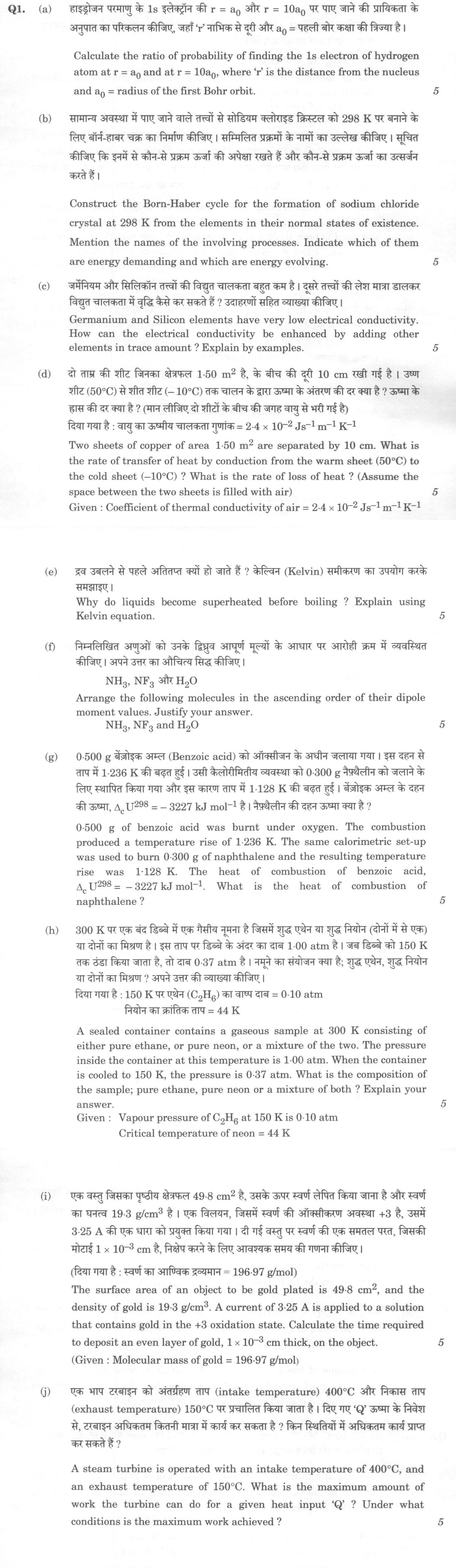
(a) Calculate the ratio of probability of finding the 1s electron of hydrogen atom at r = a₀ and at r = 10a₀, where 'r' is the…
Calculate the ratio of probability of finding the 1s electron of hydrogen atom at r = a₀ and at r = 10a₀, where 'r' is the distance from the nucleus and a₀ = radius of the first Bohr orbit. 5 marks
Construct the Born-Haber cycle for the formation of sodium chloride crystal at 298 K from the elements in their normal states of existence. Mention the names of the involving processes. Indicate which of them are energy demanding and which are energy evolving. 5 marks
Germanium and Silicon elements have very low electrical conductivity. How can the electrical conductivity be enhanced by adding other elements in trace amount? Explain by examples. 5 marks
Two sheets of copper of area 1·50 m² are separated by 10 cm. What is the rate of transfer of heat by conduction from the warm sheet (50°C) to the cold sheet (−10°C)? What is the rate of loss of heat? (Assume the space between the two sheets is filled with air) Given: Coefficient of thermal conductivity of air = 2·4 × 10⁻² Js⁻¹ m⁻¹ K⁻¹ 5 marks
Why do liquids become superheated before boiling? Explain using Kelvin equation. 5 marks
Arrange the following molecules in the ascending order of their dipole moment values. Justify your answer. NH₃, NF₃ and H₂O 5 marks
0·500 g of benzoic acid was burnt under oxygen. The combustion produced a temperature rise of 1·236 K. The same calorimetric set-up was used to burn 0·300 g of naphthalene and the resulting temperature rise was 1·128 K. The heat of combustion of benzoic acid, ΔcU²⁹⁸ = – 3227 kJ mol⁻¹. What is the heat of combustion of naphthalene? 5 marks
A sealed container contains a gaseous sample at 300 K consisting of either pure ethane, or pure neon, or a mixture of the two. The pressure inside the container at this temperature is 1·00 atm. When the container is cooled to 150 K, the pressure is 0·37 atm. What is the composition of the sample; pure ethane, pure neon or a mixture of both? Explain your answer. Given: Vapour pressure of C₂H₆ at 150 K is 0·10 atm Critical temperature of neon = 44 K 5 marks
The surface area of an object to be gold plated is 49.8 cm², and the density of gold is 19.3 g/cm³. A current of 3.25 A is applied to a solution that contains gold in the +3 oxidation state. Calculate the time required to deposit an even layer of gold, 1 × 10⁻³ cm thick, on the object. (Given: Molecular mass of gold = 196.97 g/mol) 5 marks
(j) A steam turbine is operated with an intake temperature of 400°C, and an exhaust temperature of 150°C. What is the maximum amount of work the turbine can do for a given heat input 'Q'? Under what conditions is the maximum work achieved? 5 marks
हिंदी में प्रश्न पढ़ें
हाइड्रोजन परमाणु के 1s इलेक्ट्रॉन की r = a₀ और r = 10a₀ पर पाए जाने की प्रायिकता के अनुपात का परिकलन कीजिए, जहाँ 'r' नाभिक से दूरी और a₀ = पहली बोर कक्षा की त्रिज्या है। (5 अंक)
सामान्य अवस्था में पाए जाने वाले तत्वों से सोडियम क्लोराइड क्रिस्टल को 298 K पर बनाने के लिए बॉर्न-हाबर चक्र का निर्माण कीजिए। सम्मिलित प्रक्रमों के नामों का उल्लेख कीजिए। सूचित कीजिए कि इनमें से कौन-से प्रक्रम ऊर्जा की अपेक्षा रखते हैं और कौन-से प्रक्रम ऊर्जा का उत्सर्जन करते हैं। (5 अंक)
जर्मेनियम और सिलिकॉन तत्वों की विद्युत चालकता बहुत कम है। दूसरे तत्वों की लेश मात्रा डालकर विद्युत चालकता में वृद्धि कैसे कर सकते हैं? उदाहरणों सहित व्याख्या कीजिए। (5 अंक)
दो ताम्र की शीट जिनका क्षेत्रफल 1·50 m² है, के बीच की दूरी 10 cm रखी गई है। उष्ण शीट (50°C) से शीत शीट (−10°C) तक चालन के द्वारा ऊष्मा के अंतरण की दर क्या है? ऊष्मा के ह्रास की दर क्या है? (मान लीजिए दो शीटों के बीच की जगह वायु से भरी गई है) दिया गया है: वायु का ऊष्मीय चालकता गुणांक = 2·4 × 10⁻² Js⁻¹ m⁻¹ K⁻¹ (5 अंक)
द्रव उबलने से पहले अतितप्त क्यों हो जाते हैं? कैल्विन (Kelvin) समीकरण का उपयोग करके समझाइए। (5 अंक)
निम्नलिखित अणुओं को उनके द्विध्रुव आघूर्ण मूल्यों के आधार पर आरोही क्रम में व्यवस्थित कीजिए। अपने उत्तर का औचित्य सिद्ध कीजिए। NH₃, NF₃ और H₂O (5 अंक)
0·500 g बेंजोइक अम्ल (Benzoic acid) को ऑक्सीजन के अधीन जलाया गया। इस दहन से ताप में 1·236 K की बढ़त हुई। उसी कैलोरिमितीय व्यवस्था को 0·300 g नैफ्थलीन को जलाने के लिए स्थापित किया गया और इस कारण ताप में 1·128 K की बढ़त हुई। बेंजोइक अम्ल के दहन की ऊष्मा, ΔcU²⁹⁸ = – 3227 kJ mol⁻¹ है। नैफ्थलीन की दहन ऊष्मा क्या है? (5 अंक)
300 K पर एक बंद डिब्बे में एक गैसीय नमूना है जिसमें शुद्ध एथेन या शुद्ध नियोन (दोनों में से एक) या दोनों का मिश्रण है। इस ताप पर डिब्बे के अंदर का दाब 1·00 atm है। जब डिब्बे को 150 K तक ठंडा किया जाता है, तो दाब 0·37 atm है। नमूने का संयोजन क्या है; शुद्ध एथेन, शुद्ध नियोन या दोनों का मिश्रण? अपने उत्तर की व्याख्या कीजिए। दिया गया है: 150 K पर एथेन (C₂H₆) का वाष्प दाब = 0·10 atm नियोन का कांतिक ताप = 44 K (5 अंक)
एक वस्तु जिसका पृष्ठीय क्षेत्रफल 49.8 cm² है, उसके ऊपर स्वर्ण लेपित किया जाना है और स्वर्ण का घनत्व 19.3 g/cm³ है। एक विलयन, जिसमें स्वर्ण की ऑक्सीकरण अवस्था +3 है, उसमें 3.25 A की एक धारा को प्रयुक्त किया गया। दी गई वस्तु पर स्वर्ण की एक समतल परत, जिसकी मोटाई 1 × 10⁻³ cm है, निषेप करने के लिए आवश्यक समय की गणना कीजिए। (दिया गया है: स्वर्ण का आणविक द्रव्यमान = 196.97 g/mol) (5 अंक)
(j) एक भाप टरबाइन को अंतर्ग्रहण ताप (intake temperature) 400°C और निकास ताप (exhaust temperature) 150°C पर प्रचालित किया जाता है। दिए गए 'Q' ऊष्मा के निवेश से, टरबाइन अधिकतम कितनी मात्रा में कार्य कर सकता है? किन स्थितियों में अधिकतम कार्य प्राप्त कर सकते हैं? (5 अंक)
Model answer
Written by UPSC Answer Check against this question's marking rubric, to the expected length. UPSC does not publish answers for Mains — this is one way to score well, not an official key.
(a) The normalized 1s wavefunction of hydrogen is ψ₁ₛ = (1/√π)(1/a₀)^(3/2) e^(−r/a₀). The radial probability density is P(r) = 4πr²|ψ₁ₛ|² = (4/a₀³) r² e^(−2r/a₀). At r = a₀: P(a₀) = (4/a₀³)a₀² e^(−2) = (4/a₀)e^(−2). At r = 10a₀: P(10a₀) = (4/a₀³)(10a₀)² e^(−20) = (400/a₀)e^(−20). Therefore ratio = (4e^(−2))/(400e^(−20)) = e¹⁸/100. Since e¹⁸ ≈ 6.566 × 10⁷, the radial probability density ratio is ≈ 6.566 × 10⁵. If “probability at r” is taken as point probability density |ψ|², the r² factor is omitted and the ratio becomes e¹⁸ ≈ 6.57 × 10⁷. Final: radial probability density ratio = e¹⁸/100 ≈ 6.57 × 10⁵.
(b) Use Hess’s law to construct the Born–Haber cycle for NaCl(s) from its elements in normal states: Na(s) + ½Cl₂(g) → NaCl(s), ΔfH°₂₉₈ = −411 kJ mol⁻¹. The steps are:
- Sublimation of sodium: Na(s) → Na(g), ΔH_sub = +108 kJ mol⁻¹. Energy demanding.
- Ionization of sodium: Na(g) → Na⁺(g) + e⁻, IE = +496 kJ mol⁻¹. Energy demanding.
- Dissociation of chlorine: ½Cl₂(g) → Cl(g), ½D = +121.5 kJ mol⁻¹. Energy demanding.
- Electron gain by chlorine: Cl(g) + e⁻ → Cl⁻(g), EA = −349 kJ mol⁻¹. Energy evolving.
- Lattice formation: Na⁺(g) + Cl⁻(g) → NaCl(s), ΔH_latt = −787.5 kJ mol⁻¹. Energy evolving. By Hess’s law, ΔfH° = ΔH_sub + IE + ½D + EA + ΔH_latt = 108 + 496 + 121.5 − 349 − 787.5 = −411 kJ mol⁻¹. Energy demanding: sublimation, ionization, chlorine dissociation. Energy evolving: electron gain, lattice formation; overall formation is energy evolving.
(c) Pure germanium and silicon are intrinsic semiconductors. Their small band gaps allow only a few electrons to be thermally excited from the valence band to the conduction band, so conductivity is low. Conductivity can be enhanced greatly by doping, i.e. adding trace amounts of suitable impurities. If a pentavalent element such as P, As or Sb is added to Si or Ge, four valence electrons form covalent bonds, while the fifth is weakly bound at a donor level just below the conduction band. It is easily excited into the conduction band, donating an electron. This gives an n-type semiconductor, with electrons as majority carriers. Example: Si doped with P, or Ge doped with As. If a trivalent element such as B, Al, Ga or In is added, it has only three valence electrons and creates an acceptor level just above the valence band. It accepts an electron from the valence band, leaving a hole. This gives a p-type semiconductor, with holes as majority carriers. Example: Si doped with B, or Ge doped with Ga. Doping at ppm level increases carrier concentration by many orders of magnitude, thereby increasing conductivity.
(d) Use Fourier’s law of heat conduction for steady state: Q/t = kAΔT/L. Here A = 1.50 m², L = 10 cm = 0.10 m, T_hot = 50°C, T_cold = −10°C, so ΔT = 60 K. Given k = 2.4 × 10⁻² J s⁻¹ m⁻¹ K⁻¹. Substituting: Q/t = (2.4 × 10⁻²)(1.50)(60)/(0.10) = 21.6 J s⁻¹ = 21.6 W. Thus the rate of heat transfer by conduction from the warm sheet to the cold sheet is 21.6 W. In steady state, the rate of loss of heat by the warm sheet is also 21.6 W, because the heat it supplies to the air layer is conducted away at the same rate. This assumes air conduction only, steady state, no convection, no radiation and no edge effects. Final: rate of heat transfer = rate of heat loss = 21.6 J s⁻¹ = 21.6 W.
(e) A liquid normally boils when its saturation vapour pressure equals the external pressure. However, boiling requires the formation of vapour bubbles inside the liquid. For a spherical vapour bubble of radius r, surface tension γ produces an excess Laplace pressure 2γ/r, so mechanical equilibrium requires p_v = p_ext + 2γ/r. The Kelvin equation for the curved liquid–vapour interface of a bubble is p_v = p_sat(T) exp(−2γV_m/(rRT)), where V_m is the molar volume of the liquid. Combining these gives p_sat(T) = (p_ext + 2γ/r) exp(2γV_m/(rRT)). Since the exponential factor is greater than 1, p_sat(T) must exceed p_ext. Normal boiling occurs at T_b where p_sat(T_b) = p_ext, so the liquid must be heated above T_b before a small bubble can survive and grow. For very small r, the exponential factor is very large, requiring a large superheat. Nucleation sites such as boiling chips, dust or rough surfaces provide larger effective radii and reduce the required superheat.
(f) The ascending order of dipole moments is NF₃ < NH₃ < H₂O. Typical values are NF₃ ≈ 0.23 D, NH₃ ≈ 1.47 D and H₂O ≈ 1.85 D. NH₃ is trigonal pyramidal. Its three N–H bond dipoles point toward nitrogen, and the lone-pair moment on nitrogen reinforces the resultant, giving a sizable net dipole. NF₃ is also pyramidal, but the N–F bond dipoles point from nitrogen to fluorine, opposite in sense to the lone-pair contribution on nitrogen. Therefore they largely cancel, leaving only a very small net dipole moment. H₂O is bent. The two O–H bond dipoles point toward oxygen and their vector sum is large because of the bent geometry; the lone-pair contributions also add to this resultant. Hence water has the largest dipole moment. Final order: NF₃ < NH₃ < H₂O.
(g) Use the benzoic acid combustion to calibrate the calorimeter. Molar mass of benzoic acid, C₇H₆O₂ = 122.12 g mol⁻¹. Moles of benzoic acid = 0.500/122.12 = 4.094 × 10⁻³ mol. Heat released = 4.094 × 10⁻³ × 3227 = 13.21 kJ. Therefore calorimeter constant C_cal = q/ΔT = 13.21/1.236 = 10.69 kJ K⁻¹. For naphthalene, C₁₀H₈, molar mass = 128.17 g mol⁻¹. Moles = 0.300/128.17 = 2.341 × 10⁻³ mol. Heat released by naphthalene = C_cal ΔT = 10.69 × 1.128 = 12.06 kJ. Hence ΔcU(naphthalene) = −q/n = −12.06/(2.341 × 10⁻³) = −5.15 × 10³ kJ mol⁻¹. Since a bomb calorimeter is constant-volume, the value obtained is ΔcU. Final: ΔcU(naphthalene) ≈ −5.15 × 10³ kJ mol⁻¹, i.e. about −5151 kJ mol⁻¹.
(h) For a non-condensing gas at fixed volume, P ∝ T. Neon has critical temperature 44 K, so at 150 K neon remains gaseous. If the sample were pure neon, cooling from 300 K to 150 K would give P = 1.00 × (150/300) = 0.50 atm, not 0.37 atm. Hence it is not pure neon. If the sample were pure ethane, at 150 K its vapour pressure is 0.10 atm. The ideal cooled pressure would be 0.50 atm, which exceeds 0.10 atm, so ethane would condense until the vapour pressure fell to 0.10 atm. The final pressure would then be 0.10 atm, not 0.37 atm. Hence it is not pure ethane. Therefore the sample is a mixture. At 150 K, neon contributes its ideal-gas partial pressure and ethane contributes its vapour pressure 0.10 atm. Let p_Ne(150) = x. Then x + 0.10 = 0.37, so x = 0.27 atm. Back at 300 K, p_Ne(300) = 0.27 × (300/150) = 0.54 atm. Thus initial ethane pressure = 1.00 − 0.54 = 0.46 atm. Composition: mixture of ethane and neon; at 300 K, mole fractions are Ne ≈ 0.54 and C₂H₆ ≈ 0.46.
(i) Use Faraday’s laws of electrolysis. Volume of gold layer = area × thickness = 49.8 cm² × 1 × 10⁻³ cm = 0.0498 cm³. Mass of gold = density × volume = 19.3 g cm⁻³ × 0.0498 cm³ = 0.96114 g. Moles of gold = 0.96114/196.97 = 4.879 × 10⁻³ mol. Gold is in +3 oxidation state, so Au³⁺ + 3e⁻ → Au. Moles of electrons required = 3 × 4.879 × 10⁻³ = 1.464 × 10⁻² mol. Charge Q = n_e F = 1.464 × 10⁻² × 96485 C mol⁻¹ = 1.412 × 10³ C. Given current I = 3.25 A = 3.25 C s⁻¹, time t = Q/I = 1.412 × 10³/3.25 = 434.6 s = 7.24 min. Final: time required ≈ 435 s, i.e. about 7 min 15 s.
(j) The maximum work obtainable from a heat engine is limited by the Carnot efficiency. Convert temperatures to kelvin: T_hot = 400°C + 273.15 = 673.15 K, T_cold = 150°C + 273.15 = 423.15 K. Then η_max = 1 − T_cold/T_hot = 1 − 423.15/673.15 = 250/673.15 = 0.3714. For heat input Q, maximum work W_max = η_max Q = 0.3714 Q = (250/673.15)Q. Thus the turbine can convert at most about 37.1% of the heat input into work. This maximum is achieved only under reversible Carnot conditions: heat is absorbed reversibly at T_hot, rejected reversibly at T_cold, with reversible adiabatic expansion and compression, no friction, no heat leaks, no entropy generation, and infinitesimal temperature differences between the working fluid and the reservoirs. Final: W_max = 0.371 Q, i.e. 37.1% of the heat input.
What "Solve" is asking you to do
Choose the method, then carry it through to a final answer. Identifying what kind of problem this is and why that method applies is the first thing marked; a correct figure arrived at invisibly earns almost nothing.
Structure that answers it
Given data and what is required → method chosen, with the reason it applies → set-up (equation, circuit, free body, trial balance) → working, step by step → answer with units and any condition of validity
Where marks are lost
Doing the middle steps mentally and writing only the result. In mathematics papers, a further loss comes from giving a decimal where the exact value in surds or fractions was wanted, or from skipping the justification a part explicitly asks for.
How this answer will be evaluated
Approach
(a) calculate: given > formula > substitution > result with units > interpretation | (b) describe: define > structure or process in order > labelled diagram > significance | (c) explain: definition/context > points in order > small example > short close | (d) calculate: given > formula > substitution > result with units > interpretation | (e) explain: definition/context > points in order > small example > short close | (f) justify: claim > 3-4 reasons > evidence > conclusion | (g) calculate: given > formula > substitution > result with units > interpretation | (h) justify: claim > 3-4 reasons > evidence > conclusion | (i) calculate: given > formula > substitution > result with units > interpretation | (j) calculate: given > formula > substitution > result with units > interpretation Full marks: All parts with correct methods, full working, and accurate final answers.
Key points expected
- Use 1s radial probability density function
- Substitute r=a0 and r=10a0 into the function
- Calculate the ratio of the two values
- Final numerical answer
- Sublimation of Na (endothermic)
- Dissociation of Cl2 (endothermic)
- Ionization of Na (endothermic)
- Electron affinity of Cl (exothermic)
Evaluation rubric
Each sub-part is marked on its own, against the marks and word limit printed on the paper.
- (a) Ratio of probability density for 1s electron at r=a0 and r=10a0. 5 marks
calculate— given → formula → substitution → result with units → interpretation
Must cover
- Use 1s radial probability density function
- Substitute r=a0 and r=10a0 into the function
- Calculate the ratio of the two values
- Final numerical answer
Loses marks
- Using radial distribution function instead of density
- Arithmetic errors in exponent calculation
Earns more
- Explicit mention of exponential decay term
- Correct units or dimensionless nature
Extra mark
- Graphical representation of probability density
- (b) Born-Haber cycle for NaCl formation with process names and energy signs. 5 marks
describe— define → structure or process in order → labelled diagram → significance
Must cover
- Sublimation of Na (endothermic)
- Dissociation of Cl2 (endothermic)
- Ionization of Na (endothermic)
- Electron affinity of Cl (exothermic)
Loses marks
- Missing lattice energy step
- Incorrect sign for electron affinity
Earns more
- Lattice energy (exothermic)
- Correct enthalpy cycle diagram
Extra mark
- Numerical values for each step
- (c) Mechanism of conductivity enhancement in Ge/Si via doping. 5 marks
explain— definition/context → points in order → small example → short close
Must cover
- Definition of doping
- n-type doping with Group 15 elements
- p-type doping with Group 13 elements
- Example of specific dopant (e.g., P, B)
Loses marks
- Confusing n-type and p-type dopants
- No specific element examples
Earns more
- Band gap explanation
- Carrier concentration increase
Extra mark
- Energy level diagram of doped semiconductor
- (d) Rate of heat transfer by conduction through air gap. 5 marks
calculate— given → formula → substitution → result with units → interpretation
Must cover
- Fourier's law of heat conduction
- Substitution of given values (A, d, T1, T2, k)
- Calculation of temperature difference (60 K)
- Final rate in Watts
Loses marks
- Using Celsius difference directly without conversion
- Incorrect formula for conduction
Earns more
- Correct unit conversion for distance
- Explicit statement of assumptions
Extra mark
- Comparison with convection losses
- (e) Reason for superheating using Kelvin equation. 5 marks
explain— definition/context → points in order → small example → short close
Must cover
- Kelvin equation for curved surfaces
- Effect of small bubble radius on vapor pressure
- Requirement for critical bubble size
- Nucleation site necessity
Loses marks
- Ignoring surface tension effects
- Incorrect sign in Kelvin equation
Earns more
- Mathematical form of Kelvin equation
- Explanation of metastable state
Extra mark
- Diagram of bubble growth
- (f) Ascending order of dipole moments for NH3, NF3, H2O. 5 marks
justify— claim → 3-4 reasons → evidence → conclusion
Must cover
- Correct order: NF3 < NH3 < H2O
- Vector addition of bond dipoles
- Effect of lone pair on net dipole
- Electronegativity difference analysis
Loses marks
- Ignoring lone pair contribution
- Incorrect vector direction for NF3
Earns more
- Molecular geometry (trigonal pyramidal vs bent)
- Comparison of bond angles
Extra mark
- Numerical dipole moment values
- (g) Heat of combustion of naphthalene from calorimetry data. 5 marks
calculate— given → formula → substitution → result with units → interpretation
Must cover
- Calorimeter constant calculation from benzoic acid
- Moles of benzoic acid calculation
- Moles of naphthalene calculation
- Final heat of combustion in kJ/mol
Loses marks
- Incorrect molar mass usage
- Forgetting to convert mass to moles
Earns more
- Correct sign convention for exothermic
- Unit consistency throughout
Extra mark
- Error propagation analysis
- (h) Determine gas composition from pressure-temperature data. 5 marks
justify— claim → 3-4 reasons → evidence → conclusion
Must cover
- Ideal gas law application
- Check for ethane condensation at 150 K
- Comparison with vapor pressure (0.10 atm)
- Conclusion: mixture of ethane and neon
Loses marks
- Assuming ideal behavior for ethane at 150 K
- Ignoring condensation possibility
Earns more
- Partial pressure calculation
- Neon remains gaseous (Tc=44 K)
Extra mark
- Phase diagram reference
- (i) Time required for gold plating to specified thickness. 5 marks
calculate— given → formula → substitution → result with units → interpretation
Must cover
- Volume of gold to be deposited
- Mass of gold from volume and density
- Moles of gold from mass and molar mass
- Faraday's law application for time
Loses marks
- Using wrong oxidation state
- Incorrect volume calculation
Earns more
- Correct valence factor (n=3)
- Unit conversions (cm to m)
Extra mark
- Current efficiency consideration
- (j) Maximum work from steam turbine and conditions for it. 5 marks
calculate— given → formula → substitution → result with units → interpretation
Must cover
- Carnot efficiency formula
- Temperature conversion to Kelvin
- Efficiency calculation (1 - Tc/Th)
- Maximum work = Efficiency x Q
Loses marks
- Using Celsius in efficiency formula
- Confusing work with heat
Earns more
- Reversible process condition
- Heat reservoir assumption
Extra mark
- T-S diagram of Carnot cycle
Practice this exact question
Write your answer and it is marked point by point against the model answer above — what you covered, what you missed, what you got wrong.
Evaluate my answer →More from Chemistry 2025 Paper I
- Q1 (a) Calculate the ratio of probability of finding the 1s electron of hydrogen atom at r =…
- Q2 (a) Find the probability of existence of a particle in a one-dimensional box of length 'a…
- Q3 (a) Calculate the number of collisions that oxygen makes per second on 1·00 cm² of the su…
- Q4 (a) Draw the molecular orbital (MO) diagram of NO molecule. The experimental bond dissoci…