Paper I — Q6
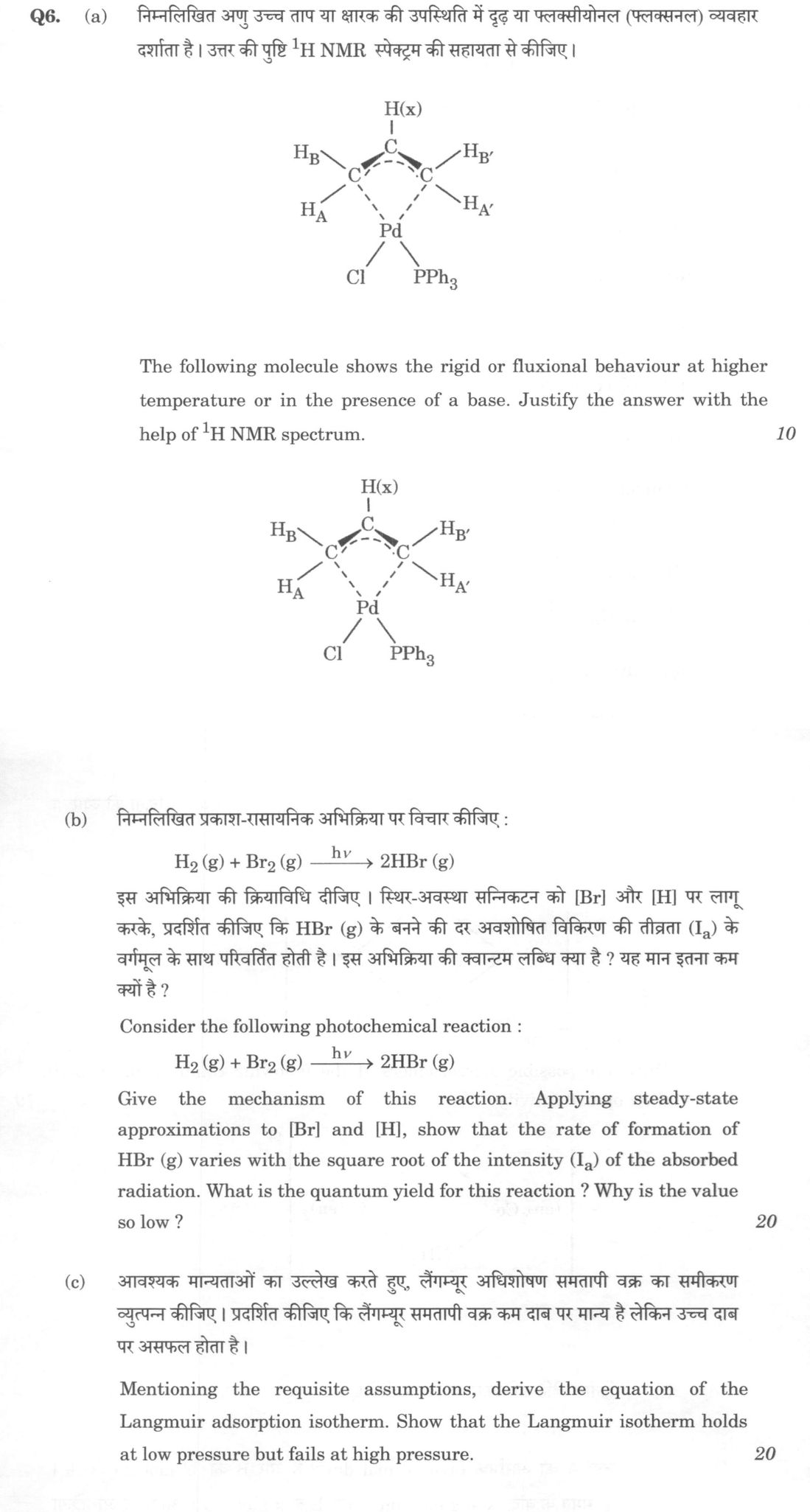
(a) The following molecule shows the rigid or fluxional behaviour at higher temperature or in the presence of a base. Justify the…
The following molecule shows the rigid or fluxional behaviour at higher temperature or in the presence of a base. Justify the answer with the help of ¹H NMR spectrum. 10 marks
Consider the following photochemical reaction: H₂ (g) + Br₂ (g) →[hν] 2HBr (g). Give the mechanism of this reaction. Applying steady-state approximations to [Br] and [H], show that the rate of formation of HBr (g) varies with the square root of the intensity (Iₐ) of the absorbed radiation. What is the quantum yield for this reaction? Why is the value so low? 20 marks
Mentioning the requisite assumptions, derive the equation of the Langmuir adsorption isotherm. Show that the Langmuir isotherm holds at low pressure but fails at high pressure. 20 marks
हिंदी में प्रश्न पढ़ें
निम्नलिखित अणु उच्च ताप या क्षारक की उपस्थिति में दृढ़ या फ्लक्सीयोनल (फ्लक्सनल) व्यवहार दर्शाता है। उत्तर की पुष्टि ¹H NMR स्पेक्ट्रम की सहायता से कीजिए। (10 अंक)
निम्नलिखित प्रकाश-रासायनिक अभिक्रिया पर विचार कीजिए: H₂ (g) + Br₂ (g) →[hν] 2HBr (g)। इस अभिक्रिया की क्रियाविधि दीजिए। स्थिर-अवस्था सन्निकटन को [Br] और [H] पर लागू करके, प्रदर्शित कीजिए कि HBr (g) के बनने की दर अवशोषित विकिरण की तीव्रता (Iₐ) के वर्गमूल के साथ परिवर्तित होती है। इस अभिक्रिया की क्वांटम लब्धि क्या है? यह मान इतना कम क्यों है? (20 अंक)
आवश्यक मान्यताओं का उल्लेख करते हुए, लैंगम्यूर अधिशोषण समतापी वक्र का समीकरण व्युत्पन्न कीजिए। प्रदर्शित कीजिए कि लैंगम्यूर समतापी वक्र कम दाब पर मान्य है लेकिन उच्च दाब पर असफल होता है। (20 अंक)
Model answer
Written by UPSC Answer Check against this question's marking rubric, to the expected length. UPSC does not publish answers for Mains — this is one way to score well, not an official key.
[(a)] The figure printed on the original question paper for this part could not be recovered from the scan, so this part is not answered here.
Part (b) The photochemical reaction is a radical chain process. Initiation is Br₂ + hν → 2Br•; if I_a is the rate of photon absorption, the primary production rate of Br atoms is 2I_a. Propagation consists of Br• + H₂ → HBr + H• (k₂) and H• + Br₂ → HBr + Br• (k₃). The product HBr can also react with Br•, HBr + Br• → H₂ + Br₂ (k₋₁), which inhibits the chain. Termination is 2Br• + M → Br₂ + M (k₄); because [M] is the constant concentration of the third body, the effective termination constant is k₄[M].
Steady-state for H• gives d[H•]/dt = k₂[Br•][H₂] − k₃[H•][Br₂] − k₋₁[H•][HBr] = 0, hence [H•] = k₂[Br•][H₂]/(k₃[Br₂] + k₋₁[HBr]). The net HBr formation rate is d[HBr]/dt = k₂[Br•][H₂] + k₃[H•][Br₂] − k₋₁[H•][HBr] = 2k₂k₃[Br•][H₂][Br₂]/(k₃[Br₂] + k₋₁[HBr]). For Br•, d[Br•]/dt = 2I_a − k₂[Br•][H₂] + k₃[H•][Br₂] − k₋₁[H•][HBr] − 2k₄[M][Br•]² = 0. Substituting [H•] gives I_a = k₄[M][Br•]² + k₂k₋₁[Br•][H₂][HBr]/(k₃[Br₂] + k₋₁[HBr]). When HBr is small, the second term is negligible, so [Br•] ≈ (I_a/k₄[M])^1/2. Therefore d[HBr]/dt ≈ 2k₂[H₂](I_a/k₄[M])^1/2, showing the required square-root dependence on absorbed intensity. The square-root law is therefore a direct consequence of second-order radical termination competing with first-order photon production. With appreciable HBr, the rate is reduced by the factor 1/(1 + k₋₁[HBr]/(k₃[Br₂])).
The primary quantum yield (Φ) is 2, since one photon produces two Br atoms. In the simplified low-conversion treatment the observed quantum yield is therefore about 2, i.e. of order unity (commonly 1 to 2), and it decreases as HBr accumulates. Thus, in the limiting case, the chain length is close to one. It is low compared with very long chain reactions because many Br atoms recombine in the encounter pair or gas cage, terminate by 2Br• + M, or are consumed by the back reaction with HBr before they can propagate many cycles; Br• + H₂ is also relatively slow, so the chain length remains short.
Part (c) The Langmuir isotherm rests on five assumptions: adsorption is confined to a monolayer; the surface contains a fixed number of equivalent sites; adsorbed molecules do not interact laterally; adsorption and desorption are elementary steps that reach dynamic equilibrium; and the enthalpy of adsorption is independent of coverage. Let θ be the fractional coverage and P the gas pressure. The rate of adsorption is proportional to the pressure and the number of vacant sites, k_a P(1−θ); the rate of desorption is proportional to occupied sites, k_d θ. At equilibrium, k_a P(1−θ) = k_d θ. Rearranging gives θ = KP/(1+KP), where K = k_a/k_d. Equivalently, P/θ = 1/K + P, which is linear in P. The linear form is useful experimentally because a plot of P/θ against P gives a straight line whose intercept gives 1/K.
At low pressure, KP is much less than 1, so θ ≈ KP and the amount adsorbed is directly proportional to pressure; this is the Henry-law region where the Langmuir model is most reliable. As pressure rises, KP becomes large, θ approaches unity, and the surface approaches monolayer saturation. At high pressure the simple Langmuir form often fails because real adsorption is not limited to one ideal layer: surfaces are heterogeneous, adsorbate-adsorbate interactions become important, and multilayer adsorption can occur. In such cases the amount adsorbed may continue to increase beyond monolayer saturation, or the apparent K may vary with coverage. BET, Freundlich, or Temkin isotherms then provide better descriptions. Thus Langmuir adsorption correctly explains the initial linear uptake and monolayer saturation, but it cannot account for the non-ideal, multilayer behaviour that dominates at high pressure.
What "Explain" is asking you to do
Make the working of something clear — what sets it off, what follows from what, and what it produces. Explain is the Commission's mechanism word: it dominates the technical papers and the “explain why” stems, where the marks sit in the causal chain and not in the label.
Structure that answers it
State what it is → the initiating condition → the chain of cause, step by step → an instance where it plays out → what the chain produces
Where marks are lost
Describing what something looks like instead of why it works that way. Naming the stages without linking them reads as description too.
How this answer will be evaluated
Approach
(a) justify: claim > 3-4 reasons > evidence > conclusion | (b) derive: given > assumptions > stepwise derivation > result > check | (c) derive: given > assumptions > stepwise derivation > result > check Full marks: Complete derivations with clear mechanisms and NMR justification
Key points expected
- Identify the molecule as a Pd-allyl complex
- State the fluxional behavior (e.g., η1-η3 equilibrium)
- Link fluxionality to high temperature or base
- Justify using 1H NMR signal averaging or splitting
- Provide the chain mechanism (initiation, propagation, termination)
- Apply steady-state approximation to [Br] and [H]
- Show rate is proportional to square root of intensity (Ia)
- Explain why quantum yield is low (chain length)
Evaluation rubric
Each sub-part is marked on its own, against the marks and word limit printed on the paper.
- (a) Determine if the Pd-allyl complex is rigid or fluxional and justify using 1H NMR. 10 marks
justify— claim → 3-4 reasons → evidence → conclusion
Must cover
- Identify the molecule as a Pd-allyl complex
- State the fluxional behavior (e.g., η1-η3 equilibrium)
- Link fluxionality to high temperature or base
- Justify using 1H NMR signal averaging or splitting
Loses marks
- Claiming the molecule is rigid without NMR evidence
- Confusing fluxionality with simple rotation
- Failing to link NMR data to the structural change
Earns more
- Mention specific NMR chemical shift changes
- Draw the η1 and η3 isomers
- Explain the role of the base in deprotonation
Extra mark
- Reference specific literature examples of Pd-allyl fluxionality
- (b) Derive the rate law for HBr formation and explain the low quantum yield. 20 marks
derive— given → assumptions → stepwise derivation → result → check
Must cover
- Provide the chain mechanism (initiation, propagation, termination)
- Apply steady-state approximation to [Br] and [H]
- Show rate is proportional to square root of intensity (Ia)
- Explain why quantum yield is low (chain length)
Loses marks
- Omitting the termination steps in the mechanism
- Failing to show the square root dependence on intensity
- Not explaining the physical reason for low quantum yield
Earns more
- Write out the specific elementary steps with rate constants
- Show the algebraic steps for the steady-state derivation
- Mention the role of light absorption in initiation
Extra mark
- Calculate a typical quantum yield value for this reaction
- (c) Derive the Langmuir isotherm and show its validity at low pressure and failure at high pressure. 20 marks
derive— given → assumptions → stepwise derivation → result → check
Must cover
- State the assumptions of the Langmuir model
- Derive the equation θ = KP / (1 + KP)
- Show that θ ≈ KP at low pressure (linear)
- Show that θ ≈ 1 at high pressure (saturation)
Loses marks
- Failing to state the assumptions before deriving
- Not showing the mathematical limits for low and high pressure
- Confusing Langmuir with other isotherms like BET
Earns more
- Define the surface coverage θ clearly
- Show the rate of adsorption equals rate of desorption
- Graph the isotherm showing the two limits
Extra mark
- Mention the limitations of the model (e.g., no lateral interactions)
Practice this exact question
Write your answer and it is marked point by point against the model answer above — what you covered, what you missed, what you got wrong.
Evaluate my answer →More from Chemistry 2025 Paper I
- Q3 (a) Calculate the number of collisions that oxygen makes per second on 1·00 cm² of the su…
- Q4 (a) Draw the molecular orbital (MO) diagram of NO molecule. The experimental bond dissoci…
- Q5 (a) The gas-phase reaction between methane (CH₄) and diatomic sulphur (S₂) is given by th…
- Q6 (a) The following molecule shows the rigid or fluxional behaviour at higher temperature o…
- Q7 (a) Distinguish the "T" (tense) and 'R' (relax) conformations of Hemoglobin on reversible…
- Q8 (a) Draw the structures of S₂N₂, S₄N₂, S₁₁N₂, S₅N₆ and I₂Cl₆. 10 marks (b) What are silic…