Paper I — Q5
(a) The gas-phase reaction between methane (CH₄) and diatomic sulphur (S₂) is given by the following reaction: CH₄ (g) + 2S₂ (g)…
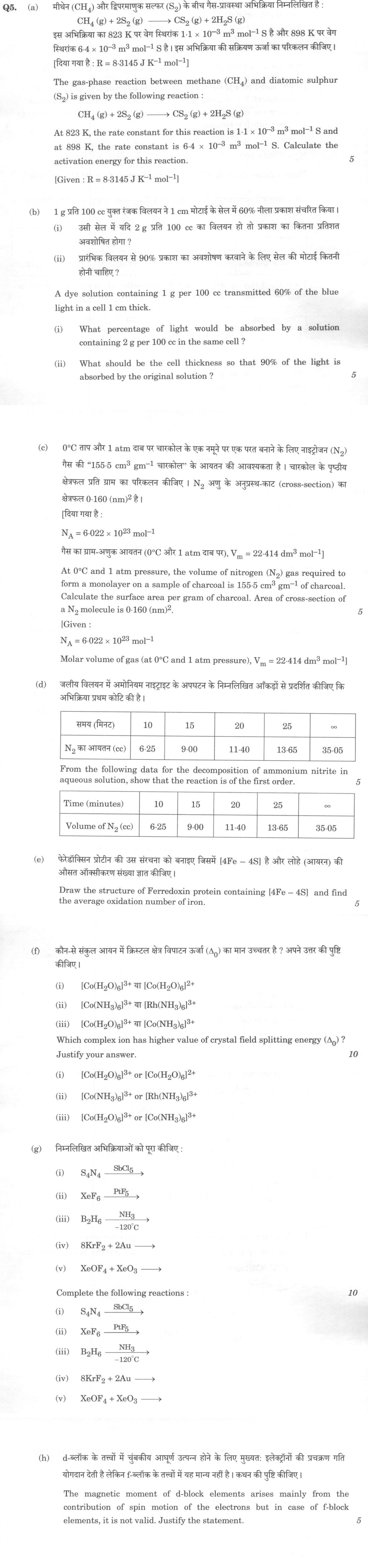
The gas-phase reaction between methane (CH₄) and diatomic sulphur (S₂) is given by the following reaction: CH₄ (g) + 2S₂ (g) ———→ CS₂ (g) + 2H₂S (g). At 823 K, the rate constant for this reaction is 1·1 × 10⁻³ m³ mol⁻¹ S and at 898 K, the rate constant is 6·4 × 10⁻³ m³ mol⁻¹ S. Calculate the activation energy for this reaction. [Given: R = 8·3145 J K⁻¹ mol⁻¹] 5 marks
A dye solution containing 1 g per 100 cc transmitted 60% of the blue light in a cell 1 cm thick. (i) What percentage of light would be absorbed by a solution containing 2 g per 100 cc in the same cell? (ii) What should be the cell thickness so that 90% of the light is absorbed by the original solution? 5 marks
At 0°C and 1 atm pressure, the volume of nitrogen (N₂) gas required to form a monolayer on a sample of charcoal is 155·5 cm³ gm⁻¹ of charcoal. Calculate the surface area per gram of charcoal. Area of cross-section of a N₂ molecule is 0·160 (nm)². [Given: Nₐ = 6·022 × 10²³ mol⁻¹; Molar volume of gas (at 0°C and 1 atm pressure), Vₘ = 22·414 dm³ mol⁻¹] 5 marks
From the following data for the decomposition of ammonium nitrite in aqueous solution, show that the reaction is of the first order. | Time (minutes) | 10 | 15 | 20 | 25 | ∞ | |---|---|---|---|---|---| | Volume of N₂ (cc) | 6·25 | 9·00 | 11·40 | 13·65 | 35·05 | 5 marks
Draw the structure of Ferredoxin protein containing [4Fe – 4S] and find the average oxidation number of iron. 5 marks
Which complex ion has higher value of crystal field splitting energy (Δ₀)? Justify your answer. (i) [Co(H₂O)₆]³⁺ or [Co(H₂O)₆]²⁺ (ii) [Co(NH₃)₆]³⁺ or [Rh(NH₃)₆]³⁺ (iii) [Co(H₂O)₆]³⁺ or [Co(NH₃)₆]³⁺ 10 marks
Complete the following reactions: (i) S₄N₄ →[SbCl₅] (ii) XeF₆ →[PtF₅] (iii) B₂H₆ →[NH₃][-120°C] (iv) 8KrF₂ + 2Au → (v) XeOF₄ + XeO₃ → 10 marks
The magnetic moment of d-block elements arises mainly from the contribution of spin motion of the electrons but in case of f-block elements, it is not valid. Justify the statement. 5 marks
हिंदी में प्रश्न पढ़ें
मीथेन (CH₄) और द्विपरमाणुक सल्फर (S₂) के बीच गैस-प्रावस्था अभिक्रिया निम्नलिखित है: CH₄ (g) + 2S₂ (g) ———→ CS₂ (g) + 2H₂S (g)। इस अभिक्रिया का 823 K पर वेग स्थिरांक 1·1 × 10⁻³ m³ mol⁻¹ S है और 898 K पर वेग स्थिरांक 6·4 × 10⁻³ m³ mol⁻¹ S है। इस अभिक्रिया की सक्रियण ऊर्जा का परिकलन कीजिए। [दिया गया है: R = 8·3145 J K⁻¹ mol⁻¹] (5 अंक)
1 g प्रति 100 cc युक्त रंजक विलयन ने 1 cm मोटाई के सेल में 60% नीला प्रकाश संचरित किया। (i) उसी सेल में यदि 2 g प्रति 100 cc का विलयन हो तो प्रकाश का कितना प्रतिशत अवशोषित होगा? (ii) प्रारंभिक विलयन से 90% प्रकाश का अवशोषण करवाने के लिए सेल की मोटाई कितनी होनी चाहिए? (5 अंक)
0°C ताप और 1 atm दाब पर चारकोल के एक नमूने पर एक परत बनाने के लिए नाइट्रोजन (N₂) गैस की "155·5 cm³ gm⁻¹ चारकोल" के आयतन की आवश्यकता है। चारकोल के पृष्ठीय क्षेत्रफल प्रति ग्राम का परिकलन कीजिए। N₂ अणु के अनुप्रस्थ-काट (cross-section) का क्षेत्रफल 0·160 (nm)² है। [दिया गया है: Nₐ = 6·022 × 10²³ mol⁻¹; गैस का ग्राम-अणुक आयतन (0°C और 1 atm दाब पर), Vₘ = 22·414 dm³ mol⁻¹] (5 अंक)
जलीय विलयन में अमोनियम नाइट्राइट के अपघटन के निम्नलिखित आँकड़ों से प्रदर्शित कीजिए कि अभिक्रिया प्रथम कोटि की है। | समय (मिनट) | 10 | 15 | 20 | 25 | ∞ | |---|---|---|---|---|---| | N₂ का आयतन (cc) | 6·25 | 9·00 | 11·40 | 13·65 | 35·05 | (5 अंक)
फेर्रोडॉक्सिन प्रोटीन की उस संरचना को बनाइए जिसमें [4Fe – 4S] है और लोहे (आयरन) की औसत ऑक्सीकरण संख्या ज्ञात कीजिए। (5 अंक)
कौन-से संकुल आयन में क्रिस्टल क्षेत्र विपाटन ऊर्जा (Δ₀) का मान उच्चतर है? अपने उत्तर की पुष्टि कीजिए। (i) [Co(H₂O)₆]³⁺ या [Co(H₂O)₆]²⁺ (ii) [Co(NH₃)₆]³⁺ या [Rh(NH₃)₆]³⁺ (iii) [Co(H₂O)₆]³⁺ या [Co(NH₃)₆]³⁺ (10 अंक)
निम्नलिखित अभिक्रियाओं को पूरा कीजिए: (i) S₄N₄ →[SbCl₅] (ii) XeF₆ →[PtF₅] (iii) B₂H₆ →[NH₃][-120°C] (iv) 8KrF₂ + 2Au → (v) XeOF₄ + XeO₃ → (10 अंक)
d-ब्लॉक के तत्वों में चुंबकीय आघूर्ण उत्पन्न होने के लिए मुख्यतः इलेक्ट्रॉनों की प्रचक्रण गति योगदान देती है लेकिन f-ब्लॉक के तत्वों में यह मान्य नहीं है। कथन की पुष्टि कीजिए। (5 अंक)
Model answer
Written by UPSC Answer Check against this question's marking rubric, to the expected length. UPSC does not publish answers for Mains — this is one way to score well, not an official key.
(a) The temperature dependence of the rate constant is given by the Arrhenius equation. In its two-temperature form, ln(k₂/k₁) = Eₐ/R (1/T₁ − 1/T₂) so Eₐ = [R T₁ T₂/(T₂ − T₁)] ln(k₂/k₁).
Given: k₁ = 1.1 × 10⁻³ m³ mol⁻¹ s⁻¹ at T₁ = 823 K k₂ = 6.4 × 10⁻³ m³ mol⁻¹ s⁻¹ at T₂ = 898 K R = 8.3145 J K⁻¹ mol⁻¹
Thus, k₂/k₁ = (6.4 × 10⁻³)/(1.1 × 10⁻³) = 6.4/1.1 = 64/11 = 5.818 ln(k₂/k₁) = ln(5.818) = 1.761
Also, T₁T₂ = 823 × 898 = 739054 K² T₂ − T₁ = 898 − 823 = 75 K
Therefore, Eₐ = 8.3145 × 739054/75 × 1.761 = 8.3145 × 9854.053 × 1.761 = 1.4428 × 10⁵ J mol⁻¹ = 144.3 kJ mol⁻¹
Final answer: Eₐ ≈ 1.44 × 10⁵ J mol⁻¹ = 144.3 kJ mol⁻¹.
(b) By the Beer–Lambert law, A = log₁₀(I₀/I) = ε c l where A is absorbance, I₀ is incident intensity, I is transmitted intensity, c is concentration, and l is path length.
For the original solution, c = 1 g per 100 cc and l = 1 cm. It transmits 60%, so I/I₀ = 0.60 A₁ = −log₁₀(0.60) = log₁₀(5/3) = 0.2218
(i) For c = 2 g per 100 cc in the same cell, the concentration is doubled. Since absorbance is proportional to concentration, A₂ = 2A₁ = 2 × 0.2218 = 0.4436 Hence transmittance is T₂ = 10⁻ᴬ² = 10⁻⁰·⁴⁴³⁶ = 0.36 So percentage transmitted = 36%. Therefore percentage absorbed = 100 − 36 = 64%.
Final answer: 64% of the light is absorbed.
(ii) For 90% absorption, transmitted light is 10%, so T = 0.10. Required absorbance: A = −log₁₀(0.10) = 1
For the original solution, absorbance per cm is A₁ = 0.2218. Since A ∝ l, l = A/A₁ = 1/0.2218 = 4.51 cm
Exact value: l = 1/log₁₀(5/3) cm = 4.5076 cm
Final answer: required cell thickness ≈ 4.51 cm.
This assumes monochromatic blue light, no scattering, and validity of the Beer–Lambert linear region.
(c) The volume of N₂ required for monolayer formation is 155.5 cm³ g⁻¹ of charcoal. At 0°C and 1 atm, molar volume is 22.414 dm³ mol⁻¹ = 22414 cm³ mol⁻¹.
Number of moles of N₂ in monolayer per gram: n = 155.5/22414 = 6.938 × 10⁻³ mol
Number of N₂ molecules per gram: N = n × Nₐ = 6.938 × 10⁻³ × 6.022 × 10²³ N = 4.178 × 10²¹ molecules g⁻¹
Area of cross-section of one N₂ molecule: 0.160 nm² = 0.160 × 10⁻¹⁸ m² = 1.60 × 10⁻¹⁹ m²
Therefore surface area per gram: A = N × area per molecule = 4.178 × 10²¹ × 1.60 × 10⁻¹⁹ m² g⁻¹ = 668.5 m² g⁻¹
In cm² g⁻¹: A = 668.5 × 10⁴ = 6.685 × 10⁶ cm² g⁻¹
Final answer: surface area ≈ 668.5 m² g⁻¹ = 6.685 × 10⁶ cm² g⁻¹.
This assumes monolayer adsorption and a close-packed arrangement of N₂ molecules.
(d) For the decomposition of ammonium nitrite, NH₄NO₂(aq) → N₂(g) + 2H₂O(l)
The volume of N₂ liberated is proportional to the amount of ammonium nitrite decomposed. Let V∞ = 35.05 cc be the final volume at infinite time. For a first-order reaction, k = (2.303/t) log₁₀[V∞/(V∞ − Vₜ)]
For t = 10 min: V∞ − Vₜ = 35.05 − 6.25 = 28.80 cc k = (2.303/10) log₁₀(35.05/28.80) = 0.2303 × log₁₀(1.2170) = 0.2303 × 0.0853 = 1.96 × 10⁻² min⁻¹
For t = 15 min: V∞ − Vₜ = 35.05 − 9.00 = 26.05 cc k = (2.303/15) log₁₀(35.05/26.05) = 0.1535 × log₁₀(1.3455) = 0.1535 × 0.1289 = 1.98 × 10⁻² min⁻¹
For t = 20 min: V∞ − Vₜ = 35.05 − 11.40 = 23.65 cc k = (2.303/20) log₁₀(35.05/23.65) = 0.11515 × log₁₀(1.4820) = 0.11515 × 0.1709 = 1.97 × 10⁻² min⁻¹
For t = 25 min: V∞ − Vₜ = 35.05 − 13.65 = 21.40 cc k = (2.303/25) log₁₀(35.05/21.40) = 0.09212 × log₁₀(1.6379) = 0.09212 × 0.2143 = 1.97 × 10⁻² min⁻¹
The rate constant is nearly constant: k ≈ 1.96 × 10⁻², 1.98 × 10⁻², 1.97 × 10⁻², 1.97 × 10⁻² min⁻¹.
Since k is constant within experimental error, the reaction is of the first order. Average k ≈ 1.97 × 10⁻² min⁻¹.
(e) The active site of ferredoxin containing a [4Fe–4S] cluster is a distorted cubane-like Fe₄S₄ core. Four iron atoms and four inorganic μ₃-sulfide ions occupy alternate corners of a cube. Each iron atom is tetrahedrally coordinated by three inorganic μ₃-S²⁻ ions and one thiolate sulfur atom from a cysteine residue of the protein.
A schematic representation is:
Cys-S μ₃-S Cys-S / / Fe —— μ₃-S —— Fe | / / | μ₃-S Fe—μ₃-S μ₃-S | / / | Fe —— μ₃-S —— Fe / \ Cys-S μ₃-S Cys-S
More compactly, the core may be written as: Fe₄(μ₃-S)₄(S-Cys)₄
For the average oxidation number of iron, let the average oxidation state of Fe be x. The inorganic sulfide is S²⁻. For oxidized ferredoxin, the cluster is commonly [Fe₄S₄]²⁺: 4x + 4(−2) = +2 4x − 8 = +2 4x = +10 x = +2.5
For reduced ferredoxin, the cluster is [Fe₄S₄]⁺: 4x + 4(−2) = +1 4x − 8 = +1 4x = +9 x = +2.25
Final answer: in oxidized [4Fe–4S] ferredoxin, average Fe oxidation number = +2.5; in reduced ferredoxin, it is +2.25.
(f) Crystal field splitting energy Δ₀ depends on the oxidation state of the metal, the principal quantum number of the metal d orbitals, and the position of the ligand in the spectrochemical series.
(i) [Co(H₂O)₆]³⁺ or [Co(H₂O)₆]²⁺ Co³⁺ has a higher positive charge and smaller ionic radius than Co²⁺. Therefore it attracts H₂O ligands more strongly, decreases metal–ligand bond length, and produces larger crystal field splitting. Hence Δ₀ for [Co(H₂O)₆]³⁺ is larger.
Final: [Co(H₂O)₆]³⁺ has higher Δ₀.
(ii) [Co(NH₃)₆]³⁺ or [Rh(NH₃)₆]³⁺ Both have the same ligand and +3 oxidation state, but Rh belongs to the 4d series while Co belongs to the 3d series. The 4d orbitals are more diffuse and overlap more effectively with ligand orbitals, giving stronger metal–ligand interaction. Also, 4d and 5d metals generally have much larger Δ₀ than 3d metals.
Final: [Rh(NH₃)₆]³⁺ has higher Δ₀.
(iii) [Co(H₂O)₆]³⁺ or [Co(NH₃)₆]³⁺ Both contain Co³⁺ and have octahedral geometry. According to the spectrochemical series, NH₃ is a stronger field ligand than H₂O: I⁻ < Br⁻ < Cl⁻ < F⁻ < OH⁻ < H₂O < NH₃ < en < NO₂⁻ < CN⁻ ≈ CO Hence NH₃ causes greater splitting than H₂O.
Final: [Co(NH₃)₆]³⁺ has higher Δ₀.
(g) Complete reactions:
(i) S₄N₄ + SbCl₅ → S₄N₄·SbCl₅ Tetrasulfur tetranitride forms a Lewis acid–base adduct with antimony pentachloride.
(ii) XeF₆ + PtF₅ → [XeF₅]⁺[PtF₆]⁻ Xenon hexafluoride donates fluoride ion to PtF₅, giving the XeF₅⁺ cation and PtF₆⁻ anion.
(iii) B₂H₆ + 2NH₃ → [BH₂(NH₃)₂]⁺[BH₄]⁻ At −120°C, diborane reacts with ammonia to form the diammoniate of diborane.
(iv) 8KrF₂ + 2Au → 2[KrF]⁺[AuF₆]⁻ + 6Kr + F₂ Krypton difluoride oxidizes gold and also forms the krypton–gold fluoride salt.
(v) XeOF₄ + XeO₃ → 2XeO₂F₂ Xenon oxytetrafluoride and xenon trioxide undergo fluoride–oxide redistribution to give xenon dioxydifluoride.
(h) For d-block elements, especially 3d transition metals, the magnetic moment is largely due to spin motion of electrons because the orbital angular momentum is largely quenched. In an octahedral or tetrahedral crystal field, the d orbitals interact strongly with ligands, lifting their degeneracy. The orbital contribution is reduced or quenched by the crystal field, so the spin-only formula is usually valid: μ_eff = √[n(n + 2)] BM where n is the number of unpaired electrons.
For f-block elements, especially lanthanides, the 4f orbitals are deeply buried inside the atom and are shielded from the ligand field by the outer 5s² and 5p⁶ electrons. Therefore, the crystal field effect on 4f electrons is very small compared with spin–orbit coupling. As a result, orbital angular momentum is not quenched. The magnetic moment depends on the total angular momentum J, obtained by Russell–Saunders coupling of L and S: μ_eff = g_J √[J(J + 1)] BM where g_J = 1 + [J(J + 1) + S(S + 1) − L(L + 1)]/[2J(J + 1)]
Thus, for d-block ions, spin-only behaviour often dominates, whereas for f-block ions, both spin and orbital contributions must be considered. An exception is Gd³⁺, for which L = 0, so its magnetic moment is approximately spin-only.
What "Solve" is asking you to do
Choose the method, then carry it through to a final answer. Identifying what kind of problem this is and why that method applies is the first thing marked; a correct figure arrived at invisibly earns almost nothing.
Structure that answers it
Given data and what is required → method chosen, with the reason it applies → set-up (equation, circuit, free body, trial balance) → working, step by step → answer with units and any condition of validity
Where marks are lost
Doing the middle steps mentally and writing only the result. In mathematics papers, a further loss comes from giving a decimal where the exact value in surds or fractions was wanted, or from skipping the justification a part explicitly asks for.
How this answer will be evaluated
Approach
Framework: Concept > Structure or mechanism > Reasoning > Result. (a) calculate: given > formula > substitution > result with units > interpretation | (b(i)) calculate: given > formula > substitution > result with units > interpretation | (b(ii)) calculate: given > formula > substitution > result with units > interpretation | (c) calculate: given > formula > substitution > result with units > interpretation | (d) justify: claim > 3-4 reasons > evidence > conclusion | (e) describe: define > structure or process in order > labelled diagram > significance | (f(i)) justify: claim > 3-4 reasons > evidence > conclusion | (f(ii)) justify: claim > 3-4 reasons > evidence > conclusion | (f(iii)) justify: claim > 3-4 reasons > evidence > conclusion | (g(i)) enumerate: list the items in order > one line each > no commentary | (g(ii)) enumerate: list the items in order > one line each > no commentary | (g(iii)) enumerate: list the items in order > one line each > no commentary | (g(iv)) enumerate: list the items in order > one line each > no commentary | (g(v)) enumerate: list the items in order > one line each > no commentary | (h) justify: claim > 3-4 reasons > evidence > conclusion Full marks: All parts with correct calculations, mechanisms, and justifications
Key points expected
- Arrhenius equation in two-point form
- Substitution of T1, T2, k1, k2
- Calculation of ln(k2/k1)
- Final Ea value with units
- Beer-Lambert law application
- Calculation of absorbance for 1 g/100 cc
- Scaling absorbance for 2 g/100 cc
- Conversion to % absorbed
Evaluation rubric
Each sub-part is marked on its own, against the marks and word limit printed on the paper.
- (a) Activation energy using Arrhenius equation 5 marks
calculate— given → formula → substitution → result with units → interpretation
Must cover
- Arrhenius equation in two-point form
- Substitution of T1, T2, k1, k2
- Calculation of ln(k2/k1)
- Final Ea value with units
Loses marks
- Wrong temperature difference
- Missing units in final answer
Earns more
- Correct use of R = 8.3145 J K⁻¹ mol⁻¹
- Consistent units for k
Extra mark
- Mention of log base 10 form
- (b(i)) Percentage light absorbed at double concentration
calculate— given → formula → substitution → result with units → interpretation
Must cover
- Beer-Lambert law application
- Calculation of absorbance for 1 g/100 cc
- Scaling absorbance for 2 g/100 cc
- Conversion to % absorbed
Loses marks
- Assuming linear % absorption
- Ignoring path length constant
Earns more
- Explicit calculation of transmittance
Extra mark
- Mention of molar absorptivity
- (b(ii)) Cell thickness for 90% absorption
calculate— given → formula → substitution → result with units → interpretation
Must cover
- Use of Beer-Lambert law
- Target transmittance of 10%
- Calculation of required path length
- Final thickness in cm
Loses marks
- Using 90% as transmittance
- Arithmetic error in log calculation
Earns more
- Consistent use of absorbance units
Extra mark
- Comparison with original thickness
- (c) Surface area per gram of charcoal 5 marks
calculate— given → formula → substitution → result with units → interpretation
Must cover
- Moles of N2 from volume and Vm
- Number of N2 molecules using NA
- Total area = molecules × cross-section
- Final area in m²/g
Loses marks
- Wrong unit conversion for nm²
- Missing Avogadro's number step
Earns more
- Correct unit conversion for cross-section
- Use of Vm = 22.414 dm³/mol
Extra mark
- Mention of monolayer assumption
- (d) Proof of first-order kinetics 5 marks
justify— claim → 3-4 reasons → evidence → conclusion
Must cover
- Calculation of k at each time point
- Use of first-order integrated rate law
- Demonstration of constant k values
- Conclusion on reaction order
Loses marks
- Using zero-order rate law
- Inconsistent k values without discussion
Earns more
- Table of calculated k values
- Use of V∞ - Vt for concentration
Extra mark
- Graphical representation of ln(V∞-Vt) vs t
- (e) Ferredoxin structure and Fe oxidation state 5 marks
describe— define → structure or process in order → labelled diagram → significance
Must cover
- Cubane structure of [4Fe-4S] cluster
- Identification of Fe(II) and Fe(III) sites
- Calculation of average oxidation number
- Labeling of sulfur bridges
Loses marks
- Incorrect cluster geometry
- Wrong average oxidation state
Earns more
- Mention of cysteine coordination
- Distinction between 2+ and 1+ cluster states
Extra mark
- Mention of biological function
- (f(i)) Higher Δo for Co(III) vs Co(II)
justify— claim → 3-4 reasons → evidence → conclusion
Must cover
- Comparison of metal oxidation states
- Effect of charge on ligand field
- Identification of [Co(H2O)6]3+ as higher
- Reasoning based on electrostatic interaction
Loses marks
- Confusing ligand with metal effect
- No justification for choice
Earns more
- Mention of ionic radius effect
Extra mark
- Spectrochemical series reference
- (f(ii)) Higher Δo for Rh(III) vs Co(III)
justify— claim → 3-4 reasons → evidence → conclusion
Must cover
- Comparison of 3d vs 4d metals
- Effect of radial extension on splitting
- Identification of [Rh(NH3)6]3+ as higher
- Reasoning based on orbital overlap
Loses marks
- Ignoring period effect
- Wrong identification of complex
Earns more
- Mention of spin-orbit coupling
Extra mark
- Comparison of magnetic properties
- (f(iii)) Higher Δo for NH3 vs H2O ligand
justify— claim → 3-4 reasons → evidence → conclusion
Must cover
- Comparison of ligand field strength
- Spectrochemical series positioning
- Identification of [Co(NH3)6]3+ as higher
- Reasoning based on donor ability
Loses marks
- Wrong ligand strength order
- No reference to spectrochemical series
Earns more
- Mention of sigma donor strength
- Reference to nephelauxetic effect
Extra mark
- Mention of color difference
- (g(i)) Product of S4N4 with SbCl5
enumerate— list the items in order → one line each → no commentary
Must cover
- Correct product formula
- Balanced equation
- Identification of reaction type
Loses marks
- Unbalanced equation
- Wrong product
Earns more
- Mention of Lewis acid-base reaction
Extra mark
- Mention of intermediate species
- (g(ii)) Product of XeF6 with PtF5
enumerate— list the items in order → one line each → no commentary
Must cover
- Correct product formula
- Balanced equation
- Identification of oxidation state change
Loses marks
- Wrong oxidation state
- Unbalanced equation
Earns more
- Mention of noble gas compound
Extra mark
- Mention of historical significance
- (g(iii)) Product of B2H6 with NH3 at -120°C
enumerate— list the items in order → one line each → no commentary
Must cover
- Correct product formula
- Balanced equation
- Mention of temperature condition
Loses marks
- Ignoring temperature condition
- Wrong product
Earns more
- Mention of adduct formation
Extra mark
- Mention of further reaction at higher T
- (g(iv)) Product of KrF2 with Au
enumerate— list the items in order → one line each → no commentary
Must cover
- Correct product formula
- Balanced equation
- Identification of oxidation state
Loses marks
- Unbalanced equation
- Wrong product
Earns more
- Mention of noble gas fluorination
Extra mark
- Mention of gold oxidation state
- (g(v)) Product of XeOF4 with XeO3
enumerate— list the items in order → one line each → no commentary
Must cover
- Correct product formula
- Balanced equation
- Identification of disproportionation
Loses marks
- Unbalanced equation
- Wrong product
Earns more
- Mention of redox reaction
Extra mark
- Mention of oxidation states
- (h) Difference in magnetic moment origin 5 marks
justify— claim → 3-4 reasons → evidence → conclusion
Must cover
- Spin-only formula for d-block
- Orbital contribution in f-block
- Shielding effect of 5s/5p orbitals
- Comparison of spin-orbit coupling
Loses marks
- Ignoring orbital contribution
- Wrong explanation for f-block
Earns more
- Mention of Lande g-factor
- Reference to Russell-Saunders coupling
Extra mark
- Mention of specific f-block examples
Practice this exact question
Write your answer and it is marked point by point against the model answer above — what you covered, what you missed, what you got wrong.
Evaluate my answer →More from Chemistry 2025 Paper I
- Q2 (a) Find the probability of existence of a particle in a one-dimensional box of length 'a…
- Q3 (a) Calculate the number of collisions that oxygen makes per second on 1·00 cm² of the su…
- Q4 (a) Draw the molecular orbital (MO) diagram of NO molecule. The experimental bond dissoci…
- Q5 (a) The gas-phase reaction between methane (CH₄) and diatomic sulphur (S₂) is given by th…
- Q6 (a) The following molecule shows the rigid or fluxional behaviour at higher temperature o…
- Q7 (a) Distinguish the "T" (tense) and 'R' (relax) conformations of Hemoglobin on reversible…
- Q8 (a) Draw the structures of S₂N₂, S₄N₂, S₁₁N₂, S₅N₆ and I₂Cl₆. 10 marks (b) What are silic…