Paper I — Q4
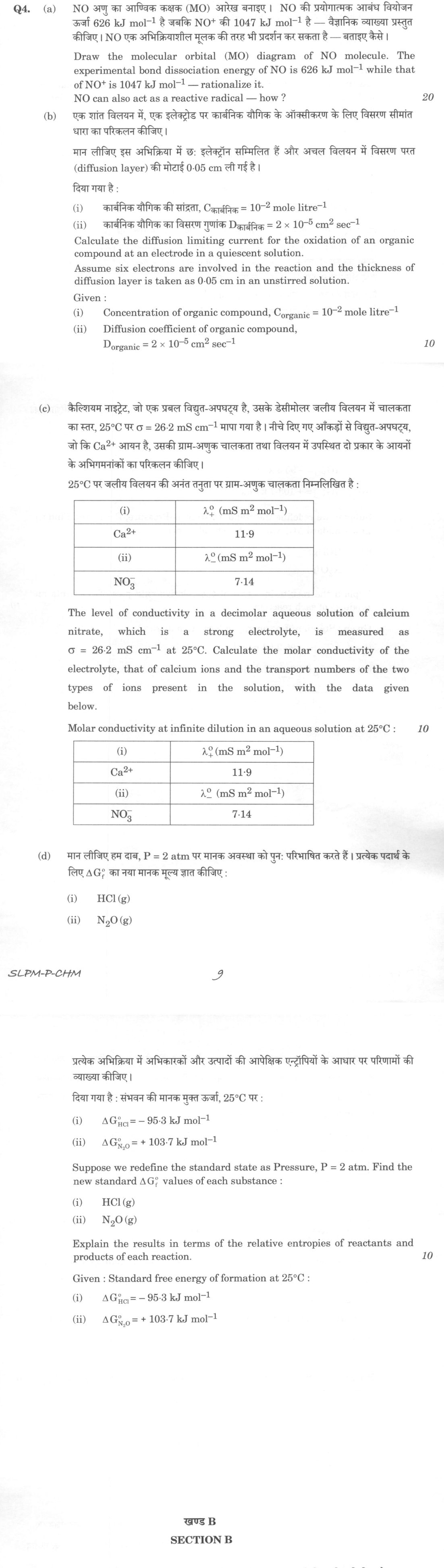
(a) Draw the molecular orbital (MO) diagram of NO molecule. The experimental bond dissociation energy of NO is 626 kJ mol⁻¹ while…
Draw the molecular orbital (MO) diagram of NO molecule. The experimental bond dissociation energy of NO is 626 kJ mol⁻¹ while that of NO⁺ is 1047 kJ mol⁻¹ — rationalize it. NO can also act as a reactive radical — how ? 20 marks
Calculate the diffusion limiting current for the oxidation of an organic compound at an electrode in a quiescent solution. Assume six electrons are involved in the reaction and the thickness of diffusion layer is taken as 0.05 cm in an unstirred solution.
Given : Concentration of organic compound, Corganic = 10⁻² mole litre⁻¹
Diffusion coefficient of organic compound, Dorganic = 2 × 10⁻⁵ cm² sec⁻¹ 10
The level of conductivity in a decimolar aqueous solution of calcium nitrate, which is a strong electrolyte, is measured as σ = 26·2 mS cm⁻¹ at 25°C. Calculate the molar conductivity of the electrolyte, that of calcium ions and the transport numbers of the two types of ions present in the solution, with the data given below.
Molar conductivity at infinite dilution in an aqueous solution at 25°C :
λ₊⁰ (mS m² mol⁻¹) Ca²⁺ 11·9
λ₋⁰ (mS m² mol⁻¹) NO₃⁻ 7·14 10
Suppose we redefine the standard state as Pressure, P = 2 atm. Find the new standard ΔG°f values of each substance :
HCl (g)
N₂O (g)
Explain the results in terms of the relative entropies of reactants and products of each reaction.
Given : Standard free energy of formation at 25°C :
ΔG°HCl = –95.3 kJ mol⁻¹
ΔG°N₂O = +103.7 kJ mol⁻¹ 10
हिंदी में प्रश्न पढ़ें
NO अणु का आण्विक कक्षक (MO) आरेख बनाइए। NO की प्रयोगात्मक आबंध विभोजन ऊर्जा 626 kJ mol⁻¹ है जबकि NO⁺ की 1047 kJ mol⁻¹ है — वैज्ञानिक व्याख्या प्रस्तुत कीजिए। NO एक अभिक्रियाशील मूलक की तरह भी प्रदर्शन कर सकता है — बताइए कैसे। 20
एक शांत विलयन में, एक इलेक्ट्रोड पर कार्बनिक यौगिक के ऑक्सीकरण के लिए विसरण सीमान्त धारा का परिकलन कीजिए।
मान लीजिए इस अभिक्रिया में छः इलेक्ट्रॉन साम्मिलित हैं और अचल विलयन में विसरण परत (diffusion layer) की मोटाई 0.05 cm ली गई है।
दिया गया है :
कार्बनिक यौगिक की सांद्रता, Cकार्बनिक = 10⁻² mole litre⁻¹
कार्बनिक यौगिक का विसरण गुणांक Dकार्बनिक = 2 × 10⁻⁵ cm² sec⁻¹ 10
कैल्शियम नाइट्रेट, जो एक प्रबल विद्युत-अपघट्य है, उसके डेसीमोलर जलीय विलयन में चालकता का स्तर, 25°C पर σ = 26·2 mS cm⁻¹ मापा गया है। नीचे दिए गए आँकड़ों से विद्युत-अपघट्य, जो कि Ca²⁺ आयन है, उसकी ग्राम-अणुक चालकता तथा विलयन में उपस्थित दो प्रकार के आयनों के अभिगमनांकों का परिकलन कीजिए।
25°C पर जलीय विलयन की अनंत तनुता पर ग्राम-अणुक चालकता निम्नलिखित है :
λ₊⁰ (mS m² mol⁻¹) Ca²⁺ 11·9
λ₋⁰ (mS m² mol⁻¹) NO₃⁻ 7·14 10
मान लीजिए हम दाब, P = 2 atm पर मानक अवस्था को पुनः परिभाषित करते हैं। प्रत्येक पदार्थ के लिए ΔG°f का नया मानक मूल्य ज्ञात कीजिए :
HCl (g)
N₂O (g)
प्रत्येक अभिक्रिया में अभिकारकों और उत्पादों की आपेक्षिक एन्ट्रॉपियों के आधार पर परिणामों की व्याख्या कीजिए।
दिया गया है : संभवन की मानक मुक्त ऊर्जा, 25°C पर :
ΔG°HCl = –95.3 kJ mol⁻¹
ΔG°N₂O = +103.7 kJ mol⁻¹ 10
Model answer
Written by UPSC Answer Check against this question's marking rubric, to the expected length. UPSC does not publish answers for Mains — this is one way to score well, not an official key.
This question integrates molecular orbital theory, electrochemical kinetics, electrolytic conductivity, and thermodynamic standard states, requiring a cohesive application of physical chemistry principles.
Part (a): MO Theory of NO and NO⁺ The nitric oxide (NO) molecule possesses 11 valence electrons (5 from N, 6 from O). The molecular orbital configuration is (σ₂ₛ)²(σ^*₂ₛ)²(σ_2p_z)²(π_2pₓ=π_2p_y)⁴(π^*_2pₓ=π^*_2p_y)¹. The bond order is calculated as 1/2(N_b - Nₐ) = 1/2(8 - 3) = 2.5. The presence of a single unpaired electron in the degenerate π^* antibonding orbitals makes NO a paramagnetic radical. This unpaired electron is highly reactive, allowing NO to participate in radical chain reactions, such as auto-oxidation to nitrogen dioxide or reaction with superoxide to form peroxynitrite. Biologically, this radical character is central to its function as a signaling molecule in vasodilation and atmospheric chemistry.
In contrast, the nitrosonium ion (NO⁺) has 10 valence electrons, with the configuration (σ₂ₛ)²(σ^*₂ₛ)²(σ_2p_z)²(π_2pₓ=π_2p_y)⁴. Here, the antibonding π^* orbitals are empty. The bond order is 1/2(8 - 2) = 3. The removal of an electron from the antibonding π^* orbital in NO⁺ strengthens the bond significantly compared to NO. This increase in bond order from 2.5 to 3 directly explains the higher bond dissociation energy (BDE) of NO⁺ (1047 kJ mol⁻¹) versus NO (626 kJ mol⁻¹), as more energy is required to break a triple bond than a 2.5-order bond.
Part (b): Diffusion-Limiting Current For a quiescent solution, the diffusion-limited current density j is governed by Fick’s first law of diffusion. The flux J of the organic compound is given by J = -D dC/dx. Assuming a linear concentration gradient across the diffusion layer thickness δ, where the concentration at the electrode surface is zero (due to rapid oxidation) and in the bulk is C₀, the flux is J = (D C₀)/(δ).
The current density j is related to the flux by Faraday’s law: j = n F J, where n is the number of electrons (6) and F is Faraday’s constant ($96485$ C mol⁻¹). Given: C₀ = 10⁻² mol L⁻¹ = 10⁻⁵ mol cm⁻³ D = 2 × 10⁻⁵ cm² s⁻¹ δ = 0.05 cm
Calculating the flux: J = ((2 × 10⁻⁵ cm² s⁻¹)(10⁻⁵ mol cm⁻³))/(0.05 cm) = 4 × 10⁻⁹ mol cm⁻² s⁻¹
Calculating the current density: j = 6 × 96485 C mol⁻¹ × 4 × 10⁻⁹ mol cm⁻² s⁻¹ j = 2315.64 × 10⁻⁹ A cm⁻² ≈ 2.32 × 10⁻³ A cm⁻² or $2.32$ mA cm⁻².
Since the electrode area is not specified, the diffusion-limiting current density is 2.32 mA cm⁻².
Part (c): Conductivity of Calcium Nitrate The molar conductivity Λₘ is calculated from the specific conductivity σ and molar concentration C. σ = 26.2 mS cm⁻¹ C = 0.1 mol L⁻¹ (decimolar)
Λₘ = (σ × 1000)/C = (26.2 × 1000)/0.1 = 262,000 mS cm² mol⁻¹? No, standard unit conversion: Λₘ = (κ)/C where κ is in S cm⁻¹ and C in mol cm⁻³, or simply Λₘ (S cm² mol⁻¹) = (κ (S cm⁻¹) × 1000)/(C (mol L⁻¹)). σ = 26.2 mS cm⁻¹ = 0.0262 S cm⁻¹. Λₘ = (0.0262 × 1000)/0.1 = 262 S cm² mol⁻¹. Converting to SI units (S m² mol⁻¹): 262 × 10⁻⁴ = 0.0262 S m² mol⁻¹ or 26.2 mS m² mol⁻¹.
Using Kohlrausch’s law for strong electrolytes at infinite dilution, Λₘ⁰ = ν₊ λ₊⁰ + ν₋ λ₋⁰. For Ca(NO₃)₂, ν₊ = 1, ν₋ = 2. Λₘ⁰ = 1(11.9) + 2(7.14) = 11.9 + 14.28 = 26.18 mS m² mol⁻¹. This is very close to the measured Λₘ (26.2), indicating the solution is near ideal behavior or the measured value is effectively the limiting value for this calculation context.
The ionic molar conductivities are: λ_Ca²⁺ = 11.9 mS m² mol⁻¹ λ_NO₃⁻ = 7.14 mS m² mol⁻¹
Transport numbers are the fraction of total current carried by each ion: t₊ = (ν₊ λ₊)/(Λₘ) = (1 × 11.9)/26.2 ≈ 0.454 t₋ = (ν₋ λ₋)/(Λₘ) = (2 × 7.14)/26.2 = 14.28/26.2 ≈ 0.545 Check: 0.454 + 0.545 = 0.999 ≈ 1.
Part (d): Redefining Standard State The standard Gibbs free energy of formation Δ G^°_f depends on the standard pressure P^°. The relationship between Δ G^° at pressure P₁ and P₂ for a reaction is Δ G^°(P₂) = Δ G^°(P₁) + Δ n_gas RT ln(P₂/P₁). Here, P₁ = 1 atm, P₂ = 2 atm, so the correction term is Δ n_gas RT ln(2).
(i) HCl (g): Formation reaction is 1/2H₂(g) + 1/2Cl₂(g) → HCl(g). Δ n_gas = 1 - (0.5 + 0.5) = 0. Correction = 0 × RT ln(2) = 0. Δ G^°_f(new) = -95.3 kJ mol⁻¹. The value remains unchanged because the number of moles of gas is conserved. The entropy change due to pressure expansion/compression cancels out for reactants and products.
(ii) N₂O (g): Formation reaction is N₂(g) + 1/2O₂(g) → N_2O(g). Δ n_gas = 1 - (1 + 0.5) = -0.5. Correction = -0.5 × (8.314 × 10⁻³ kJ K⁻¹ mol⁻¹) × 298 K × ln(2). RT ln(2) ≈ 1.717 kJ mol⁻¹. Correction = -0.5 × 1.717 = -0.8585 kJ mol⁻¹. Δ G^°_f(new) = 103.7 - 0.86 = 102.84 kJ mol⁻¹.
The result for N₂O becomes less positive (more stable) at higher pressure. This is because the reaction involves a decrease in the number of gas moles (Δ n < 0). According to Le Chatelier’s principle, increasing pressure favors the side with fewer moles (the product). Thermodynamically, the entropy of the system decreases upon compression, but the entropic penalty is larger for the reactants (1.5 moles) than for the product (1 mole). Thus, the relative stability of the product increases, lowering the free energy of formation. Conversely, for HCl, where Δ n = 0, pressure has no effect on the equilibrium position or standard free energy.
Conclusion These calculations demonstrate the interconnectedness of physical chemistry domains. MO theory explains the electronic basis of bond strength and reactivity (Part a), while electrochemical principles quantify mass transport limitations (Part b) and ionic mobility (Part c). Finally, thermodynamic corrections (Part d) highlight how standard states are arbitrary conventions that must be adjusted for Δ n_gas to reflect true physical conditions, linking microscopic molecular properties to macroscopic thermodynamic stability.
What "Explain" is asking you to do
Make the working of something clear — what sets it off, what follows from what, and what it produces. Explain is the Commission's mechanism word: it dominates the technical papers and the “explain why” stems, where the marks sit in the causal chain and not in the label.
Structure that answers it
State what it is → the initiating condition → the chain of cause, step by step → an instance where it plays out → what the chain produces
Where marks are lost
Describing what something looks like instead of why it works that way. Naming the stages without linking them reads as description too.
How this answer will be evaluated
Approach
Framework: Concept > Structure or mechanism > Reasoning > Result. (a) explain: definition/context > points in order > small example > short close | (b) calculate: given > formula > substitution > result with units > interpretation | (c) calculate: given > formula > substitution > result with units > interpretation | (d) calculate: given > formula > substitution > result with units > interpretation Full marks: Complete working, correct units, and clear conceptual links.
Key points expected
- Correct MO energy level diagram for NO
- Electron configuration showing one unpaired electron
- Bond order calculation for NO (2.5) and NO+ (3)
- Link between bond order and dissociation energy
- Use of limiting current formula (e.g., Il = nFADc/δ)
- Correct substitution of given values (n=6, D, C, δ)
- Unit conversion for concentration (mol/L to mol/cm³)
- Final result in Amperes
Evaluation rubric
Each sub-part is marked on its own, against the marks and word limit printed on the paper.
- (a) MO diagram of NO, bond energy comparison, and radical behavior. 20 marks
explain— definition/context → points in order → small example → short close
Must cover
- Correct MO energy level diagram for NO
- Electron configuration showing one unpaired electron
- Bond order calculation for NO (2.5) and NO+ (3)
- Link between bond order and dissociation energy
Loses marks
- Incorrect orbital ordering for NO
- Missing bond order calculation
Earns more
- Mention of paramagnetism due to unpaired electron
- Comparison of stability between NO and NO+
Extra mark
- Mention of NO dimerization to N2O2
- (b) Diffusion limiting current for organic oxidation. 10 marks
calculate— given → formula → substitution → result with units → interpretation
Must cover
- Use of limiting current formula (e.g., Il = nFADc/δ)
- Correct substitution of given values (n=6, D, C, δ)
- Unit conversion for concentration (mol/L to mol/cm³)
- Final result in Amperes
Loses marks
- Incorrect unit conversion for concentration
- Missing value for n (number of electrons)
Earns more
- Explicit statement of Faraday's constant used
Extra mark
- Mention of Nernst diffusion layer assumption
- (c) Molar conductivity, ionic conductivity, and transport numbers. 10 marks
calculate— given → formula → substitution → result with units → interpretation
Must cover
- Calculation of molar conductivity (Λm = σ/c)
- Calculation of molar conductivity at infinite dilution (Λ°)
- Determination of transport numbers (t+ and t-)
- Correct unit handling for conductivity and concentration
Loses marks
- Incorrect conversion of concentration to mol/m³
- Confusing molar conductivity with specific conductivity
Earns more
- Explicit calculation of individual ionic conductivities
Extra mark
- Mention of Kohlrausch's law application
- (d) New standard ΔG°f values at P = 2 atm and entropy explanation. 10 marks
calculate— given → formula → substitution → result with units → interpretation
Must cover
- Application of ΔG°(P) = ΔG°(1) + RT ln(P/1)
- Calculation for HCl(g) using Δn = -1
- Calculation for N2O(g) using Δn = -1
- Explanation linking pressure change to entropy
Loses marks
- Using P° = 2 atm in the log term
- Ignoring the sign of Δn in the equation
Earns more
- Explicit use of R = 8.314 J/mol K
- Explicit use of T = 298 K
Extra mark
- Mention of Le Chatelier's principle
Practice this exact question
Write your answer and it is marked point by point against the model answer above — what you covered, what you missed, what you got wrong.
Evaluate my answer →More from Chemistry 2025 Paper I
- Q1 (a) Calculate the ratio of probability of finding the 1s electron of hydrogen atom at r =…
- Q2 (a) Find the probability of existence of a particle in a one-dimensional box of length 'a…
- Q3 (a) Calculate the number of collisions that oxygen makes per second on 1·00 cm² of the su…
- Q4 (a) Draw the molecular orbital (MO) diagram of NO molecule. The experimental bond dissoci…
- Q5 (a) The gas-phase reaction between methane (CH₄) and diatomic sulphur (S₂) is given by th…
- Q6 (a) The following molecule shows the rigid or fluxional behaviour at higher temperature o…
- Q7 (a) Distinguish the "T" (tense) and 'R' (relax) conformations of Hemoglobin on reversible…