Paper I — Q7
(a) Distinguish the "T" (tense) and 'R' (relax) conformations of Hemoglobin on reversible binding of oxygen (O₂). 15 marks (b)…
Distinguish the "T" (tense) and 'R' (relax) conformations of Hemoglobin on reversible binding of oxygen (O₂). 15 marks
What is the basic difference between Cytochrome 'b' and Cytochrome 'c' ? Explain the role of Cytochrome 'c' oxidase. 5 marks
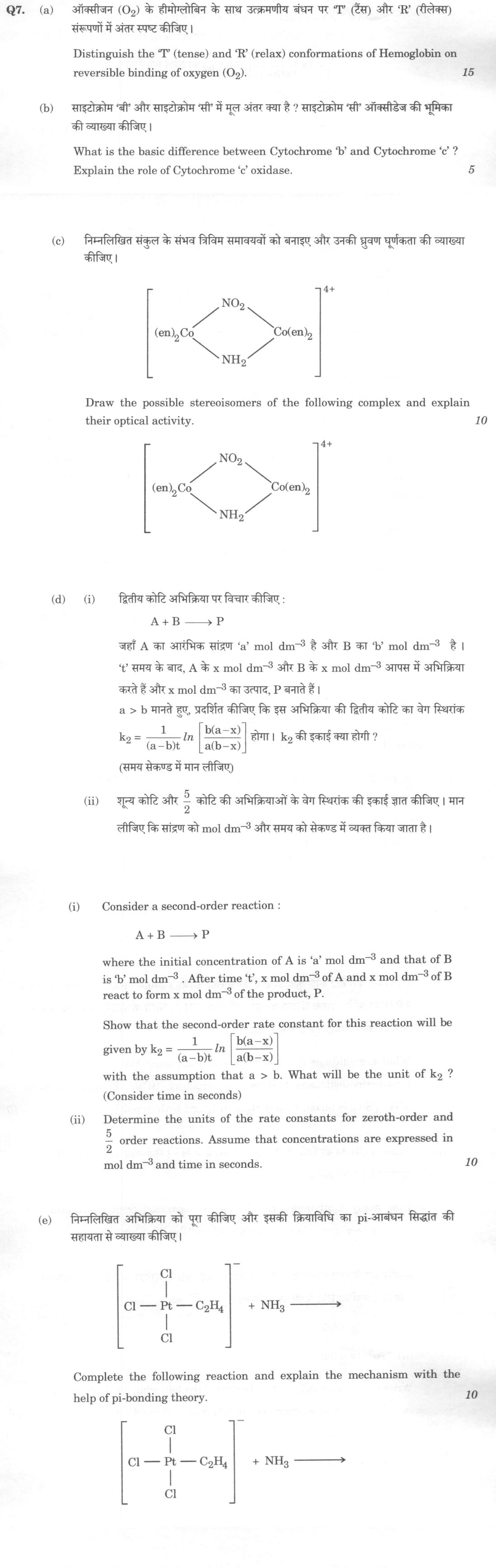
Draw the possible stereoisomers of the following complex and explain their optical activity. 10 marks
Consider a second-order reaction : A + B → P where the initial concentration of A is 'a' mol dm⁻³ and that of B is 'b' mol dm⁻³. After time 't', x mol dm⁻³ of A and x mol dm⁻³ of B react to form x mol dm⁻³ of the product, P. Show that the second-order rate constant for this reaction will be given by k₂ = 1/((a-b)t) ln [b(a-x)/a(b-x)] with the assumption that a > b. What will be the unit of k₂ ? (Consider time in seconds)
Determine the units of the rate constants for zeroth-order and 5/2 order reactions. Assume that concentrations are expressed in mol dm⁻³ and time in seconds. 10 marks
Complete the following reaction and explain the mechanism with the help of pi-bonding theory. 10 marks
हिंदी में प्रश्न पढ़ें
ऑक्सीजन (O₂) के हीमोग्लोबिन के साथ उत्क्रमणीय बंधन पर 'T' (टेंस) और 'R' (रिलैक्स) संरूपणों में अंतर स्पष्ट कीजिए । 15 अंक
साइटोक्रोम 'बी' और साइटोक्रोम 'सी' में मूल अंतर क्या है ? साइटोक्रोम 'सी' ऑक्सीडेज की भूमिका की व्याख्या कीजिए । 5 अंक
निम्नलिखित संकुल के संभव विसम समावयवों को बनाइए और उनकी द्रुवण घूर्णकता की व्याख्या कीजिए। 10 अंक
द्वितीय कोटि अभिक्रिया पर विचार कीजिए : A + B → P जहाँ A का आरंभिक सांद्रण 'a' mol dm⁻³ है और B का 'b' mol dm⁻³ है। 't' समय के बाद, A के x mol dm⁻³ और B के x mol dm⁻³ आपस में अभिक्रिया करते हैं और x mol dm⁻³ का उत्पाद, P बनाते हैं। a > b मानते हुए, प्रदर्शित कीजिए कि इस अभिक्रिया की द्वितीय कोटि का वेग स्थिरांक k₂ = 1/(a-b)t ln [b(a-x)/a(b-x)] होगा। k₂ की इकाई क्या होगी? (समय सेकंड में मान लीजिए)
शून्य कोटि और 5/2 कोटि की अभिक्रियाओं के वेग स्थिरांक की इकाई ज्ञात कीजिए। मान लीजिए कि सांद्रण को mol dm⁻³ और समय को सेकंड में व्यक्त किया जाता है। 10 अंक
निम्नलिखित अभिक्रिया को पूरा कीजिए और इसकी क्रियाविधि का pi-आबंधन सिद्धांत की सहायता से व्याख्या कीजिए। 10 अंक
The figure this question refers to, in words
The question paper is a scan and the diagram did not survive as text. This is the figure as read from the original page — every component, value and label — so the question can be worked from the text below.
(c) A chemical structure of a dinuclear cobalt complex ion with an overall charge of 4+. The structure consists of two central cobalt (Co) atoms. Each cobalt atom is coordinated to two ethylenediamine (en) ligands, denoted as (en)2. The two cobalt centers are bridged by two ligands: a nitro group (NO2) at the top and an amine group (NH2) at the bottom. The NO2 group connects to both cobalt atoms via its nitrogen atom. The NH2 group connects to both cobalt atoms via its nitrogen atom. The entire complex is enclosed in square brackets with a superscript 4+.
(d) Table with two rows and six columns. Row 1 headers: Time (minutes), 10, 15, 20, 25, infinity. Row 2 headers: Volume of N2 (cc), 6.25, 9.00, 11.40, 13.65, 35.05.
(e) A chemical reaction scheme showing a reactant complex and a reagent. The reactant is a square planar platinum complex enclosed in square brackets with a negative charge superscript. The central atom is Pt. It is bonded to three Chlorine (Cl) atoms and one ethylene group (C2H4). The C2H4 group is bonded to the Pt via a double bond (pi-bond). The reagent is ammonia (NH3). An arrow points to the right indicating the reaction proceeds to form products.
Model answer
Written by UPSC Answer Check against this question's marking rubric, to the expected length. UPSC does not publish answers for Mains — this is one way to score well, not an official key.
(a) T and R states of haemoglobin. Haemoglobin reversibly interconverts between T (tense) and R (relaxed) quaternary conformations. In the T state, the Fe²⁺ ion of each deoxy haem is high-spin and sits slightly out of the porphyrin plane, displaced toward the proximal histidine; the α₁β₂ subunit interfaces contain stabilising salt bridges, and the O₂-binding pockets are constrained, so O₂ affinity is low. In the R state, O₂ binding converts Fe²⁺ to low-spin; the iron moves into the porphyrin plane, pulls the proximal histidine and F-helix, breaks the T-state salt bridges, and opens the quaternary structure. The R state therefore has high O₂ affinity. The key distinction is that the T state has an out-of-plane, constrained iron and low affinity, whereas the R state has an in-plane iron and high affinity. This T→R shift produces cooperative binding, with a Hill coefficient of about 2.8–3.0. Deoxygenation reverses the change, allowing the T state to re-form and O₂ to be released in tissues.
(b) Cytochrome b, cytochrome c and cytochrome c oxidase. Cytochrome b is an integral membrane protein of Complex III, the bc1 complex. It contains b-type hemes, usually bL and bH, in which protoporphyrin IX is non-covalently bound to the protein; it is a membrane-embedded electron-transfer centre involved in the Q cycle. Cytochrome c is a peripheral protein on the outer surface of the inner mitochondrial membrane. Its c-type heme is covalently attached to the protein through thioether bonds from cysteine residues to the porphyrin ring, and it acts as a mobile electron carrier between Complex III and Complex IV. The basic difference is therefore location and heme attachment: cytochrome b is integral and non-covalent, while cytochrome c is peripheral and covalent. Cytochrome c oxidase, Complex IV, is the terminal oxidase. It contains CuA, heme a, heme a₃ and CuB. It accepts electrons from reduced cytochrome c, transfers them to O₂, and catalyses the four-electron reduction of O₂ to H₂O. In doing so it pumps protons from the matrix to the intermembrane space, contributing to the proton-motive force used for ATP synthesis.
(c) Stereoisomers of the dinuclear cobalt complex. The printed ion is a dinuclear Co complex in which each Co is octahedrally coordinated by two en chelates and by the two bridging nitrogen donors, one from NO₂ and one from NH₂. Each metal centre is therefore locally of the [Co(en)₂B₂] type, where B denotes a bridging N donor. The two B donors at a Co can be cis or trans. In the drawn structure the NO₂ and NH₂ bridges are cis at both Co centres, giving a Co₂N₂ ring. For a cis [Co(en)₂B₂] unit, the two en chelates can be arranged as Δ or Λ; hence each Co centre is chiral. In the dimer the possible configurations are ΔΔ, ΛΛ and ΔΛ. The ΔΔ and ΛΛ forms are non-superimposable mirror images and are optically active. If the two en chelates at one Co are drawn as Δ and at the other as Λ, the bridging NO₂ and NH₂ groups can lie in a mirror plane, so the ΔΛ form is a meso form and is optically inactive. If a trans-bridged isomer is considered, in which the two B donors are opposite at each Co, the local [Co(en)₂B₂] unit possesses a plane of symmetry and is optically inactive. Thus optical activity is associated with the cis-bridged, homochiral ΔΔ/ΛΛ pair, while trans or heterochiral ΔΛ arrangements are inactive.
(d) Kinetics. For A + B → P, with initial concentrations a and b and x reacted after time t, the concentrations are (a−x) and (b−x). The rate is dx/dt = k₂(a−x)(b−x). Separating variables gives dx/[(a−x)(b−x)] = k₂ dt. Using partial fractions, 1/[(a−x)(b−x)] = 1/(a−b) [1/(b−x) − 1/(a−x)]. Integrating from x=0 to x and t=0 to t gives k₂t = 1/(a−b) {ln[(a−x)/(b−x)] − ln(a/b)} = 1/(a−b) ln [b(a−x)/a(b−x)]. Hence k₂ = 1/[(a−b)t] ln [b(a−x)/a(b−x)], valid for a > b. Since rate is mol dm⁻³ s⁻¹ and the concentration term is (mol dm⁻³)², the unit of k₂ is dm³ mol⁻¹ s⁻¹.
For a zeroth-order reaction, rate = k₀, so k₀ has the same unit as rate, mol dm⁻³ s⁻¹. For a reaction of order 5/2, rate = k C to the 5/2 power. The concentration factor is (mol dm⁻³) to the 5/2 power, i.e. mol to the 5/2 power and dm to the −15/2 power. Hence the unit of k is (mol dm⁻³ s⁻¹) divided by that concentration factor, giving dm⁴·⁵ mol⁻¹·⁵ s⁻¹, which is the same as dm to the 9/2 power, mol to the −3/2 power, and s to the −1 power.
(e) Reaction and π-bonding mechanism. The reaction is completed as: [PtCl₃(η²-C₂H₄)]⁻ + NH₃ → trans-[PtCl₂(NH₃)(η²-C₂H₄)] + Cl⁻, the major product having NH₃ trans to C₂H₄. The substitution is associative. NH₃ approaches the square-planar Pt(II) centre perpendicular to the ligand plane and forms a five-coordinate trigonal-bipyramidal intermediate, [PtCl₃(NH₃)(C₂H₄)]⁻. In this intermediate the entering NH₃ and the leaving Cl occupy the axial positions, while the three spectator ligands, C₂H₄ and the two remaining Cl, occupy equatorial positions. The chloride that leaves is the one originally trans to C₂H₄. This selectivity is explained by π-bonding theory: C₂H₄ donates its π electron pair to an empty Pt orbital and Pt back-donates from a filled dπ orbital into the C₂H₄ π* orbital. This π-acceptor interaction strengthens the Pt–C₂H₄ bond, stabilises the crowded five-coordinate intermediate, and weakens the Pt–Cl bond trans to C₂H₄ by drawing electron density from the d orbital involved in M–Cl bonding. Consequently the trans chloride is labilised, NH₃ replaces it, and the product retains the η²-ethylene ligand.
Together, these answers show how metal-centre geometry, chirality, electron transfer and π-bonding control function in bioinorganic and coordination chemistry: haemoglobin uses T/R switching for cooperative O₂ transport, cytochromes use heme type and location for electron transfer, and the Pt complex uses π-acceptor bonding to determine which ligand is substituted.
What "Distinguish" is asking you to do
Name the property that separates the items and say which side holds it. Distinguish is marked exactly as differentiate is, with no difference in expectation, but its stems more often line up three terms rather than two — gender equality, gender equity and empowerment — and every pair in the set has to be separated.
Structure that answers it
The category they all sit in → the property dividing the first pair → the second pair → the third → why the boundary matters in practice
Where marks are lost
Separating the two obviously different items and leaving the middle term unplaced. A description of each side from which the line must be inferred is marked as description, not as a distinction.
How this answer will be evaluated
Approach
Framework: Concept > Structure or mechanism > Reasoning > Result. (a) compare: paired headings or table > key differences > significance > conclusion | (b) explain: definition/context > points in order > small example > short close | (c) describe: define > structure or process in order > labelled diagram > significance | (d(i)) derive: given > assumptions > stepwise derivation > result > check | (d(ii)) calculate: given > formula > substitution > result with units > interpretation | (e) explain: definition/context > points in order > small example > short close Full marks: Complete derivations, correct structures, and clear mechanistic reasoning.
Key points expected
- T state: low affinity, deoxy, Fe out of plane
- R state: high affinity, oxy, Fe in plane
- H-bond changes at alpha/beta interfaces
- Cooperative binding mechanism (T to R transition)
- Cytochrome b: integral membrane protein
- Cytochrome c: peripheral/soluble protein
- Cytochrome c oxidase: terminal oxidase
- Reduction of O2 to H2O
Evaluation rubric
Each sub-part is marked on its own, against the marks and word limit printed on the paper.
- (a) Distinguish T and R conformations of Hemoglobin on O2 binding. 15 marks
compare— paired headings or table → key differences → significance → conclusion
Must cover
- T state: low affinity, deoxy, Fe out of plane
- R state: high affinity, oxy, Fe in plane
- H-bond changes at alpha/beta interfaces
- Cooperative binding mechanism (T to R transition)
Loses marks
- Confusing T and R states
- Omitting the role of Fe position
Earns more
- Mention of Bohr effect (pH/CO2 influence)
- Description of quaternary structure shift
Extra mark
- Reference to Perutz model
- (b) Difference between Cytochrome b and c; role of Cytochrome c oxidase. 5 marks
explain— definition/context → points in order → small example → short close
Must cover
- Cytochrome b: integral membrane protein
- Cytochrome c: peripheral/soluble protein
- Cytochrome c oxidase: terminal oxidase
- Reduction of O2 to H2O
Loses marks
- Swapping b and c properties
- Failing to identify oxidase as terminal
Earns more
- Mention of heme types (b vs c)
- Location in ETC (Complex III vs IV)
Extra mark
- Mention of proton pumping by oxidase
- (c) Draw stereoisomers of the Co(en)2 complex and explain optical activity. 10 marks
describe— define → structure or process in order → labelled diagram → significance
Must cover
- Identify cis/trans isomers
- Draw cis isomer (NO2 and NH2 adjacent)
- Draw trans isomer (NO2 and NH2 opposite)
- Explain chirality of cis isomer (optical isomers)
Loses marks
- Drawing only one isomer
- Incorrect ligand placement
Earns more
- Correct wedge-dash notation for en ligands
- Identification of enantiomers (d and l)
Extra mark
- Mention of symmetry elements (plane of symmetry in trans)
- (d(i)) Derive the rate constant expression for A+B->P and state units.
derive— given → assumptions → stepwise derivation → result → check
Must cover
- Rate law: -d[A]/dt = k2[A][B]
- Substitution: (a-x)/(b-x) = [A]/[B]
- Integration steps to reach ln[b(a-x)/a(b-x)]
- Unit of k2: dm3 mol-1 s-1
Loses marks
- Skipping integration steps
- Wrong unit for k2
Earns more
- Clear algebraic manipulation
- Correct handling of integration constants
Extra mark
- Verification by differentiation
- (d(ii)) Determine units of rate constants for zeroth and 5/2 order reactions.
calculate— given → formula → substitution → result with units → interpretation
Must cover
- General formula: (conc)^(1-n) (time)^-1
- Zeroth order unit: mol dm-3 s-1
- 5/2 order unit: dm3 mol-1 s-1 (or (mol dm-3)^-1/2 s-1)
- Correct substitution of n=0 and n=2.5
Loses marks
- Incorrect exponent in unit
- Confusing concentration and time units
Earns more
- Step-by-step unit derivation
Extra mark
- Comparison of units
- (e) Complete reaction of Pt complex with NH3 and explain via pi-bonding theory. 10 marks
explain— definition/context → points in order → small example → short close
Must cover
- Product: cis-[Pt(NH3)2Cl2] (trans effect)
- Mechanism: Dissociative (D or Id)
- Role of pi-acceptor ligands (Cl vs C2H4)
- Trans effect: Cl- > C2H4
Loses marks
- Wrong product (cis instead of trans)
- Associative mechanism instead of dissociative
Earns more
- Drawing of transition state
- Explanation of pi-backbonding
Extra mark
- Mention of Vaska's complex analogy
Practice this exact question
Write your answer and it is marked point by point against the model answer above — what you covered, what you missed, what you got wrong.
Evaluate my answer →More from Chemistry 2025 Paper I
- Q4 (a) Draw the molecular orbital (MO) diagram of NO molecule. The experimental bond dissoci…
- Q5 (a) The gas-phase reaction between methane (CH₄) and diatomic sulphur (S₂) is given by th…
- Q6 (a) The following molecule shows the rigid or fluxional behaviour at higher temperature o…
- Q7 (a) Distinguish the "T" (tense) and 'R' (relax) conformations of Hemoglobin on reversible…
- Q8 (a) Draw the structures of S₂N₂, S₄N₂, S₁₁N₂, S₅N₆ and I₂Cl₆. 10 marks (b) What are silic…