Paper I — Q2
(a) Find the probability of existence of a particle in a one-dimensional box of length 'a' in the region 0 ≤ x ≤ a/4 for the…
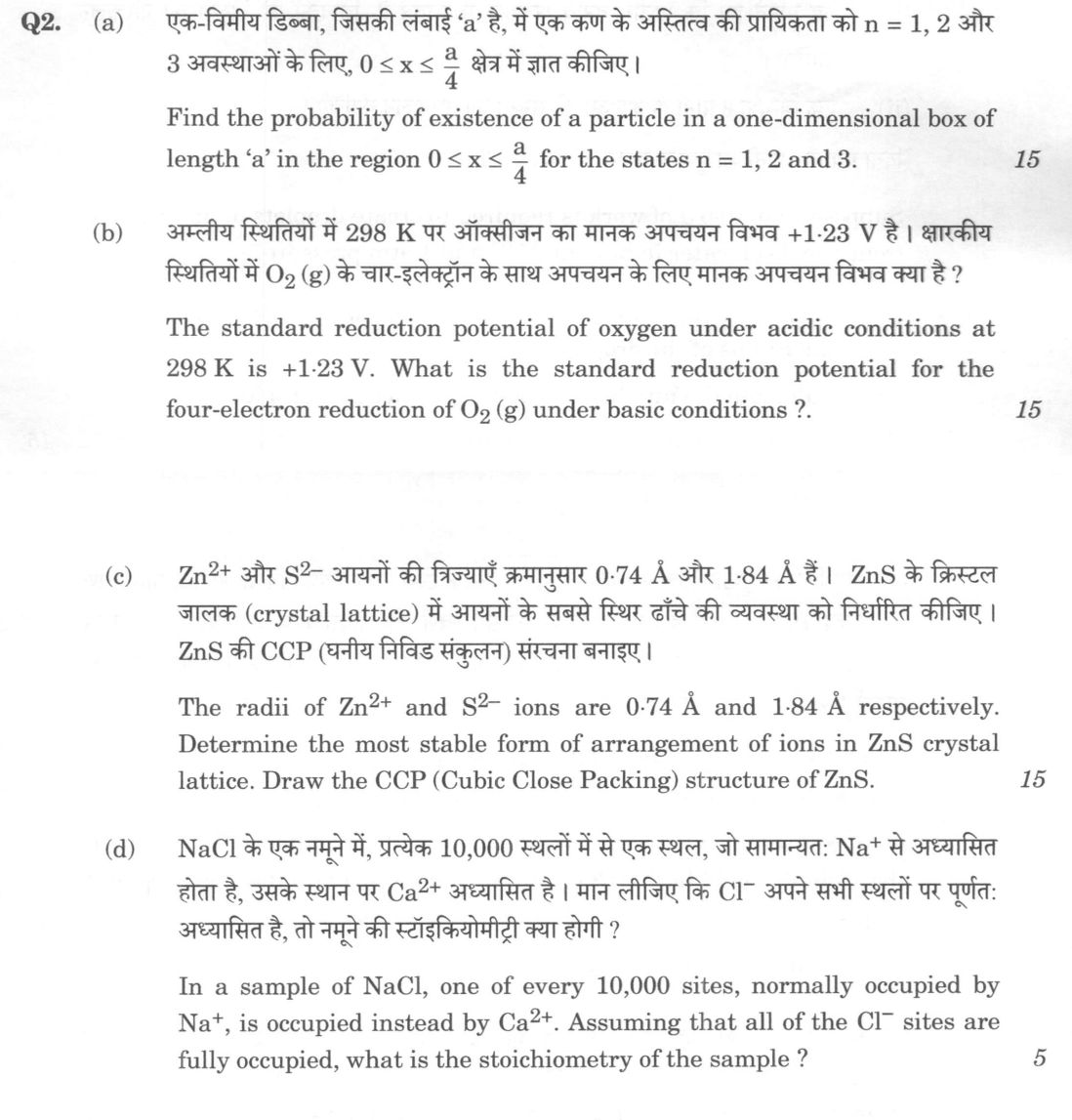
Find the probability of existence of a particle in a one-dimensional box of length 'a' in the region 0 ≤ x ≤ a/4 for the states n = 1, 2 and 3. 15 marks
The standard reduction potential of oxygen under acidic conditions at 298 K is +1.23 V. What is the standard reduction potential for the four-electron reduction of O₂(g) under basic conditions? 15 marks
The radii of Zn²⁺ and S²⁻ ions are 0·74 Å and 1·84 Å respectively. Determine the most stable form of arrangement of ions in ZnS crystal lattice. Draw the CCP (Cubic Close Packing) structure of ZnS. 15 marks
In a sample of NaCl, one of every 10,000 sites, normally occupied by Na⁺, is occupied instead by Ca²⁺. Assuming that all of the Cl⁻ sites are fully occupied, what is the stoichiometry of the sample? 5 marks
हिंदी में प्रश्न पढ़ें
एक-विमीय डिब्बा, जिसकी लंबाई 'a' है, में एक कण के अस्तित्व की प्रायिकता को n = 1, 2 और 3 अवस्थाओं के लिए, 0 ≤ x ≤ a/4 क्षेत्र में ज्ञात कीजिए। (15 अंक)
अम्लीय स्थितियों में 298 K पर ऑक्सीजन का मानक अपचयन विभव +1.23 V है। क्षारीय स्थितियों में O₂(g) के चार-इलेक्ट्रॉन के साथ अपचयन के लिए मानक अपचयन विभव क्या है? (15 अंक)
Zn²⁺ और S²⁻ आयनों की त्रिज्याएँ क्रमानुसार 0·74 Å और 1·84 Å हैं। ZnS के क्रिस्टल जालक (crystal lattice) में आयनों के सबसे स्थिर ढाँचे की व्यवस्था को निर्धारित कीजिए। ZnS की CCP (घनीय निविड संकुलन) संरचना बनाइए। (15 अंक)
NaCl के एक नमूने में, प्रत्येक 10,000 स्थलों में से एक स्थल, जो सामान्यतः Na⁺ से अध्यासित होता है, उसके स्थान पर Ca²⁺ अध्यासित है। मान लीजिए कि Cl⁻ अपने सभी स्थलों पर पूर्णतः अध्यासित है, तो नमूने की स्टॉइकियोमीट्री क्या होगी? (5 अंक)
Model answer
Written by UPSC Answer Check against this question's marking rubric, to the expected length. UPSC does not publish answers for Mains — this is one way to score well, not an official key.
(a) For a particle in a one-dimensional box of length a, the normalized wavefunction is ψₙ(x) = √(2/a) sin(nπx/a). The probability of finding the particle in 0 ≤ x ≤ a/4 is Pₙ = ∫ from x = 0 to x = a/4 |ψₙ(x)|² dx = (2/a) ∫ from x = 0 to x = a/4 sin²(nπx/a) dx.
Let u = nπx/a, so dx = (a/nπ) du. When x = 0, u = 0; when x = a/4, u = nπ/4. Thus Pₙ = (2/nπ) ∫ from u = 0 to u = nπ/4 sin²u du.
Using sin²u = (1 − cos2u)/2, ∫ sin²u du = u/2 − sin2u/4. Therefore Pₙ = (2/nπ)[u/2 − sin2u/4] from 0 to nπ/4 = 1/4 − sin(nπ/2)/(2nπ).
For n = 1: P₁ = 1/4 − sin(π/2)/(2π) = 1/4 − 1/(2π) = (π − 2)/(4π) ≈ 0.0908.
For n = 2: P₂ = 1/4 − sin(π)/(4π) = 1/4 = 0.2500.
For n = 3: P₃ = 1/4 − sin(3π/2)/(6π) = 1/4 + 1/(6π) ≈ 0.3031.
Final probabilities: P₁ = (π − 2)/(4π), P₂ = 1/4, P₃ = 1/4 + 1/(6π).
(b) The acidic reduction half-reaction is O₂(g) + 4H⁺ + 4e⁻ ⇌ 2H₂O(l), E° = +1.23 V. Under basic conditions, the corresponding four-electron reduction is O₂(g) + 2H₂O(l) + 4e⁻ ⇌ 4OH⁻, with E° = ?
Use the Nernst equation for the acidic couple: E = E° − (0.05916/4) log(1/([H⁺]⁴ p_O₂)). Taking p_O₂ = 1 bar, E = E° + 0.05916 log[H⁺] = E° − 0.05916 pH.
At standard basic conditions, [OH⁻] = 1 mol L⁻¹, so pOH = 0 and pH = 14 at 298 K. Hence the potential of the acidic couple at pH 14 is E = 1.23 − 14 × 0.05916 = 1.23 − 0.82824 = 0.40176 V.
This is exactly the standard reduction potential of the basic couple, because [OH⁻] = 1 mol L⁻¹ is the standard basic state.
Final answer: E°(O₂/OH⁻) = +0.40176 V ≈ +0.40 V at 298 K.
(c) (i) The radius ratio is r(Zn²⁺)/r(S²⁻) = 0.74 Å / 1.84 Å = 0.402.
For ionic crystals:
- 0.225 < r₊/r₋ < 0.414 favours tetrahedral coordination, CN = 4.
- 0.414 < r₊/r₋ < 0.732 favours octahedral coordination, CN = 6.
Here r₊/r₋ = 0.402, which lies just below 0.414. Therefore the stable arrangement is tetrahedral 4:4 coordination. ZnS accordingly adopts the zinc blende (sphalerite) structure, in which S²⁻ ions form a cubic close-packed array and Zn²⁺ ions occupy half of the tetrahedral voids. Each Zn²⁺ is tetrahedrally surrounded by four S²⁻ ions, and each S²⁻ is tetrahedrally surrounded by four Zn²⁺ ions.
(ii) In the CCP/zinc blende unit cell, S²⁻ occupies the face-centred cubic lattice positions: eight corners and six face centres. Zn²⁺ occupies four alternate tetrahedral voids. Using fractional coordinates in the cubic unit cell:
S²⁻ positions: (0,0,0), (0,½,½), (½,0,½), (½,½,0), plus the equivalent face-centred positions. Zn²⁺ positions: (¼,¼,¼), (¼,¾,¾), (¾,¼,¾), (¾,¾,¼).
A schematic representation is:
S²⁻ at corners and face centres of the cube; Zn²⁺ at four alternate tetrahedral holes inside the cube.
S²⁻ -------- S²⁻ /| /| S²⁻ |------- S²⁻ | | | | | | S²⁻-----|- S²⁻ | / Zn | / S²⁻ -------- S²⁻
The unit cell contains 4 Zn²⁺ and 4 S²⁻, so the formula is ZnS. The structure is the cubic close-packed zinc blende form.
(d) Let the total number of cation sites normally occupied by Na⁺ be 10,000. One site is occupied by Ca²⁺. Ca²⁺ has one extra positive charge compared with Na⁺, so this creates an excess positive charge of +1 per 10,000 cation sites.
To maintain electrical neutrality, one Na⁺ site must be vacant. Therefore: Number of Ca²⁺ = 1 Number of Na⁺ vacancies = 1 Number of Na⁺ present = 10,000 − 1 − 1 = 9998 Number of Cl⁻ = 10,000, since all Cl⁻ sites are fully occupied.
Thus the stoichiometry is Na₉₉₉₈CaCl₁₀₀₀₀, or after normalizing to one Cl⁻, Na₀.₉₉₉₈Ca₀.₀₀₀₁Cl, with one Na⁺ vacancy per 10,000 cation sites.
What "Solve" is asking you to do
Choose the method, then carry it through to a final answer. Identifying what kind of problem this is and why that method applies is the first thing marked; a correct figure arrived at invisibly earns almost nothing.
Structure that answers it
Given data and what is required → method chosen, with the reason it applies → set-up (equation, circuit, free body, trial balance) → working, step by step → answer with units and any condition of validity
Where marks are lost
Doing the middle steps mentally and writing only the result. In mathematics papers, a further loss comes from giving a decimal where the exact value in surds or fractions was wanted, or from skipping the justification a part explicitly asks for.
How this answer will be evaluated
Approach
(a) calculate: given > formula > substitution > result with units > interpretation | (b) calculate: given > formula > substitution > result with units > interpretation | (c) describe: define > structure or process in order > labelled diagram > significance | (d) calculate: given > formula > substitution > result with units > interpretation Full marks: Full derivation, correct values, clear diagrams, and logical reasoning.
Key points expected
- Wavefunction ψ_n = √(2/a) sin(nπx/a)
- Probability integral P = ∫₀^(a/4) |ψ_n|² dx
- Correct evaluation for n=1, 2, 3
- Final numerical values for each state
- Acidic reduction half-reaction (O₂ + 4H⁺ + 4e⁻)
- Basic reduction half-reaction (O₂ + 2H₂O + 4e⁻)
- Use of Nernst equation or ΔG relationship
- Correct final potential value
Evaluation rubric
Each sub-part is marked on its own, against the marks and word limit printed on the paper.
- (a) Probability of particle in 0 ≤ x ≤ a/4 for n=1, 2, 3. 15 marks
calculate— given → formula → substitution → result with units → interpretation
Must cover
- Wavefunction ψ_n = √(2/a) sin(nπx/a)
- Probability integral P = ∫₀^(a/4) |ψ_n|² dx
- Correct evaluation for n=1, 2, 3
- Final numerical values for each state
Loses marks
- Missing normalization constant √(2/a)
- Incorrect limits of integration
Earns more
- Explicit integration steps shown
- Comparison of probabilities for different n
Extra mark
- Graphical representation of probability density
- (b) Standard reduction potential of O₂ in basic conditions. 15 marks
calculate— given → formula → substitution → result with units → interpretation
Must cover
- Acidic reduction half-reaction (O₂ + 4H⁺ + 4e⁻)
- Basic reduction half-reaction (O₂ + 2H₂O + 4e⁻)
- Use of Nernst equation or ΔG relationship
- Correct final potential value
Loses marks
- Confusing oxidation and reduction potentials
- Incorrect stoichiometry in half-reactions
Earns more
- Derivation of relationship between E°(acid) and E°(base)
- Explicit use of K_w = 10⁻¹⁴
Extra mark
- Mention of standard hydrogen electrode reference
- (c) Stable ion arrangement and CCP structure of ZnS. 15 marks
describe— define → structure or process in order → labelled diagram → significance
Must cover
- Calculation of radius ratio (r+/r-)
- Determination of coordination number from ratio
- Identification of ZnS structure type (Zinc Blende)
- Labeled diagram of CCP structure
Loses marks
- Incorrect radius ratio calculation
- Diagram missing labels for ions
Earns more
- Explanation of tetrahedral void occupancy
- Comparison with Rock Salt structure
Extra mark
- Unit cell parameters calculation
- (d) Stoichiometry of NaCl sample with Ca²⁺ substitution. 5 marks
calculate— given → formula → substitution → result with units → interpretation
Must cover
- Charge balance equation for the lattice
- Calculation of cation vacancies
- Final stoichiometric formula of the sample
Loses marks
- Ignoring charge neutrality requirement
- Incorrect ratio of ions in final formula
Earns more
- Explicit calculation of vacancy concentration
Extra mark
- Discussion of defect type (Schottky/Frenkel)
Practice this exact question
Write your answer and it is marked point by point against the model answer above — what you covered, what you missed, what you got wrong.
Evaluate my answer →More from Chemistry 2025 Paper I
- Q1 (a) Calculate the ratio of probability of finding the 1s electron of hydrogen atom at r =…
- Q2 (a) Find the probability of existence of a particle in a one-dimensional box of length 'a…
- Q3 (a) Calculate the number of collisions that oxygen makes per second on 1·00 cm² of the su…
- Q4 (a) Draw the molecular orbital (MO) diagram of NO molecule. The experimental bond dissoci…
- Q5 (a) The gas-phase reaction between methane (CH₄) and diatomic sulphur (S₂) is given by th…