Paper I — Q8
(a) Draw the structures of S₂N₂, S₄N₂, S₁₁N₂, S₅N₆ and I₂Cl₆. 10 marks (b) What are silicones ? Mention some of their uses. How…
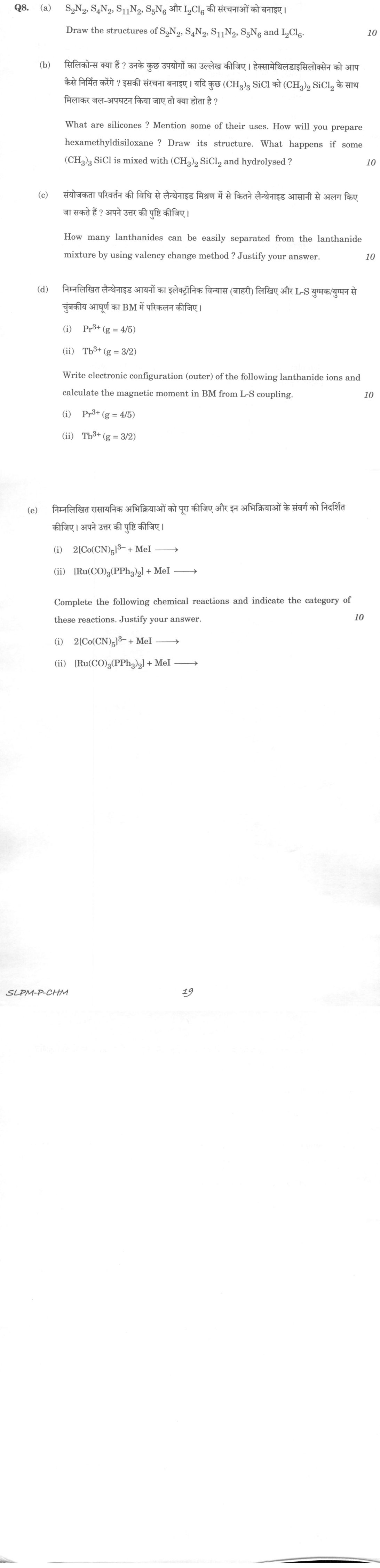
Draw the structures of S₂N₂, S₄N₂, S₁₁N₂, S₅N₆ and I₂Cl₆. 10 marks
What are silicones ? Mention some of their uses. How will you prepare hexamethyldisiloxane ? Draw its structure. What happens if some (CH₃)₃ SiCl is mixed with (CH₃)₂ SiCl₂ and hydrolysed ? 10 marks
How many lanthanides can be easily separated from the lanthanide mixture by using valency change method ? Justify your answer. 10 marks
Write electronic configuration (outer) of the following lanthanide ions and calculate the magnetic moment in BM from L-S coupling. 10 marks Pr³⁺ (g = 4/5)
Tb³⁺ (g = 3/2)
Complete the following chemical reactions and indicate the category of these reactions. Justify your answer. 10 marks 2[Co(CN)₅]³⁻ + MeI ———→
[Ru(CO)₃(PPh₃)₂] + MeI ———→
हिंदी में प्रश्न पढ़ें
S₂N₂, S₄N₂, S₁₁N₂, S₅N₆ और I₂Cl₆ की संरचनाओं को बनाइए। 10 अंक
सिलिकोन्स क्या हैं ? उनके कुछ उपयोगों का उल्लेख कीजिए। हेक्सामेथिलडाइसिलोक्सेन को आप कैसे निर्मित करेंगे ? इसकी संरचना बनाइए। यदि कुछ (CH₃)₃ SiCl को (CH₃)₂ SiCl₂ के साथ मिलाकर जल-अपघटन किया जाए तो क्या होता है ? 10 अंक
संयोजकता परिवर्तन की विधि से लैन्थेनाइड मिश्रण में से कितने लैन्थेनाइड आसानी से अलग किए जा सकते हैं ? अपने उत्तर की पुष्टि कीजिए। 10 अंक
निम्नलिखित लैन्थेनाइड आयनों का इलेक्ट्रॉनिक विन्यास (बाहरी) लिखिए और L-S युग्मक/युग्मन से चुंबकीय आघूर्ण का BM में परिकलन कीजिए। 10 अंक Pr³⁺ (g = 4/5)
Tb³⁺ (g = 3/2)
निम्नलिखित रासायनिक अभिक्रियाओं को पूरा कीजिए और इन अभिक्रियाओं के संवर्ग को निर्दिशित कीजिए। अपने उत्तर की पुष्टि कीजिए। 10 अंक 2[Co(CN)₅]³⁻ + MeI ———→
[Ru(CO)₃(PPh₃)₂] + MeI ———→
Model answer
Written by UPSC Answer Check against this question's marking rubric, to the expected length. UPSC does not publish answers for Mains — this is one way to score well, not an official key.
(a)
- S₂N₂: four-membered planar ring with alternating S and N atoms: S—N—S—N (closing to the first S). The ring is square-planar.
- S₄N₂: six-membered ring with the sequence N—S—S—N—S—S (closing to the first N). It contains two S—S bonds and four S—N bonds; the ring is puckered.
- S₅N₆: bicyclic cage. It consists of a six-membered S₃N₃ ring, S—N—S—N—S—N, bridged by an N—S—N—S—N chain linking two sulfur atoms of the ring.
- S₁₁N₂: bicyclic molecule. It contains a ten-membered S₁₀ ring bridged by an N—S—N unit linking two sulfur atoms of the ring; total S = 10 + 1 = 11 and N = 2.
- I₂Cl₆: dimeric iodine trichloride. Two iodine atoms are bridged by two chlorine atoms; each iodine is also bonded to two terminal chlorine atoms. The core is I(μ-Cl)₂I, with each I bearing two terminal Cl, so the molecule is planar.
(b) Silicones are polymeric organosilicon compounds containing repeating Si—O—Si linkages, with organic groups such as CH₃, C₆H₅, etc., attached to silicon. Their general formula for the common methyl silicone is (CH₃)₃Si—[O—Si(CH₃)₂]ₙ—O—Si(CH₃)₃. They are chemically inert, thermally stable, water-repellent, and excellent electrical insulators. Uses include silicone oils and greases as lubricants, antifoaming agents, water-proofing coatings, sealants, adhesives, electrical insulation, medical implants, catheters, cosmetics, and heat-resistant rubber.
Hexamethyldisiloxane is prepared by hydrolysis and condensation of trimethylchlorosilane: (CH₃)₃SiCl + H₂O → (CH₃)₃SiOH + HCl 2 (CH₃)₃SiOH → (CH₃)₃Si—O—Si(CH₃)₃ + H₂O Net: 2 (CH₃)₃SiCl + H₂O → (CH₃)₃Si—O—Si(CH₃)₃ + 2 HCl. Its structure is (CH₃)₃Si—O—Si(CH₃)₃, i.e. two trimethylsilyl groups joined through an oxygen atom.
If (CH₃)₃SiCl is mixed with (CH₃)₂SiCl₂ and hydrolysed, both undergo hydrolysis: (CH₃)₂SiCl₂ + 2 H₂O → (CH₃)₂Si(OH)₂ + 2 HCl (CH₃)₃SiCl + H₂O → (CH₃)₃SiOH + HCl. The difunctional silanediol condenses to give linear polysiloxane chains, while the monofunctional (CH₃)₃SiOH caps the chain ends. Hence a linear silicone oil/gum is formed: n (CH₃)₂Si(OH)₂ + 2 (CH₃)₃SiOH → (CH₃)₃Si—[O—Si(CH₃)₂]ₙ—O—Si(CH₃)₃ + (n+1) H₂O. The (CH₃)₃SiCl therefore acts as a chain stopper; its proportion controls the chain length and molecular mass of the silicone.
(c) Four lanthanides can be easily separated from a lanthanide mixture by the valency change method: Ce, Eu, Sm, and Yb.
Justification: Most lanthanides exist stably as M³⁺ ions. Separation by valency change requires formation of a stable +4 or +2 state in aqueous solution, followed by precipitation or extraction. Ce can be oxidised to Ce⁴⁺ and separated as Ce(IO₃)₄, Ce(OH)₄, or Ce(SO₄)₂. Eu, Sm, and Yb can be reduced to Eu²⁺, Sm²⁺, and Yb²⁺ respectively and precipitated as their sulfates or separated by ion exchange. The remaining lanthanides stay as M³⁺ and are not easily separated by this simple method. Although Pr⁴⁺ and Tb⁴⁺ exist in some solid oxides/fluorides, they are not sufficiently stable in aqueous solution for easy valency-change separation. Hence the answer is four.
(d)(i) Pr³⁺ has the outer configuration [Xe]4f². For 4f², Hund’s rules give S = 1 and L = 5, so the ground term is ³H₄; hence J = 4. Given g = 4/5, the magnetic moment from L–S coupling is μ = g√[J(J+1)] BM = (4/5)√[4(4+1)] BM = (4/5)√20 BM = (4/5)(2√5) BM = (8√5)/5 BM ≈ 3.58 BM.
(d)(ii) Tb³⁺ has the outer configuration [Xe]4f⁸. For 4f⁸, the ground term is ⁷F₆, so S = 3, L = 3, and J = 6. Given g = 3/2, μ = g√[J(J+1)] BM = (3/2)√[6(6+1)] BM = (3/2)√42 BM = (3√42)/2 BM ≈ 9.72 BM.
(e)(i) 2[Co(CN)₅]³⁻ + MeI → [Co(CN)₅(CH₃)]³⁻ + [Co(CN)₅I]³⁻. Category: oxidative addition. In [Co(CN)₅]³⁻, cobalt is Co(II) (d⁷, 17e). In both products cobalt is Co(III) (d⁶, 18e). Thus two Co(II) centres are oxidised to Co(III), one receiving CH₃ and the other receiving I from MeI. The net change is oxidative addition of MeI across two metal centres, often proceeding through a radical pathway.
(e)(ii) [Ru(CO)₃(PPh₃)₂] + MeI → [Ru(CO)₂(PPh₃)₂(CH₃)I] + CO. Category: oxidative addition accompanied by CO dissociation. The starting complex is Ru(0) (d⁸, 18e). In the product, Ru is Ru(II) (d⁶, 18e): 2 CO = 4e, 2 PPh₃ = 4e, CH₃ = 2e, I = 2e, plus d⁶ = 6e, total 18e. MeI adds as CH₃ and I ligands, while one CO is eliminated to maintain the 18-electron count. The oxidation state of Ru increases from 0 to +2, so the reaction is an oxidative addition.
What "Draw" is asking you to do
Produce the diagram as the answer, not as an ornament to it. Where the question lists several items — circuit, function table, logic symbol, structure — each is separately marked, and the lines of text must refer to the diagram through its own labels.
Structure that answers it
Diagram drawn large and clean → every part, axis and terminal labelled → caption → two or three lines tying it to what was asked
Where marks are lost
Delivering part of the list and leaving the rest, which forfeits those marks directly. In chemistry, a flat sketch where the geometry or stereochemistry was the point; in engineering, unlabelled terminals, missing polarity, or no sign convention stated.
How this answer will be evaluated
Approach
(a) map: locate accurately > label > one line on why it matters | (b) explain: definition/context > points in order > small example > short close | (c) justify: claim > 3-4 reasons > evidence > conclusion | (d) calculate: given > formula > substitution > result with units > interpretation | (e) justify: claim > 3-4 reasons > evidence > conclusion Full marks: All structures drawn correctly; full derivations for magnetic moments; precise reaction mechanisms with correct categorization.
Key points expected
- S₂N₂ drawn as a planar four-membered ring
- S₄N₂ drawn as a planar eight-membered ring
- S₁₁N₂ drawn as a cage structure
- I₂Cl₆ drawn as a dimer with bridging chlorines
- Definition of silicones as polysiloxanes
- Preparation of hexamethyldisiloxane from dimethyldichlorosilane
- Structure of hexamethyldisiloxane drawn
- Prediction of cross-linked polymer from mixed hydrolysis
Evaluation rubric
Each sub-part is marked on its own, against the marks and word limit printed on the paper.
- (a) Draw the structures of S₂N₂, S₄N₂, S₁₁N₂, S₅N₆ and I₂Cl₆. 10 marks
map— locate accurately → label → one line on why it matters
Must cover
- S₂N₂ drawn as a planar four-membered ring
- S₄N₂ drawn as a planar eight-membered ring
- S₁₁N₂ drawn as a cage structure
- I₂Cl₆ drawn as a dimer with bridging chlorines
Loses marks
- Drawing S₄N₂ as a linear chain
- Omitting bridging chlorines in I₂Cl₆
Earns more
- S₅N₆ drawn as a cage structure
- Bond angles or geometry noted for S₂N₂
Extra mark
- Mention of S₄N₂ as 'devil's rope'
- (b) Define silicones, list uses, prepare hexamethyldisiloxane, and predict hydrolysis product of mixed chlorosilanes. 10 marks
explain— definition/context → points in order → small example → short close
Must cover
- Definition of silicones as polysiloxanes
- Preparation of hexamethyldisiloxane from dimethyldichlorosilane
- Structure of hexamethyldisiloxane drawn
- Prediction of cross-linked polymer from mixed hydrolysis
Loses marks
- Confusing silicones with silicates
- Failing to draw the structure of hexamethyldisiloxane
Earns more
- Mention of specific uses like heat-resistant oils
- Equation for hydrolysis of (CH₃)₂SiCl₂
Extra mark
- Mention of Dow's process for silanes
- (c) Identify the number of lanthanides separable by valency change and justify. 10 marks
justify— claim → 3-4 reasons → evidence → conclusion
Must cover
- Identification of Ce and Eu (and Yb) as separable
- Explanation of stable +4 state for Ce
- Explanation of stable +2 state for Eu
- Justification based on electronic configuration stability
Loses marks
- Listing all lanthanides as separable
- Failing to link stability to f-electron count
Earns more
- Mention of Yb(II) stability
- Reference to half-filled f-subshell for Eu
Extra mark
- Mention of specific separation reagents
- (d) Write outer electronic configurations and calculate magnetic moments for Pr³⁺ and Tb³⁺. 10 marks
calculate— given → formula → substitution → result with units → interpretation
Must cover
- Configuration for Pr³⁺ (4f²) and Tb³⁺ (4f⁸)
- Determination of L and S values for both ions
- Calculation of J using Hund's rules
- Substitution into μ = g√(J(J+1)) formula
Loses marks
- Using spin-only formula instead of L-S coupling
- Incorrect determination of J value
Earns more
- Correct use of provided g-values (4/5 and 3/2)
- Step-by-step working for L-S coupling
Extra mark
- Comparison with spin-only values
- (e) Complete reactions of Co and Ru complexes with MeI and categorize them. 10 marks
justify— claim → 3-4 reasons → evidence → conclusion
Must cover
- Product for Co reaction: [Co(CN)₅(Me)]³⁻
- Product for Ru reaction: [Ru(CO)₃(PPh₃)₂(Me)]⁺
- Identification of Co reaction as oxidative addition
- Identification of Ru reaction as nucleophilic attack
Loses marks
- Swapping the reaction categories for Co and Ru
- Failing to balance charges in products
Earns more
- Justification based on electron count (18e rule)
- Mention of Co(III) to Co(V) oxidation
Extra mark
- Drawing of transition state or intermediate
Practice this exact question
Write your answer and it is marked point by point against the model answer above — what you covered, what you missed, what you got wrong.
Evaluate my answer →More from Chemistry 2025 Paper I
- Q5 (a) The gas-phase reaction between methane (CH₄) and diatomic sulphur (S₂) is given by th…
- Q6 (a) The following molecule shows the rigid or fluxional behaviour at higher temperature o…
- Q7 (a) Distinguish the "T" (tense) and 'R' (relax) conformations of Hemoglobin on reversible…
- Q8 (a) Draw the structures of S₂N₂, S₄N₂, S₁₁N₂, S₅N₆ and I₂Cl₆. 10 marks (b) What are silic…