Paper I — Q3
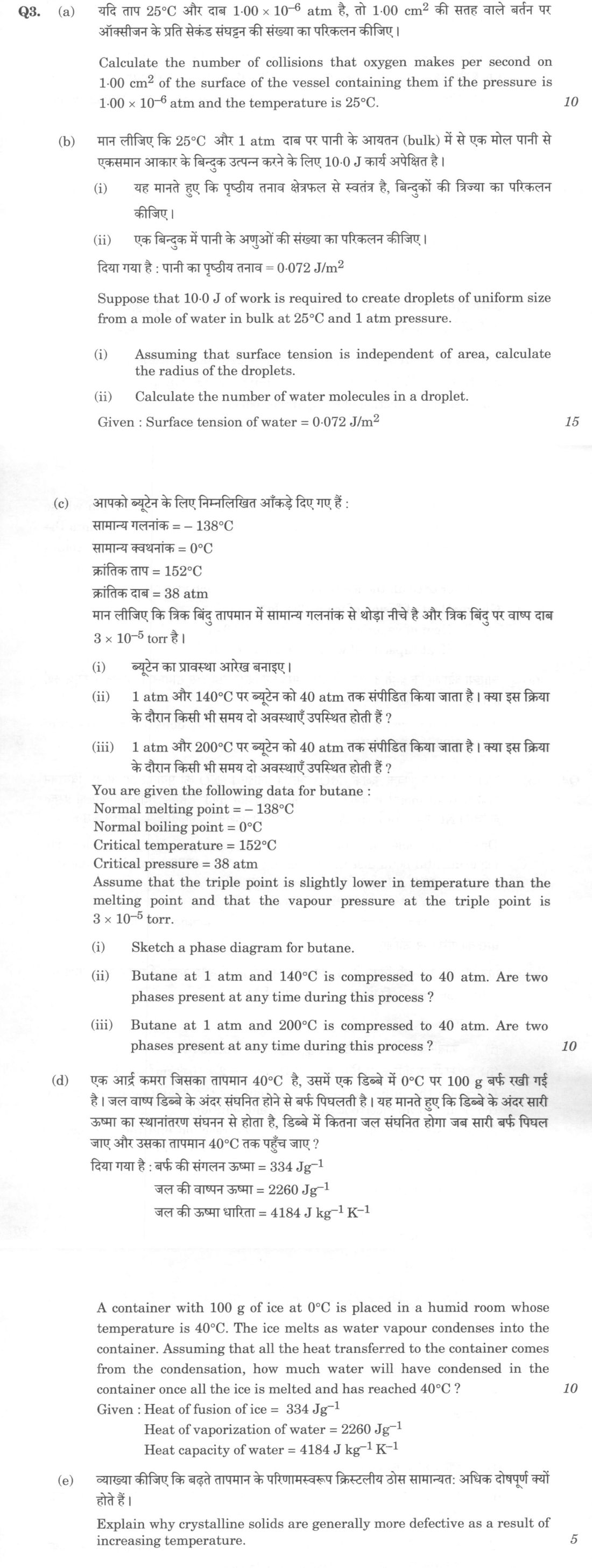
(a) Calculate the number of collisions that oxygen makes per second on 1·00 cm² of the surface of the vessel containing them if…
Calculate the number of collisions that oxygen makes per second on 1·00 cm² of the surface of the vessel containing them if the pressure is 1·00 × 10⁻⁶ atm and the temperature is 25°C. 10 marks
Suppose that 10·0 J of work is required to create droplets of uniform size from a mole of water in bulk at 25°C and 1 atm pressure.
Assuming that surface tension is independent of area, calculate the radius of the droplets.
Calculate the number of water molecules in a droplet.
Given : Surface tension of water = 0·072 J/m² 15
You are given the following data for butane : Normal melting point = – 138°C Normal boiling point = 0°C Critical temperature = 152°C Critical pressure = 38 atm Assume that the triple point is slightly lower in temperature than the melting point and that the vapour pressure at the triple point is 3 × 10⁻⁵ torr.
Sketch a phase diagram for butane.
Butane at 1 atm and 140°C is compressed to 40 atm. Are two phases present at any time during this process ?
Butane at 1 atm and 200°C is compressed to 40 atm. Are two phases present at any time during this process ? 10 marks
A container with 100 g of ice at 0°C is placed in a humid room whose temperature is 40°C. The ice melts as water vapour condenses into the container. Assuming that all the heat transferred to the container comes from the condensation, how much water will have condensed in the container once all the ice is melted and has reached 40°C ?
Given : Heat of fusion of ice = 334 Jg⁻¹ Heat of vaporization of water = 2260 Jg⁻¹ Heat capacity of water = 4184 J kg⁻¹ K⁻¹ 10
Explain why crystalline solids are generally more defective as a result of increasing temperature. 5 marks
हिंदी में प्रश्न पढ़ें
यदि ताप 25°C और दाब 1·00 × 10⁻⁶ atm है, तो 1·00 cm² की सतह वाले बर्तन पर ऑक्सीजन के प्रति सेकंड संघट्टन की संख्या का परिकलन कीजिए। 10
मान लीजिए कि 25°C और 1 atm दाब पर पानी के आयतन (bulk) में से एक मोल पानी से एकसमान आकार के बिंदुक उत्पन्न करने के लिए 10·0 J कार्य अपेक्षित है।
यह मानते हुए कि पृष्ठीय तनाव क्षेत्रफल से स्वतंत्र है, बिंदुओं की त्रिज्या का परिकलन कीजिए।
एक बिंदुक में पानी के अणुओं की संख्या का परिकलन कीजिए।
दिया गया है : पानी का पृष्ठीय तनाव = 0·072 J/m² 15
आपको ब्यूटेन के लिए निम्नलिखित आँकड़े दिए गए हैं : सामान्य गलनांक = – 138°C सामान्य क्वथनांक = 0°C क्रांतिक ताप = 152°C क्रांतिक दाब = 38 atm मान लीजिए कि त्रिक बिंदु तापमान में सामान्य गलनांक से थोड़ा नीचे है और त्रिक बिंदु पर वाष्प दाब 3 × 10⁻⁵ torr है।
ब्यूटेन का प्रावस्था आरेख बनाइए।
1 atm और 140°C पर ब्यूटेन को 40 atm तक संपीड़ित किया जाता है। क्या इस क्रिया के दौरान किसी भी समय दो अवस्थाएँ उपस्थित होती हैं ?
1 atm और 200°C पर ब्यूटेन को 40 atm तक संपीड़ित किया जाता है। क्या इस क्रिया के दौरान किसी भी समय दो अवस्थाएँ उपस्थित होती हैं ? 10 marks
एक आर्द्र कमरा जिसका तापमान 40°C है, उसमें एक डिब्बे में 0°C पर 100 g बर्फ रखी गई है। जल वाष्प डिब्बे के अंदर संघनित होने से बर्फ पिघलती है। यह मानते हुए कि डिब्बे के अंदर सारी ऊष्मा का स्थानांतरण संघनन से होता है, डिब्बे में कितना जल संघनित होगा जब सारी बर्फ पिघल जाए और उसका तापमान 40°C तक पहुँच जाए ?
दिया गया है : बर्फ की संगलन ऊष्मा = 334 Jg⁻¹ जल की वाष्पन ऊष्मा = 2260 Jg⁻¹ जल की ऊष्मा धारिता = 4184 J kg⁻¹ K⁻¹ 10
व्याख्या कीजिए कि बढ़ते तापमान के परिणामस्वरूप क्रिस्टलीय ठोस सामान्यतः अधिक दोषपूर्ण क्यों होते हैं। 5
Model answer
Written by UPSC Answer Check against this question's marking rubric, to the expected length. UPSC does not publish answers for Mains — this is one way to score well, not an official key.
(a) The collision frequency on a surface is obtained from the kinetic theory of gases. For an ideal gas in equilibrium, the number of molecules striking unit area per second is Z = (1/4)n v̄ where n = P/(kT) and v̄ = √(8kT/(πm)). Thus Z = P / √(2πmkT).
Given: P = 1.00 × 10⁻⁶ atm = 1.00 × 10⁻⁶ × 1.01325 × 10⁵ Pa = 0.101325 Pa. T = 25°C = 298.15 K. For O₂, m = 32.00 × 10⁻³ kg mol⁻¹ / 6.022 × 10²³ mol⁻¹ = 5.314 × 10⁻²⁶ kg.
Therefore 2πmkT = 2 × π × 5.314 × 10⁻²⁶ × 1.381 × 10⁻²³ × 298.15 = 1.374 × 10⁻⁴⁵. So √(2πmkT) = 3.707 × 10⁻²³ kg m s⁻¹.
Hence Z = 0.101325 / (3.707 × 10⁻²³) = 2.733 × 10²¹ m⁻² s⁻¹.
Area = 1.00 cm² = 1.00 × 10⁻⁴ m². Collisions per second = Z × A = 2.733 × 10²¹ × 1.00 × 10⁻⁴ = 2.73 × 10¹⁷ s⁻¹.
Final answer: 2.73 × 10¹⁷ collisions per second on 1.00 cm².
(b)(i) The work done creates new surface, so it equals surface tension times increase in surface area. Let one mole of water have molar volume Vm. If N droplets of radius r are formed, volume is conserved: N × (4/3)πr³ = Vm so N = 3Vm/(4πr³).
Total new surface area = N × 4πr² = 3Vm/r. Work W = γ × area = 3γVm/r. Therefore r = 3γVm/W.
Using density of liquid water ≈ 1.00 g cm⁻³ and M = 18.0 g mol⁻¹, Vm = 18.0 cm³ mol⁻¹ = 1.80 × 10⁻⁵ m³ mol⁻¹. γ = 0.072 J m⁻², W = 10.0 J mol⁻¹.
Thus r = 3 × 0.072 × 1.80 × 10⁻⁵ / 10.0 = 3.89 × 10⁻⁷ m.
Final answer: radius of each droplet = 3.89 × 10⁻⁷ m = 0.389 μm.
(b)(ii) Volume of one droplet = (4/3)πr³. With r = 3.89 × 10⁻⁷ m, r³ = 5.89 × 10⁻²⁰ m³. Volume of droplet = (4/3)π × 5.89 × 10⁻²⁰ = 2.47 × 10⁻¹⁹ m³.
Moles of water in one droplet = volume of droplet / Vm = 2.47 × 10⁻¹⁹ / 1.80 × 10⁻⁵ = 1.37 × 10⁻¹⁴ mol.
Number of molecules = 1.37 × 10⁻¹⁴ × 6.022 × 10²³ = 8.25 × 10⁹.
Final answer: about 8.2 × 10⁹ water molecules per droplet.
(c)(i) A phase diagram of butane is drawn with pressure on the y-axis and temperature on the x-axis. Mark the following points:
- Triple point: temperature just below −138°C, pressure = 3 × 10⁻⁵ torr = 3.95 × 10⁻⁸ atm.
- Normal melting point: (−138°C, 1 atm).
- Normal boiling point: (0°C, 1 atm).
- Critical point: (152°C, 38 atm).
Draw the sublimation curve from the triple point downwards to lower temperatures and pressures. Draw the vaporisation curve from the triple point through (0°C, 1 atm) to the critical point (152°C, 38 atm). Draw the fusion curve from the triple point through (−138°C, 1 atm) upwards, with a positive slope. The regions are: solid on the left/above the fusion and sublimation curves, liquid between fusion and vaporisation curves, and gas/vapour on the right/below the vaporisation curve. Above the critical point, there is no distinction between liquid and gas.
(c)(ii) At 140°C, butane is below its critical temperature 152°C. At 1 atm and 140°C, it is a vapour because the normal boiling point is 0°C. When it is compressed isothermally, its pressure rises until it reaches the saturation vapour pressure at 140°C. Since 140°C < 152°C, this saturation pressure lies below the critical pressure 38 atm and above 1 atm. At that pressure, liquid and vapour coexist. Further compression converts vapour into liquid. Therefore, during compression from 1 atm to 40 atm at 140°C, two phases are present for part of the process.
Final answer: yes, liquid and vapour coexist during part of the compression.
(c)(iii) At 200°C, butane is above its critical temperature 152°C. Above the critical temperature, no liquid-vapour coexistence boundary exists, irrespective of pressure. Compression from 1 atm to 40 atm keeps the substance in a single supercritical fluid phase.
Final answer: no, two phases are not present at any time.
(d) Heat required to melt 100 g ice at 0°C: Q₁ = mLf = 100 g × 334 J g⁻¹ = 3.34 × 10⁴ J.
Heat required to warm the melted water from 0°C to 40°C: Q₂ = mcΔT = 0.100 kg × 4184 J kg⁻¹ K⁻¹ × 40 K = 1.6736 × 10⁴ J.
Total heat required: Q = Q₁ + Q₂ = 3.34 × 10⁴ + 1.6736 × 10⁴ = 5.0136 × 10⁴ J.
This heat comes from condensation of water vapour. If m grams condense, Q = mLv = m × 2260 J g⁻¹. So m = 5.0136 × 10⁴ / 2260 = 22.18 g.
Final answer: approximately 22.2 g of water condenses in the container.
(e) Crystalline solids become more defective at higher temperature because defect formation increases configurational entropy. The formation of a defect costs enthalpy, so ΔG = ΔH − TΔS. At absolute zero, ΔH dominates and defects are unfavourable. As temperature increases, the −TΔS term becomes more negative and stabilises defects.
For Schottky defects, the equilibrium fraction is approximately proportional to exp(−ΔH/(2kT)); for Frenkel defects, a similar exponential law holds. Thus the defect concentration rises steeply with temperature. In addition, higher thermal energy increases atomic vibrations, anharmonic displacements, and mobility of defects, allowing more vacancies, interstitials, and dislocation-related defects to appear. Near the melting point, the defect concentration can become appreciable. Therefore, increasing temperature generally makes crystalline solids more defective.
What "Calculate" is asking you to do
Apply the standard formula or schedule to data the question has already supplied — a table of readings, cost records, a balance sheet — and produce the number. The method is rarely in doubt; the marks sit in the named intermediate quantities, each of which has to appear as a labelled line.
Structure that answers it
Data as given → formula or standard treatment, named → substitution → each intermediate, labelled → result with units
Where marks are lost
Omitting an intermediate the marking scheme pays for separately, or rounding at an intermediate line so the final figure drifts. In commerce and accountancy, any figure in a statement that no numbered working note supports is treated as unearned.
How this answer will be evaluated
Approach
(a) calculate: given > formula > substitution > result with units > interpretation | (b(i)) calculate: given > formula > substitution > result with units > interpretation | (b(ii)) calculate: given > formula > substitution > result with units > interpretation | (c(i)) describe: define > structure or process in order > labelled diagram > significance | (c(ii)) explain: definition/context > points in order > small example > short close | (c(iii)) explain: definition/context > points in order > small example > short close | (d) calculate: given > formula > substitution > result with units > interpretation | (e) explain: definition/context > points in order > small example > short close Full marks: All calculations correct with full working; diagrams accurate; explanations mechanistic.
Key points expected
- Use kinetic theory collision frequency formula
- Convert pressure to SI units (Pa)
- Convert area to SI units (m²)
- Substitute T=298 K and M=32 g/mol
- Relate work to surface energy (W = γΔA)
- Calculate total surface area of droplets
- Relate total volume to number of droplets
- Solve for radius r
Evaluation rubric
Each sub-part is marked on its own, against the marks and word limit printed on the paper.
- (a) Number of collisions per second on 1.00 cm² surface. 10 marks
calculate— given → formula → substitution → result with units → interpretation
Must cover
- Use kinetic theory collision frequency formula
- Convert pressure to SI units (Pa)
- Convert area to SI units (m²)
- Substitute T=298 K and M=32 g/mol
Loses marks
- Unit conversion errors (atm to Pa)
- Using diameter instead of radius in area
Earns more
- Correct value for mean molecular speed
- Explicit calculation of number density
Extra mark
- Mention of Maxwell-Boltzmann distribution context
- (b(i)) Radius of uniform droplets formed from 1 mole water.
calculate— given → formula → substitution → result with units → interpretation
Must cover
- Relate work to surface energy (W = γΔA)
- Calculate total surface area of droplets
- Relate total volume to number of droplets
- Solve for radius r
Loses marks
- Forgetting factor of 4π in surface area
- Confusing surface tension with surface energy
Earns more
- Correct use of molar volume of water
- Clear algebraic steps
Extra mark
- Comparison of result to molecular scale
- (b(ii)) Number of water molecules in a single droplet.
calculate— given → formula → substitution → result with units → interpretation
Must cover
- Calculate volume of one droplet
- Use density of water to find mass
- Convert mass to moles
- Multiply by Avogadro's number
Loses marks
- Using total moles instead of per droplet
- Arithmetic errors in volume calculation
Earns more
- Consistent use of radius from part (i)
- Correct unit handling
Extra mark
- Estimation of order of magnitude
- (c(i)) Sketch phase diagram for butane with key points.
describe— define → structure or process in order → labelled diagram → significance
Must cover
- Plot P vs T axes
- Mark triple point, critical point
- Draw solid-liquid, liquid-vapor, solid-vapor lines
- Label regions (solid, liquid, gas)
Loses marks
- Missing critical point
- Incorrect phase region labels
Earns more
- Correct relative positions of points
- Indication of slope of fusion curve
Extra mark
- Annotation of normal boiling/melting points
- (c(ii)) Determine if two phases exist during compression at 140°C.
explain— definition/context → points in order → small example → short close
Must cover
- Locate 140°C on T-axis
- Trace path from 1 atm to 40 atm
- Check if path crosses phase boundary
- Conclude based on critical temperature
Loses marks
- Confusing critical temperature with boiling point
- Failing to check if T < Tc
Earns more
- Reference to critical temperature (152°C)
- Clear statement of single phase region
Extra mark
- Sketch of the specific path on diagram
- (c(iii)) Determine if two phases exist during compression at 200°C.
explain— definition/context → points in order → small example → short close
Must cover
- Locate 200°C on T-axis
- Note T > Tc (152°C)
- State that no liquid-gas transition possible
- Conclude single supercritical phase
Loses marks
- Assuming phase change occurs above Tc
- Ignoring pressure limit of 40 atm
Earns more
- Explicit comparison of 200°C to 152°C
- Definition of supercritical fluid
Extra mark
- Mention of continuous transition to gas
- (d) Mass of water condensed to melt ice and heat to 40°C. 10 marks
calculate— given → formula → substitution → result with units → interpretation
Must cover
- Calculate heat to melt ice (mL)
- Calculate heat to warm water to 40°C
- Equate total heat to condensation heat
- Solve for mass of condensed water
Loses marks
- Forgetting to heat the melted ice
- Unit mismatch in heat capacities
Earns more
- Correct use of specific heat capacity
- Clear energy balance equation
Extra mark
- Check if condensed water heats up
- (e) Reason for increased defects in crystalline solids at high T. 5 marks
explain— definition/context → points in order → small example → short close
Must cover
- Reference to thermal energy
- Mention of atomic vibrations
- Link to vacancy/interstitial formation
- Entropy increase at higher T
Loses marks
- Confusing defects with phase changes
- Vague statements without mechanism
Earns more
- Boltzmann distribution reference
- Distinction between point and line defects
Extra mark
- Equation for defect concentration vs T
Practice this exact question
Write your answer and it is marked point by point against the model answer above — what you covered, what you missed, what you got wrong.
Evaluate my answer →More from Chemistry 2025 Paper I
- Q1 (a) Calculate the ratio of probability of finding the 1s electron of hydrogen atom at r =…
- Q2 (a) Find the probability of existence of a particle in a one-dimensional box of length 'a…
- Q3 (a) Calculate the number of collisions that oxygen makes per second on 1·00 cm² of the su…
- Q4 (a) Draw the molecular orbital (MO) diagram of NO molecule. The experimental bond dissoci…
- Q5 (a) The gas-phase reaction between methane (CH₄) and diatomic sulphur (S₂) is given by th…
- Q6 (a) The following molecule shows the rigid or fluxional behaviour at higher temperature o…